Key Takeaways
- A realistic wine tumbler factory direct MOQ starts around 1,000-3,000 pcs per color for custom color coating
- 304 stainless steel at 0.4-0.5 mm inner wall is the normal B2B baseline
- Plan 25-35 days for bulk production after artwork and pre-production sample approval
- Use AQL 2.5/4.0 plus 100% leak checks for lid and drinking-mouth assemblies
Factory-direct wine tumblers look simple until five China quotes land on your desk: one says 304 stainless, one hides the inner-wall grade, one changes the carton from 24 pcs to 36 pcs, and one sets the logo limit at 45 mm without saying why. You are not just buying cups. You are buying the same red powder coat on the second reorder, a lid that does not pop after hot-water testing, FDA/LFGB-ready materials, and fewer emails from customers after delivery. QC pulled a 12 oz sample last month where the rim was 0.4 mm out of round; the price was fine, but the math did not work.
At our Hangzhou, Zhejiang line, we see this go sideways every quarter. A buyer fights over USD 0.12 per piece, then misses 0.5 mm wall thickness, loose slider lids, AQL 2.5 wording, or a retail box that crushes under a 15 kg carton stack test. If you source custom drinkware for retail, promotions, hotels, or distributor programs, this is the wrong question to ask: “Who is cheapest?” Ask who can hold color, packing, inspection standard, and ship date across 3,000 pcs now and 20,000 pcs on the reorder.
What factory direct really changes
Factory direct is not magic pricing. It means you cut out 1-2 trading layers and talk closer to the people setting the tooling, polishing wheel, powder-coating gun, laser jig, packing method, and AQL check. For a standard 12 oz stemless stainless wine tumbler, we normally see a clean factory-direct FOB Ningbo quote land USD 0.20-0.60 per piece below a reseller quote, depending on gift box paper, logo size, and whether the buyer asks for individual polybags.
Unit price is the wrong question to ask first. Control matters more. Ask the canteen factory or tumbler workshop how many coating lines they run, whether lids are made in-house or bought from a lid vendor, and what lid tolerance they hold in mm after shrinkage. We run calipers on the press-fit lids because buyers have flagged loose lids at 0.4 mm off before. If a canteen manufacturer understands vacuum welding and lid fit, that know-how carries into wine tumblers without much drama.
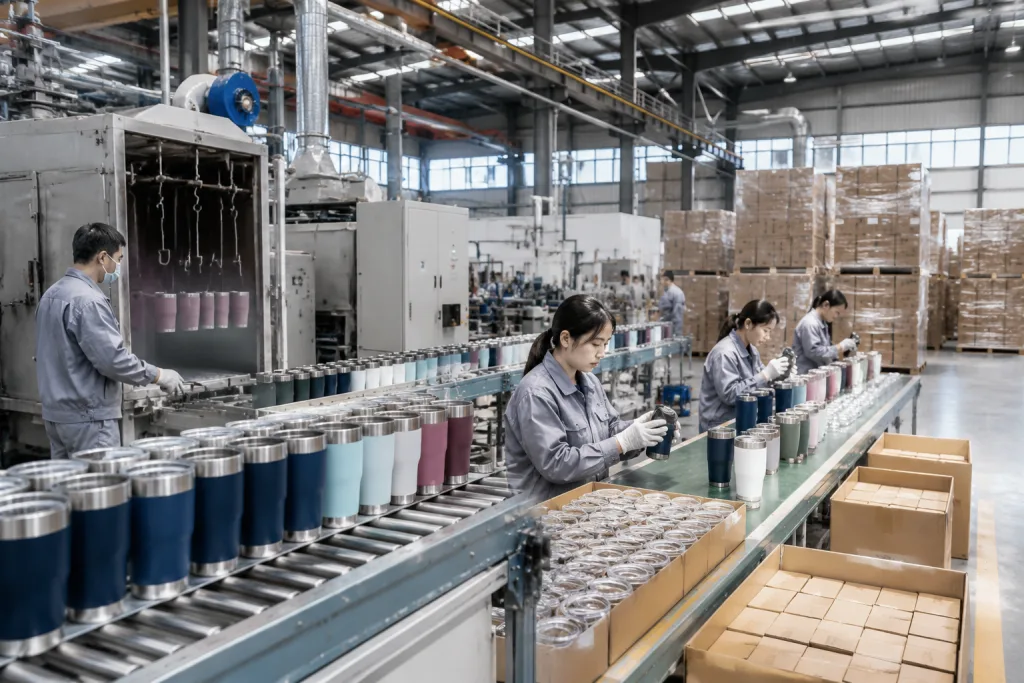
At BottleForge Industrial in Zhejiang, our stainless drinkware output is about 450,000 units per month across tumblers, bottles, growlers, and canteen customized programs. A 3,000-piece wine tumbler order will not choke the line. Still, the math has to work: color setup, logo fixtures, carton printing plates, and QC time need enough pieces to spread the cost. Last month QC pulled the sample after carton artwork showed “matte balck” on the PO, and catching that before mass printing saved 62 cartons from rework.
Factory direct only earns its place when the factory gives better technical answers, not just a lower proforma invoice.
You should still expect normal export terms: 30% deposit, 70% before shipment for new buyers, FOB Ningbo or Shanghai, and a written specification sheet. No spec sheet, no real comparison. If a canteen supplier or tumbler vendor quotes without wall thickness, coating type, lid material, logo method, carton size, and inspection standard, you are comparing guesses, not products.
What specifications should I lock
Lock the product definition before you ask for a price. A wine tumbler looks simple in a catalog photo, but a 0.1 mm steel change or a different lid gasket can move the quote by USD 0.18-0.35 and raise defect risk. For most B2B programs, we run 304 stainless steel inner wall, 201 or 304 outer wall depending on price target, 0.4-0.5 mm wall thickness, double-wall vacuum insulation, BPA-free lid, and powder coating tested by cross-hatch adhesion with a 3M 600 tape pull.
State capacity in ounces and milliliters. A 12 oz tumbler may be sold as 350 ml, but usable fill volume can be 330-360 ml depending on lid shape. If your retailer requires exact claim language, ask for brimful capacity and recommended fill capacity separately; QC pulled one sample last month at 342 ml recommended fill, and the buyer flagged the “350 ml” carton copy before shipment.
Buyer checklist before quotation
- Material: 304 inner stainless steel, LFGB or FDA food-contact declaration if needed; ask whether the mill sheet matches the batch used on the line.
- Body: double wall vacuum, copper lining optional, 0.4 mm minimum inner wall for normal retail grade; confirm weight tolerance, such as ±8 g per cup.
- Lid: AS, PP, Tritan, or silicone components listed clearly; no vague “plastic lid” wording because this is where substitutions happen.
- Finish: powder coating, spray painting, plating, or raw brushed steel, with Pantone reference and a signed color chip under D65 light.
- Logo: laser engraving, silk screen, heat transfer, or full-wrap print with artwork size; send logo height in mm, not just “same as photo.”
- Packaging: egg crate, white box, kraft box, color box, insert card, barcode, FNSKU, or master carton mark; one wrong FNSKU digit on a PO can stop Amazon receiving.
This same checklist works when you compare canteen customizable projects, a customized growler, or a distributor canteen program. Good factories like exact requirements because it cuts dispute later. Vague quoting is the wrong place to save time. We have seen this go sideways when a canteen vendor swapped in thinner steel, a lighter lid, and cheaper coating after order approval; AQL 2.5 inspection then found coating chips around the rim after only 24 pieces were rubbed in the test tray.
How should pricing be compared
Compare wine tumbler prices only after the incoterm, packing spec, logo method, and inspection standard match line by line. We see this mistake every week. A USD 2.35 FOB Ningbo quote can beat USD 2.18 EXW after you add RMB 1,600 inland trucking, export document fees, and a 5-layer master carton instead of a soft 3-layer carton. For Europe and North America, we tell most buyers to ask for FOB unless they already run a China consolidation warehouse; otherwise the math gets messy fast, and the buyer usually flags it after the PO is issued.
For reference, a 12 oz stainless wine tumbler factory direct project often lands in these ranges at 3,000-5,000 pcs: plain powder coating with one-side laser logo around USD 2.20-3.10 FOB; full color box adds roughly USD 0.18-0.45, depending on 350 gsm white card versus corrugated mailer; individual polybag plus kraft box adds roughly USD 0.08-0.18; a slider lid may add USD 0.15-0.35 compared with a simple sip lid. These are working ranges, not promises. Last month QC pulled the sample because the matte coating yield dropped under 92% on a dark green batch, and that alone changed the cost sheet.
If you are a canteen distributor or one of several canteen distributors bidding for a seasonal retail program, ask your factory to break out the cost lines. This is the wrong question to ask: “Can you do cheaper?” Ask where the cost sits. We run quotes with separate lines for cup body, lid, logo, inner box, master carton, inland freight, and sample fee, because a USD 0.22 gap often comes from packaging padding rather than 304 stainless steel cost.
Quote comparison questions
- Is the price FOB, EXW, CIF, or DDP?
- Is 304 stainless steel used for the inner wall only or both walls?
- Does the quote include one logo position or two, and is it laser, silk screen, or heat-transfer print?
- What is the carton drop-test assumption: 60 cm, 80 cm, or none?
- Are pre-production samples included or billed separately at USD 50-150?
A serious canteen manufacturer, canteen supplier, or tumbler factory will answer these directly. If they only reply “best price friend,” move on. We have seen that go sideways: one PO even had “FOB Shanghai” typed in the header and “EXW factory” in the remarks, which delayed booking by 3 days.

Can branding survive real use
Branding is where 6 out of 10 custom drinkware quotes get bumped after the first artwork check. A wine tumbler gives you a curved wall, a tapered body, and usually 60-80 μm powder coating, so the print window is smaller than the buyer expects. Our pad-print jig can hold the cup steady, but it cannot make 4 pt legal text readable on a radius. Small legal lines and QR codes may look sharp on a PDF, then blur or scan badly on a curved 12 oz cup. QC pulled one matte white sample last month because the QR code read only 3 times out of 10.
Laser engraving is the safer choice for corporate gifting and distributor drinkware because it cuts through the coating and shows the stainless steel underneath. We run it for 1-color logos, and the usual add-on is USD 0.10-0.25 per piece, depending on logo size and daily line load. Silk screen costs less when the logo sits on a broad, flatter area, but registration starts fighting you once the artwork wraps too far around the body. Heat transfer or water transfer can carry multi-color artwork. Test it first. On our side, the buyer’s “dishwasher safe” claim goes into the sample room only after adhesion checks, not after a salesperson says it is fine.
For canteen promotional orders, buyers often ask for a 70 mm logo at the lowest price. That can work for a 30-day campaign where the cup is handed out at a booth and the math is tight. For retail shelves, this is the wrong question to ask. Ask for coating adhesion testing, alcohol rub testing, and one sample packed in the final box so you can see rub marks from the insert. Powder coating should pass cross-hatch adhesion at 3M tape pull with no major flaking. Dishwasher-safe claims need real testing; we have seen this go sideways when a PO typo changed “hand wash” to “dishwasher safe.”
The same rules apply to canteen custom, canteen customized, and customizable growler projects. Larger items invite bigger artwork, and bigger artwork makes defects easier to spot. A 1 mm dust speck on a matte black tumbler may pass under AQL; a full-wrap retail logo shifted 2 mm will get flagged at receiving. We ship plenty of growlers, but the line still checks the wrap seam with a steel ruler because buyers notice that seam before they notice the steel grade.
What quality controls are non-negotiable
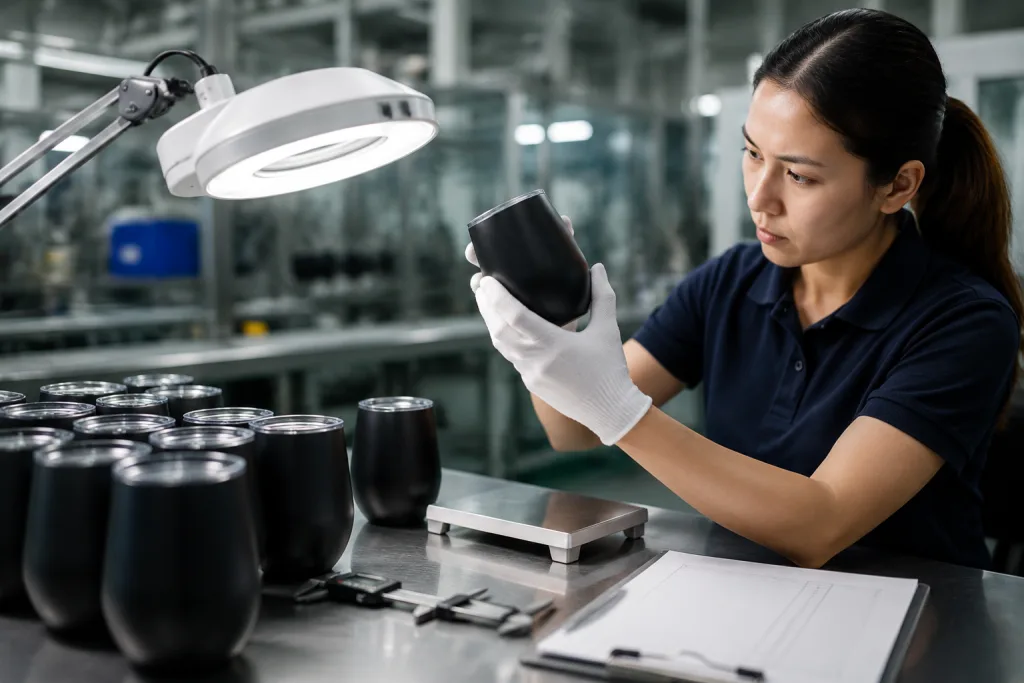
For wine tumblers, QC has to lock down material safety, vacuum performance, coating finish, lid fit, and export carton strength. Start with acceptance criteria, not a 40-page manual. For a 2,000-piece order, we usually run AQL 2.5 for major defects and AQL 4.0 for minor defects, with critical defects at zero tolerance. QC writes these limits on the inspection sheet before the line packs the first master carton, because “check carefully” on a PO is where trouble starts.
Major defects are sharp rims, leaking lids, wrong material, failed vacuum insulation, coating peel, wrong logo placement, mixed colors in one SKU, or packaging that lets the cup rub through the polybag. Minor defects are small dust points, slight shade drift inside the signed color card tolerance, or tiny polishing lines away from the logo window. We’ve seen this go sideways when a buyer approved a black powder coat sample under office light, then flagged 312 pcs under a D65 light box after arrival.
Ask your canteen manufacturers or tumbler suppliers for these checks before shipment:
- Vacuum test: run a hot water hold test at 95°C, or use thermal imaging to catch weak insulated bodies before packing.
- Leak check: check 100% of lid assemblies when sliders, silicone rings, or press-fit seals are used; QC pulled the sample and found 7 leaking lids in one 500-pc pre-pack once.
- Salt spray: test plated handles, colored metal straws, or trim parts for 24-48 hours, then check red rust and coating lift.
- Food contact: match FDA, LFGB, REACH, or EU 1935/2004 paperwork to the sales market and the exact material list, including silicone gaskets.
- Carton drop: run an ISTA-style internal test or a 60-80 cm drop on the export carton after loading the real cup, lid, insert, and gift box weight.
For North American retail, ASTM and CPSIA questions can still come up if the artwork, straw, or gift set sits near children on shelf, even when the item is sold as an adult wine tumbler. For EU programs, REACH and packaging waste obligations need checking before mass production, not after the vessel books. A China canteen vendor shipping every month should know these files. If they mix up REACH with FDA, pause the order and ask for the test report number, lab name, and matching product photos.
How do MOQ and lead time work
MOQ is not a punishment. It is the break-even line where setup cost, coating loss, logo jig time, packing labor, and export handling stop eating the margin. For wine tumblers, factory direct MOQ is usually 1,000 pcs for stock colors with simple laser logo, 2,000-3,000 pcs per Pantone color for custom powder coating, and 5,000 pcs or more for new lid tooling or unusual body shapes. On the line, we run a separate spray gun clean-out for each Pantone color; QC pulled 18 cups last month because one beige batch drifted about 1.5 mm on the logo position.
Lead time starts after deposit, approved artwork, and approved pre-production sample. Not after the first email. A normal schedule from our Zhejiang team is 5-7 days for digital proof and logo sample, 7-10 days for pre-production sample if a physical sample is needed, and 25-35 days for bulk production. Ocean freight then adds roughly 25-40 days to the US West Coast or Europe depending on port and season. We had one PO with the logo file named “final-final-old.ai”; that small mess cost 2 days before the laser fixture could be locked.
Customizable canteen, customized canteen, custom growler, and distributor growler programs follow the same factory math, but larger products use more steel and take more polishing and coating hours. That can push lead time by 5-10 days during peak season. The math does not work if the buyer approves samples on a Friday and asks us to absorb the lost week. A 64 oz growler ties up more rack space in the powder coating oven than a 12 oz wine tumbler, so we ship it on a different slot when the line is full.
For Amazon or marketplace sellers, add time for FNSKU labels, carton labels, master carton weight limits, and pallet instructions. A 24-piece carton may be efficient for wholesale, but too heavy for some fulfillment centers once color boxes are included. Tell your supplier the sales channel before the carton is designed. We have seen this go sideways: the buyer flagged a 17.8 kg master carton after packing was finished, and repacking 1,200 pcs into 12-piece cartons took 1 extra day plus new carton stickers.
Which supplier questions expose risk
The quickest way to qualify a wine tumbler factory direct supplier is to ask shop-floor questions, not showroom questions. A real factory or export team answers with units, mm tolerances, line names, and lead times. A weak canteen supplier says “good quality” and sends 6 glossy photos. We run this check before quoting because QC once pulled a 12 oz sample with a 0.8 mm rim wave, and the buyer only found out after asking for the polishing standard.
Use this short sourcing checklist
- What is your monthly stainless drinkware capacity in units, and how many units are wine tumblers versus bottles or mugs?
- Which processes are in-house: forming, welding, polishing, coating, logo, packing?
- What is the MOQ per color for powder coating and per logo for engraving, and does the MOQ change for 12 oz, 14 oz, or 16 oz bodies?
- Can you provide recent BSCI, ISO 9001, or social audit documents, with the factory name matching the proforma invoice?
- Which food-contact tests are available for the exact material, coating, gasket, and lid used on this order?
- What AQL level do you use for final random inspection, and who signs the defect list before shipment?
- Can you pack mixed SKUs for distributor drinkware orders, such as 4 colors in one master carton with barcode stickers?
- Do you support replacement parts such as lids, straws, or silicone seals, and what is the spare-parts MOQ?
These questions work the same way when you source from canteen suppliers, canteen vendors, or a canteen manufacturer for a related line extension. About 6 out of 10 buyers we see start with wine tumblers, then add a custom canteen or customized growler for the next season. The math does not work if you restart factory qualification every quarter. One buyer flagged this after a PO typo changed “matte black” to “mate black,” and the line had already booked coating slots for 3,000 pcs.
Be practical. Do not ask a factory for every certificate on day one if your order is 1,000 pcs. Share the target market, annual forecast, packaging level, and inspection expectation first. Good suppliers move organized buyers up the queue because clean specs mean fewer artwork revisions, fewer carton-mark changes, and fewer payment delays. We ship smoother when the buyer sends a 1-page spec sheet with lid type, Pantone code, logo size in mm, and AQL 2.5 written clearly.
Send your wine tumbler RFQ for review
Share quantity, target price, logo file, market, and delivery date. We will reply with practical MOQ, lead time, and export options.
Frequently asked questions
What is a realistic MOQ for wine tumbler factory direct orders?
For a standard stainless wine tumbler, realistic factory direct MOQ is 1,000 pcs if you use available body shape, available lid, stock color, and one-position laser engraving. If you need Pantone powder coating, plan on 2,000-3,000 pcs per color because coating setup and color-change loss are real costs. New mold or custom lid development usually starts at 5,000-10,000 pcs, sometimes higher. If a supplier accepts 200 pcs with full customization, check whether they are using stock goods from a market warehouse rather than controlled factory production.
Can I combine wine tumblers with canteen or growler SKUs?
Yes, but combine them at the quotation and packing-planning stage, not after production starts. A factory handling custom canteen, customizable growler, and wine tumbler lines can often consolidate shipment under one FOB booking from China. The catch is carton size, production timing, and inspection sampling. A custom growler may need 35-45 production days while a tumbler needs 25-35 days. If you want one shipment, the slowest SKU controls the schedule. For distributor canteen and distributor growler programs, we usually recommend one shared carton-marking standard and SKU-level packing lists.
Which logo method is best for B2B wine tumblers?
Laser engraving is the safest default for B2B wine tumblers because it is durable, clean, and predictable on powder coating. Cost is commonly USD 0.10-0.25 per piece depending on logo size and order quantity. Silk screen can be cheaper for simple one-color promotional logos, but curved surfaces make registration harder. Heat transfer works for multi-color artwork, yet it needs adhesion testing before retail use. If your buyer requires dishwasher-safe claims, do not rely on verbal promises. Request test evidence on the exact coating, logo process, and curing conditions used for your order.
What certificates should I ask a China drinkware factory for?
Ask based on your market, not from a generic certificate checklist. For the US, FDA food-contact documentation is common, and CPSIA may matter if the item is marketed to children. For the EU, LFGB, REACH, and EU 1935/2004 declarations are often requested. For retailer or brand-owner audits, BSCI, ISO 9001, or a recent social compliance audit may be required. Also ask whether the test report matches the exact stainless steel, coating, lid plastic, and silicone used in production. A report for another bottle model is useful background, but it is not perfect protection.
How early should I start sourcing before a retail launch?
Start 90-120 days before your required warehouse date if ocean freight is involved. A practical timeline is 7-14 days for supplier qualification and quotation, 7-10 days for artwork and sampling, 25-35 days for production, 3-5 days for final inspection and export booking, then 25-40 days for ocean freight to Europe or North America. Air freight can rescue a late order, but it may add USD 1.50-4.00 per tumbler depending on carton volume. For seasonal custom drinkware, late approval is usually more expensive than choosing a slightly higher unit price early.