Key Takeaways
- Set bottle, lid, and carton specs before PO; our typical MOQ starts at 1,000 units per SKU
- Use AQL 2.5/4.0 inspections for drinkware bulk orders instead of relying on factory photos
- Vacuum bottles need heat-retention testing, lid torque checks, and 100% leak-risk screening
- Plan 30-45 days production after sample approval, plus ocean or air freight to the US
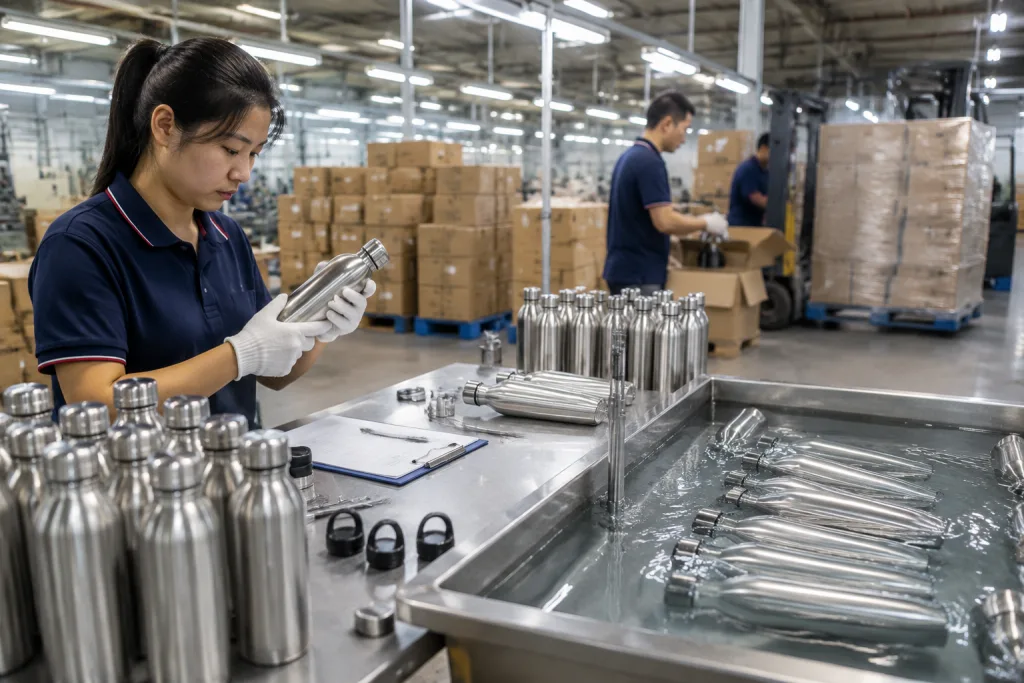
If you buy wholesale water bottles US programs, the costly mistakes usually show up before the line starts. We have seen a 50,000 pcs order slip from 12 days to 18 days because the RFQ only said “leak-proof lid” and the logo arrived as a 72 dpi PNG; QC pulled the pre-production sample, filled it to 600 ml, inverted it for 30 minutes, and the cap still left a wet ring on the test paper.
We manufacture in Hangzhou, Zhejiang, and we run into the same issues on wholesale drinkware, canteen wholesale, beer tumbler wholesale, and growler wholesale orders. The fix is not asking for the cheapest FOB price first. That is the wrong question to ask. Lock the material grade, mouth tolerance in mm, carton drop-test rule, barcode position, and AQL 2.5 inspection points before the PO goes to China; one buyer even had “matte black” typed as “mate black” on the PO, and the line stopped for half a shift while sales confirmed the finish.
The RFQ That Causes Defects
A weak RFQ is the first failure mode. We see this every week: “24 oz stainless bottle with logo, FOB China” typed into an email subject line, then the buyer expects 6 factories to quote the same product. They won’t. One factory prices 201 stainless steel, another prices 304; one includes individual color boxes, another packs in polybags; one quotes 0.45 mm body thickness while another drops to 0.35 mm to win the bid. QC catches this later with a digital caliper, but by then the sample bill and 7–10 days are already gone.
For wholesale water bottles US buyers, your RFQ should read like a control document, not a mood board. List capacity in ml and oz, outside diameter, height, mouth opening, cap type, handle type, finish, logo method, Pantone color, carton pack, drop test requirement, and compliance targets. Be specific. A 73 mm diameter bottle and a 78 mm diameter bottle do not sit the same in a car cup holder, and we have had buyers flag this only after the PP sample arrived. If the product is for kids, add CPSIA and ASTM F963 screening. For general adult drinkware, ask for FDA food-contact documentation, LFGB if you sell into Europe, and REACH for coatings where needed.
At BottleForge Industrial in Zhejiang, our normal stainless bottle MOQ is 1,000 units per color, with custom mold projects starting much higher depending on tooling. Capacity is about 650,000 units/month across stainless bottles, tumblers, canteen bulk programs, and growler bulk orders. Those numbers matter. A 5,000-unit order might run on one line with 2 carton sizes, while a 150,000-unit retail rollout needs locked artwork files, golden samples, AQL 2.5 inspection, spare caps, and a packing plan that the warehouse team can follow without guessing.
Do not ask for the “best wholesale drink bottle” without defining best. This is the wrong question to ask. Best for Amazon FBA means barcode control, 5-layer carton strength, and a low return rate. Best for a distributor means repeatable colors and reorder stability, so the navy bottle in March does not turn into a purple-blue bottle in July. Best for a promotional buyer may mean a safe price point with acceptable AQL performance. We have seen this go sideways when the PO says “matte black” but the approved sample was powder-coated black with a 60–70 gloss reading.
Material Swaps Hidden in Plain Sight
The second failure mode is material substitution. It usually looks boring on paper. A supplier can keep the bottle shape the same and still move the cost by 3-6%: wall thickness drops by 0.05 mm, the lid changes from PP to cheaper mixed plastic, powder coat goes from 70 μm to 45 μm, or the silicone ring gets swapped for a gasket that smells after our 95°C hot-water test. We have seen this go sideways. QC pulled one 40 oz sample last year because the lid passed color matching under the D65 light box, but the gasket smelled like tires after 30 minutes.
For stainless wholesale drinkware, write 304 stainless steel for inner walls and drinking surfaces on the PO, not just in the email thread. If the outer wall uses 201 stainless for a cost-driven model, state it clearly and run a salt-spray or spot corrosion check before shipment. For vacuum bottles, common body wall thickness is around 0.40-0.50 mm depending on shape and size. Below that, dent risk jumps, especially for 32 oz and 40 oz bottles shipped in master cartons through US parcel networks. On the line, we check wall thickness with a digital micrometer at the shoulder and lower body; a 0.38 mm reading on a tall bottle is not a small detail.
If you buy wholesale canteen or bulk canteen styles for outdoor brands, check the neck weld first, then the shoulder forming under side light. Canteen bulk orders often use wide profiles that dent more easily than straight bottles, so the math doesn't work if the buyer only compares FOB price. For alcohol flask bulk or alcohol flask wholesale bulk programs, confirm 304 stainless inside, smooth seams, and no oily residue after ultrasonic cleaning. A flask is small, but complaints are visible because it sits close to the nose. We run a white-cloth wipe after cleaning; if the cloth picks up grey oil near the seam, the carton stays closed.
Ask for a material declaration, food-contact test reports, and production sample retention before deposit, not after the vessel date is booked. We normally keep signed golden samples in our Zhejiang sample room and match mass production to those samples during inline and final QC. Simple habit. It prevents the classic China sourcing argument: “the sample was better than the shipment.” One buyer once flagged a PO typo that said “304 outside” instead of “304 inside”; catching that single line before production saved 5,000 bottles from becoming a claim.
Lids Leak Before Bottles Fail
Most complaints we see are not from the steel body. They come from lids. A bottle can pass visual QC under a 6000K inspection lamp and still leak inside a gym bag. Usual trouble spots are weak gasket compression, cap thread mismatch, brittle PP plastic, straw vent design, and a handle hinge that starts wobbling after 300 to 500 open-close cycles.
For wholesale water bottles US programs, treat the lid as its own engineered part, not an accessory. Put the plastic grade, silicone hardness, thread turns, gasket dimensions, hinge cycle target, and dishwasher requirement on the spec sheet. We run a 24-hour inverted leak test on pre-production sports-lid samples, then random leak checks during final inspection under AQL 2.5. For straw lids, fill water to 90% capacity, shake for 30 seconds, then invert. Empty-bottle testing is the wrong question to ask.
This matters for beer tumbler bulk, beer tumbler wholesale, and beer tumbler in bulk orders as well. Sliding lids often weep at the mouth slot; they are splash-resistant, not leak-proof. If your product page says leak-proof, QC needs a test record to back it up, not just a supplier promise on WhatsApp. For beer growler wholesale or beer growler wholesale bulk, pressure and seal performance carry more risk. A 64 oz growler with a weak cap liner can lose carbonation in 12 hours, leak during carton drop testing, or smell sour because residue sits under the closure lip.
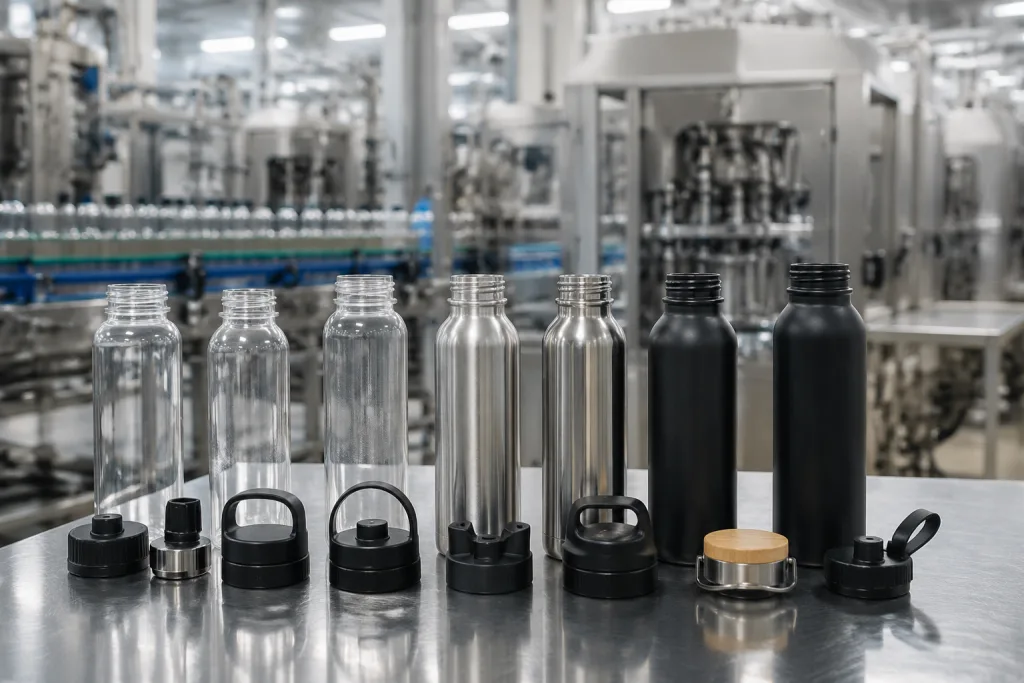
For wholesale water bottles US orders, add a lid compatibility table to the specification sheet. If one bottle body accepts three lid types, approve all three combinations with signed samples and photos; QC pulled the sample last month on a PO where “straw lid” was typed as “spout lid.” A change from straw lid to chug lid is not cosmetic. It changes the leak risk, the carton complaint rate, and the math on replacement parts.
Decoration Problems Buyers Underestimate
Decoration is where brand owners catch the defect first. A bottle can pass our 30-minute leak test and still get rejected because the logo sits 3 mm off-center, the white ink dries slightly gray, or the laser burns through powder coating in uneven patches. We see this on about 6 of every 20 new bulk drinkware and drinkware bulk projects, usually because the buyer signed a PDF mockup but skipped the decorated strike-off. Bad shortcut. QC pulled one sample last month with a logo centered on the flat artwork, then measured 2.8 mm drift on the actual bottle using a clear acetate grid.
Silkscreen printing works for one- or two-color logos, but curved bottles need the right jig and bottle rotation setting. Large logos on tapered bodies stretch at the shoulder; the math does not work if the artwork is approved only on a rectangle. Laser engraving holds up well, but the final mark depends on coating thickness and the 304 stainless color under it. UV print gives better detail for gradients, but adhesion needs proof on matte powder coating. For US retail and corporate buyers, we run 3M 600 tape at 90 degrees, 20 alcohol rubs with a cotton pad, and a 65°C dishwasher cycle when the decoration claim is printed on the PO.
For alcohol flask wholesale, small logo placement is not simple. The body is curved, reflective, and only gives the operator a narrow flat visual line; on the line we use a metal locator block, but a 1.5 mm shift still happens if the flask shell tolerance is loose. For alcohol flask in bulk orders, write the accepted logo shift in mm, such as ±1.5 mm, not “looks centered.” For wholesale growler and beer growler bulk programs, wrap artwork often runs 160–220 mm around a large radius, so approve a physical strike-off before mass production. We have seen this go sideways when the buyer approved a front view only, then flagged the side seam after 3,000 pcs were printed.
Color is another trap. Pantone on paper is not Pantone on powder-coated steel. If your brand color matters, approve a metal color chip or a pre-production sample under a D65 light box, not under office LED lighting at 7 p.m. In China production, “close enough” is not a QC standard; write Delta E tolerance, such as ΔE ≤ 1.5 or ΔE ≤ 2.0, if retail brand rules are strict. If you do not have that spec, sign one golden sample and let QC inspect against it. One buyer even typed “Pantone 186U” on the PO while the artwork said “186C,” and the line stopped for half a day before printing.
Cartons Break After Inspection
A shipment can pass factory QC and still land in the US with dented bottles because the carton was built for a clean warehouse aisle, not 23 days on the water, two port lifts, and a UPS guy dropping it from waist height. We see this a lot with wholesale water bottles US importers chasing a USD 0.03 carton saving; the math does not work after 4% of cases show crushed corners.
Write the packaging spec on the PO: master carton size, gross weight limit, carton burst strength, inner dividers, polybag or tissue wrap, and drop-test requirement. On our line, we run stainless bottle master cartons under 18 kg where possible, checked on a 30 kg bench scale before sealing. Heavy cartons look efficient in the quote sheet but cause corner collapse and rough handling. For Amazon FBA or 3PL delivery, carton labels, FNSKU labels, suffocation warnings, and case-pack consistency need checking at packing; fixing a missing FNSKU in a US warehouse at USD 0.35 per unit is painful.
Bulk growler, growler bulk, and beer growler in bulk orders need stronger packaging because the wide body dents before the carton fails. A 64 oz stainless growler should not be packed like a 500 ml promotional bottle. We use individual corrugated sleeves or molded pulp when the selling price can carry it, and QC pulled the sample last month after finding 2 rim dents in a 10-piece drop test. For beer tumbler wholesale bulk and beer tumbler in bulk, the buyer usually flags lid scratching or rim abrasion when tumblers are nested with only a thin polybag between them.
FOB Ningbo or FOB Shanghai pricing usually stops before the ugly part of US inland handling. If you ship DDP or delivered duty paid, spell out who owns damage claims and what photos count: outer carton, inner packing, shipping label, and damaged unit, ideally within 48 hours of delivery. A good China factory can build strong packaging, but we need the route before we quote: palletized LCL, full container, courier, FBA, or distributor warehouse.
Inspections That Actually Catch Trouble
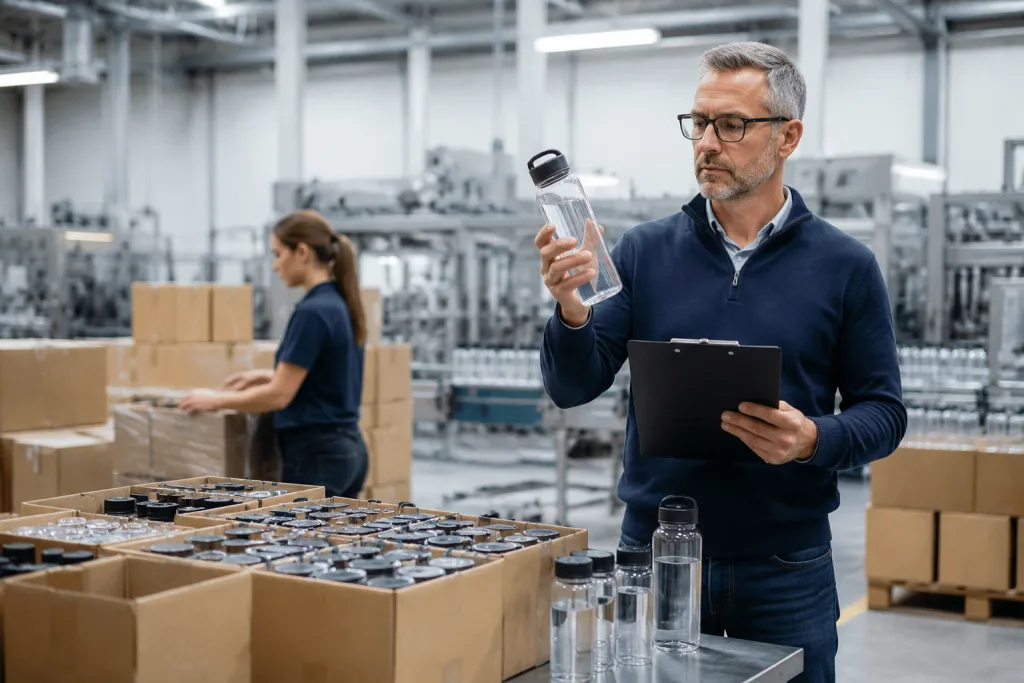
The last failure mode is trusting finished-goods photos instead of inspection data. Photos show the bottle looked clean on a table. They do not prove 750 ml capacity, 6-hour vacuum drop, cross-hatch coating adhesion, barcode scan rate, 5-layer carton burst strength, or 30-minute leak resistance. For wholesale drinkware programs, we run incoming material checks with a PMI gun on 304 stainless coils, inline inspection at the logo and assembly stations, then final random inspection under AQL before cartons move to the loading bay.
A common setting is AQL 2.5 for major defects and 4.0 for minor defects, with critical defects set to 0 acceptance. Critical defects include sharp edges on the mouth, contaminated interiors, broken glass liners, unsafe plastic odor, and serious leakage after the bottle is inverted. Major defects include wrong logo, poor coating, lid failure, dents above the approved limit, and incorrect packaging; QC pulled one sample last month where the PO said matte black but the carton label was typed “matt back.” Minor defects include small cosmetic marks inside the agreed tolerance, such as a 1 mm speck under the base where the buyer has already signed the limit sample.
At our Hangzhou, Zhejiang facility, standard production lead time is usually 30-45 days after sample approval for repeat wholesale water bottles US orders, depending on decoration and order quantity. New molds, complex powder colors, and custom lids can add 15-25 days because tooling trial, color matching, and lid fit testing cannot all sit on the same line. If a supplier promises 10 days for a fully custom 20,000-unit China order during peak season, ask what step they are skipping. We’ve seen this go sideways: the math does not work when powder coating alone needs 2 shifts plus 24 hours for adhesion testing.
For canteen wholesale, wholesale canteen, alcohol flask wholesale, wholesale growler, and beer tumbler wholesale bulk orders, request a pre-shipment inspection report with photos of measured capacity, unit weight, logo position, leak test, carton marking, and packing method. If the order is large enough, hire a third-party inspector; for a 50,000 pcs shipment, one missed lid gasket can turn into 600 customer complaints. If it is a reorder, compare defect rates against the previous lot, not against a clean sales photo. Procurement is not about avoiding every defect; it is about keeping defects predictable, bounded, and commercially manageable before we ship.
Send your bottle spec for a practical RFQ review
We will flag leak, logo, packing, and compliance risks before you commit to a China production order.
Frequently asked questions
What MOQ should I expect for wholesale water bottles shipped to the US?
For standard stainless steel wholesale water bottles US buyers usually start at 1,000 units per SKU or color. Custom logo with existing bottle molds is normally manageable at that level. Custom powder colors are easier at 2,000-3,000 units because coating lines waste material during setup. Fully custom shapes, lids, or molds can require 5,000-20,000 units depending on tooling complexity. If you need mixed colors in one order, ask whether the MOQ is per color or per total order. That detail changes your landed cost and inventory risk.
How long does production take after I approve samples?
For repeat models, plan 30-45 days after written sample approval and deposit. Decoration-heavy orders, custom colors, or peak-season schedules can push this to 50-60 days. Add about 25-40 days for ocean freight to many US ports, plus customs clearance and inland trucking. Air freight is faster but expensive for drinkware because bottles take volume. If your launch date is fixed, approve artwork, packaging, barcode rules, and carton labels before production starts. Late packaging decisions are a common reason shipments miss the vessel.
Can one supplier handle bottles, canteens, tumblers, flasks, and growlers?
Yes, but do not assume every category uses the same QC rules. Wholesale drinkware covers many formats: bulk canteen, canteen bulk, beer tumbler bulk, alcohol flask bulk, and beer growler wholesale all have different risk points. Bottles usually fail at lids and coating. Canteens dent at shoulders. Flasks need seam cleanliness and odor control. Growlers need strong closures and better carton protection. A capable China supplier should give you category-specific test plans, not one generic inspection checklist for everything.
What tests should I require before paying the balance?
At minimum, require final random inspection under AQL 2.5/4.0, capacity measurement, unit weight check, logo position check, leak testing, coating adhesion testing, and carton drop or compression review where relevant. For vacuum bottles, add heat-retention testing, such as starting water near 95°C and measuring temperature after 6 or 12 hours. For food-contact compliance, request FDA-related documentation for the US and LFGB or REACH if you also sell in Europe. Balance payment should follow a passed inspection, not just finished production photos.
How do I compare FOB prices from different China factories?
Normalize the spec before comparing price. Confirm stainless grade, wall thickness, lid material, coating type, logo method, carton packing, test standard, and whether the quote is FOB Ningbo, FOB Shanghai, EXW, or DDP. A $0.18 lower unit price may disappear if the cheaper quote excludes color box packing or uses thinner cartons. Ask for gross weight, carton dimensions, and estimated CBM per 1,000 units so you can calculate freight. The right comparison is landed cost per sellable unit, not the lowest FOB line item.