Key Takeaways
- For Germany, plan 1,000-3,000 pcs MOQ per SKU for most stainless bottle programs
- 304 stainless steel, LFGB-grade contact parts, and REACH coating checks matter more than a low FOB price
- Vacuum insulated bottles fit corporate and retail; single-wall bottles fit event and budget promotion
- Beer growler and alcohol flask programs need tighter sealing, labeling, and volume-marking checks
German buyers rarely miss on color. They miss on the spec sheet: steel grade left open, coating never tested, carton pack too soft for cross-dock handling, or a low FOB quote that ignores EU compliance work and lands badly later.
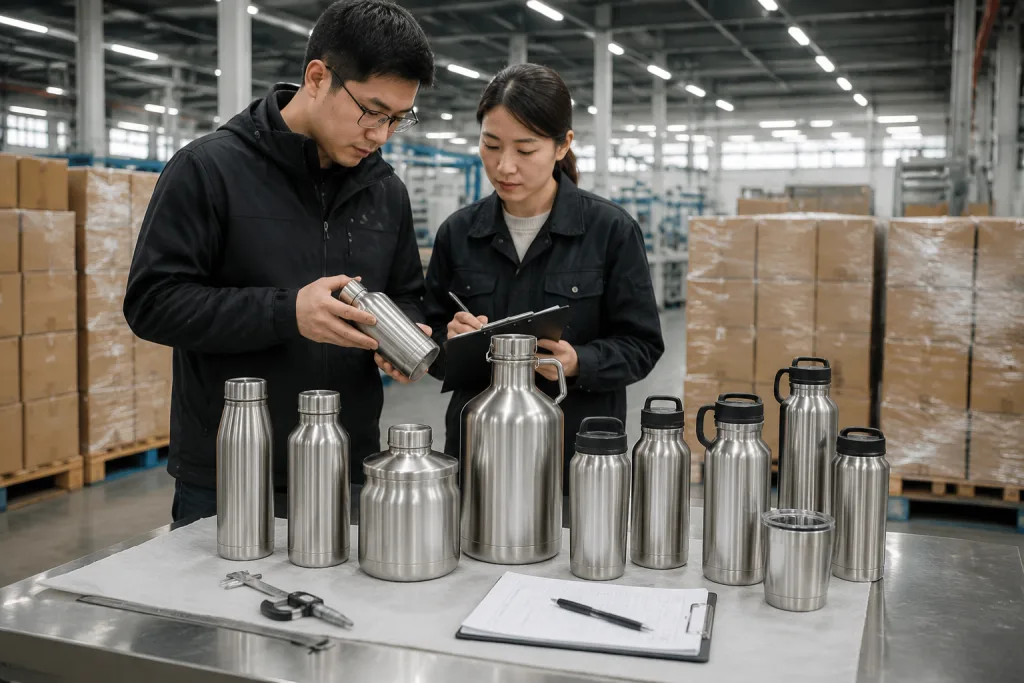
If you are sourcing wholesale water bottles Germany buyers can move through retail, corporate gifting, online marketplaces, or brewery channels, you need a side-by-side read on product types. We run export drinkware from Hangzhou, Zhejiang, with MOQs from 1,000 pcs per SKU, a typical 30-45 days after sample approval, and monthly output around 600,000 units depending on season and model mix. QC pulled the sample at the line before it left; that check saves everyone a headache.
The shortlist buyers should compare
A request for wholesale water bottles Germany can mean 4 different RFQs on our side of the line. A corporate buyer may want 500 ml vacuum bottles with a 38 mm laser logo. A distributor may need drinkware bulk stock packed for supermarket shelves. A brewery may ask for beer growler wholesale bulk with swing caps or screw lids. A camping brand may need canteen wholesale in 304 stainless steel or Tritan. We have seen this go sideways: one PO said “bottle” in the item line, but the buyer flagged the sample because they expected a screw-cap growler, not a vacuum bottle.
Ask for a spec comparison before asking for price. Price without wall thickness, lid type, coating, and carton pack is mostly noise. We run this table with European procurement teams, then check the risky points with a digital caliper and a 24-hour leak test before the quotation is locked.
| Product type | Common capacity | Material | Best fit | Typical MOQ |
|---|---|---|---|---|
| Vacuum water bottle | 500-750 ml | 304 stainless steel, double wall | Retail shelves, corporate gifting programs, outdoor brands needing heat retention claims | 1,000 pcs/SKU |
| Single-wall sports bottle | 600-1,000 ml | 304 stainless or Tritan | Events and gyms; school programs where low weight matters | 2,000 pcs/SKU |
| Canteen | 750 ml-1.2 L | 304 stainless, aluminum, Tritan | Camping ranges, military-style promotions, kids outdoor sets with strap or pouch | 1,500 pcs/SKU |
| Beer growler | 1 L-2 L | 304 stainless or glass | Brewery merchandise and refill programs with cap seal checks | 1,000 pcs/SKU |
| Alcohol flask | 5 oz-8 oz | 304 stainless | Gift sets and travel retail; private label boxes with insert tray | 3,000 pcs/SKU |
The right wholesale drink bottle is not the one with the lowest unit cost. Wrong question. For Germany, the math depends on wall thickness, lid system, powder coating or spray paint, test report, carton packing, and channel margin. QC pulled one 750 ml sample last quarter with a 0.32 mm outer wall instead of 0.40 mm; the quote looked cheaper, but dent claims would have eaten the margin. Confirm the selling channel first, then choose the bottle type.
Vacuum bottles versus sports bottles
I’ll rewrite the section in-place, keep the HTML tags and list structure unchanged, and tighten the prose so it reads like a factory-side sales engineer wrote it.For most wholesale drinkware programs in Germany, the first call is insulated or not. A 500 ml double-wall vacuum bottle in 304 stainless steel usually runs about 0.5 mm on the outer wall and 0.4 mm on the inner wall. It holds heat or cold longer, sells at a cleaner retail price point, and ships heavier. The carton takes more space too.
A single-wall sports bottle is simpler. If the buyer needs bulk drinkware for a marathon, a university welcome pack, a gym chain, or a tight promo budget, this is the better match. We get a clean logo area, lower FOB, and faster line time because there is no vacuum leak test. On our Zhejiang line, a normal stainless sports bottle order can run 35,000-50,000 pcs per month, depending on coating and print method.
The head-to-head choice looks like this:
- Vacuum bottle: stronger shelf value, works for retail boxes, needs more QC checks, usually USD 3.20-6.80 FOB for mid-range 500-750 ml models.
- Single-wall sports bottle: lighter, cheaper, faster, usually USD 1.60-3.20 FOB depending on material, cap, and logo process.
- Tritan bottle: clear and light, but the buyer should check BPA-free resin papers and the temperature-use note. QC pulled a sample once because the spec sheet forgot that line.
If you sell through German corporate gifting distributors, vacuum bottles with laser engraving or one-color silk screen are the safer pick. If the order is under brutal price pressure, single-wall stainless or Tritan usually wins. We’ve seen this go sideways when the buyer mixes them in one quote and then asks for the same AQL, packaging, and test plan. The math doesn’t work.
Canteen, growler, and flask fit
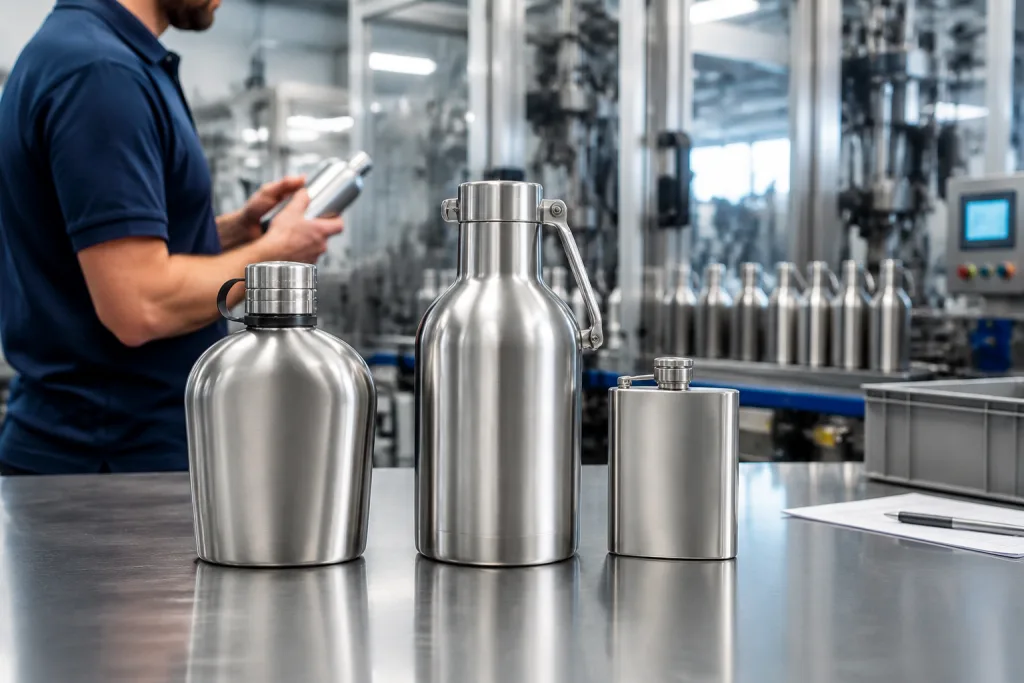
I’ll keep the HTML exactly as-is and rewrite only the prose, with tighter B2B factory language and a few concrete shop-floor details.Canteens, growlers, and flasks sit outside the standard office bottle line, but German buyers ask for them all the time. A bulk canteen order usually goes to outdoor labels, camping programs, scouting kits, or promo brands. Search terms like canteen bulk, wholesale canteen, and canteen wholesale show up in RFQs, but the real test is shape stability. Flat canteens and military-style bodies need tighter tooling control than straight cylindrical bottles, because one 0.3 mm dent line or a rough weld bead shows up fast under print and powder coat.
Growlers are a different game. For bulk growler, growler bulk, growler wholesale, beer growler in bulk, or beer growler wholesale requests, the lid seal comes first. A 1.9 L stainless beer growler with a weak gasket brings complaints back in 12 days, not 18. We run 100% leak testing on the line for brewery programs, and QC pulled the sample after a pressure test failed at the cap thread. Our usual call is 304 stainless steel, food-grade silicone gasket, and pressure-related warning labels where required. Glass growlers look classic, but carton breakage climbs fast once the goods move through two or three EU distribution points.
Alcohol flasks are smaller, but the inspection is no softer. If you buy alcohol flask bulk, alcohol flask in bulk, alcohol flask wholesale, or alcohol flask wholesale bulk, check the weld seam, inner polishing, and cap thread consistency. A 6 oz flask with a burr on the rim or a metallic smell will not pass a brand audit. We’ve seen this go sideways on a PO typo too, where a buyer flagged “6oz” and the carton artwork still showed “8oz.” Gift-set packaging changes the math; adding a funnel and black box can add USD 0.35-0.90 per set.
Our blunt view: water bottles are won by coating and insulation; growlers are won by sealing; flasks are won by welding and odor control.
For Germany, do not print use cases your test files cannot back up. If the item is sold for hot beverages, alcohol, or beer refill, the material sheet and gasket paperwork should match that claim. We ship fewer headaches that way, and the customs desk likes clean documents better than clever copy.
Compliance Germany buyers cannot ignore
I’ll rewrite the section in-place, keep the HTML structure intact, and tighten the wording for a real sales-engineer voice with concrete factory and QC detail.EU buyers often ask if a China factory is “certified.” That question is too broad. For wholesale water bottles Germany programs, we need product compliance, factory responsibility, and shipment QC on the same order. We run them separately, and they do not mean the same thing.
For contact materials, German importers usually ask for LFGB testing or EU food-contact documents. On the shop floor, we check 304 or 316 stainless with a caliper and material traceability card when the spec calls for it. Plastic parts need food-contact declarations. Coatings and outside paint may need REACH screening for restricted substances. If the bottle is for children, the buyer pushes us to review the mouthpiece, lid torque, and age grade more strictly. For US-bound parallel programs, buyers may ask for ASTM or FDA papers, but those do not replace EU checks.
Factory audits matter when you sell to larger retailers or corporate programs. BSCI, Sedex, ISO 9001, or customer audits can support approval. They do not prove the exact order passes. We’ve seen this go sideways: a Zhejiang factory can have a clean audit file and still need a fresh test for a custom coating, logo ink, straw material, or lid gasket. The line does not care about the certificate.
Quality inspection should be written into the PO. A common level is AQL 2.5 for major defects and 4.0 for minor defects, with critical defects at 0. QC pulled the sample, and we checked vacuum performance, leakage, coating adhesion, color comparison, barcode scan, carton drop condition, and pack count. For beer tumbler wholesale bulk or beer tumbler in bulk, add rim finishing and lid fit. For beer tumbler bulk programs with powder coating, request cross-hatch adhesion testing and boiling-water exposure checks before mass packing. The math does not work if you skip those two tests.
Logo, packaging, and channel math
I’ll rewrite the section in place, keep the HTML exactly as-is, and tighten the sales-engineering tone with specific factory and channel details.Decoration is where a lot of wholesale drinkware jobs bleed margin. We’ve seen a buyer sign off on a clean sample, then the line shows the logo method adds 18 seconds per piece or blows up cost on 20,000 pcs. For Germany, the usual routes are laser engraving, silk screen printing, heat-transfer printing, UV printing, and full powder coating with a second logo step.
Laser engraving holds up well on 304 stainless steel. Good for corporate sets and smaller premium runs, but bottle color and logo size decide whether it works. Silk screen printing stays cost-effective for one- or two-color art on straight walls. Heat transfer gives wider graphic coverage, but QC pulled the sample after the dishwasher test because adhesion and wash claims need real checking. UV printing looks sharp on multicolor logos, yet curved bodies and rough handling will show weak process control fast.
Packaging has to fit the channel. For Amazon-style online sales into Germany, you need barcode labels, FNSKU handling if the goods go through marketplace fulfillment, stronger individual boxes, and outer cartons that match warehouse rules. For wholesale drinkware going to distributors, a plain white box often does the job. For gift sets, a rigid color box adds shelf value, but it also pushes up carton volume and freight. The buyer flagged it on one PO: the box looked nice, the math didn’t work.
Here is a real cost build for a 500 ml vacuum bottle made in China: base FOB USD 3.80, powder coating USD 0.35, one-position laser logo USD 0.18, color box USD 0.28, inner bag and manual USD 0.06. That “cheap” bottle lands at USD 4.67 FOB before sea freight, duty, domestic trucking, and distributor margin. We’ve seen this go sideways when someone chases a USD 0.10 factory discount and ignores packing cost. For drinkware bulk and wholesale drinkware, landed-cost control wins.
MOQ, lead time, and freight reality
I’ll rewrite the section in-place, keep the HTML tags untouched, and tighten the sales-engineer tone with concrete factory details and shipping realities.Most factories will not take a 200 pc custom order as a production run. On our line, a real MOQ for stainless bottles is 1,000 pcs per color or logo version when the model already exists. New color work usually starts at 3,000 pcs. If you want a new lid, body shape, or a patented structure, plan for 5,000-10,000 pcs plus tooling from USD 1,500 to USD 8,000. We’ve seen buyers push back on this, then ask for a sample anyway; the math does not work.
Lead time is less flexible than most buyers expect. From our Zhejiang workshop, we normally run 5-7 days for digital mockup, 7-12 days for pre-production samples, 30-45 days for mass production after approval, and 7-10 days for final inspection and export booking. QC pulled the sample on one 500 ml bottle job because the logo was 1.2 mm off-center, and that alone cost two extra days. Before Christmas, summer outdoor season, and big promo windows, add at least two weeks. Chinese New Year can take out three to four working weeks, so this is the wrong question to ask if the ship date is already fixed.
Freight choice comes down to volume and urgency. Air freight only makes sense for small replenishment orders or sample cartons. For 5,000 pcs of 750 ml vacuum bottles, sea freight is normally the sane option. FOB Ningbo or Shanghai is standard for Zhejiang factories. If you ask for DDP Germany, get the breakdown in writing: duty, VAT handling, customs clearance, and local delivery. We’ve seen a PO typo on the destination postcode turn a smooth shipment into a mess at the last mile.
For beer growler bulk, beer growler wholesale, and beer growler wholesale bulk orders, carton strength needs extra care because the units are bigger and heavier. We usually run 5-ply export cartons, molded pulp or EPE separation for premium items, and carton drop testing before shipment. On a 64 oz growler job, the carton test failed at 60 cm on the first drop, so we changed the insert before loading. A dented bottle is not a freight problem for your customer; it is your brand problem.
How to brief a factory properly
I’ll rewrite the section in-place, keep the HTML structure unchanged, and make the copy read like a factory-side sales engineer.A solid RFQ is short, specific, and testable. If you send only “need best price for wholesale water bottles Germany,” we get a pile of quotes that are impossible to compare. Send capacity, material, insulation requirement, cap type, coating, logo method, packaging, compliance target, order quantity, delivery term, and sales channel.
For example: “500 ml double-wall 304 stainless vacuum bottle, powder coated matte black, laser logo one side 40 x 25 mm, LFGB food contact support, REACH coating screening, individual kraft box, 2,000 pcs, FOB Ningbo, target delivery to Germany warehouse by 20 September.” That spec gives us enough to price the line properly. QC pulled a sample with a 1.2 mm wall check and the quote matched the build, not a guess.
If you are buying canteen bulk, say whether the canteen needs a shoulder strap, carabiner, cup, pouch, or wide-mouth cap. If you are buying beer tumbler wholesale or beer tumbler wholesale bulk, give lid type, foam control target, and the use case: beer garden, retail shelf, or event handout. If you are buying alcohol flask wholesale bulk, list the gift-set parts and state whether the funnel is stainless or plastic. The buyer flagged a PO typo once — “cup” became “cap” — and the whole carton set had to be redrawn.
Ask for a golden sample and keep it. Approve Pantone color, logo position, lid torque feel, gasket smell, box print, and carton mark before mass production. Then inspect against that sample. This is not paperwork for show; we’ve seen it go sideways after 3,000 cartons already left China. Use the same sample on the bench, on the torque wrench, and at final QC.
Send your Germany bottle spec for factory review
Share capacity, material, logo, packaging, quantity, and deadline. We will return a practical MOQ, FOB quote, and compliance checklist.
Frequently asked questions
What MOQ should I expect for wholesale water bottles shipped to Germany?
For existing stainless steel water bottle models, expect 1,000 pcs per SKU as a realistic starting MOQ. If you need a custom Pantone powder coating, many factories will ask for 3,000 pcs per color because coating lines and paint purchasing have setup losses. For a new mold, custom lid, or exclusive body shape, plan 5,000-10,000 pcs plus tooling charges. Small sample runs of 50-200 pcs are possible, but the unit cost is not a wholesale production price. For Germany, it is better to run one clean 2,000 pc SKU than split the same budget into six weak variants.
Which bottle type is best for German corporate gifting?
A 500 ml or 750 ml double-wall 304 stainless vacuum bottle is usually the safest choice for German corporate gifting. It has higher perceived value than a single-wall sports bottle and works well with laser engraving, one-color silk screen, or subtle retail-style packaging. For a mid-range program, expect FOB China pricing around USD 3.50-6.50 depending on lid, coating, and box. Ask for AQL inspection, leak testing, and vacuum performance checks. If the gift must feel premium, spend money on coating consistency and packaging instead of adding unnecessary accessories that increase freight volume.
Do I need LFGB testing for wholesale drinkware in Germany?
For products intended for food or beverage contact in Germany, you should budget for EU food contact documentation and often LFGB-related testing, especially if selling through retailers or serious distributors. Stainless steel, plastic lids, silicone gaskets, straws, coatings near the mouth area, and printed decorations may all need review. A past test report from another model is useful but may not cover your exact custom bottle. If you change the coating, gasket, straw, or inner surface, ask whether a new test is required. Testing cost is small compared with a rejected shipment or retailer complaint.
Can I source beer growlers and water bottles from the same factory?
Yes, if the factory has the right welding, polishing, sealing, and inspection process. A factory that makes standard water bottles can often produce stainless beer growler bulk orders, but you should not assume the same QC checklist is enough. For beer growler wholesale, add 100% leak testing, gasket material confirmation, cap torque checks, carton drop testing, and capacity verification. For 1 L to 2 L growlers, dents during shipping are more common than on 500 ml bottles, so packaging needs to be stronger. Ask for 5-ply cartons and internal separation before approving production.
What lead time should I plan before a German launch date?
For a normal custom drinkware order, plan 60-75 days from RFQ confirmation to arrival planning, not just 30 days of production. Sampling usually takes 7-12 days after artwork confirmation. Mass production is commonly 30-45 days after sample approval. Final inspection, export documents, vessel booking, and sea freight add more time. If your launch is before summer, Oktoberfest promotions, or Christmas gifting, add a two-week buffer. Around Chinese New Year, add three to four weeks because many China factories, coating suppliers, and packing vendors close or operate at reduced capacity.