Key Takeaways
- A workable wholesale tritan water bottle order usually starts at 3,000-5,000 units MOQ and 30-45 days lead time.
- Tritan is best when you need clarity, impact resistance, and a BPA-free story; it is not ideal for boiling water or aggressive solvents.
- FOB China pricing for a 650 ml Tritan bottle typically lands around USD 2.10-4.80 depending on lid, print, and pack-out.
- Ask for REACH, food-contact declarations, and AQL 2.5 inspection before you approve bulk production.
If you are buying a wholesale tritan water bottle, the hard part is not finding a supplier in China or Zhejiang. The hard part is locking the spec before you wire the deposit: copolyester grade, lid system, decoration method, test standard, and carton pack. Get those wrong and you pay twice, once on claims and once on rework. We have seen a buyer miss a 0.2 mm cap fit check and lose 18 days.
Good sourcing is a buying decision, not a catalog search. For procurement managers and brand owners, the wrong question is “What bottle is cheapest?” The math does not work. Ask what will pass your market, survive distribution, and still leave margin after freight and duty. At BottleForge Industrial in Hangzhou, Zhejiang, we usually start with 3 numbers: target retail price, compliance needed, and order size. On the line, that is where the spec gets real.
Start With the Sales Channel
I’ll keep the tags intact and rewrite the prose to sound like a factory-side sales engineer. I’m tightening the channel logic, adding a few concrete shop-floor details, and removing the AI filler.The first call is where the bottle sells. A wholesale tritan water bottle for Amazon FBA needs different handling than one sold through a gym chain, corporate gift program, or distributor catalog. Retail channels punish bad pack-out and barcode mistakes. B2B channels punish thin margin and color drift. Skip this step and you end up optimizing the wrong spec.
For e-commerce, we push a lighter bottle, a clean silhouette, and a lid that survives repeated opening in fulfillment centers. For offline wholesale, case efficiency matters more. A 500 ml bottle packed 24 pcs/carton can ship better than a bulky 1 liter shape that looks fine on a shelf but hurts freight density. On our line in Zhejiang, we quote both because the freight gap can run 8%-12% of landed cost on a full container.
Think in terms of the channel’s pain points:
- Amazon or marketplace: unit carton, FNSKU, suffocation warnings, and drop-test packaging.
- Distributor or import wholesaler: pallet pattern, carton strength, and repeatability over 5,000-20,000 units.
- Corporate or promotional: logo area, color consistency, and a fast decoration slot.
That is why “best wholesale drink bottle” is the wrong question. The real answer is the bottle that fits your route to market with the least friction. QC pulled a sample with a barcode typo last month, and that one mistake would have turned into a warehouse claim.
Choose Tritan Grade and Wall Thickness
I’ll rewrite the prose in place, keep the HTML structure unchanged, and make the section sound like a factory-side sales engineer wrote it.Not every Tritan claim means the same thing. For a serious wholesale tritan water bottle program, ask which resin grade they run, whether it has food-contact paperwork, and how much post-industrial regrind sits in the body. If the answer is vague, the quote is just a placeholder. We’ve seen buyers accept that and then QC pulled a cloudy sample on the first carton. A good China factory will name the resin supplier, the melt flow range, and whether the body is injection or injection-stretch blown.
Wall thickness decides how the bottle feels in hand. A typical 650 ml Tritan body usually sits around 1.8-2.4 mm. Go thinner and the bottle starts to feel flimsy, with stress whitening and dents near the base or shoulder; we’ve had a buyer flag a 1.6 mm sample for that exact reason. Go thicker and freight climbs fast because the unit weight jumps. For a clean premium feel without waste, 2.0-2.2 mm is the spot we usually recommend.
Use Tritan when you need:
- Clear product display for fruit infusers or branded inserts.
- Impact resistance for gym, school, or travel programs.
- Lower odor retention than standard plastic bodies.
- A strong BPA-free position for wholesale drinkware.
Do not use Tritan when: the product must handle boiling water, direct flame, or repeated chemical exposure. If your buyer asks for a hot-fill flask, the math does not work; a metal system is the better call than forcing Tritan into a job it was never meant to do. On our line, that usually means switching the spec before tooling, not after the PO typo lands.
Match Lid Style to Usage
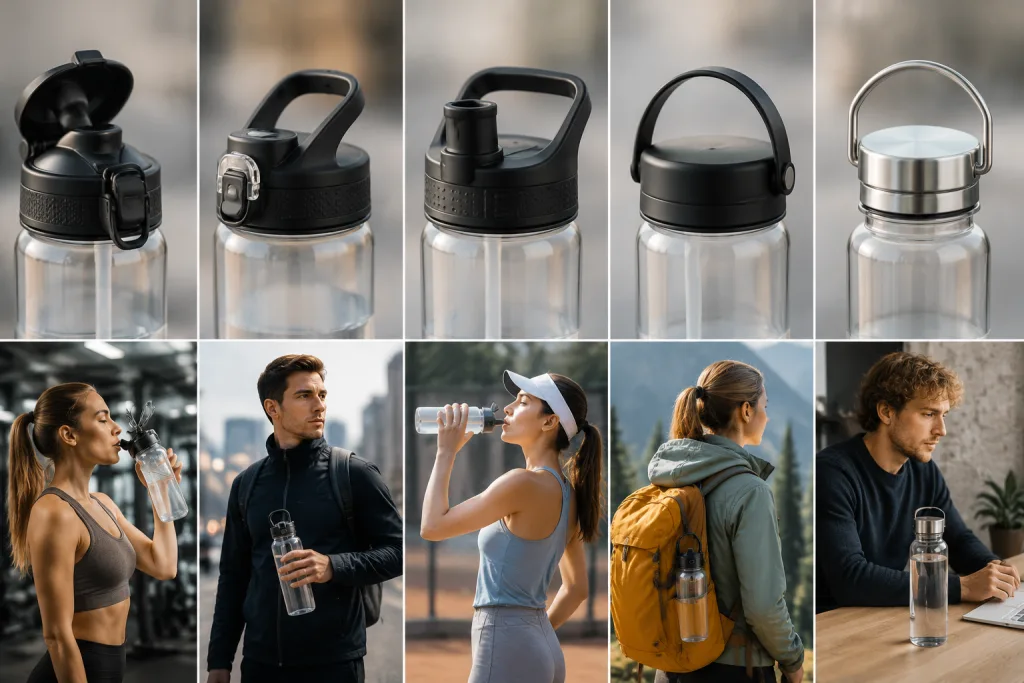
I’ll rewrite the prose in place, keep the HTML exactly as-is, and tune the tone to sound like a buyer-facing sales engineer.The lid is where wholesale margin slips away. A bottle body can pass, while the cap leaks, cracks, or adds 40 seconds to pack-out on the line. For bulk drinkware, pick the lid for the use case, not for a pretty render. A flip-top fits sports and commuting. A screw cap with a carry loop is simpler. A straw lid is convenient, but it brings cleaning complaints and more part-count risk.
For a wholesale tritan water bottle moving through retail or promo channels, I stick with fewer moving parts. One extra silicone seal sounds small, but on the floor it is one more assembly step and one more place for AQL sampling to catch a miss. If the buyer wants a lock, run it through at least 3,000 open-close cycles before you sign off the mold. If custom color matters, ask the supplier to match Pantone on both lid and body; mismatched plastic is one of the fastest ways to make a product look cheap, even when the tooling is right.
Buyers looking at bulk canteen, canteen bulk, wholesale canteen, or bulk drinkware should apply the same rule. The closure system decides whether the bottle gets used or gets returned. We’ve seen this go sideways with a 2 mm seal gap and a PO typo on the lid code. The same thing shows up in bulk growler and beer growler wholesale programs: a good shape without a sound seal is just stock sitting in the warehouse.
Price the Real Landed Cost
I’ll rewrite just this section, keep the HTML intact, and tighten the sales-engineering tone with concrete sourcing details and cleaner pricing logic.Do not compare factory quotes line by line unless the pack-out matches. A tritan bottle at USD 2.05 FOB and another at USD 2.40 FOB can flip once you add printing, inner boxes, lid upgrades, and carton drop tests. We see buyers in Zhejiang chase unit price and miss pallet count. The math does not work.
For a mid-size wholesale tritan water bottle, a realistic FOB China range is often USD 2.10-4.80 per set at 3,000-5,000 units, depending on capacity, mold complexity, lid, and print. Mold charges may run USD 4,000-12,000 for a custom shape, and sampling usually takes 7-12 days after artwork confirmation. QC pulled the sample last week and found a 1.2 mm mismatch on the lid thread, which is the kind of issue that turns into a late shipment. If you need laser engraving, the setup is slower but the mark stays sharp. If you need silk screen, ask about color count and cure method. We quote a lot of buyers on custom logo options through silkscreen versus laser engraving because decoration changes both the finish and the scrap rate.
For freight, lock the carton size early. A 24 pcs/carton pack that saves 5 mm per unit can change your cube in a real way. On one 20-foot container, that can mean 10,800 units instead of 12,000 units loaded. That is margin, not theory.
Demand the Right Compliance
I’ll rewrite this section in place, keep the HTML exactly as-is, and tighten the language so it reads like a factory-side sales engineer.If you sell into Europe or North America, compliance is not optional. We run this check before the first mold trial, not after shipment. A serious supplier should show food-contact declarations, REACH, and the right state or federal test package for your market. Ask for the test scope before production starts. If the quote skips compliance, you are not buying a finished product; you are buying a promise.
For a wholesale tritan water bottle, I would expect batch traceability, migration data where it applies, and material safety papers from the resin side. On one job, QC pulled the sample because the carton spec had a 2 mm gap at the corner; that sort of miss turns into chargebacks fast. If you are sourcing for retail, add carton drop tests and transit packaging checks. If you are sourcing private label, confirm the logo ink and adhesive are in scope too. Ink failure is where the buyer gets burned.
Inspection belongs in the PO. AQL 2.5 is standard for major defects on consumer drinkware, but critical, major, and minor need plain definitions. A bottle with a small flash line is not the same issue as a leaking lid. Put that in writing, line by line. Factories that ship exports every week will take that seriously; this is not a hard ask.

Build a Supplier Brief That Works
I’ll keep the HTML exactly as-is and rewrite the prose to sound like a real factory-side sales engineer. I’m also going to tighten the wording, add a few concrete shop-floor details, and avoid the AI filler the brief called out.The quickest way to get a usable quote is a brief that cuts out guesswork. For wholesale drinkware, we want capacity, target market, required certifications, logo method, carton pack, lead time, and annual volume. Leave it fuzzy, and the quote comes back fuzzy too. Give us the numbers, and we can line up suppliers in Zhejiang on the same basis.
Add a tolerance band to your target spec. Example: 650 ml Tritan body, 2.1 mm wall thickness, PP lid with silicone ring, one-color pad print, 24 pcs/carton, MOQ 3,000 pcs, sample in 10 days, production in 35 days. That is enough detail for a factory to price it without guessing. QC pulled a sample like this last week and the wall thickness came in at 2.08 mm, which is close enough for us to quote cleanly and flag the risk early.
If your portfolio includes beer tumbler bulk, beer tumbler in bulk, or beer tumbler wholesale bulk, keep the same brief format. If you also buy alcohol flask bulk or alcohol flask wholesale bulk, split those jobs by material and compliance route. The carton spec, test plan, and even the outer box size change fast. A buyer once sent one PO with a Tritan bottle line and a flask line mixed together; the supplier had to stop and rework the file before the line could run.
Good sourcing is specific. A supplier can only protect your margin if you tell them exactly which margin you want to protect.
At BottleForge Industrial in Hangzhou, Zhejiang, we run about 450,000 units a month across drinkware lines, and that only works when the brief is tight. The same rule holds whether you are ordering canteen wholesale, growler wholesale, or one best wholesale drink bottle SKU. A buyer once left the logo position out of the PO, and the proof came back wrong by 8 mm. That sort of typo costs time.
Send your bottle brief and get a real quote
Share capacity, MOQ, logo method, and target market. We’ll price the spec properly and flag the trade-offs before production starts.
Frequently asked questions
What is a normal MOQ for a wholesale tritan water bottle?
For a standard private-label program, MOQ usually starts around 3,000-5,000 units per design and color. If you need a custom mold, the tool order is separate and the first run can take 35-45 days after sample approval. A stock shape with custom logo may be possible at 1,000-2,000 units, but the per-unit price is often 15-25% higher. For multi-SKU programs, many buyers split one order into 2-3 colorways to keep risk manageable.
How much should I budget for FOB China pricing?
A realistic FOB China range for a 650 ml wholesale tritan water bottle is often USD 2.10-4.80 per set at 3,000-5,000 units. The lower end usually means a simpler lid, one-color print, and basic carton packing. The higher end usually includes custom shape, premium closure, more complex decoration, and stricter testing. Add mold cost if needed, often USD 4,000-12,000 depending on geometry and cavity count.
Is Tritan actually better than standard plastic for wholesale drinkware?
For many bulk drinkware programs, yes. Tritan offers better clarity, better impact resistance, and a stronger BPA-free story than basic SAN or generic copolyester options. It is a smart choice for transparent bottles sold through retail or promotional channels. It is not the right material for boiling water, strong solvents, or high-heat sterilization. If your use case is cold or room-temperature hydration, Tritan is usually one of the safest commercial choices.
What compliance documents should I ask for?
At minimum, request food-contact declarations, REACH-related support for Europe, and batch traceability. If you sell in North America, ask for market-specific compliance support and confirm whether any state-level requirements apply to your item. For retail packaging, add transit and drop-test criteria. For decoration, make sure inks and coatings are covered too, not just the bottle resin. Good suppliers in Zhejiang and other export hubs will provide these documents before mass production.
How do I reduce leakage complaints in bulk orders?
Start with the lid design and seal material. A simple screw cap with a well-molded silicone ring is usually more reliable than a complex multi-part lid if your team wants low complaint rates. Ask for 3,000-cycle open-close testing and a leak test on sample units before approval. During production, request AQL 2.5 inspection for general defects and a separate leak check for critical failures. Also confirm carton protection so lids are not distorted in transit.