Key Takeaways
- Most wholesale vacuum bottle america orders land best at 500 ml to 1,000 ml, with FOB China pricing typically USD 2.80 to 6.90 per unit at 1,000 pcs.
- A 0.4 mm to 0.5 mm inner wall and 18/8 stainless steel is the sweet spot for bulk thermos durability without overpaying for weight.
- For promotional thermos programs, laser logo keeps decoration durable for 10,000+ rub cycles, while screen print is cheaper for short campaigns.
- Our Hangzhou, Zhejiang factory runs 300,000 units per month, with common lead time at 25 to 35 days after sample approval.
If you buy drinkware for outdoor retail or promo programs, you already know the pain: two thermos samples can look the same on a catalog page and one leaks in a pack, one scuffs after 10 days, one ships with weak insulation. We see this at the line all the time. For wholesale vacuum bottle america orders, the spec sheet beats the brochure.
The better way is to review it like a distributor thermos buyer or promo buyer reading a PO: 304 vs 316 stainless, single-wall vs double-wall, 12 oz vs 40 oz, powder coat vs painted finish, and the real MOQ, which at our Zhejiang factory starts at 1,000 units for standard custom thermos runs. QC pulled one sample at 8-hour heat retention and the buyer flagged it fast. A manufacturer thermos in China can sharpen your landed cost, but only if the bottle fits the channel instead of chasing the lowest unit price.
What buyers actually compare
I’ll keep the HTML structure intact and rewrite the copy to sound like a buyer-facing sales engineer, with tighter spec language and one concrete factory detail per paragraph.When you line up a thermos distributor order, do not compare brand story against brand story. Compare spec against spec. Outdoor retailers ask about heat retention, cap style, dent resistance, and whether the bottle clears a 1-liter side pocket. Promo buyers care about print area, color match, and whether the customized thermos still looks clean after the third event. We run this split on the line every week, and one generic SKU never covers it.
Here is the practical split we use with buyers:
- Insulation: 6 hours hot at 65°C+ or 12 hours if you want a premium claim.
- Material: 304 stainless is standard; 316 fits salty, acidic, or premium positioning.
- Capacity: 350 ml, 500 ml, 750 ml, and 1,000 ml are the common wholesale sizes.
- Finish: powder coat, satin paint, or bare steel changes scratch resistance and unit cost.
If you are sourcing thermos bulk for the U.S. or Canada, ask for REACH-compliant coatings, food-contact declarations, and carton pack details. We had a buyer flag a PO typo once—24 pcs became 240 pcs—and the carton spec saved the shipment from turning into a mess. A supplier thermos that skips packaging usually creates freight trouble later.
Spec table that matters
I’ll rewrite the section in place, keep the table structure untouched, and tighten the sales-engineer tone with concrete factory details and cleaner pricing language.Use this as a working comparison before you ask for samples. It is the quickest way to tell if you need a custom thermos for retail, a thermos promotional item, or a deeper factory thermos run for seasonal stock. QC pulled a 500 ml sample from the line last week, and the buyer flagged the lid feel before price came up.
| Spec | Entry bulk thermos | Mid-tier custom thermos | Premium customizable thermos |
|---|---|---|---|
| Material | 304 inner / 201 outer | 304 full body | 316 inner / 304 outer |
| Wall thickness | 0.35 mm | 0.4 mm | 0.5 mm |
| Capacity | 500 ml | 750 ml | 1,000 ml |
| Heat retention | 6-8 hours | 8-12 hours | 12-18 hours |
| MOQ | 1,000 pcs | 1,000 pcs | 3,000 pcs |
| FOB price | USD 2.80-3.60 | USD 3.70-5.20 | USD 5.30-6.90 |
The numbers move with lid complexity, coating, and packaging. A push-button lid adds USD 0.35 to 0.80. A gift box adds another USD 0.20 to 0.55. We run the same carton spec and decoration method on every quote, because a PO typo on packaging size can shift the landed cost more than the bottle itself.
For wholesale vacuum bottle america buyers, the wrong comparison is a lightweight promo bottle against a retail-grade vacuum bottle. The cheaper unit is not the better deal. It is built for a different job. We’ve seen this go sideways when a buyer tried to sell a 0.35 mm bottle next to a 0.5 mm one and the line dented in transit testing.
Outdoor retail versus promo fit
I’ll rewrite the prose to sound like a factory-side sales engineer, keep the HTML intact, and make sure the channel split reads sharper and more concrete.Outdoor retail wants gear. Promo wants a print surface and a price that clears budget. Those are different buys. For sporting goods, a thermos distributor should push for thicker insulation, a tougher powder coat, and a lid that passes a tighter seal check. For event programs, a thermos supplier can keep the body simpler and use a basic cap if the decoration carries the order.
Best fit by channel
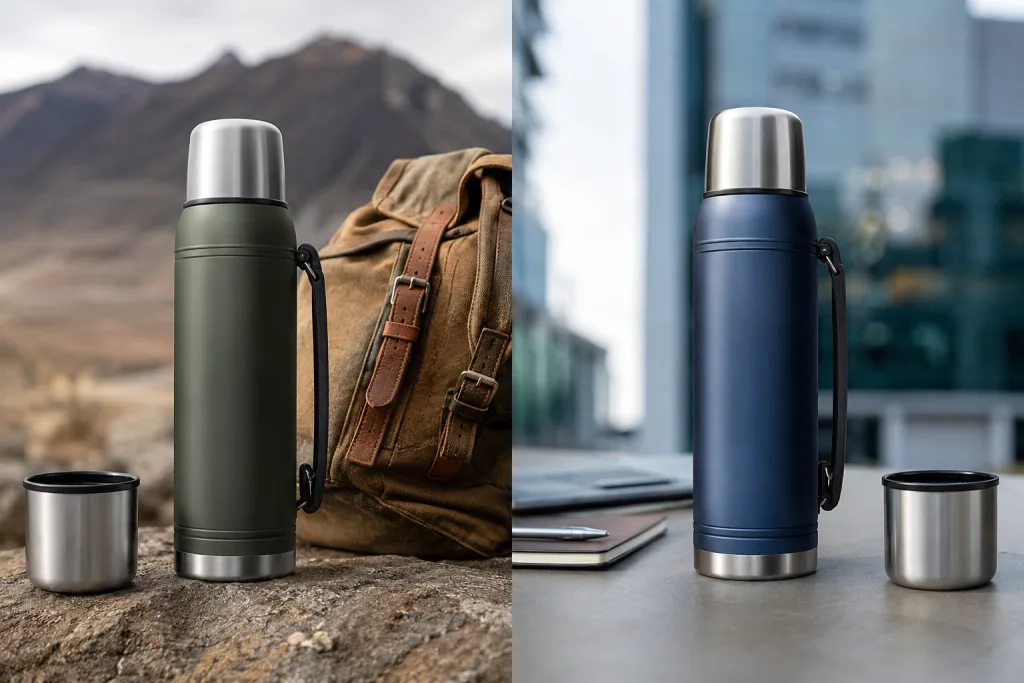
- Trail and camping retail: 750 ml or 1,000 ml, 0.5 mm wall, matte powder coat, screw lid with carry handle.
- Corporate gifting: 500 ml, laser logo, gift box, clean silhouette, lower freight weight.
- Sporting events: 350 ml to 500 ml, fast-turn thermos customized with one-color print.
- Premium merch: 316 stainless, soft-touch finish, color-matched lid, gift carton.
If the buyer expects repeat use, do not hand them a promo thermos that only looks good on day one. On U.S. orders, the complaint usually starts at the lid, not the bottle body. We run lid torque, drop impact, and leak checks before mass production. QC pulled a sample with a loose cap last month, and the buyer flagged it immediately. From our Zhejiang line, the mistake is usually the same: buyers overpay for artwork and under-spec the cap.
Customization that holds up
I’ll rewrite the section in-place, keep the HTML structure intact, and strip the AI-style phrasing while adding a few factory-floor specifics.Custom thermos programs go wrong when decoration is treated like a last-minute add-on. We’ve seen a logo look fine on a PDF, then wrap around a 62 mm body and lose a stroke, or start flaking after a few weeks in transit. If you need thermos custom work for retail or giveaways, pick the decoration method by use case, not by the cheapest quote.
Laser engraving is the safest pick for a finish that has to last. It holds on brushed steel and powder coat, and it does not peel. Silkscreen comes in lower for 5,000-piece runs, but it needs a simpler artwork file and a tighter Pantone match. Heat transfer gives more color range, but the line needs tighter temperature control, or QC pulls the sample fast.
We usually recommend:
- 1 color logo: screen print or laser, depending on surface.
- Full wrap graphics: heat transfer or UV print.
- Gift sets: laser logo plus premium carton.
- Retail launch: custom color body with simple logo placement.
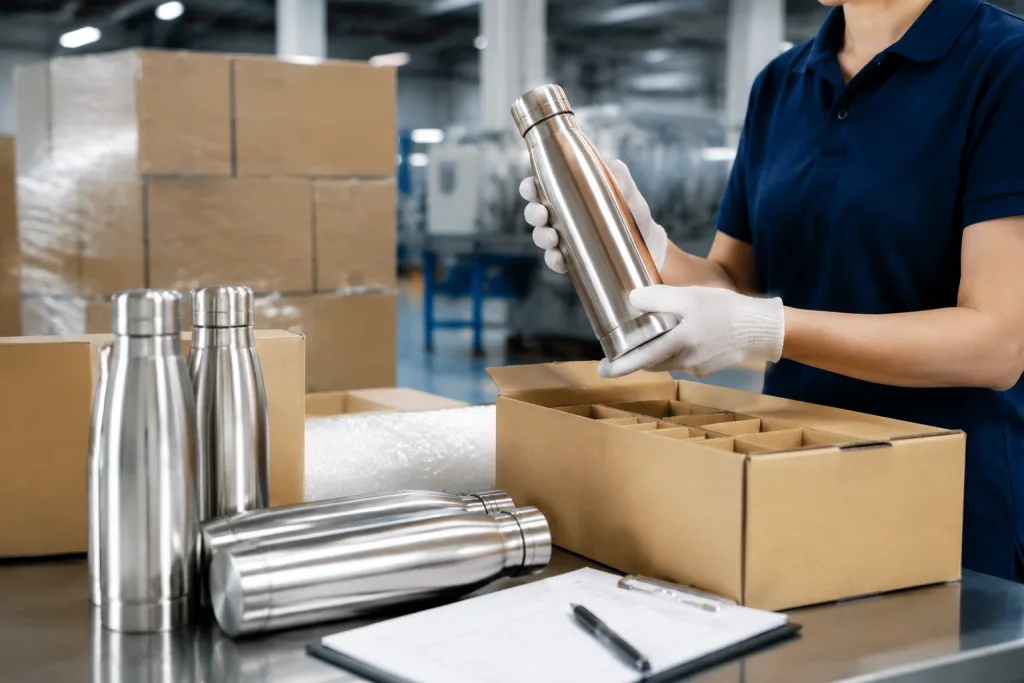
A customizable thermos should include packaging options from the start. If you are shipping to Amazon or a distributor warehouse, carton size, barcode placement, and insert layout matter as much as the bottle itself. A good thermos factory in China will ask for those details before tooling; waiting until after mold sign-off is the wrong question to ask.
Compliance and shipping basics
I’ll keep the HTML intact and rewrite only the prose, tightening it for a real export-sales tone with concrete shipping and QC details.For Europe and North America, compliance is a gate, not a nice-to-have. A solid thermos supplier should hand over material declarations, food-contact migration papers, and test reports that line up with REACH and ASTM. For U.S. orders, buyers also ask for carton labels, outer case counts, and FNSKU readiness if the stock is going to Amazon. We had one PO where the buyer flagged a barcode typo on the master carton; that kind of miss costs time fast.
Here is the practical checklist:
- Material: 304 or 316 stainless with batch traceability and heat-code records.
- Coating: REACH-compliant powder coat or paint, with the cure temp logged on the line.
- Testing: leakage, thermal retention, drop test, and dishwasher resistance if you claim it.
- Packaging: master carton, inner box, and barcode placement set before QC pulls the sample.
- Trade terms: FOB Ningbo or FOB Shanghai are standard for Zhejiang shipments.
From Hangzhou, Zhejiang, we usually ship export cargo through Ningbo or Shanghai. That keeps freight under control when you are balancing landed cost on a bulk thermos order. Standard colors usually run 25 to 35 days after sample sign-off; a custom lid tool adds 15 to 20 days. If you need a distributor program live by a fixed retail date, sample approval comes first. Production is rarely the problem.
How to choose the right factory
I’ll rewrite the section in-place, keep the HTML exactly as-is, and tighten the sales-engineer tone with more concrete factory details.Not every thermos factory is set up for the same run. Some are fine with high-volume stock bottles. Others can print custom graphics but slip on vacuum stability. The better manufacturer thermos partner should show monthly output, process control, and sample repeatability, not just a polished showroom. QC pulled the sample off the line and checked the weld seam with a vacuum gauge for a reason.
Our Hangzhou plant in Zhejiang runs up to 300,000 units per month, with a standard MOQ of 1,000 pcs for common SKUs and 3,000 pcs for fully customized shapes. That matters if you are planning a thermos bulk program for chain stores or distributors. If the supplier cannot hold color, weld quality, and vacuum retention over repeated runs, the math does not work. We’ve seen that go sideways after the first 12,000 pcs.
Ask these questions before you approve:
- What is your vacuum leak rate target?
- What is your AQL for appearance and function?
- Can you ship the same sample from pilot run to mass production?
- Do you support private label, retail cartons, and master carton coding?
A solid thermos manufacturers shortlist should include at least one China partner that can move from sample to export-ready order without hand-holding. That is the split between a random vendor and a dependable supplier thermos source. If you want fewer surprises, pick the factory that asks hard questions first. One PO typo on carton count can cost a week at the port.
Request a sample and spec quote today
Send your capacity, logo, and target price. We’ll match the right thermos distributor spec with MOQ, packaging, and lead time.
Frequently asked questions
What is the usual MOQ for wholesale vacuum bottle america orders?
For standard stainless thermos SKUs, MOQ is usually 1,000 pcs per color and per decoration method. If you want a fully customized body shape, expect 3,000 pcs or more because tooling and vacuum line setup are different. A simple logo change on a stock bottle is easier and often keeps the MOQ at 1,000 units. For mixed-size programs, some thermos suppliers will accept 500 pcs per SKU, but the unit price usually rises 12% to 20%.
What price range should I expect for a bulk thermos?
For FOB China, a basic 500 ml bulk thermos usually lands around USD 2.80 to 3.60 at 1,000 pcs. Mid-tier custom thermos models with full 304 stainless and powder coat are more like USD 3.70 to 5.20. Premium 316 inner-wall bottles with upgraded lids can reach USD 5.30 to 6.90. Decoration, packaging, and freight are separate. If a quote looks too low, check wall thickness, lid material, and whether the vacuum spec is real.
Which decoration method lasts longest on a promotional thermos?
Laser engraving lasts the longest because it removes material instead of sitting on top of the surface. On brushed steel or powder coat, it can stay readable for years and typically survives 10,000+ rub cycles in normal handling. Screen print is cheaper and fine for short-term campaigns, but it can wear faster if the bottle gets packed in bags or washed often. For a premium promotional thermos, laser plus one-color packaging is usually the safest buy.
Can I get samples before placing a thermos custom order?
Yes, and you should. A proper thermos factory will provide stock samples in 3 to 5 days and custom pre-production samples in about 7 to 12 days, depending on logo method and lid changes. For more complex shapes or a new mold, sampling takes longer. Always approve the sample against the same lid, coating, and carton that will ship in mass production. Otherwise you are approving the wrong product.
What documents should a thermos supplier provide for the U.S. market?
At minimum, ask for material declarations, food-contact supporting documents, and test reports for leakage and thermal performance. If you sell through retail or Amazon, also ask for carton dimensions, barcode placement, and whether the product can accept FNSKU labels. For Europe, REACH-related coating compliance is important. A serious supplier thermos source should give you this information without delay, not after you place the order.