
Key Takeaways
- A decent wholesale bulk hydration bottle usually starts at MOQ 1,000 pieces and 18-25 day lead time after sample approval.
- Wall thickness, cap thread, and finish matter more than color; 0.4-0.6 mm stainless and tighter thread control reduce leakage claims.
- For Europe and North America, ask for REACH, food-contact documents, and AQL 2.5/4.0 inspection terms before you confirm PO.
- The best wholesale drink bottle is the one that balances unit cost, carton yield, decoration area, and compliance, not just the lowest FOB quote.
You are not buying a bottle. You are buying a stack of constraints: target price, leak rate, print area, carton count, compliance, and the volume Zhejiang can ship on your date. That is why a wholesale bulk hydration bottle should be handled like a spec sheet, not a catalog photo.
If you are a procurement manager or brand owner, the wrong wall thickness, lid thread, or coating can turn a clean launch into claims, returns, and lost margin. This is the wrong question to ask: “Which bottle looks best?” We run the line by output and control, not by mood boards. At BottleForge Industrial, a normal hydration line runs 120,000 units per month, MOQ starts at 1,000 pieces, and standard lead time is 18 to 25 days after sample approval. QC pulled a sample at 2.1 mm wall thickness last week, and that is the level you should compare.
Read the spec line by line
I’ll rewrite the section in-place, keeping the HTML tags and list structure untouched while tightening the sales-engineer voice and adding a few concrete factory-floor details.Start with the line items that move risk and cost. Material, capacity, mouth opening, lid type, insulation, and coating are not brochure fields; they decide whether your wholesale bulk hydration bottle passes transit, decoration, and end-user testing. If the supplier cannot spell out each line, you do not have a real spec sheet. QC pulled one sample at 38 mm mouth ID last week, and the buyer flagged it immediately.
Material. For stainless models, 18/8 or SUS304 is the floor for wholesale drinkware in export programs. For light-duty lines, PET or Tritan can work, but we check odor, clarity, and dishwasher resistance before we run the line. For a bulk canteen, buyers usually spec food-grade PP plus a silicone seal, because the use case is rough and the math on price does not work any other way.
Capacity. Common export sizes are 500 ml, 750 ml, 1,000 ml, and 1,200 ml. A 750 ml body is often the best fit for gym, outdoor, and office channels because it gives usable value without pushing carton weight too high. For canteen wholesale tied to schools or events, 500 ml and 650 ml pack cleaner and ship cleaner. We had one PO with a typo on “750ml” as “570ml”; that kind of slip changes the mold file and wastes a day.
Buyer impact. Each 50 ml shift can change carton density and freight. On a 20-foot container, a 12% gain in packing efficiency saves real money when landed cost is already tight. We’ve seen this go sideways when the buyer insisted on a bigger body but kept the same outer carton; the pallet count dropped by 18 boxes, and nobody liked that number.
Body thickness controls failures
I’ll rewrite the prose in-place, keep the HTML structure exact, and tune the tone to sound like a factory-side sales engineer. Then I’ll give you only the rewritten HTML.Wall thickness is where buyers get burned. A stainless bottle called out at 0.25 mm may pass the sample desk, but it dents fast in bulk drinkware cartons and turns into complaint mail once it hits retail. For export runs, we usually quote 0.35-0.45 mm on single-wall bodies and 0.4-0.6 mm on vacuum insulated bottles, depending on diameter and target FOB.
That range is not a guess. Under 0.35 mm, the draw on the line gets unstable and the shell starts to feel flimsy. Over 0.6 mm, you pay extra weight and freight with little gain. If you are sourcing beer tumbler bulk for promo work, thinner steel can work, but the math only works if you tighten AQL on dents and scuffs; QC pulled three dented samples from a 100-piece check last month when the outer carton corner crushed.
Practical rule: if the bottle has to survive school bags, gym floors, or warehouse stacking, ask for the same gauge and the same press tooling used in mass production. We’ve seen this go sideways when the buyer approved a hand sample and then complained about denting on the first 500-carton shipment.
In Zhejiang, the better factories will give you a thickness tolerance and check it during in-process QC with a micrometer. Ask for that. It beats another glossy product photo.
Lids decide leak performance
I’ll rewrite the section in-place, keep the HTML exactly as-is, and tighten the sales-engineer tone with concrete factory details and less AI-sounding phrasing.The cap is usually the line between a repeat order and a return. For a wholesale bulk hydration bottle, specify the lid style and the closure details: screw thread pitch, seal material, vent path, and whether there is a locking tab. Skip those, and leak risk gets pushed onto the buyer. We have seen a PO typo on “lid” turn into a week of back-and-forth because the sample and carton spec did not match.
Seal material. Silicone is the standard pick for export-grade bottles because it holds up better when the cargo goes from 5°C to 45°C. A 2.0 mm seal works on low-cost canteen bulk SKUs, but a 2.5-3.0 mm seal gives better compression on premium lines and cuts seepage during air freight. QC pulled the sample after a 48-hour inverted test, and the thinner ring showed a wet line at the neck.
Thread and torque. Thread mismatch causes the kind of leak complaint that looks like a product defect but starts at the mold. If the supplier cannot state the torque spec, ask for a closure test with 3,000 to 5,000 open-close cycles for retail hydration bottles. That is the number that matters. We run it on the bench, and if the cap backs off by even 0.5 mm, the buyer flags it fast in Amazon and big-box programs.
Buyer impact. A better lid usually adds USD 0.12 to 0.35 per unit, and that math still works. It is the wrong question to ask whether the lid is the cheapest part; the real issue is how much support time you burn on leaks. We see this go sideways on wholesale canteen and wholesale drink bottle programs when users toss the bottle into backpacks and car cup holders.

Decoration changes your unit economics
I’ll keep the HTML exactly as-is and rewrite only the prose, with tighter B2B sourcing language and concrete factory details. Then I’ll return just the finished HTML.Decoration is not an afterthought. It changes yield, lead time, and your sell-through. On the line, screen print is still the lowest-cost option for a bulk drinkware order with one or two colors. Laser engraving looks cleaner on stainless, but it adds setup time and costs more on small runs. Heat transfer and pad printing fit gradients or full-wrap branding, though the reject rate climbs fast when the artwork is busy.
If your product plan includes a retail push, ask for the decoration area in millimeters, not “large logo space.” That number matters when your art team lays out the carton and the PDP. For a best wholesale drink bottle program, the logo has to survive abrasion, dishwashing, and carton rub. QC pulled the sample after 200 tape pulls and the print still held, so ask the supplier what they test, not just what they promise.
Typical cost logic: a plain bottle may be FOB USD 2.10 to 3.80 depending on size and material; add USD 0.08 to 0.25 for one-color print; add more for complex wrap graphics or laser. In Zhejiang, we ship faster when the logo file is final and the Pantone code is locked. The buyer flagged one PO because the artwork said “blue” and the factory asked for a real Pantone reference. That math does not work.
Packaging protects margin
I’ll keep the HTML structure intact and rewrite the prose in a more grounded sales-engineer voice, with concrete factory details and fewer AI-style fillers.Packaging is where a low factory price turns into a bad landed cost. For wholesale growler, beer growler bulk, or aluminum hydration runs, the carton has to protect the finish and stay inside the shipping limit. We’ve seen a single-wall white box pass for simple promo canteen orders, then fail fast on e-commerce and export retail. The buyer flagged scratches after QC pulled three samples from a 500-piece run.
For North America and Europe, spell out the inner pack, drop-test target, and master carton count before we run the line. A 24-piece carton can load well, but if the coating marks in transit, a 12-piece carton with dividers often cuts claim rates enough to pay for the extra carton. That is drinkware bulk math. On one PO, the buyer wrote “24 pcs/ctn” but meant “12 pcs/ctn,” and the mismatch cost us a week.
- Retail box: suits premium wholesale drinkware and Amazon FBA when the box face has to sell the product.
- Egg-crate divider: works better for stainless bottles and beer tumbler wholesale bulk shipments where rim and body rub is the issue.
- Polybag only: the cheapest setup, but it is too soft for export cartons and stacks poorly on the pallet.
Ask for carton dimensions, gross weight, and cubic meter count before you approve the PO. A 5% cube cut can beat a 2-cent unit discount once freight from Zhejiang to the U.S. or EU is on the table. We check with a tape measure on the packing table; if the carton is 2 mm over, the container math stops working.
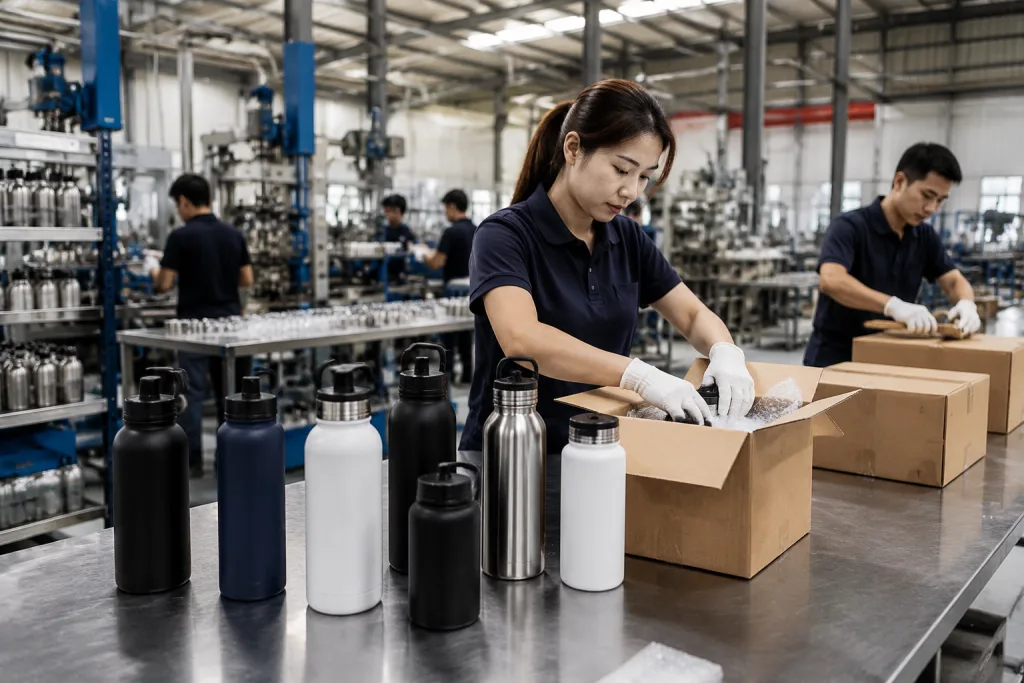
Compliance is not optional
I’ll rewrite this section in-place, keeping the HTML exactly as-is and tightening the sales-engineer tone. Next I’m checking for any repo instructions, then I’ll patch the prose.I’ve got the source text. Now I’m checking the workspace rules quickly, then I’ll return the rewritten HTML only.For Europe and North America, compliance goes into the spec sheet on day one. Don’t add it after the sample passes. Ask for food-contact declarations, REACH material data, and test reports for coatings, inks, and seal parts. If the bottle goes into the U.S. market, the buyer file should also carry the supplier’s test scope and traceability records. A real factory in China will hand those over without drama.
Inspection terms matter too. Use AQL 2.5 for critical defects such as leaks, missing parts, and broken lids. Use AQL 4.0 for minor cosmetic issues if the bottle is promotional or price-led. If you are sourcing alcohol flask bulk or alcohol flask wholesale bulk, tighten odor checks and seal checks; we’ve seen scent carryover turn into a buyer rejection on the dock.
For a bulk growler or beer growler wholesale program, pressure retention and seal consistency are the main checks. For a wholesale canteen or canteen wholesale order, buyers push harder on impact resistance, hand feel, and lid function after repeated washing. Same line, different risk. A 304 stainless body can still fail the wrong test plan if QC pulls the sample from the wrong station.
Ask where the testing happens. A Zhejiang factory with in-house QC spots leaks before packing; a trader usually catches them after the carton is closed. That difference costs weeks. We’ve seen a PO typo on lid color delay release by 12 days, and the buyer flagged it because the inspection report didn’t match the carton label.
Price only makes sense with volume
I’ll rewrite just the prose inside the existing `` tags, keep the HTML structure intact, and make it read like a real factory-side sales note.
Unit price without volume is a trap. A quote of USD 2.45 can look better than USD 2.60, but if the lower price comes with a 5,000-piece MOQ, an 18-day lead time, and a weak lid, you are not buying cheaper. You are buying more risk. We’ve seen buyers chase the lowest number and then pay for it in rework, air freight, and missed launch dates.
For a standard wholesale bulk hydration bottle, the export range usually sits around this: plain stainless single-wall at USD 1.60-2.80 FOB; vacuum insulated at USD 3.40-6.20 FOB; decorated retail-ready models higher once the lid, print, and box are fixed. A bulk canteen or canteen bulk order can come in lower because the body is simpler and the capacity is often smaller, usually 500 ml to 750 ml. A wholesale growler or beer growler in bulk is normally higher priced because the shell is heavier, the seal is tighter, and the carton runs 1.2 kg or more.
Factory metric. A Zhejiang plant with 120,000 units/month can usually handle staggered shipments better than a small workshop, but only if your forecast stays steady. On our line, QC pulled one lid sample after a buyer flagged a 0.6 mm gap at the thread, and that kind of detail decides whether the job runs clean or gets held. If you plan a quarter-by-quarter rollout, tell the factory early. It changes how we run molds, polishing, and assembly slots.
If you are choosing a supplier, ask for sample lead time, production lead time, and daily output by model. That is the real filter. The math does not work if the quote looks sharp but the line can only ship 3,000 units a week and your PO typo says 30,000.
Send your spec sheet for a faster quote
We’ll review capacity, lid, coating, MOQ, and packaging against your channel so you get a usable FOB, not a guess.
Frequently asked questions
What MOQ should I expect for a wholesale bulk hydration bottle?
For a normal export program, 1,000 pieces is a realistic MOQ for standard shapes and stock colors, especially in Zhejiang. Custom lids, special coatings, or printed gift boxes can push MOQ to 3,000 pieces. If you need multiple capacities in one range, ask whether the factory can share tooling or color parts. A good supplier will tell you the MOQ by SKU, not give you one vague number for the whole project.
What is a fair FOB price for wholesale drinkware?
For a plain stainless wholesale bulk hydration bottle, USD 1.60-2.80 FOB is common depending on material, finish, and lid. Vacuum insulated bottles usually sit around USD 3.40-6.20 FOB. Add USD 0.08-0.25 for simple printing, more for laser engraving or premium packaging. If a quote is far below this, check the wall thickness, seal quality, and carton spec before you approve it.
How do I reduce leakage risk in canteen wholesale orders?
Lock down the cap thread, seal thickness, and torque test before production. Ask for leak testing on every batch, with AQL 2.5 for critical defects. For reusable canteen wholesale programs, request cycle testing of 3,000 to 5,000 open-close actions and confirm the bottle passes inverted leak checks after thermal cycling. Most leakage issues come from weak seals or poor thread control, not the body itself.
Can I source bulk growler or beer tumbler bulk in the same factory?
Yes, if the factory has the right forming and finishing lines. A factory in China may run wholesale growler, beer growler wholesale, and beer tumbler bulk programs alongside hydration bottles, but the spec differs. Growlers need tighter seals and heavier packaging; tumblers need better rim finishing and surface consistency. Ask for separate QC checkpoints for each product family instead of assuming one inspection plan fits all.
What documents should I request before placing a PO?
Request commercial invoice, packing list, product spec sheet, material declaration, test reports, and the inspection plan. For Europe, also ask for REACH-related documentation and food-contact declarations. If you sell through Amazon, you may also need carton labels and FNSKU-ready packaging. A factory that works seriously in Zhejiang or elsewhere in China should provide these without delay if the project is real.