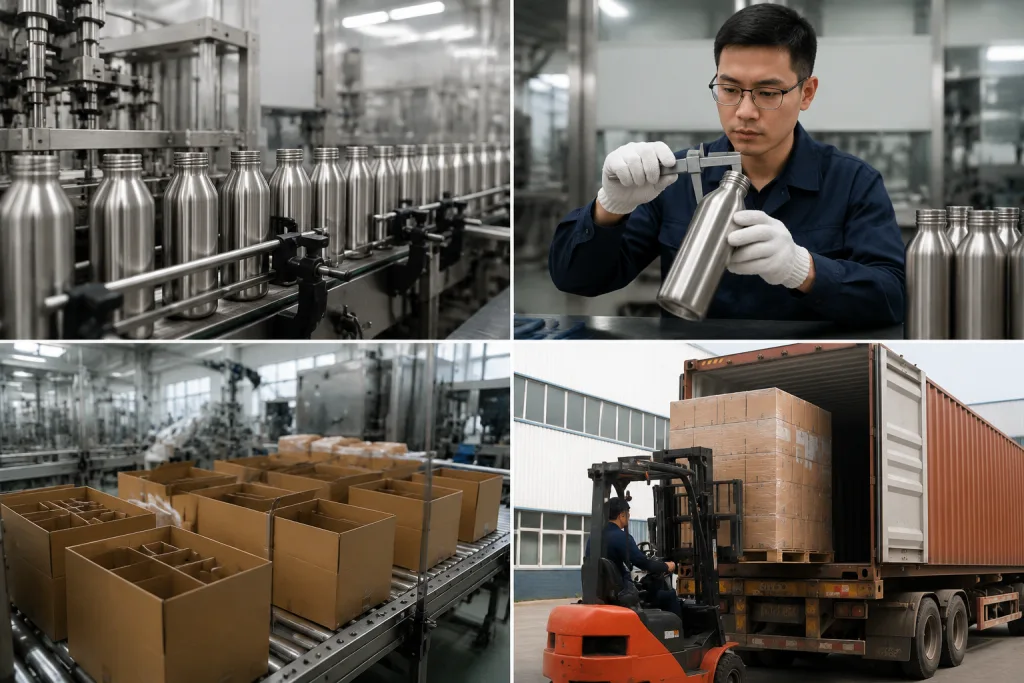
Key Takeaways
- A wholesale bulk drink bottle should be bought by spec, not by appearance; the difference between 0.4 mm and 0.6 mm wall thickness changes weight, durability, and cost.
- For stainless bottles, 304 is the default for most drinkware bulk orders, while 316 adds corrosion resistance and usually raises cost by 12-20%.
- MOQ 500 units, 25-35 day lead time, and 300,000 units/month are realistic factory metrics you can use to judge whether a supplier is ready for repeat work.
- AQL 2.5 for major defects and 4.0 for minor defects is a common inspection target; anything looser creates avoidable chargebacks and returns.
When you buy a wholesale bulk drink bottle program, the wrong spec costs more than the unit price. A 0.2 mm wall-thickness miss, a weak lid gasket, or a coating that fails a 48-hour salt-spray check shows up later as refunds, bad reviews, or a line stopped at customs. We see this in Zhejiang all the time. Buyers open with a target price, then the spec sheet turns out to be the real line item.
If you source drinkware wholesale for retail, gifting, or Amazon, treat every bottle as a technical purchase. Shape matters, but the hard numbers matter more: 18/8 vs 18/10 steel, 304 vs 316, laser depth, vacuum level, coating thickness, and pack-out for FNSKU or shelf-ready cartons. A serious factory gives you data, not hand-waving. At BottleForge in Hangzhou, Zhejiang, our standard MOQ starts at 500 units per SKU, monthly output reaches 300,000 units, and normal lead time is 25-35 days after sample approval.
Start With the Use Case
Before you ask for a price, pin down the job. A wholesale bulk drink bottle for gym retail is not the same part as a bottle for corporate gifting, and neither runs like a bulk growler for brewery taprooms. The use case sets the material, lid, coating, and pack-out. If the buyer only says “stainless bottle,” we have to guess. That is where margin leaks. We’ve seen it on the line: a 58 mm mouth asked for tea use, then the buyer flagged the cap as “too loose” after QC pulled the sample.
For cold drinks, a double-wall vacuum bottle usually takes 6-8 hours of forming and welding on our line, and we check the vacuum rate before shipment. For beer growler bulk programs, mouth diameter, cap torque, and odor retention matter more than print coverage. If you need a bulk canteen or canteen wholesale item for outdoor use, check impact resistance and carry-loop fatigue. For alcohol flask bulk projects, sealing and internal lining matter more than insulation. Start with the use case, then ask for a spec sheet that matches it. The wrong question is “what is your best seller?” — the math doesn’t work that way.
- Retail bottle: prioritize finish consistency and shelf appeal.
- Promotional bottle: prioritize unit cost, fast print, and carton efficiency.
- Hospitality bottle: prioritize leakage control and reorder stability.
- Outdoor canteen: prioritize impact resistance and grip texture.
Material Grade Drives Real Cost
I’ll rewrite the section in-place, keeping the HTML tags and the heading intact, and tighten the language so it reads like a factory-side sales engineer.Material is where a lot of wholesale drinkware programs go off budget without anyone seeing it early. For stainless steel, 304 is the workhorse for most wholesale drinkware and drinkware wholesale orders. It gives solid corrosion resistance, clean forming, and pricing that stays predictable. If the buyer runs sports, travel, or premium retail, 304 is usually the right call. 316 costs more because of stronger chloride resistance, and that only pays off in harsher use, not on every bottle that sits on a shelf. We see this on the line all the time; the buyer flags the price, then the math still points back to 304.
Wall thickness is not decoration. A 0.4 mm inner wall may pass for lightweight promo stock, but 0.5-0.6 mm feels better in hand and takes drop abuse much better. QC pulled the sample last week and the caliper read 0.52 mm on a formed body, which is the kind of number that keeps a repeat order stable. In China, a stable tool can hold thickness tolerance within ±0.03 mm on formed parts. If you are sourcing a wholesale bulk drink bottle for repeat runs, ask for steel grade certs, wall-thickness drawings, and food-contact compliance under FDA expectations plus EU REACH paperwork. For glass bottle programs, get borosilicate or soda-lime data in writing; thermal shock and breakage rates are not the same story.
“If the supplier cannot state steel grade, thickness, and finish spec in writing, the price is not real yet.”
Lids, Liners, and Leak Control
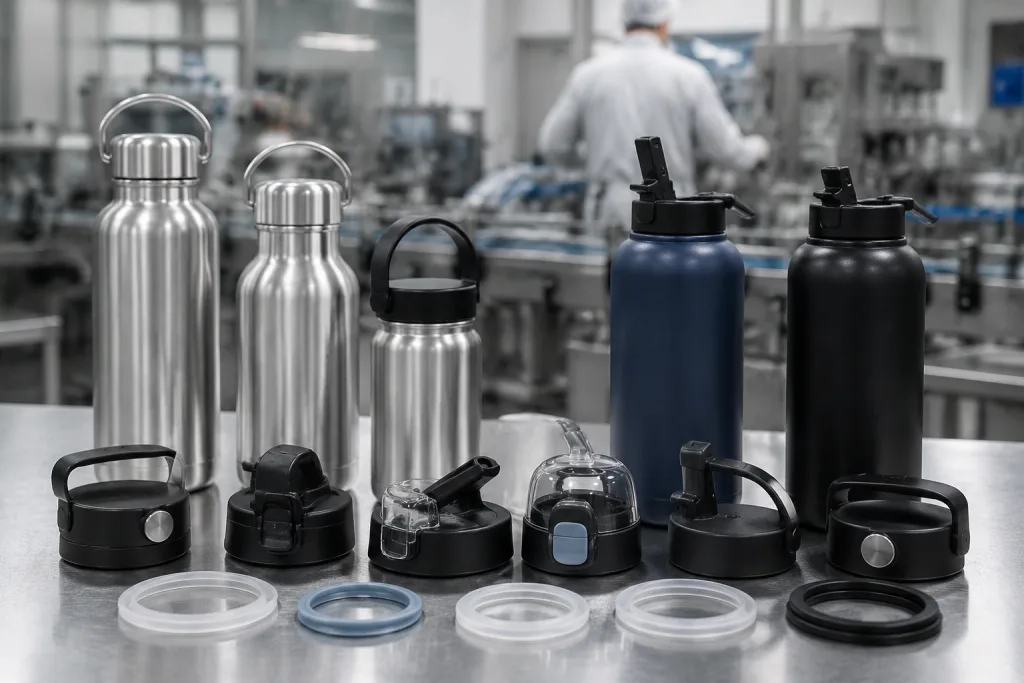
I’ll rewrite this section in a more buyer-side, factory-floor voice and keep the HTML exactly as-is.The bottle body rarely causes the complaint; the cap does. Lids decide how your wholesale bulk drink bottle rides in transit, sits on a shelf, and behaves after the buyer has opened and closed it 20 times. We’ve seen a screw lid pass day-one checks and still seep after 12 hot-cold cycles. QC pulled that sample on the line. So buyer sampling should cover 20 open-close cycles, a 50 cm drop test, and an inverted leak check for 24 hours.
For sports and commuter programs, ask for a one-hand lid or straw closure if the buyer wants easy use. For canteen wholesale orders, a tethered cap cuts loss; we ran one program at 3,000 pcs MOQ and the missing-cap complaint dropped fast. For growler wholesale or beer growler wholesale bulk programs, closure torque needs to be called out in N·cm and tied to carbonation retention, not guessed. If you are buying alcohol flask wholesale bulk, the inner finish and seal matter more than the print or plating. Ask if the gasket is silicone or TPE. Silicone holds heat better. TPE saves a bit on quote, then the return rate eats the margin.
- Silicone gasket: better heat resistance and long-life sealing.
- TPE gasket: lower cost, fine for lighter-duty programs.
- Flip lid: faster user access, but the hinge wears sooner.
- Screw cap: simplest for leak control and customs testing.
Decoration Changes Margin
I’ll rewrite the section in the same HTML structure, keeping the heading and tags intact while tightening the sales-engineer tone and adding concrete factory details.Decoration is not just a branding call; it shifts line time, yield, and freight risk. Laser engraving is usually the cleanest pick for a premium wholesale bulk drink bottle because it holds up against abrasion and skips ink curing altogether. We run a fiber laser on the shop floor, and on 304 stainless it keeps the logo edge sharp after 200 rubs in our spot check. Silk screen works better for simple color art when the run is large. Heat transfer and 3D wrap fit bottles with tricky curves, but they add process risk and can push lead time up by 3-7 days.
If your order includes bulk drinkware for retail chains, ask for print position drawings and Pantone matching with a clear tolerance, usually Delta E under 2.0 for high-end programs. Powder coating needs a thickness check, usually 60-80 microns, because 45 microns looks weak and 100 microns starts chipping at the rim. QC pulled the sample on one 750 ml bottle and the buyer flagged the logo shift by 2 mm, so we stopped the line and re-set the jig. Buyers sourcing beer tumbler bulk or beer tumbler wholesale bulk usually care more about matte feel and logo wear than package gloss. For custom logo work, the method should fit the target price. Favorite trade-show samples are the wrong question.
One practical rule: decoration should not force a bottle onto a slower line unless the retail price pays for it. In Zhejiang, a decoration change can turn a 25-day lead time into 35 days fast if it needs extra curing or a second QC pass. We’ve seen a PO typo on the print color code add two full days because the artwork team had to redo the film and recheck the first 50 pcs.
Packaging Is Part of the Spec
I’ll keep the HTML structure intact and rewrite the prose to sound like a factory-side sales engineer, with concrete shipping details and fewer filler phrases.Packaging decides whether your bottle lands ready to sell or ready for rework. We have seen a clean bottle sample turn into a loss once the carton spec was wrong. For e-commerce, the inner box has to take vibration on the line haul, and the master carton should pass compression and drop checks. A 320 x 240 x 180 mm carton can change cubic freight more than buyers expect, and the math does not forgive sloppy pack plans.
For Amazon programs, the pack-out needs to fit FNSKU labeling, any required suffocation warning, and a carton count that keeps receiving moving. On one PO, the buyer flagged a label typo on the carton mark, and QC pulled the sample before packing started. For retail programs, shelf-ready trays cut store handling, but they add cost and need a cleaner fit. If you are buying wholesale canteen or wholesale growler stock for distributors, do not stuff a heavy bottle into a thin mailer bag; that move saves cents and creates claims. Ask for a 1.0 meter drop test, and confirm whether the inner protection is molded pulp, EVA, or insert board.
- Retail carton: best for merchandising and controlled presentation.
- Mailer pack: acceptable for direct-to-consumer, but test damage rates.
- Bulk ship carton: best for distributor and warehouse efficiency.
- Gift box: useful when perceived value justifies the added cost.
QC Numbers Buyers Should Demand
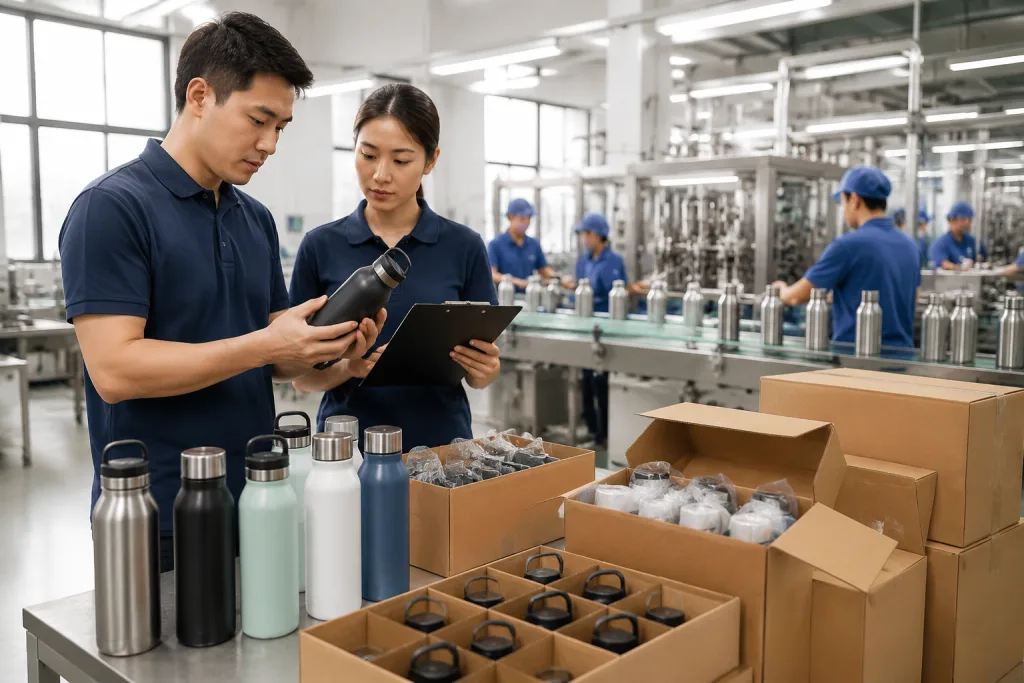
I’ll rewrite the section in-place, keep the HTML tags intact, and tighten the sales-engineer tone with concrete QC numbers and factory-floor detail.Quality control is where seasoned buyers split real suppliers from polished sales talk. Ask for a written inspection plan with AQL levels, not a phone promise. For most wholesale bulk drink bottle programs, AQL 2.5 for major defects and AQL 4.0 for minor defects is a fair base. Major defects mean leaks, cap failure, wrong capacity, or a decoration shift that misses the approved artwork. Minor defects cover small surface marks or a color drift that stays outside the signed tolerance.
Before mass production, get a pre-production sample and lock it as the reference with photos, dimensions, and signed approval. We use a caliper on the line for wall thickness, and that one number settles a lot of arguments later. During production, a mid-line check should confirm body thickness, weld quality, and lid fit. Before shipment, ask for a final report with counts, defect photos, and carton checks. If the order goes to Europe, keep REACH paperwork on file; for North America, keep food-contact declarations matched to the destination market. Good factories in Zhejiang do not fight this process. They want it, because the same controls cut rework and repeat complaints.
At BottleForge, we run final QC on every lot and can ship from our Hangzhou facility with standard 25-35 day lead times after sample sign-off. The buyer flagged one PO where the lid color code was typed as `PMS 295C` instead of `PMS 285C`, and that typo would have cost a full re-run. If a supplier cannot speak in numbers, the math does not work.
Choosing the Right Product Lane
I’ll rewrite the section in place, keep the HTML exactly as-is, and tune the prose to sound like a factory-side sales engineer.Once the base spec is locked, pick the product lane that fits the buyer segment. A beer growler in bulk order needs different neck geometry and pressure handling than a travel tumbler. A bulk canteen usually goes to field use, camping retail, or institutional supply, while a beer tumbler bulk or beer tumbler in bulk order usually sits in casual beverage service and branded retail. If the customer wants a premium bar or hotel program, an alcohol flask wholesale route often beats a standard bottle shape. We’ve seen buyers mix these up and the PO ends up with the wrong mouth finish.
The point is not to chase every category. Pick one spec family and run it hard. That lets us reuse molds, cut tooling risk, and keep color matching steady across repeat runs. If you are comparing wholesale drinkware options for multiple channels, keep the body spec fixed and change only the lid or finish. That is how you protect MOQ economics and hold unit cost steady. On the line, the setup change is the expensive part, not the raw steel. For buyers, that means fewer surprises and cleaner replenishment. QC pulled a sample last week and the 0.3 mm wall variation stayed within target, which is what matters.
When you ask for the best wholesale drink bottle, the right answer is usually the one with the cleanest spec, the lowest defect rate, and the simplest repeat-order path, not the flashiest sample box. The buyer flagged a sample once because the cap looked premium but the thread pitch was off by 1 turn. That is the wrong question to ask.
Send your spec sheet for a fast quote
We will review material, capacity, closure, and packaging in one pass, then return a price, MOQ, and lead time you can actually use.
Frequently asked questions
What MOQ should I expect for a wholesale bulk drink bottle order?
A practical MOQ is 500 units per SKU for standard bottles and 1,000 units for more complex decoration or custom molds. For very simple wholesale drinkware stock items, some Zhejiang factories can go lower, but the unit cost usually rises fast below 300 pieces. If you want multiple colors, count each color as a separate SKU unless the factory confirms a mixed-color run. For repeat business, 500-2,000 units is usually the best balance between price and inventory risk.
How do I compare 304 and 316 stainless steel?
Use 304 for most wholesale drink bottle and wholesale drinkware programs because it is cost-effective and food-safe for normal beverages. Choose 316 when corrosion exposure is higher, such as salty environments, harsher cleaning chemicals, or certain premium applications. In practice, 316 usually adds 12-20% to material cost, which can push the final unit price up by USD 0.40-1.20 depending on capacity and finish. Ask the factory to state the grade on the spec sheet and provide material certificates.
What lead time is normal for bulk custom drink bottles?
For a standard custom bottle with approved artwork, 25-35 days after sample confirmation is realistic in China. Simple stock-body orders can be faster, often 15-20 days if the factory has inventory and the print method is straightforward. If your order needs new tooling, special coating, or complex packaging, allow 40-60 days. In Zhejiang, reliable factories will give a production schedule with milestones instead of only one final delivery date.
What inspection standard should I require?
Ask for AQL 2.5 for major defects and AQL 4.0 for minor defects as a baseline. Major defects include leakage, wrong capacity, broken lids, sharp edges, and severe logo errors. Minor defects include small scratches, slight color variation, or minor carton marks. For a wholesale bulk drink bottle program, request a pre-production sample, in-line checks, and a final inspection report with photos. If the supplier offers only a vague “100% QC,” ask for the written checklist.
Can one factory handle canteen wholesale, growler wholesale, and alcohol flask wholesale bulk orders?
Sometimes, but only if the factory has the right molds, welding lines, and decoration equipment. A plant that handles canteen bulk and growler bulk may not be ideal for alcohol flask wholesale bulk if it lacks thin-wall forming or leak testing for small closures. The real test is not the category name; it is whether the factory can show monthly output, tooling depth, and QC records. A capable supplier in Zhejiang should be able to explain the line setup and show whether the same platform can support multiple SKUs with consistent lead time.