Key Takeaways
- A 5,000-unit MOQ is common for wholesale bulk canteen runs in Zhejiang, with 35-45 days lead time after sample approval.
- Target FOB pricing for a 750 ml stainless canteen usually lands around USD 2.60-3.90 depending on finish, packaging, and logo method.
- A useful QC plan combines AQL 2.5 for critical defects, 4.0 for major defects, and leak testing at 100% on assembled lids.
- The best wholesale drinkware orders define stainless grade, wall thickness, carton drop standard, and REACH/food-contact paperwork before production starts.
You are not buying a “bottle.” You are buying a repeatable supply line that has to survive ocean freight, customs, warehouse handling, and end-customer use. That is why a wholesale bulk canteen order needs a different lens than a sample buy. In Zhejiang and across China, the factories that ship this well watch wall thickness at 0.45 mm, coating adhesion, leak rate, carton crush strength, and re-order stability. Pretty renders do not pass QC.
Here is the buyer case we see all the time: 8,000 units of a 750 ml stainless wholesale bulk canteen for a retail launch in Europe, two colors, one logo method, and a target FOB under USD 3.40. Sounds tidy. Then the buyer flags cap torque, vacuum performance, and whether the carton survives a 1.2 m drop test. We ran that line last month, and QC pulled the sample because one lid came back 18 N·cm under spec. If you are sourcing bulk drinkware or canteen wholesale, this is where the math gets real.
Start with the real use case
I’ll rewrite the prose only, keep the HTML structure intact, and make it sound like a factory-side sales engineer wrote it.Before you ask for a quote, pin down how the canteen is actually sold and used. A 750 ml double-wall stainless wholesale bulk canteen for hiking retail is a different animal from a powder-coated canteen wholesale item for corporate gifting, and neither matches a beer tumbler bulk product for promotional alcohol service. Skip that, and you waste time comparing the wrong samples. We’ve seen buyers fight over price when the spec was wrong from day one.
For a clean buyer brief, lock these points first: capacity, target liquid temperature, lid style, finish, and pack-out. If the product sits inside a wholesale drinkware program, say whether it needs a carry handle, silicone base, or dishwasher-safe coating. On the line, we usually start with 18/8 stainless steel, 0.5 mm inner and outer walls, vacuum insulation, and a lid seal in food-grade silicone. QC pulled the sample twice on a 12-day run because the lid gasket sat 1 mm off; that is the kind of detail that saves you a headache later.
- Capacity: 500 ml, 750 ml, or 1,000 ml
- Material: 304/18-8 stainless, or 201 if the price target is aggressive
- Finish: matte powder coat, brushed, or polished
- Pack-out: color box, kraft box, or bulk master carton
Once the use case is clear, the supplier can quote straight instead of stuffing in margin for guesswork. The math does not work any other way. Good factories in China ask these questions first; the weak ones just throw out a number and hope the buyer does not notice the gap.
Build the spec sheet first
I’ll rewrite the section in-place, keeping the HTML tags and list structure intact while tightening the sales-engineer tone and adding a few concrete factory-floor details.A buyer-friendly spec sheet saves 3 to 5 days. It should read like a production sheet, not a marketing brief. For a wholesale bulk canteen, we put down drawings with dimensions, lid section, logo position, coating color code, and tolerance bands. If you want canteen bulk pricing that holds on reorder, the spec has to stay frozen. We’ve seen that slip turn into a 12-day delay at the line.
Use numbers, not adjectives. A solid stainless wall spec is 0.5 mm for the inner body and 0.5 mm for the outer body, with a total weight target around 320-420 g for a 750 ml unit depending on the structure. For a beer growler wholesale project, we often go heavier on gauge and wider on mouth, but the math is the same. Ask for neck finish, lid thread type, and gasket hardness; 50-70 Shore A for silicone seals is the range QC pulls against. The buyer flagged a “same as sample” PO typo once, and that went sideways fast.
What belongs on the drawing
- Overall height, diameter, and mouth opening in mm
- Logo size, position, and process: silkscreen, laser, or emboss
- Color reference: Pantone or physical chip
- Packaging spec: 1 pc/box, then 24 pcs/master carton
Do not let the supplier swap in “similar” materials. If you are buying drinkware wholesale for Europe or North America, the material declaration has to match the actual production lot, not a warehouse guess. That matters when you ask for REACH support, food-contact statements, or customer compliance files later. One lab report can save a lot of back-and-forth, and the wrong question is whether it “looks close enough.”
Quote the order like a buyer
I’ll rewrite the section in-place, keep the HTML exactly as-is, and tighten the sales tone so it sounds like a buyer-side quotation note from a real factory.When you ask for price, ask for the landed structure at the factory gate first. A clean quotation for wholesale drinkware should split body cost, lid cost, logo cost, packing cost, and tooling if there is any. We once quoted a 750 ml stainless wholesale bulk canteen at USD 2.85 FOB Ningbo for 5,000 units with single-color print; the buyer flagged the missing carton spec, and the corrected two-color powder-coated version moved to USD 3.20-3.55 FOB once we locked the accessory and export carton choice.
That is normal. One number with no assumptions is the wrong question to ask. If you are sourcing wholesale canteen or wholesale growler items, put these points in writing:
- MOQ: 3,000-5,000 units per SKU per color is a real number for many Zhejiang lines
- Lead time: 35-45 days after sample approval and deposit
- Price term: FOB, not vague “factory price”
- Sample policy: free stock sample or USD 30-80 custom sample fee
For alcohol flask bulk or alcohol flask wholesale bulk jobs, the same logic applies, but packing and finish usually move the cost more than the metal body. If a supplier cannot explain why a laser logo adds USD 0.08 while a two-pass silkscreen adds USD 0.12, they do not control the line. QC pulled the sample on our side last week and found a 1.5 mm logo shift; that kind of miss shows up fast when the factory is guessing instead of quoting from the process sheet.

Check the factory before you place PO
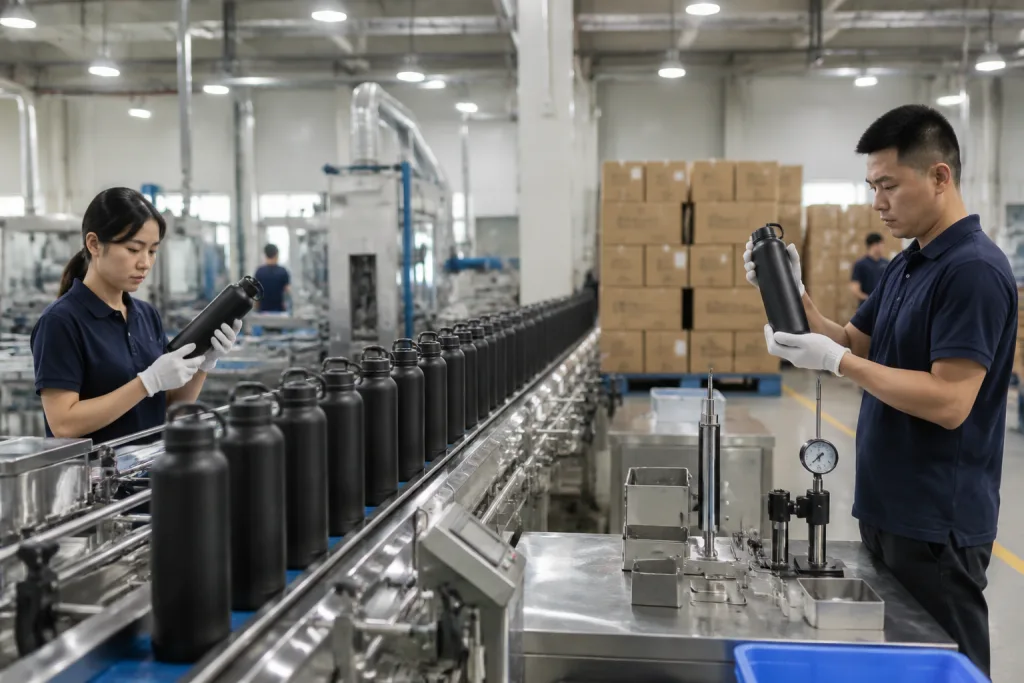
I’ll rewrite the section in-place, keep the HTML structure unchanged, and tune the prose to sound like a factory-side sales engineer.You do not need a luxury audit, but you do need proof of process. Ask whether the factory has BSCI, ISO 9001, or a documented incoming and final inspection system. For wholesale bulk canteen programs, the line should show weld control, vacuum leak testing, coating cure logs, and carton compression standards. If they cannot walk you through those steps, keep looking.
One useful factory metric is output capacity. A solid mid-size Zhejiang plant may ship 120,000 to 250,000 units per month across stainless lines, with 5,000-unit MOQ on custom runs and 35-45 day normal lead time. That does not guarantee quality, but it tells you the line is built for repeat work. We once had a buyer flag a PO because the lid torque spec was missing by mistake; that is the wrong question to ask if the factory cannot hold 8,000 units to the same finish and fit.
Ask the supplier to send production photos from the same line, not from a sample room. Sample rooms hide weak process control.
Also check documentation. For North America and Europe, you may need food-contact declarations, REACH support, and for some retail channels, traceability by batch number. A real China export factory will know how to mark cartons, pallets, and master lots for receiving. QC pulled the sample at the 0.8 mm weld bead check, and that is the sort of paper trail that saves a shipment.
Run QC before the shipment leaves
I’ll rewrite the section in-place, keep the HTML structure exactly, and tighten the sales-engineer voice with more concrete factory-floor detail.The QC plan needs to be set before the line starts. For a wholesale bulk canteen order, we write critical, major, and minor defects into the inspection sheet with AQL numbers, then QC signs off before mass production. A common setup is AQL 2.5 for critical defects, 4.0 for major defects, and 6.5 for minor defects, plus 100% leak testing on assembled lids or vacuum bottles where we can run it. That is the floor, not a luxury. Last month the buyer flagged a carton typo on a 6,000-unit PO, and it turned into a week of back-and-forth.
What do we check? On a stainless canteen wholesale order, we inspect denting, weld marks, logo clarity, coating chips, lid fit, gasket placement, and odor. On a beer tumbler bulk or beer growler bulk project, we also check mouth finish and closure consistency, because those units get rough treatment in channel distribution. For alcohol flask in bulk orders, the cap seal and thread alignment need to be tested on a real sample lot, not one cherry-picked piece. QC pulled the sample with a caliper, and the gap was 0.4 mm off spec on two lids.
- Leak test: 100% assembled lids for 30-60 seconds
- Drop test: 1.0-1.2 m carton drop on 5 sides
- Coating check: cross-hatch or tape adhesion on a sample basis
- Carton test: verify 5-ply or 7-ply master carton strength
If you are buying canteen wholesale for retail, add barcode verification and carton count reconciliation. A shipment short by 2% or packed in the wrong color is not a small miss when you are receiving 8,000 units. We run this check on the packing table, with the scan gun and the master carton list side by side, because the math does not work any other way.

Plan packaging for the channel
I’ll rewrite the section in-place, keep the HTML structure untouched, and tune the prose for a real export-sales voice with concrete packing details.Packaging drives damage rate, not just shelf look. For bulk drinkware, we treat it as part of the spec, especially for ocean freight to Europe or North America. A color box can look clean, but if it adds 18% to carton volume and pushes freight up, the margin gets squeezed fast. For wholesale drinkware sold into Amazon or retail chains, carton fit and barcode placement beat fancy print.
For a wholesale bulk canteen, the usual retail pack is 1 pc in an inner box, then 24 or 25 pcs in a master carton. On one run, QC pulled the sample and the carton dropped 2 mm short on the height check, so the lid rubbed the print. That is the wrong place to save money. If the product sits in a growler wholesale program, the outer carton needs more crush strength because the item is bulkier and takes harder impact in transit.
Keep the channel in mind:
- Retail shelf: printed box, hang tag, barcode, color story
- Corporate gift: cleaner box, less retail noise, stronger logo focus
- E-commerce: polybag, insert, FNSKU-ready label space if needed
If you are comparing beer growler wholesale bulk and wholesale canteen options, look at carton cube and freight density first. The math does not work any other way. We have seen a 0.8 kg lighter unit lose on landed cost because the carton was 12% bigger and the line could only load 720 pcs instead of 840. A tighter pack from China often wins even when the ex-works price is a bit higher.
Send your spec and get a factory quote
Share your target MOQ, finish, and carton format. We will price your wholesale bulk canteen order with clear lead time and QC terms from Zhejiang.
Frequently asked questions
What MOQ should I expect for wholesale bulk canteen orders?
For most custom stainless wholesale bulk canteen jobs, a realistic MOQ is 3,000 to 5,000 units per SKU or color. If you want multiple lid options, the MOQ may split by component, so one body plus two caps can still require 5,000 bodies and 2,500 caps per style. In Zhejiang, factories with export lines often prefer 5,000 units because setup, coating, and packing are more efficient at that level. Below 1,000 units, your unit price usually jumps by 20% to 40%.
What price range is normal for a bulk canteen?
For a 750 ml stainless bulk canteen, FOB pricing often lands between USD 2.60 and USD 3.90 depending on material, wall thickness, finish, and logo method. A plain brushed model is cheaper than a powder-coated version with laser engraving or multi-color print. If you ask for custom packaging, add USD 0.12 to USD 0.45 per unit. For wholesale drinkware programs, the quote should always state whether it includes carton inserts, testing, and export labels.
How do I QC a canteen wholesale order before shipment?
Use a written inspection plan with AQL 2.5 for critical defects and AQL 4.0 for major defects, plus 100% leak testing on assembled lids. Check random samples for dents, coating chips, logo alignment, thread fit, odor, and carton count. For a 5,000-unit lot, a normal pre-shipment inspection may sample 200 to 315 units depending on the AQL table. If the item is a beer tumbler bulk or alcohol flask wholesale bulk order, add cap torque and seal checks.
Can I source wholesale growler and canteen items from the same factory?
Yes, if the factory handles stainless forming, welding, and surface finishing well. A Zhejiang plant that makes wholesale canteen and wholesale growler products often shares body-making equipment but may use different lids, mouths, and carton specs. That is efficient if your brand wants a unified drinkware wholesale range. Still, do not assume the same QC applies automatically; a growler bulk item needs different drop and seal checks than a standard canteen.
What compliance documents should I ask for in China?
For Europe and North America, ask for food-contact declarations, material specs, and where relevant REACH support or test reports. If the item is stainless drinkware bulk, request 304 or 18/8 material confirmation and batch traceability. For branded retail, ask for carton labels, product photos, and packing lists that match the PO exactly. A good China supplier will also provide BSCI or ISO documents if they have them, but do not treat a certificate as a substitute for real process control.