
Key Takeaways
- A realistic wholesale bulk beer tumbler MOQ is 500-1,000 pcs per color, with FOB China pricing often starting around USD 1.85-3.60 depending on steel grade and finish.
- For stable production, specify 18/8 stainless steel, 0.35-0.50 mm wall thickness, and a 304 interior if you want fewer complaints on odor or taste transfer.
- A normal export lead time is 20-35 days after sample approval; custom lid or coating changes can add 7-12 days.
- Use AQL 2.5 for critical defects and ask for REACH, food-contact, and dishwasher-test documentation before you release a beer tumbler wholesale bulk order.
You are not buying a “nice cup.” You are buying a carton count that repeats, a decoration process that stays stable, and a product that survives freight, retail handling, and the first customer who drops it on concrete. That is the job when you source a wholesale bulk beer tumbler order. Treat it like a simple drinkware SKU, and you pay for it later in leakage, sloppy laser marks, or packaging that fails in transit.
At BottleForge Industrial in Zhejiang, we see this mistake all the time. A buyer asks for a beer tumbler wholesale program, then finds the wall thickness, lid fit, and coating hardness all move the landed cost; QC pulled a sample at 0.8 mm and the buyer flagged the print shift. The math does not work unless you lock the use case, volume, and QC standard before the line starts. That is how bulk drinkware becomes something you can ship with confidence.
Start With The Buyer Scenario
I’ll rewrite the section in place, keep the HTML exactly intact, and tune the prose to sound like a factory-side sales engineer.Picture a procurement manager at a regional beverage brand in Germany or a US distributor. The sales team wants a wholesale bulk beer tumbler for summer promo, and the landed price has to stay under USD 4.00. The cup must survive bar use and still look clean on a retail shelf. That is where sourcing gets real. A brushed cup can look cheap on paper and still blow up the order because the coating, print area, or lid tolerance is off by 1 mm.
Start with the use case in plain words. Is this a beer tumbler in bulk for event giveaways, or a retail item that needs gift packaging and a barcode? For bar programs, we run checks on stacking, anti-slip base, and dishwasher cycles. For retail, the carton print, barcode placement, and Amazon-style drop test rules matter. Put the spec on one page: capacity, finish, logo method, lid type, inner and outer steel grade, and carton count. A buyer who sends only a photo is asking us to guess; a buyer who sends a spec sheet gets a price we can stand behind.
Factories in Zhejiang move fast when the brief is tight. At BottleForge, our stainless drinkware line runs 180,000 units per month, and QC pulled the sample on the 3 p.m. shift before it went to packing. That pace only works when the order stops wobbling. If the buyer keeps changing lid color or asks for a new carton size after sample approval, the math does not work.
Specify The Cup Like An Engineer
I’ll rewrite this section in place, keeping the HTML structure intact and tightening the wording to sound like a factory-side sales engineer.For a beer tumbler wholesale program, the metal callout carries most of the risk. If you want a retail-grade cup, specify 18/8 stainless steel on the inside and 201 or 304 stainless on the outside, depending on budget and coating plan. We run a wall thickness of 0.35-0.50 mm on this line. Go thinner and the cup picks up dents fast; go thicker and freight climbs for no real gain unless the buyer wants a heavy-duty build. QC pulled a sample at 0.32 mm once, and the buyer flagged it the first time the carton was dropped.
Capacity trips up a lot of buyers. The usual asks are 12 oz, 16 oz, and 20 oz, but the fill line and brimful capacity need to be written down, not guessed. A 16 oz beer tumbler bulk SKU may show 470-500 ml brimful volume with a 16 oz recommended fill volume. That gap changes carton weight, shelf copy, and print placement. If you are placing a beer tumbler wholesale bulk order for two or three markets, keep the body shape the same and change only the decoration or lid accessory where needed. Tooling stays simpler, and the MOQ does not creep up.
Surface treatment needs the same discipline. Powder coating gives you grip and color, but the spec should call out hardness and adhesion, not just a nice-looking finish. For laser engraving, confirm the reveal color on the coating board. For silk screen, ask for the rub-cycle target in writing. We’ve seen this go sideways when a PO typo turned “matte black” into “matt black” and the sample sign-off stalled for 4 days. If you want a wholesale drinkware program that runs past one season, tight specs beat a polished sales pitch every time.
Price The Order Properly
I’ll rewrite the section in-place, keep the HTML exactly intact, and tune the copy to sound like a factory-side sales engineer.Buyers often ask for a single unit price too early. That is the wrong first question. The real cost on beer tumbler wholesale depends on steel grade, finish, packaging, and decoration. On our Zhejiang line, a plain stainless beer tumbler at 1,000 pcs MOQ usually sits around USD 1.85-2.40 FOB China. Add powder coating, laser logo, or a retail box, and it moves to USD 2.80-4.20 fast. If the spec calls for double-wall vacuum construction or a special lid, QC will already flag a higher build cost.
Do not compare only unit price. Ask for the full commercial stack: sample fee, tooling fee if any, logo setup, carton spec, spare parts policy, and payment terms. A lower unit price with a heavy packaging charge is not cheaper. A bulk drinkware order should be priced on the landed result, not one headline number. For Europe and North America, ask whether the quote is FOB Ningbo, FOB Shanghai, or EXW factory. We have seen 12 days turn into 18 days just because the buyer missed the freight leg from Zhejiang to port.
If your project includes related SKUs like a bulk canteen, bulk growler, or alcohol flask bulk item, bundle them only when the same production line and decoration method apply. Otherwise, you create mixed complexity that slows the line. I’d rather quote three clean SKUs than one messy basket of wholesale canteen, wholesale growler, and tumbler items with different lead-time profiles. The buyer flagged a PO typo once—one extra box count—and the carton math did not work.
Demand Real QC, Not Promises
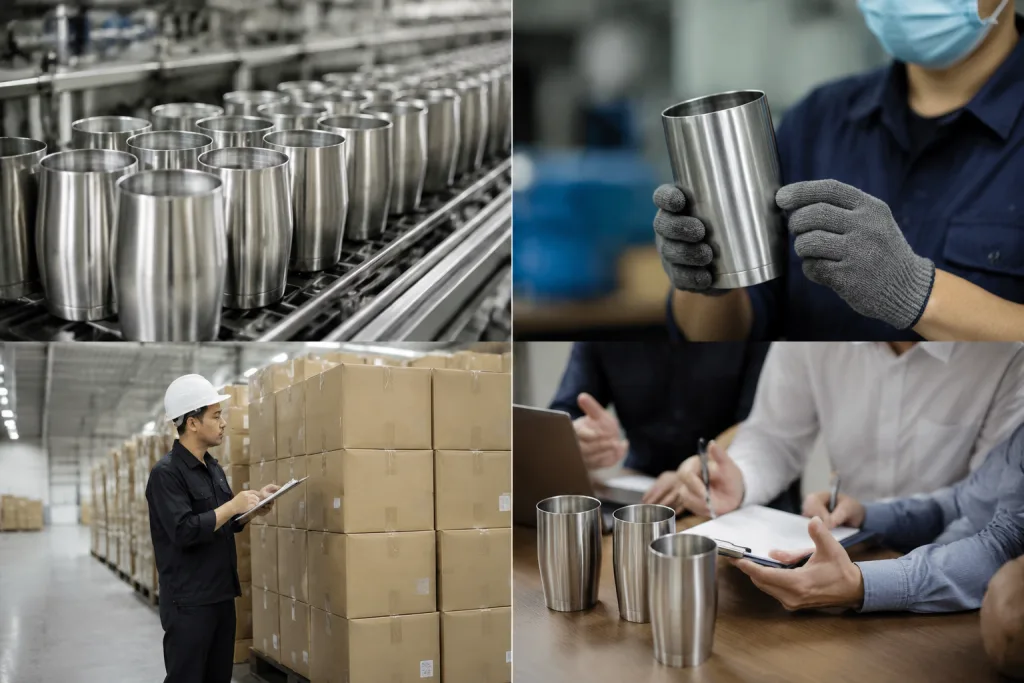
I’ll rewrite the section in-place, keep the HTML intact, and make the QC language sound like a factory-side sales engineer wrote it. Then I’ll quickly sanity-check that I didn’t alter tags or structure.Working through the prose now. I’m keeping the same paragraph and blockquote structure, but tightening the claims and adding a few shop-floor details so it reads like we actually run the line.This is where a lot of import jobs go off track. The pre-production sample looks clean, then the mass run drifts. For a wholesale bulk beer tumbler order, lock the QC points before the first coil goes on the forming machine: incoming 304 stainless check, in-line cup-wall inspection, coating thickness gauge reading, logo position check, and carton audit at pack-out. We usually run AQL 2.5 for major defects and AQL 4.0 for minor defects. No leaks. No sharp edges. No odor. If the lid is part of the spec, failure is a hard stop.
For export drinkware, test the product the way the buyer will use it. Do a hot-water odor test, a dishwasher cycle test if the item is sold for that use, a drop test on the outer carton, and a thread-fit check on every lid sample. If the order is for a beer tumbler in bulk into bars, ask for stackability proof. If you also sell a beer growler wholesale line, keep the cap torque and seal test on a separate report. A growler is not a tumbler. The buyer flagged a PO typo on one run because the seal spec was copied from the tumbler sheet, and that mistake costs time. The same goes for an alcohol flask wholesale project: the leak standard is tighter, and weak inner trays turn a good finish into scratch marks before the carton leaves the line.
Good QC is not an email with a certificate attached. It is a pass/fail rule the QC puller can check on the floor with a caliper and a leak ring, without guessing.
In Zhejiang, the factories that hold accounts respect process. The ones that lose orders treat QC like a photo album. We’ve seen that go sideways on a 5,000-piece run, and the math does not work. You want the first group.
Packaging And Compliance Matter
I’ll rewrite the section in-place, keep the HTML structure exactly, and strip the AI-ish phrasing while adding a few factory-floor specifics.If you ship to the EU or North America, packaging is compliance work, not decoration. For a retail-ready wholesale drinkware order, we ask for carton drop-test strength, barcode placement, and master carton marks that stay legible after 3 rounds of handling. If the buyer is Amazon or an Amazon-linked distributor, you may also need polybag suffocation warnings, FNSKU labels, and carton sizes that stay under the next fee band. We have seen 2 cm of carton height wipe out the margin on a full pallet.
Material compliance needs paper in hand before the truck leaves. Ask for a food-contact declaration, REACH statements where they apply, and testing built to ASTM or FDA-style market needs. QC pulled the sample on one 16 oz run and found the declaration still used the old model code, which is the kind of typo that gets a customs officer interested. If your order includes beer tumbler wholesale bulk and matching canteen wholesale or drinkware wholesale items, keep each SKU file separate. Mixing documents across SKUs is the wrong move, and it slows clearance fast.
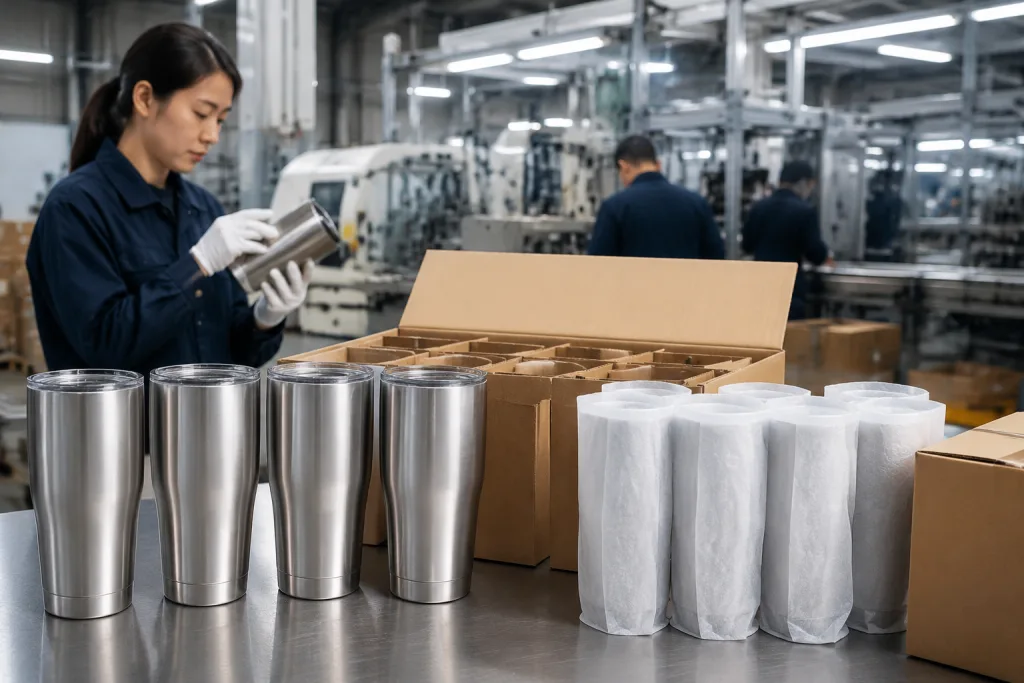
Packaging changes the buyer’s first touch. A plain bulk shipper works for B2B pallets, but a retail program may want color boxes with a window or insert. On the line, we run a 5 mm insert check because a loose cup in a printed box turns into dents before the carton even hits the warehouse. If your range expands into bulk canteen, canteen bulk, or bulk growler formats, keep the packaging terms consistent so the distributor can sell the line as one family, not three separate buys.
Run The Order Like A Timeline
I’ll rewrite the section in-place, keeping the HTML tags and the heading structure intact while tightening the prose and adding a more lived-in factory-sales tone.Here is the order flow that holds up on a real import. Day 1 to Day 3: send spec, target market, annual volume, and the decoration file. Day 4 to Day 7: we send the quote, sample photos, and the changes we think the line needs. Day 8 to Day 15: approve the pre-production sample, lock packaging, and sign off on QC criteria. Day 16 to Day 35: mass production, with a midline check after the first 10%-20% of output. Final packing and shipment usually take another 3-5 days, depending on vessel space and export docs.
This is a normal timeline for a beer tumbler wholesale order from Zhejiang. We run a lot of these, and the clock moves fast only when the spec is clean. If you ask for mold changes, color-matched lid inserts, or a multi-color print, the schedule slips. A straight beer tumbler wholesale bulk job often lands in 20-35 days after sample approval. If the order also includes a special finish or a companion item like beer growler in bulk or alcohol flask wholesale bulk, build in more time because each SKU needs its own QC check and carton sign-off. The buyer flagged it once on a PO typo, and we lost two days just fixing the carton mark.
Keep one decision owner on your side. If procurement, brand, and sales each edit the spec, the factory gets three versions and the line starts chasing ghosts. That is the wrong way to buy. The clean orders come from one buyer, one spec sheet, one approval path. QC pulled the sample once and found a 2 mm artwork shift; with one signer, that got cleared in an hour, not a week.
Choose The Supplier By Execution
I’ll rewrite the prose only, keep the tags intact, and make it sound like a real factory-side sales engineer wrote it.When you line up suppliers in China, ignore the product photos first. Ask what stainless gauge they run, how many units the line ships each month, whether they work with BSCI or a similar audit program, and how they handle defect replacements. We had one buyer flag a 1.2 mm wall spec on a PO typo last quarter; that kind of detail tells you more than a polished catalog. A Zhejiang supplier that can explain process control straight is safer than one selling mood boards. You are buying execution.
For a wider program, the better factory is often the one that handles related categories without mixing up the details: wholesale canteen, wholesale growler, drinkware bulk, or alcohol flask in bulk. That matters because brand owners usually add SKUs after the first order. If the supplier already knows coating consistency, carton drop tests, and export labeling, the next launch moves faster. QC pulled the sample on one recent run and caught a 2 mm print shift before packing; that is the kind of thing that saves a shipment. Ask for a factory tour video, floor photos, and a sample from a recent retail order. A good supplier talks in numbers, not adjectives.
If you are weighing the best wholesale drink bottle range across your catalog, use the beer tumbler order as the test. A factory that can keep a tumbler program clean usually has the discipline to support the rest of the line. In Zhejiang and across China, that is the difference between a vendor and a manufacturing partner. The math does not work any other way.
Send your spec and get a factory quote
We can review your wholesale bulk beer tumbler requirements, confirm MOQ, and quote FOB China pricing with QC and packaging built in.
Frequently asked questions
What MOQ should I expect for a wholesale bulk beer tumbler order?
A normal MOQ is 500-1,000 pcs per color or per decoration version. If you want a standard stainless body with one logo method, 500 pcs is workable at many China factories. If you add custom coating, special lid tooling, or retail packaging, 1,000 pcs is more realistic. For mixed SKUs like beer tumbler bulk plus bulk growler or bulk canteen, treat each product line separately unless the factory confirms shared tooling and shared packaging. That keeps your MOQ honest and your margin predictable.
What is a realistic FOB China price for beer tumbler wholesale bulk?
For a plain 12 oz to 16 oz stainless beer tumbler, many Zhejiang suppliers quote around USD 1.85-2.40 FOB China at 1,000 pcs. Add powder coating, laser logo, or gift box packaging, and the price usually moves to USD 2.80-4.20. If you want double-wall vacuum construction, special lids, or multi-color decoration, expect higher. Always ask for FOB port, not just a unit price, because inland freight, carton spec, and export handling can change the landed cost quickly.
What QC standard should I request for bulk drinkware?
Use AQL 2.5 for major defects and AQL 4.0 for minor defects as a starting point. For a beer tumbler wholesale program, critical defects should be zero tolerance if they relate to leakage, sharp edges, bad odor, coating peel, or visible deformation. Ask for incoming material inspection, in-line checks, and final carton audit. If the product includes a lid or gasket, ask for fit and seal testing on every production lot, not just on samples.
How long does production take in China or Zhejiang?
For a standard beer tumbler in bulk order, production is often 20-35 days after sample approval. If you need a custom color, special print, or retail packaging, add 7-12 days. Busy seasons in China can extend the schedule, especially before summer promotions or Q4 shipping peaks. If the order includes a companion line such as beer growler wholesale bulk or alcohol flask wholesale bulk, allow extra time because each SKU needs its own QC and packing confirmation.
Can I source related items like a growler wholesale or alcohol flask wholesale order from the same factory?
Yes, if the factory has the right metal forming, sealing, and decoration capability. A good supplier can handle beer tumbler wholesale, wholesale growler, and alcohol flask wholesale bulk programs, but each item has different QC needs. Growler bulk products need stronger seal and cap testing; flasks need leak checks and surface scratch control. Ask the supplier for separate specs, separate QC records, and separate carton plans so you do not mix risk across categories.