Key Takeaways
- Set wall thickness at 0.6-0.8 mm for stainless growlers and require ±0.05 mm on critical formed areas
- Lock lid torque at 8-12 N·m and 100% leak test for every beer growler in bulk order
- Use AQL 2.5 for major defects and AQL 4.0 for minor defects on first mass production
- Expect MOQ from 3,000-5,000 pcs and lead time of 25-35 days for standard beer growler wholesale bulk runs
If you are sourcing a wholesale bulk beer growler, the price on the quote is not the part that bites you. The bad batch does: pinholes, lid leaks, weak welds, or a coating that flakes after one hot wash. In Zhejiang, we run into the same pattern again and again — the buyer signs off on a sample, then the line changes 0.2 mm on wall thickness, torque slips on the cap, or cure time gets shortened by 12 minutes, and QC pulls the sample before the first container turns into a claim.
This guide is about failure modes, because that is where growler orders go sideways. If you are buying bulk growler, beer growler wholesale, or a wider wholesale drinkware program, you need specs that hold up under scrap, chargebacks, delayed launch, and rework. A Hangzhou factory can ship 300,000 units a month, but the math does not work if your drawing, tolerance, and inspection sheet are loose; one PO typo on the lid size and the whole run gets stuck at packing.
Where growler projects fail
I’ll rewrite the section in place, keeping every tag and the original structure intact, then I’ll sanity-check the tone against your sourcing-guide brief.The first failure mode is structural, not cosmetic. A buyer asks for a cheap beer growler bulk quote, the factory says yes, then trims wall thickness by 0.1 mm to hit the number. That looks harmless on paper. On the line, we see the result: denting in transit, weak vacuum on insulated units, or a seam opening in a drop test. For stainless steel, I would not sign off below 0.5 mm on a small decorative bottle and 0.6-0.8 mm for a real bulk growler built for repeat use. For single-wall beer service, you still need enough gauge to handle capping, stacking, and washing. The buyer flagged a “lightweight” sample once; QC pulled the same bottle after a 1.2 m drop, and the base flattened.
The second failure is closure mismatch. The body can pass, then the cap leaks after 20-30 cycles because the gasket compound is wrong. Ask for silicone or food-grade EPDM, not a vague “rubber seal.” Ask for a compression spec too, not just a photo. If you are also sourcing wholesale canteen or canteen wholesale SKUs in the same program, do not assume one lid works across the board. Beer needs a tighter seal than water, and alcohol vapor exposes weak seals fast. We’ve seen this go sideways when a PO typo swapped “EPDM” for “EPMD”; the sample looked fine until the pressure test.
Most growler complaints are not about the body. They come from the details the buyer left open before production.
In China, especially Zhejiang, the factories that run clean will ask for drawings, torque limits, and fill test rules before they cut tooling. If they do not ask, that is a warning sign. On a good day, we ship after the buyer signs off on the 300 mm neck gauge and the cap torque sample; on a bad day, the project starts with a price fight and ends with rework.
Lid leaks and seal drift
I’ll rewrite just the prose inside the existing HTML, keep every tag and list structure intact, and tune the copy to sound like a factory-side sales engineer.Leakage is the first thing buyers complain about on wholesale growler orders. We see it on the line: thread mismatch, a neck finish that runs 0.2 mm out, cheap gasket rubber, or cap torque set outside the safe band. Ask for the neck tolerance on the drawing, then run a room-temperature water test and a hot-cold cycle test. We’ve seen this go sideways after a 24-hour hold.
For screw caps, call out a torque window like 8-12 N·m and ask for a retention check after 24 hours. For swing-top styles, check spring force and hinge alignment with a torque wrench, not by hand. If you are buying beer growler wholesale bulk for retail, add a shake test and an upside-down hold test for 2 minutes. The math does not work if QC only checks samples.
- Specify gasket material by name: silicone, EPDM, or TPE.
- Require 100% leak testing on production, not only on samples.
- Set cap torque limits and record them in the QC sheet.
- Reject any neck finish with visible flash, burrs, or ovality.
For alcohol flask wholesale and alcohol flask wholesale bulk programs, sealing gets tighter because small mouths expose tolerance drift fast. We had one buyer flag a PO typo on the gasket spec, and the sample failed on the first fill. The same thing applies to a related beer tumbler wholesale line. Different shapes, same issue: lid control is where margin gets protected or lost.
Coatings that chip or smell
I’ll rewrite the three paragraphs in-place, keep the HTML exactly as-is, and tighten the language so it sounds like a factory-side sales engineer.When a buyer asks for color, matte, or powder coat, the risk moves from metal forming to finishing. A lot of low-priced drinkware wholesale orders pass the eye test on day one, then chip after a drop test or smell off-gas after curing. We’ve seen that on the line. It usually starts with weak prep: the shell was not cleaned well, the blast profile was off, or the pretreat tank sat outside spec. If the surface is not ready, the coating has nothing to grab.
Ask the factory to state the coating type and the cure curve. A powder coat needs a fixed bake schedule, and the shop should show tape pull, cross-hatch adhesion, and 24 hours of wet abrasion with no obvious wear. For one 500-unit pilot, QC pulled the sample after a cross-hatch failed at the corner seam, and the buyer flagged it before mass production. If you need a retail-grade finish, ask for salt-spray resistance where it fits the use case and a scratch test with a defined load. For wholesale drinkware sold in North America or Europe, ask for REACH-compliant materials and a coating declaration. That is the right question, not “can you make it look nice?”
Do not brush off smell. If the container opens with a solvent note, that is not normal; it means the curing step missed. We had one PO where the buyer typed “matte balck” and the coating shop still shipped the first run, but the smell came back in the first customer review. That kind of miss kills repeat orders. If you are comparing drinkware bulk offers, take the factory that can hold the same cure result across a 500-unit pilot, not the one shaving 3-5 percent off the quote.
Body distortion in forming
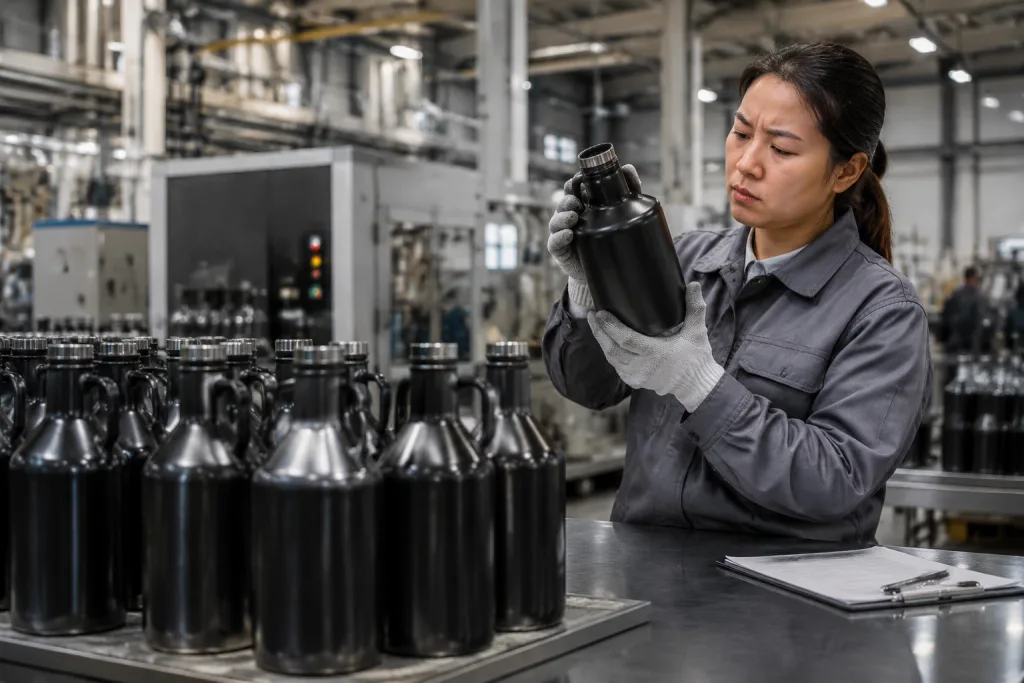
I’ll rewrite the section in-place, keep the HTML structure untouched, and make the language sound like a factory-side sales engineer with tighter sourcing detail.Beer growlers look simple on paper: a container, a handle, maybe a wider neck. On the line, that simplicity disappears fast. Deep drawing, handle welding, and neck forming can pull the body out of shape and leave wall thickness uneven. You may receive a unit that passes visual check, then rocks on a flat table or misses the carton insert by 2 mm. That turns into packing trouble, then freight damage, then a claim.
For stainless parts, ask for a base flatness target and a coaxiality check on the neck. If the growler has a handle, lock down the weld method and the weld appearance standard. For beer growler in bulk orders, we run a pre-production sample plus a pilot of 100-200 pcs, because the die tells the truth there. If QC pulled the sample and the neck drifted after the 60th piece, the mass run will follow the same pattern. The math does not work any other way.
This is where a China supplier with real process control matters. In Zhejiang, the better shops show fixture data, not just one pretty sample on a bench. They will flag that an embossing hit or a handle move will push tolerance the wrong way. We’ve seen a buyer push for a bigger logo, then the base lean went to 3 mm and the carton stopped stacking cleanly. That is not a good deal; it is damaged inventory.
- Ask for base flatness tolerance and neck concentricity.
- Check carton fit with 10 random units from the pilot run.
- Require a first article inspection before mass production.
- Reject any sample that rocks, tips, or leans.
What specs to lock first
I’ll rewrite the section in place, keep the HTML structure intact, and tighten the sales-engineer tone with concrete factory details and fewer AI-style fillers.If you want fewer failures, lock the specs that actually cause failures. Start with material, wall thickness, lid type, finish, and test method. For a stainless wholesale bulk beer growler, the base spec is simple: 304 stainless steel, 0.6-0.8 mm wall thickness, food-grade gasket, defined torque, 100% leak test, and AQL levels for visual inspection. On our line, QC pulled the sample twice because the cap torque drifted by 0.4 N·m, so we do not treat that number like decoration. If the design is double-wall insulated, add vacuum retention targets and condensation limits.
Do not let the factory “optimize” your drawing after sampling without written approval. One millimeter on the cap diameter or one revision in the gasket groove can throw the fit off and start returns. The buyer flagged a PO typo once—`Ø64` became `Ø46`—and the production lot had to be reworked. For branded programs, lock logo location, logo depth or stroke width, and acceptable color delta. If you need related SKUs such as bulk canteen, canteen bulk, or beer tumbler bulk, make separate spec sheets. Mixing standards across product families is the wrong question to ask; it creates a clean sample and a messy shipment.
Use this order of control: functional spec first, appearance second, packaging third. Packaging matters if you ship through Amazon or a distributor network, but it will not save an underspecified product. We run into this with 2 mm carton shifts all the time—good outer packs, bad fit inside. A factory in Hangzhou or elsewhere in China can make good drinkware at scale, but only if you define where the tolerance stack starts and where it stops.
If you do not write the failure mode into the spec, the factory will find it in production.
QC checks that actually catch defects
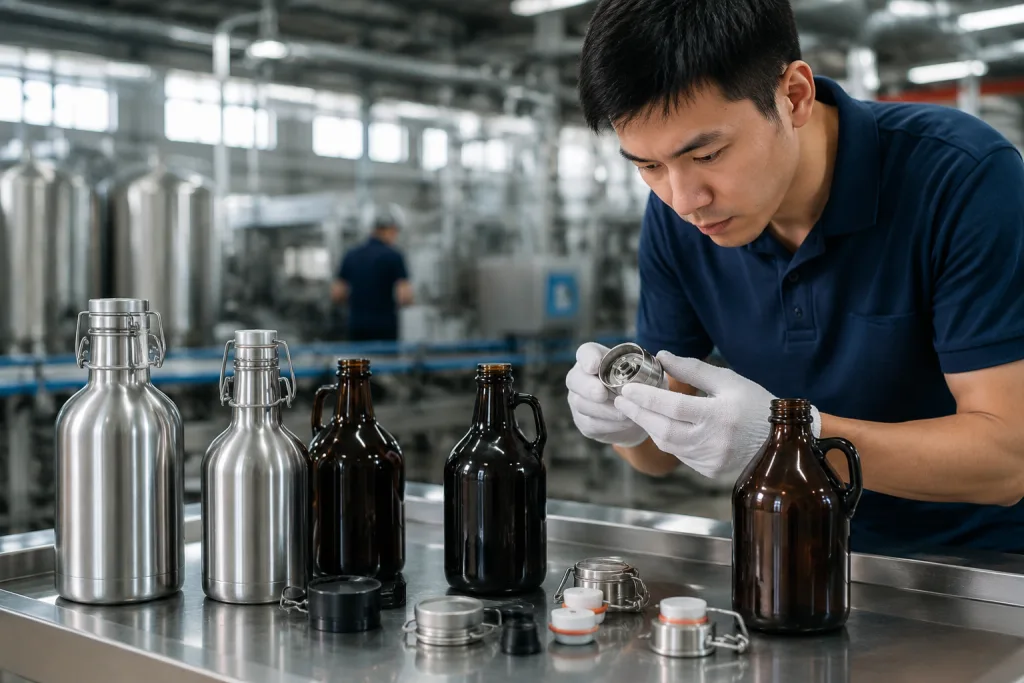
I’ll rewrite the section in-place, keep the HTML structure exactly, and tighten the sales-engineer tone while preserving the required terms and QC specifics.Inspection has to match the risk. A visual check alone misses the stuff that hurts you later, and growlers have plenty of hidden failure points. For beer growler wholesale orders, we run incoming material verification, in-process checks on formed parts, and final inspection before packing. Use AQL 2.5 for major defects and AQL 4.0 for minor defects on retail-facing orders. If the item is premium or gift-grade, go tighter than that.
At minimum, test leak, torque, coating adhesion, capacity, dimensional accuracy, and carton drop survivability. We also do a hot water rinse and a smell check. That catches oil residue, solvent smell, and under-cured coatings. For printed items, check logo alignment and color consistency under standard light. If you are sourcing alcohol flask bulk or alcohol flask in bulk in the same cycle, split the inspection files. A flask and a growler may share a CAD look, but the failure modes are different, and the buyer flagged it on one of our old PO slips where the carton spec was copied across by mistake.
- Incoming: check stainless grade and gasket certificates.
- In-process: measure neck diameter every 2 hours with calipers.
- Final: 100% leak test and random drop test.
- Packing: verify barcode, carton marks, and inner protection.
Good factories in Zhejiang can support this if you ask early. The ones with a real QA team will show a control plan and sample record, often with an AQL sheet and a torque gauge log from the line. If they only send a glossy product photo, keep moving. That is the wrong question to ask a supplier.
Commercial terms that protect margin
I’ll keep the tags and structure intact, then tighten the prose so it sounds like a buyer-facing factory note with concrete trade terms and a few floor-level details.Price matters, but commercial terms decide whether the project keeps margin. For a standard stainless growler, FOB China usually lands around USD 2.80-6.50 per piece, depending on capacity, finish, and lid build. We ran a 64 oz sample last month with a brushed body and flip-top lid; the lid alone added cost on the line. If a quote comes in well below that band, the math usually means something got cut: wall thickness, polish passes, drop test, or carton quality.
Typical MOQ for a custom wholesale growler program is 3,000-5,000 pcs, with lead time at 25-35 days after sample approval and deposit. QC pulled the sample twice before release because the cap torque was off by 0.3 N·m. If you need multiple SKUs, ask how the factory handles split runs across 2 colors and 2 logo placements. Some can do it without drama, some blow up the schedule. That is the wrong question to ask first; the real test is whether they can hold cost and ship date when the order gets fragmented.
If you are building a broader assortment, including wholesale canteen, wholesale drinkware, or beer tumbler wholesale bulk, lock packaging size and barcode placement early. One PO typo on carton height can turn into a warehouse charge at intake. We keep the master carton within a fixed 60 x 40 x 32 cm box when possible, because it fits freight planning and distributor shelves. Written approval for any material substitution is non-negotiable. We’ve seen this go sideways when a buyer did not block it in the purchase order.
Send your growler spec for a fast quote
Get a practical production review, target price, and QC plan from a Zhejiang factory that ships 300,000 units monthly.
Frequently asked questions
What MOQ should I expect for wholesale bulk beer growler orders?
For a custom stainless beer growler, a normal MOQ is 3,000-5,000 pcs per design. If you want multiple colors or logo variations, some Zhejiang factories will allow mixed production, but the total order still usually needs to stay above 5,000 pcs to keep pricing stable. For a simple stock shape with a standard lid, smaller pilot orders of 500-1,000 pcs may be possible, but you will pay more per unit. If a supplier promises 300 pcs at factory pricing, ask what they are omitting from the quote. Low MOQ often means weaker QC, higher freight cost per unit, or longer queue time.
How do I prevent leaks in beer growler wholesale bulk production?
Lock the sealing system before mass production. Specify the gasket material, neck tolerance, cap torque, and leak test method in writing. For screw lids, use a torque window like 8-12 N·m and require a 100% water leak test. For swing-top lids, test spring force and seal compression. Also ask for a 24-hour recheck after initial filling. In practice, most leak issues come from weak gasket compounds or poor neck finish, not from the body itself. A good factory in China will give you a documented leak test record and keep the same gasket lot through the order.
What quality standards should I request from a China supplier?
Ask for AQL 2.5 on major defects and AQL 4.0 on minor defects for retail orders. For materials, request food-contact compliance documentation such as REACH where relevant to your market, plus stainless material certificates for 304 or your specified grade. If you are sourcing for the US, many buyers also ask for ASTM-based test references when applicable. For factory management, BSCI audit status can help if you need social compliance, but it does not replace product QC. The key is a written inspection plan with measurable acceptance criteria, not a vague promise of “good quality.”
Can I source beer growler wholesale bulk together with other drinkware?
Yes, but only if you separate the specs. A beer growler, bulk canteen, and beer tumbler have different risk points: growlers need seal control, canteens need cap durability, and tumblers need finish and insulation consistency. A factory can often run them in the same month, especially in Zhejiang, but you should issue separate drawings, packaging specs, and QC checklists. This avoids mixing acceptance standards and creating a claim problem later. If the supplier also handles wholesale drinkware or wholesale growler lines, ask for capacity by SKU so you know whether one order will delay the other.
What is a realistic FOB price for a custom wholesale growler?
For a standard stainless wholesale growler, a realistic FOB China price is often USD 2.80-6.50 per piece. The lower end usually means a simpler body, plain lid, and minimal decoration. Add laser engraving, powder coating, insulated walls, or premium packaging, and the cost moves up quickly. If the offer is much cheaper than that, check the wall thickness, material grade, leak testing, and carton packing. A quote is only useful when you know what has been removed to hit the number. In China, the cheapest bid is often the most expensive mistake.