Key Takeaways
- A 304 stainless wholesale alcohol flask usually starts around USD 1.15-2.40 FOB China at 5,000 pcs, depending on size and finish
- For sample approval, ask for 1-2 prototypes, 7-12 days lead time, and full measurements: 0.5 mm body thickness, 0.8 mm lid gauge, leak test
- A serious PO should list capacity, logo method, carton spec, AQL level, and packing count; that cuts claim risk by 30%+
- A Zhejiang factory with 300,000 units/month can usually support alcohol flask wholesale bulk and mixed drinkware wholesale orders with 25-35 day production
If you are buying a wholesale alcohol flask, finding a factory in China is not the hard part. The hard part is putting the right flask spec into the RFQ so you do not burn 14 days on samples that were dead on arrival. We see this all the time on the line. A buyer asks for “stainless flask,” then gets quotes that swing 20% to 40% because 0.4 mm versus 0.6 mm, a screw cap versus a captive cap, or brushed versus mirror polish changes the number fast.
In Zhejiang, this comes up every week: a buyer wants alcohol flask bulk pricing, but the real job is to lock down use case, 6 oz or 8 oz capacity, compliance, and decoration before FOB is even on the table. If you are sourcing bulk drinkware, bulk canteen, or beer growler wholesale bulk, the same rule applies. Start with a clean RFQ, compare samples against one master, then release the PO with the line items that avoid a fight later. QC pulled the sample, and the buyer flagged a typo on the packing list before it turned into a 500-piece mess.
Start With The Use Case
I’ll rewrite the section in-place, keep the HTML structure intact, and tighten the copy so it sounds like a factory-side sales engineer.Do not start with decoration. Start with how the flask will get used. A wholesale alcohol flask for promo gifting is not the same as a retail pack for a bar chain, and neither matches a private-label item sold with a whiskey set. Capacity is the first fork in the road: 4 oz, 6 oz, 8 oz, and 12 oz are all common, but our line moves the most 6 oz and 8 oz units because they stay balanced on hand feel, margin, and carton weight. We ran this in a 1,000-unit trial last season, and the buyer cut the 12 oz option after QC pulled the sample for loose pocket fit.
Write the RFQ around one clear product definition. For example: 304 stainless steel body, brushed finish, screw cap attached or loose, laser logo, single-piece gift box, and master carton for 50 units. If you need a bulk drinkware program, say so straight. If you are also buying a bulk canteen or wholesale canteen line, the factory can often bundle raw material and packing, which helps freight and MOQ. That is not a marketing line; we see the math on the cutting table. In Zhejiang and across China, suppliers quote faster when the use case is specific because the tooling, polishing, and packing assumptions are already fixed.
- State capacity in ounces and milliliters
- Specify 304 or 201 stainless steel
- Confirm loose lid, captive lid, or hinged lid
- List target market and retail channel
If you want the best wholesale drink bottle for a broader assortment, define whether the flask is a gift item, bar accessory, or outdoor carry item. That choice changes finish, carton protection, and whether we run a matte powder coat or a simple brushed shell. We once had a buyer flag a PO typo on “matte” versus “metallic,” and the rerun cost three days on the line.
Build A Tight RFQ Package
I’ll rewrite the section in place, keep the HTML tags intact, and tighten the prose to sound like a factory-side sales engineer.A sloppy RFQ gets sloppy pricing. Send one page with dimensions, material, color, logo, packaging, compliance, and target order volume. If you are comparing alcohol flask wholesale bulk offers from multiple factories, use the same sheet for every supplier. Otherwise the low quote is usually the one built on the weakest assumptions.
Put the numbers on the table. For a stainless flask, body thickness usually sits at 0.5 mm to 0.7 mm, with lid gauge around 0.6 mm to 0.8 mm depending on cap type. Ask for food-contact compliance options such as REACH and LFGB if you sell in Europe, and ASTM or CPSIA-adjacent documentation if you bundle with other drinkware wholesale SKUs for North America. If you need a printed box, specify carton size, paper weight, and whether the insert is molded pulp or EVA. Freight and breakage move on those details; we see it on the packing line every week.
One missing line in the RFQ can turn into three sample rounds. That is not a sourcing issue; that is a spec issue.
For bulk canteen, wholesale growler, or beer tumbler wholesale programs, the same RFQ logic applies. A factory in China can quote fast, but it needs clean inputs. Give quantity breakpoints, target FOB port, decoration method, and whether you want mixed SKUs in one shipment. If the supplier is in Zhejiang, ask for a capacity statement. A real producer should name monthly output, say 300,000 units/month, not just “large capacity.” We’ve seen the buyer flag a PO typo on the port code and the shipment sat for 12 days.
Compare Quotes Without Guessing
I’ll keep the HTML structure intact and rewrite the prose to sound like a factory-side sales engineer, with concrete sourcing details and cleaner quote comparison language.When the quotes land, compare them line by line, not by headline price. A USD 0.18 gap looks tiny until QC pulled the sample and found one supplier on 201, another on 304, and the third left out the gift box. For a reliable wholesale alcohol flask, the low bid is often the one with the thinner lid, weaker steel, or a packing claim that never survives carton drop testing.
Use a simple comparison table in your internal review: unit price, MOQ, sample cost, lead time, carton count, logo method, compliance docs, and payment terms. A private-label flask usually sits at 3,000 to 5,000 pcs MOQ, though some Zhejiang lines will take 1,000 pcs if you keep the finish plain and use a stock cap. Sample fees usually run USD 30-80 per style, and we refund them after bulk order. Production lead time is normally 25-35 days after sample approval and deposit.
- Check whether FOB includes inner packing and the master carton
- Ask if logo cost is separate from tooling
- Confirm whether the quote includes freight carton test
- Verify if the sample is pre-production or hand-finished
If you are buying beer growler bulk or beer growler in bulk at the same time, keep the quote matrix separate. The line runs thicker walls and different logistics for growlers, so comparing them to a flask is the wrong question to ask. The same goes for beer tumbler bulk or beer tumbler wholesale bulk programs; the shape changes the cost, and we have seen buyers flag a quote just because they mixed product types in one sheet.
Approve Samples Like A Buyer
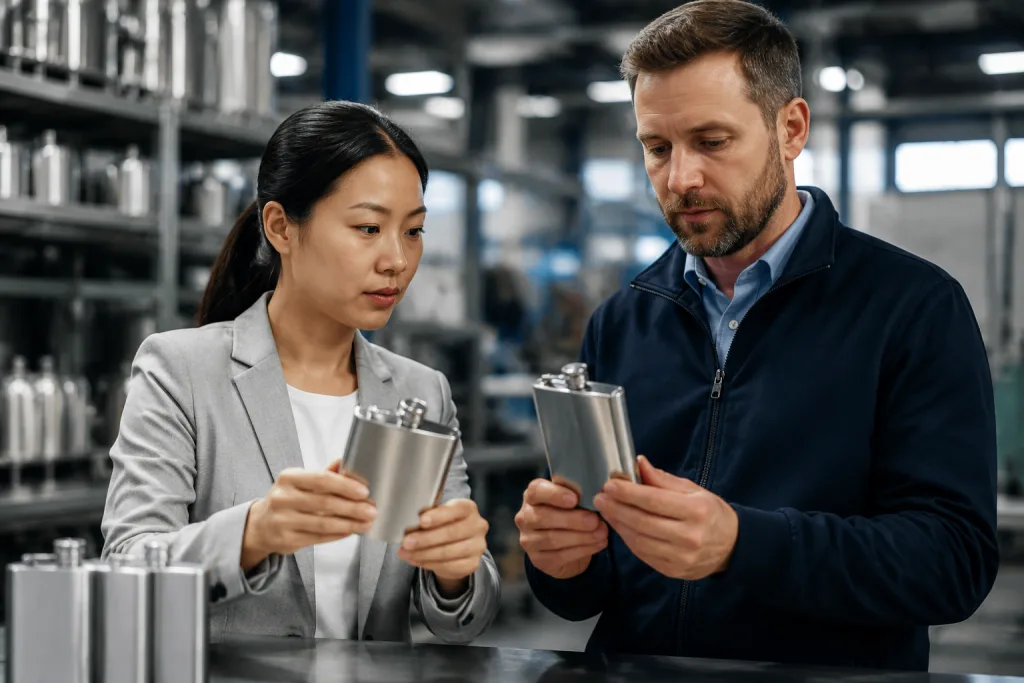
I’ll rewrite the three paragraphs in place, keeping the HTML untouched and tightening the sales-engineer tone with concrete factory details.Sample approval is where bad sourcing gets locked in. Do not ask the factory for “a better sample” without a checklist. For a wholesale alcohol flask, we check dimensions with calipers, lid thread fit, leak resistance, edge smoothness, and logo alignment. If the flask is brushed, the grain has to run the same way across the face. If it is painted or powder coated, we look for pinholes and thin coverage around the neck, where the line often misses a corner.
Ask for two samples at minimum: one stays as the visual master, the other goes to testing. Fill it, invert it for 24 hours, then check smell after washing. For a 6 oz or 8 oz flask, we run a 1-meter drop test and a 30-minute hot-water soak; zero visible leakage is the bar. QC pulled one sample last month with a tiny seam flaw at the shoulder, and that was enough to stop the lot. If you also source wholesale drinkware, use one approval sheet for all SKUs so the buyer does not rewrite the rules every time.
For alcohol flask in bulk, the sign-off note should list approved thickness, approved logo size, approved carton artwork, and approved AQL. AQL 2.5 for major defects and 4.0 for minor defects is common for consumer drinkware, but premium retail often needs a tighter call. We have seen POs stall because someone typed the carton code one digit off, so put the packaging reference number on the approval form. If the flask sits in a larger wholesale drink bottle or wholesale canteen range, that line saves a lot of back-and-forth when the PO lands three weeks later.
Write The PO Like A Control Document
I’ll rewrite the section in place, keep the HTML structure exactly, and tighten the sales-engineer tone with a few concrete factory details.Your purchase order is not a payment request. It is the control sheet we run against the sample, and if the PO is loose, the line drifts. For a wholesale alcohol flask, spell out product name, capacity, material, surface finish, logo method, box style, carton quantity, net and gross weight, plus the inspection standard. If the supplier is in China, especially Zhejiang, this level of detail is standard for a serious buyer; we see it every week at the packing table.
A solid PO also locks down pack-out. List inner box count, master carton quantity, carton dimensions, palletization if needed, and whether you need FNSKU labels or UPC labels for Amazon-style retail channels. If you are doing alcohol flask wholesale bulk for North America, this is not paperwork fluff—the buyer flagged it for a reason, because wrong label placement can stall receiving for days. For Europe, add EAN where needed and confirm any language on the insert card before QC pulls the sample.
Useful PO line items include:
- Material: 304 stainless steel, 0.5 mm body thickness
- Finish: brushed, satin, or powder coated
- Logo: laser engrave, 1 color silk screen, or UV print
- Packing: 1 pc/polybag, 1 pc/color box, 50 pcs/master carton
- Inspection: AQL 2.5 major, 4.0 minor
If you are also placing growler wholesale or canteen wholesale orders with the same supplier, keep the SKU codes separate. We have seen mixed cartons go sideways fast; one PO typo can put the wrong 12 oz flask into the wrong box run. That is the wrong place to save time.
Move Into Bulk Production Safely
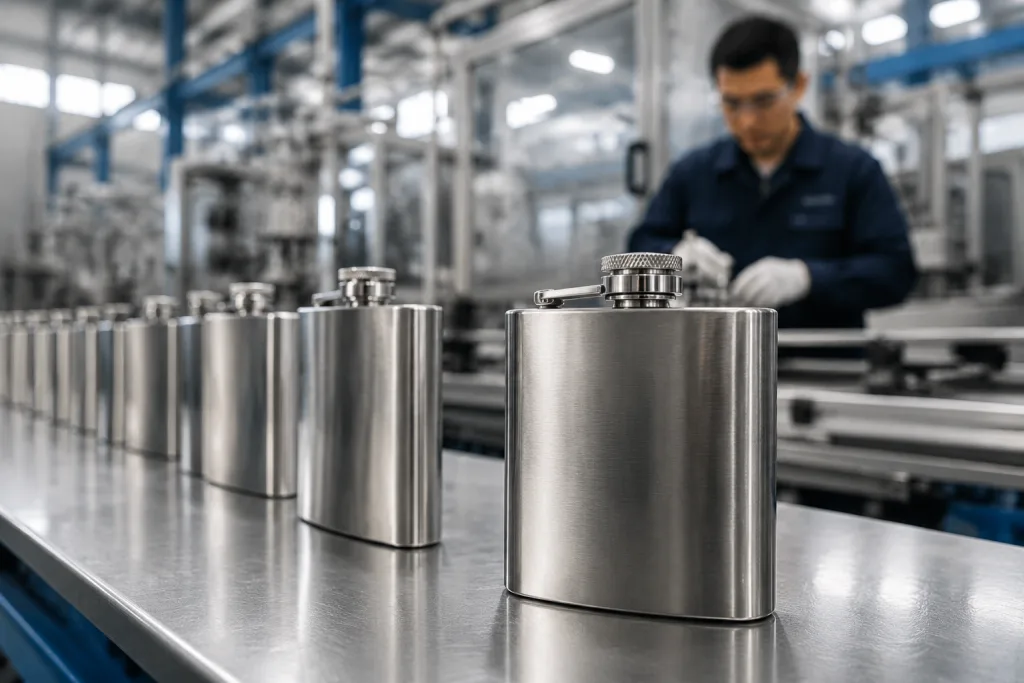
I’ll rewrite the section in-place, keeping the HTML tags and structure intact while making the prose sound like a real factory-side sales engineer wrote it.Once the PO lands, bulk should go quiet. That is the target. We ask for a pre-production sign-off with the raw material lot, logo proof, carton proof, and first-article photos before the line starts; otherwise the job drifts fast. A solid factory will show the polishing wheel, the leak test bench, and the ultrasonic washer. In Hangzhou and the wider Zhejiang belt, one run can push 300,000 units/month across several drinkware shapes, but only after the buyer freezes artwork and packaging.
During production, we run checks at 30%, 60%, and 100%. QC pulled the sample once and found a cap thread issue at 60%—that saved a rework lot. Check thread fit on caps, edge finishing on the mouth, and wash cleanliness after ultrasonic cleaning. For beer growler wholesale bulk or beer growler wholesale, the same discipline applies, only tighter, because the handling risk climbs with volume. Keep defect photos and batch numbers in one log. That makes corrections possible before the cartons move.
Before balance payment, ask for the pre-shipment inspection report and photos of the loaded cartons. If you use a third-party inspector, tell them to check random samples against the sample-approved file, not some loose product idea. That is the wrong question to ask if you care about margin on bulk drinkware and drinkware bulk programs. If the supplier also handles beer tumbler in bulk or best wholesale drink bottle assortments, make sure each SKU label reads cleanly and the carton marks match the PO. We have seen a typo on the PO turn into the wrong case count. Clean flask, wrong carton. It happens.
Send your RFQ for a clean flask quote
Get a same-day response with MOQ, FOB pricing, sample lead time, and packing options from our Zhejiang team.
Frequently asked questions
What MOQ should I expect for a wholesale alcohol flask?
For a standard 304 stainless wholesale alcohol flask, a realistic MOQ is 3,000 to 5,000 pcs per design and finish. If you keep the cap stock and use laser logo, some Zhejiang factories can open at 1,000 pcs, but the price will usually be 10% to 20% higher. Custom box printing also pushes MOQ up. For mixed drinkware wholesale orders, factories often allow SKU consolidation if the raw material and decoration are similar, which helps you hit a better tier on freight and packing.
What does a fair FOB China price look like?
For an 8 oz stainless flask, FOB China often lands around USD 1.15 to 2.40 per piece at 5,000 pcs, depending on material, thickness, lid type, and packaging. A brushed 304 body with simple laser logo is on the lower end; powder coat, gift box, and custom inserts move it up. If you are comparing alcohol flask wholesale bulk offers, make sure each quote includes the same carton spec and compliance documents, or the numbers are not comparable.
How long does sample and bulk production take?
Samples usually take 7 to 12 days if the design is straightforward and the factory already has the cap tooling. Bulk production is commonly 25 to 35 days after sample approval and deposit. If you need custom packaging, add 5 to 7 days. A Zhejiang supplier with stable capacity can often keep these timelines, but only if your logo file, carton artwork, and PO line items are final before you pay the deposit.
Which compliance documents should I ask for?
For Europe, ask for REACH and, if needed, LFGB food-contact support. For North America, ask for food-contact declaration, material spec sheet, and test reports tied to the exact production batch. If the flask is part of a broader wholesale drinkware or wholesale canteen order, keep documentation per SKU. Also ask for the stainless steel grade, usually 304, and the test method used for migration or odor checks so your QC team can verify it later.
Can I mix flasks with growlers or tumblers in one order?
Yes, but only if you control the paperwork. Many factories in China will accept a mixed container with wholesale growler, beer tumbler wholesale bulk, and wholesale alcohol flask SKUs, especially if they share packaging lines. The key is to separate each SKU by code, carton mark, and inspection record. Mixed orders can improve freight efficiency, but they also increase the risk of packing errors if the PO is vague. Keep each item’s dimensions, quantity, and label requirements explicit.