Key Takeaways
- Most water bottles wholesale quotes only make sense when you compare MOQ, decoration, and carton pack, not unit price alone.
- For custom orders, a realistic factory MOQ is 3,000-5,000 pcs, with 20-35 day lead times from approved samples.
- Compliance for Europe and North America usually means REACH, food-contact declarations, and testing to ASTM or ISO-related requirements.
- The cheapest supplier often loses money on packaging, cap tolerances, or rework, which is why bulk drinkware sourcing needs a checklist.
If you buy water bottles wholesale, you are not buying bottles alone. You are buying print hold, leak performance, carton count, compliance files, and a supplier who can ship the same item twice without color drift or thread-fit trouble. That is where sourcing goes wrong. A clean sample can still hide a weak mold, soft caps, or a coating that fails after 1,000 dishwasher cycles. We have seen that fail at QC.
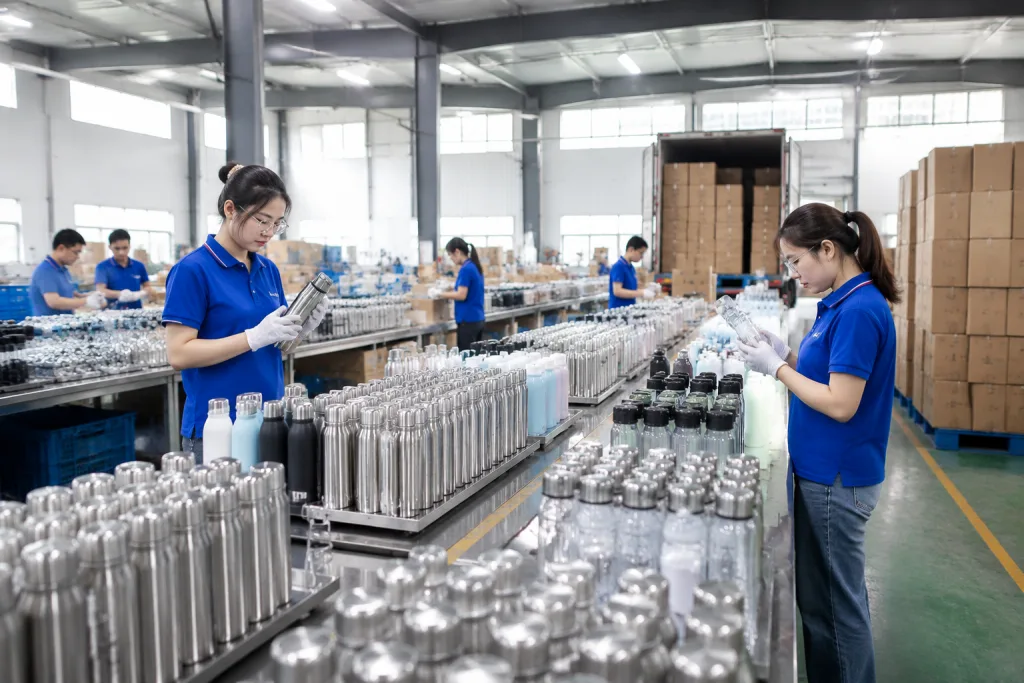
In Zhejiang and across China, the better factories do not sell “one bottle.” They run a repeatable production line: 120,000 units per month, MOQ from 3,000 pieces per SKU, and lead times around 20-35 days depending on decoration and packaging. The buyer flagged a PO typo on cap color once, and the whole carton label set had to be rechecked on the line. If you are comparing wholesale drinkware options, this is the wrong question to ask: “Which bottle looks best?” Ask which plant can hold spec on the second order.
What are you really buying?
I’ll rewrite this section in a more operator-style voice, keep the HTML intact, and preserve the structure and meaning while removing the AI-ish phrasing.When you source water bottles wholesale, the product name is the least important line on the sheet. You are buying a spec package: material, wall thickness, lid type, decoration method, carton setup, and whether the factory can hold those choices for the next 12 months. A stainless bottle at 0.5 mm wall thickness behaves differently from one at 0.7 mm. A Tritan bottle with a soft TPE loop is not the same as a basic PP sports bottle. We’ve had buyers push back on this, then QC pulled the sample and the wall gauge told the story. If you do not lock the spec, the line will optimize for cost, not for your shelf or your customer.
Ask the supplier to quote on a full sheet: capacity in ml/oz, material grade, single-wall or double-wall, cap liner type, print area, and drop-test expectations. For drinkware wholesale, that sheet matters more than the sales pitch. We run into PO typos here all the time — one missing “double-wall” and the whole margin changes. You also want the packaging format defined early. A 24-pack inner carton, master carton of 48, and a pallet pattern that fits 1,080 pcs per euro pallet can save more freight cost than a 5-cent cut in unit price.
Do not compare bottle prices until you know whether the quote includes logo setup, individual polybags, and export cartons.
If you are buying for Amazon, retail, or distributor channels, the best wholesale drink bottle is the one that gives you consistent fill, fewer returns, and less repack labor. That is the real margin. The math does not work any other way.
Which bottle type fits your channel?
I’m rewriting the section in place, keeping the HTML structure intact and tightening the sales language so it reads like a factory-side sourcing note.Not every order should be a classic sports bottle. We’ve had buyers start with one SKU and end up with three after QC pulled the sample and the channel check came back. A bulk canteen fits outdoor and campus programs. A bulk drinkware line often needs stainless tumblers plus plastic bottles. A bulk growler works for breweries and taproom retail, while alcohol flask bulk orders usually sit in promo gifting or travel accessories. The channel decides the build.
Match product to buyer behavior
- Sports and fitness: PP, Tritan, or stainless; 400-750 ml; cap opens fast and the lid has to survive 20,000 flips.
- Outdoor and military: canteen bulk or wholesale canteen; 800-1,200 ml; tougher lid and loop, usually with a 2.0 mm wall spec.
- Beer and beverage: beer growler bulk or beer growler wholesale bulk; 32 oz, 64 oz, or 128 oz sizes with pressure and seal control.
- Premium gifts: beer tumbler bulk or beer tumbler wholesale; cleaner surface finish and gift-ready packaging, because the buyer flags scuffs in the first carton.
- Travel and promo: alcohol flask wholesale or alcohol flask wholesale bulk; compact format, usually 7 oz to 8 oz.
For European retail buyers, a simple vacuum bottle often wins because it ships better and prints cleaner on the line. For North American distributors, the math is speed-to-market and reorder consistency, not fancy curves. We’ve seen this go sideways when the catalog photo drives the spec instead of the channel.
Do not miss the terminology when you brief the factory. A buyer saying canteen wholesale may mean an aluminum military-style bottle, while the supplier hears a basic water jug. One PO typo cost us 2 days on a 5,000-piece run. Precision saves samples and weeks.
How do you judge a factory quote?
I’ll rewrite this section in-place, keep the HTML exactly as-is, and make the quote language sound like a factory-side sales engineer wrote it.A proper quote for water bottles wholesale should split out tooling, sample charge, unit price, print cost, packaging, and freight terms. One line with a price and lead time is not a quote; it is a guess. We run quotes in Zhejiang by line item: resin or steel cost, forming or drawing cost, decoration cost, and carton cost. That is the level buyers should ask for.
FOB China is the clean starting point for most buyers. Then you compare it with landed cost after ocean freight, duty, and inland delivery. We had a buyer flag a USD 1.18 FOB bottle because the carton spec was loose; once freight and repack were added, it landed at USD 2.05, while a USD 1.26 bottle with tighter carton density came in lower. This is the wrong question to ask if you only stare at unit price. For drinkware bulk orders, the math has to be built, not hoped for.
Ask for these points before you sign a PO:
- Tooling ownership: who pays for the mold and who keeps it.
- Sample timing: 5-10 days for existing molds, 15-25 days for new decoration.
- Mass production lead time: 20-35 days after sample approval.
- Inspection terms: AQL 2.5 for major defects, AQL 4.0 for minor defects is common.
- Testing documents: food-contact declaration, REACH where relevant, and any market-specific lab reports.
If the factory will not talk about AQL or cannot explain its process controls, walk away. QC pulled the sample at our line once and found 3% leakage on a bad cap batch; that cheap quote turned into a costly claim. A low price with no QC discipline is not a bargain.

What compliance should you ask for?
I’ll rewrite the section in place, keep the HTML intact, and tighten the language so it reads like a factory-side sales engineer wrote it.Compliance is not file work. It is what keeps customs, Amazon, and retail buyers from stopping a shipment at the door. For Europe, ask for REACH declarations, food-contact statements, and migration test reports when the bottle structure calls for them. For North America, check whether your buyer wants FDA food-contact support for the material and a third-party lab report; we’ve seen a carton held because the PO said “FDA ok” but never named the material. If the bottle is stainless steel, nickel and heavy metal limits still matter. If it is plastic, you need the resin grade and the color masterbatch spec, or the math does not work.
For wholesale drinkware, the supplier should name the test path before we run the first sample, not after the line is already packed. BSCI or a similar social audit matters if you sell into retail chains. ISO systems help when the factory uses them every day; QC pulled one sample off the line at 2.5 mm lid gap, and the buyer still flagged the wrong label code. A certificate on the wall is not enough.
Buyers of growler wholesale or beer growler wholesale products should ask for seal checks and pressure tolerance, usually in writing, before mass production. A growler that leaks after carbonation handling becomes a retailer headache fast. The same goes for beer tumbler in bulk and beer growler in bulk orders, where a weak shipper or a loose divider can mark the finish before it leaves the warehouse. We have seen this go sideways on a 5,000-piece order because the buyer skipped the drop test.
Put compliance in the purchase order. Do not leave it as a promise from the sales rep.
If you buy from China, especially Zhejiang or other export-heavy regions, keep the lab file on the supplier scorecard. One typo on a PO—“food grade” without the standard number—can slow a release by 12 days versus 18 days. It is a clean way to tell a real exporter from a trader.
What is the right MOQ and price range?
I’ll rewrite just the prose, keep the HTML structure intact, and make it sound like a factory-side sales engineer wrote it.MOQ is where buyers burn time by asking the wrong question. The real question is not “What is the MOQ?” It is “What MOQ keeps unit cost steady and packing efficient?” On our line, 3,000 pcs per SKU is a normal starting point for custom bottle jobs. For two-color printing or mixed-color caps, 5,000 pcs is more common. Stock items can start at 500-1,000 pcs, but you give up control on color, print, and carton plan.
For reference, a basic PP sports bottle usually sits around USD 0.85-1.60 FOB, depending on quantity and print method. A stainless vacuum bottle often lands around USD 2.80-6.50 FOB, and premium powder coat or special lids push it higher. We’ve seen buyers chase the cheapest quote, then QC pulled three cracked lids from a 50-piece sample. A best wholesale drink bottle for retail is the one that ships clean, passes drop checks, and comes back with the same numbers on the next reorder.
These keywords often point to the same sourcing logic:
- canteen bulk and wholesale canteen buyers usually push for thicker walls and a loop that does not snap at 5 kg pull.
- growler bulk, wholesale growler, and beer growler wholesale buyers care about cap seal, carton insert size, and how the bottles ride in a 12-pack master carton.
- alcohol flask in bulk and alcohol flask bulk buyers care about brushed finish consistency and whether the print lines stay straight after packing.
- beer tumbler wholesale bulk buyers care about logo wear and carton cube, because freight math gets ugly fast.
One rule we stick to: if a supplier cannot quote 3,000 pcs with lead time, packing detail, and one confirmed FOB number, the buyer is not looking at a serious factory. The math does not work.
How should you run samples and QC?
I’ll rewrite the section in place, keeping the HTML tags and structure intact while tightening the prose and adding a few concrete factory-floor details.Sampling is where smart buyers stop waste before it starts. Ask for 2 or 3 sample rounds if the bottle is custom. First round, check the dimensions, lid fit, and pad-print position with a caliper and a tape. Second round, run the use tests: leak, thermal retention if it matters, dishwasher cycle, and a 1.2 m drop. Third round, lock the packaging and labeling. If you sell into the United States, FNSKU labels and carton marks need to match your warehouse flow. For Europe, barcodes and language labels have to be right before the first pallet leaves Ningbo.
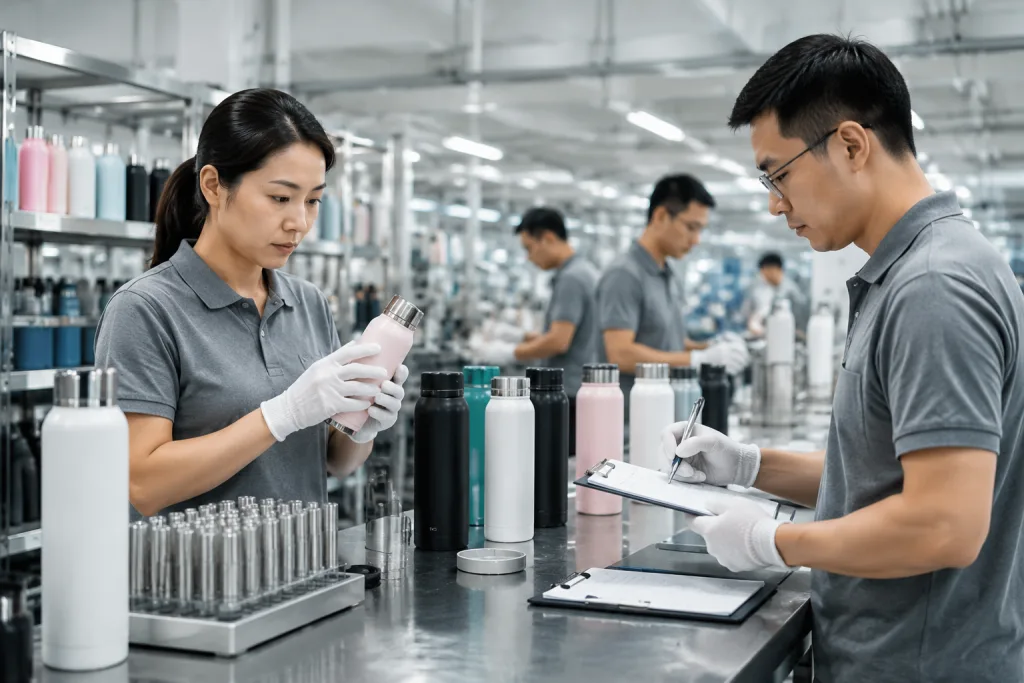
For QC, we run a pre-production sample, then a production sample, then one gold sample with sign-off. If you are ordering bulk drinkware or drinkware wholesale across 4 or 5 SKUs, this is the only sane way to keep the line under control. Build one master spec sheet per SKU. Put the color tolerance, logo position tolerance, and packing method on it. A buyer once sent a PO with the lid code typed wrong by one digit; QC pulled the sample and caught it before we opened the full line.
Inspection needs numbers, not good intentions. We ask for a 100% leak test on caps, random drop tests from 1.2 meters, and carton compression checks when the route is long. For a 12,000-unit order, a third-party check at AQL 2.5 before balance payment is money well spent. The math does not work any other way. Skip that step, and you are paying later on claims and rework.
Factories in Zhejiang that ship export work this way every day. They know buyers want fewer surprises and cleaner handoffs. If a supplier pushes back on sample control, we’ve seen that go sideways on claims too. One bad carton mark can delay a whole pallet.
Which products deserve a broader range?
I’ll rewrite this section in-place, keep the HTML intact, and tighten the sales-engineer tone with concrete factory detail and cleaner sourcing logic.Once you have one bottle that sells, do not widen the line just to look busy. We run cartons on the packing table for a reason: if the carton size, margin, and buyer use case do not line up, the extra SKU burns time. A brand starting with water bottles wholesale can add a bulk canteen for outdoor accounts, a bulk growler for brewery buyers, or a beer tumbler bulk item for gift packs, but only if the tooling, finish, and packaging all match the same production setup.
Portfolio logic beats random keyword chasing. A buyer asking for beer growler wholesale bulk usually wants taproom or on-premise sales. A buyer asking for alcohol flask wholesale is often buying for low-MOQ promo gifts with custom boxes. A buyer asking for canteen wholesale may want a rugged body, a carabiner or loop, and fewer returns than a polished bottle. That is the real brief.
We have seen this go sideways when a factory says yes to every category and never shows process separation. Stainless vacuum lines, plastic injection lines, and glass lines do not share the same QC checks. QC pulled a sample with a 1.2 mm lip mismatch once, and the buyer flagged it before shipment. If your vendor in China cannot show where each line is made and packed, the math does not work. In Zhejiang, the better factories quote the limits up front.
Use the checklist below before you expand:
- Does the new SKU share the same cap family or packaging line?
- Can the same carton size be used across two or more products?
- Will the new item improve reorder frequency, not just first-order revenue?
- Can the supplier hold the same QC standard at 10,000 pcs and 50,000 pcs?
If the answer is no, keep the line tight and profitable first.
What should be in your buyer checklist?
I’ll rewrite the section in place, keep the HTML structure intact, and tighten the prose so it reads like a factory-side sales engineer wrote it.Before you approve any water bottles wholesale order, run a checklist that cuts out guesswork. Good procurement is not magic. It is control. Start with the commercial basics: target MOQ, target FOB, target carton count, and payment terms. Then move to the build details: material, wall thickness, cap style, logo method, and packaging. Finish with export readiness: compliance papers, labels, and inspection terms. We have seen buyers sign off at 5,000 pcs and miss a 2 mm lid mismatch, so this is where the math either works or it does not.
A practical checklist for wholesale drinkware looks like this:
- Confirm the exact SKU spec and the approved sample code.
- Fix the price by quantity tier, not by loose “big order” talk.
- Put MOQ, lead time, and re-order lead time in writing.
- Set the AQL standard, inspection timing, and remedy terms.
- Confirm REACH, food-contact, and market-specific paperwork.
- Check export cartons, pallet pattern, and barcode format.
If you are comparing drinkware wholesale offers across China, do not get pulled in by a lower headline price and ignore freight, breakage, and defect risk. QC pulled the sample at our line last month because the buyer flagged a barcode typo on the PO, and that saved a full carton rework. A supplier that answers straight, owns mistakes, and gives numbers you can plan against is the partner you want.
That is the difference between buying bottles and buying supply stability.
Get a cleaner wholesale quote today
Send your target MOQ, material, and market. We’ll turn it into a factory-ready spec with pricing, lead time, and export controls.
Frequently asked questions
What MOQ should I expect for water bottles wholesale?
For custom water bottles wholesale, a realistic MOQ is usually 3,000-5,000 pcs per SKU. Stock items can go lower, sometimes 500-1,000 pcs, but you lose control over color, print, and packaging. If the supplier offers 200 pcs on a custom item, the quote often hides costs elsewhere or uses unstable production planning. For serious procurement, ask for MOQ by decoration method, because silkscreen, laser, and heat transfer can each have different setup thresholds. In Zhejiang and other export hubs in China, factories prefer repeat orders, so a clean 3,000-piece PO often gets better attention than a tiny trial order.
What is a normal lead time from China?
For most water bottles wholesale orders from China, plan on 20-35 days after sample approval and deposit. Existing molds and simple printing can ship faster, around 15-25 days. New molds, multiple colors, or retail-ready packaging can push the schedule past 40 days. If a factory promises 7 days for a custom bottle, be careful. The schedule is only reliable when the supplier controls tooling, decoration, and carton production in-house. A good Zhejiang factory will tell you where the real bottleneck is instead of promising impossible dates.
How do I compare FOB quotes fairly?
Compare quotes using the same spec sheet. Match material, capacity, wall thickness, lid type, logo method, packaging, and carton count. A USD 1.10 FOB quote can be worse than a USD 1.24 quote if the cheaper item needs extra packaging or fails inspection. Also check whether the quote includes setup fees, sample fees, and color matching. For drinkware wholesale, landed cost matters more than the factory line price. Add freight, duty, inland delivery, and rework risk before you decide.
What compliance documents should I request?
At minimum, ask for food-contact declarations, material specifications, and market-relevant testing support such as REACH for Europe when applicable. If you sell into retail, ask whether the factory has BSCI or another accepted social audit. For North America, ask what support they have for FDA-related food-contact requirements and whether the item needs additional third-party lab testing. If you buy alcohol flask wholesale, beer growler wholesale, or other specialty drinkware, also ask about leakage and seal test reports. Get the documents before mass production, not after shipment.
Can I mix different drinkware styles in one order?
Yes, but only if the supplier has the process depth to handle it. Mixing water bottles wholesale with bulk canteen, bulk growler, or beer tumbler bulk items is possible, but each material family and decoration method changes the QC flow. Do not force plastic, stainless, and glass into one vague order unless the factory is genuinely set up for it. If the vendor in China is strong, they will tell you which items belong on the same production line and which ones should be split. That honesty usually saves you defects and delays.