Key Takeaways
- A 3,000-unit 500 ml stainless bottle in China can land at $2.30-$4.10 FOB depending on steel grade, coating, and packaging
- MOQ for custom drinkware usually starts at 1,000-3,000 pcs, while lead time runs 18-30 days after sample approval
- AQL 2.5 for major defects and 4.0 for minor defects is a realistic inspection baseline for wholesale drinkware
- The best wholesale drink bottle price is the one that survives freight, duties, and packaging, not just the factory quote
You are not buying a bottle. You are buying landed cost, decoration, a customs file, and one less headache when the buyer flags a shortage claim. When buyers search for water bottles wholesale price, they want one clean number. The line never works that way. Material, lid style, logo method, carton spec, plus FDA, LFGB, REACH, or a retail-ready barcode can change the quote fast. We’ve seen a $0.42 swing on the same 500 ml bottle just from switching the cap insert and outer box.
Here’s the way we run it: a 500 ml stainless steel bottle from Zhejiang can leave the factory at $2.30 FOB for a 3,000-unit run, then move to $4.10 if you ask for 304 inside, powder coating, laser logo, and color box packing. QC pulled the sample on a 1.2 mm wall spec and found the lid torque was off by 2 N·m, which is the kind of detail that changes the real price. The buyers who save money price the order before sampling, not after. This walkthrough follows one order from brief to QC, so you can compare drinkware wholesale quotes without guessing.
Start With the Shelf Price
I’ll rewrite the section in-place, keeping the HTML tags and the heading structure intact, while tightening the sales tone and adding a few factory-floor details.The buyer here is a North American outdoor retailer with one clear brief: a 500 ml insulated bottle for spring replenishment. They want something that sits beside premium hydration gear, not a commodity that feels cheap. So the sourcing job starts with shelf price, not the factory quote.
If the retail tag is $19.99, the factory number usually needs to sit under 15% of retail after decoration and packaging. That puts the bottle around $2.80-$3.40 FOB before freight. For a branded best wholesale drink bottle, that is workable in Zhejiang if you keep the spec tight: 18/8 stainless, single-wall or basic vacuum build, one powder-coat color, one logo method. Add a gift box, laser logo, silicone base, and custom cap insert, and the math stops working fast. We’ve seen buyers push for all four, then act surprised when the line quote jumps.
Do not ask for a quote on “water bottle” alone. Ask for material, volume, wall thickness, finish, lid type, and packing. A solid factory in China will answer with a real build sheet, not a vague number. At BottleForge Industrial in Hangzhou, we usually run trade orders from 3,000 pcs per SKU, with monthly output around 300,000 units across drinkware lines. QC pulled one sample last week with a 0.3 mm coating gap at the weld seam; that is the kind of detail that changes a drinkware wholesale offer, because it hits consistency and lead time.
Lock the Spec Before Pricing
I’ll keep the tags and structure, then rewrite the prose to sound like a factory-side sales engineer with tighter pricing logic and a few concrete shop-floor details.The first sample quote looks cheap because the spec is loose. That is where buyers get burned. One US buyer sent us “500 ml insulated bottle, screw lid, matte black.” Too open. We locked it on one sheet: 304 inner, 201 outer, 0.45 mm wall, vacuum sealed, powder coat at 70-90 μm, PP lid with silicone ring, and one-color laser logo. QC pulled the sample against that sheet before the line started.
Once the spec is fixed, the quote gets real. The same bottle can jump from $2.35 to $3.05 FOB when the outer shell moves from 201 to 304. Switch from simple screen print to laser engraving, and another $0.18-$0.35 shows up. If you want custom logo plus retail carton, add $0.20-$0.45. We’ve seen buyers skip this part, then argue over a “price increase” that was already sitting in the drawing. If you source from Zhejiang or anywhere else in China, write it down before sample approval. The math does not work any other way.
- Material: 304/304, 304/201, or 316 for premium use
- Capacity: 350 ml, 500 ml, 750 ml, or 1 L
- Finish: matte powder coat, gloss paint, bare steel, or UV print
- Logo: silkscreen, laser engraving, deboss, or full-wrap print
- Packing: white box, color box, mailer, or display carton
This is where “bulk” language can waste time. A buyer may ask for bulk drinkware, drinkware bulk, or wholesale drinkware, but we only price cleanly when the spec is tight. A vague request is a slow request. The buyer flagged it only after the PO had “matte blak” typed in the notes, and we had to recheck the artwork file before we could ship a corrected sample.
Read the Quote Like a Buyer
I’ll rewrite the section in a tighter buyer-seller voice, keep the HTML intact, and make the pricing logic sound like it came from the floor, not a template.For this order, the supplier in Zhejiang sent three FOB quotes. The first was $2.42 for 3,000 pcs with 201 outer, the second was $2.88 for 304/201, and the third was $3.36 for full 304 with an upgraded lid and gift box. The procurement manager nearly picked the lowest line. Bad call. That quote left out the carton insert and used a thinner lid ring, and QC would have caught that on the first sample pull.
When you compare water bottles wholesale price, split the quote into component cost. Check bottle body, lid, logo, packing, and testing one by one. If the supplier won’t itemize, the missing cost shows up later. We see this in wholesale canteen and canteen wholesale orders too, where a plain-looking bottle jumps in cost once coating and compliance paperwork hit the line. I’d ask for a breakdown every time. The math doesn’t work any other way.
Good pricing is not the cheapest line on the quotation. Good pricing is the line that survives production, inspection, freight, and customer complaints.
For beverage brands, ask for two numbers: FOB China and a landed estimate to your warehouse. If you buy through Zhejiang, ask for loading port, carton count, net weight, and cubic meter value. Then compare real freight. We had one PO with a typo on the carton size, 38 x 38 x 25 cm instead of 36 x 36 x 24 cm, and that 2 cm change pushed the sea freight up more than the buyer expected. A bottle that is $0.30 cheaper at factory level can end up costlier if it packs badly and adds 12% to freight.
Sample the Order Before Buying
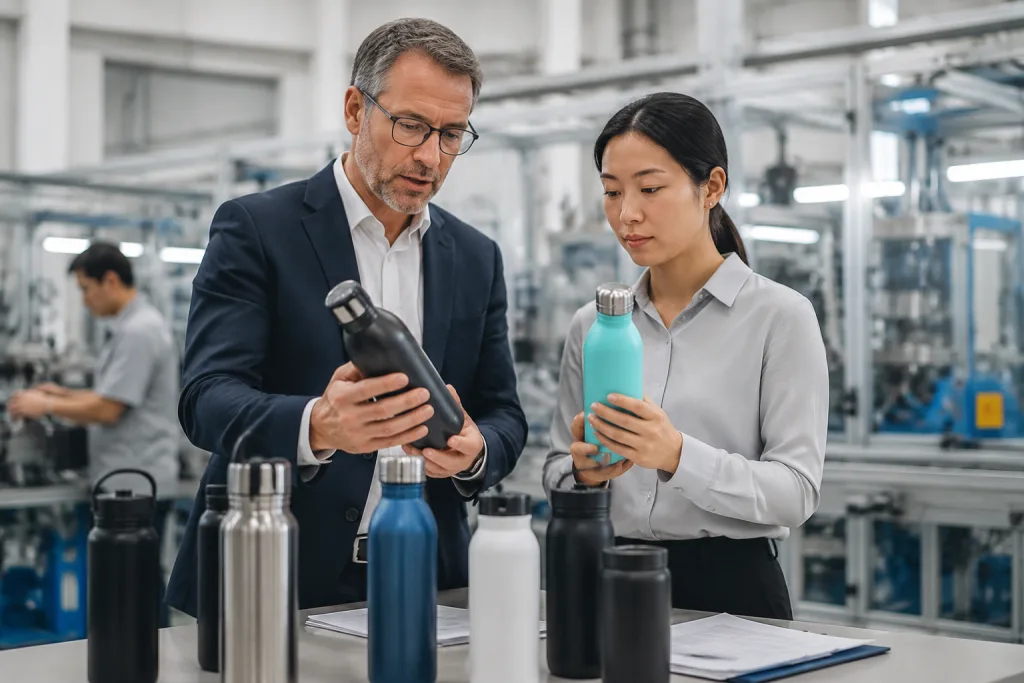
I’ll rewrite the section in-place, keep the HTML tags untouched, and tighten the prose so it sounds like a factory-side sales engineer wrote it.The buyer signed off the pre-production sample on the second round. The first pull had a coating flaw near the shoulder and the lid thread felt loose by hand, so we sent it back and fixed both before mass production. Normal. If a supplier claims the first sample is flawless, I’d question the line. Real factories in China always have a few corrections, and QC pulled the sample twice before we cleared it.
Sample approval is where you test the things that never show up on a PDF: lid torque, leak resistance, coating adhesion, logo abrasion, and drop behavior. For insulated bottles, we check thermal retention at 6 hours and 12 hours, not because every buyer asks for both, but because it tells us the vacuum is holding. For beer tumbler wholesale or beer tumbler bulk orders, we also watch condensation and rim finish; bar buyers will flag a sloppy lip fast. That is the wrong place to cut corners.
If your order includes side products like a bulk canteen or bulk growler, use the same approval sheet. A 1 L canteen may cost $1.20-$2.10 FOB depending on material and cap, while a 64 oz growler for beverage use can run $3.00-$5.20 FOB if it needs a thick wall, handle, and pressure-safe cap. Growler bulk and growler wholesale orders go sideways when the buyer treats them like plain bottles. They are not. We’ve seen the math fail on that assumption more than once.
One habit saves headaches: send a written sample sign-off with photos, dimensions, weight, and tolerances. We ask for it on every run, and we keep the tolerance callout at 3% on weight and 0.5 mm on critical dimensions. If the production lot drifts past that, reject it before packing. A PO typo on the cap color once cost us three days on the line; paper first, then production.
QC the Production Lot Hard
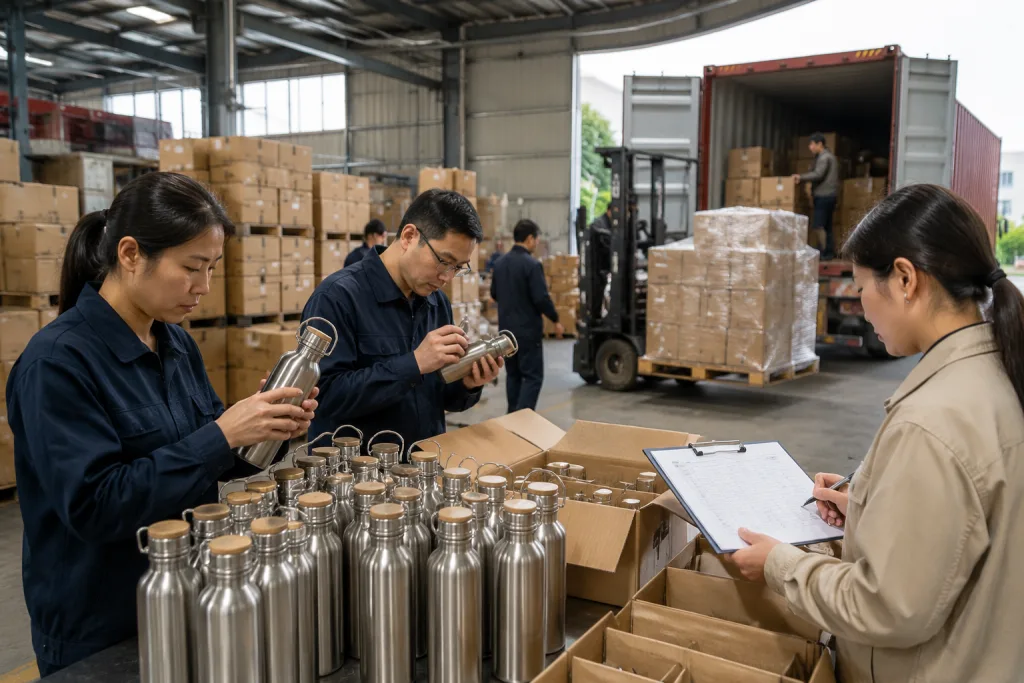
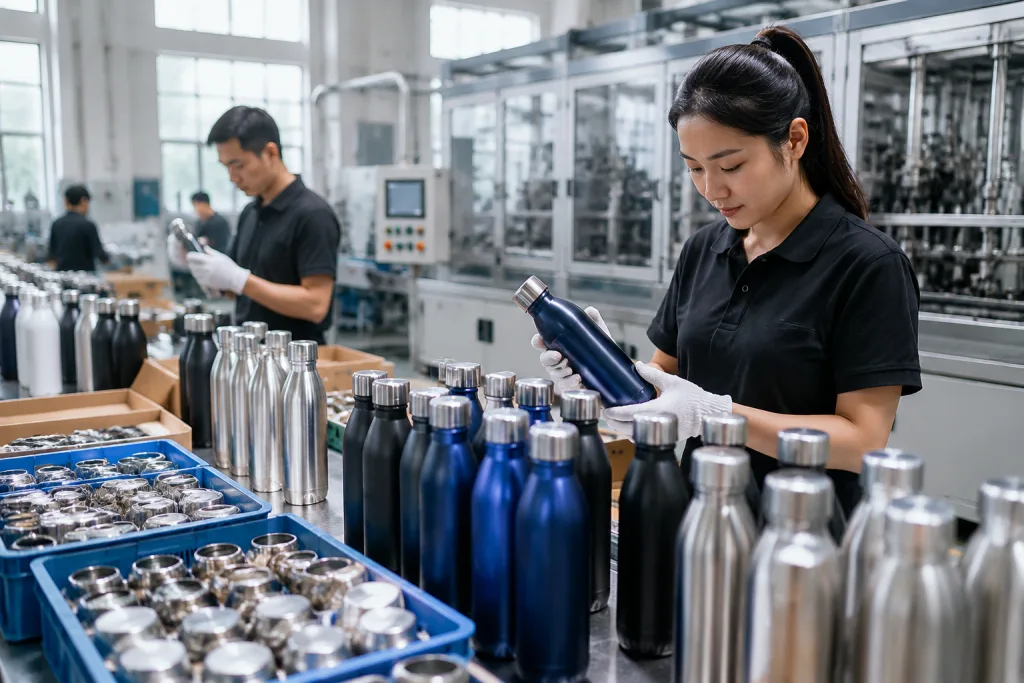
I’ll rewrite the section in place, keep the HTML exactly as-is, and tune the prose to sound like a factory-side sales engineer with sharper QC detail.The run was 3,000 pcs, packed into 100 cartons. We ran inline QC and final inspection before loading, and QC pulled 20 lids for leak checks while the line was still active. AQL 2.5 for major defects and 4.0 for minor defects is the right call for wholesale drinkware. The buyer pushed for 100% lid testing too, because one leaking retail bottle can cost more than a stack of small cosmetic rejects.
QC has to fit the product risk. A plain cold-water bottle gets dimensional checks, finish checks, and a 1 meter drop test. An insulated bottle needs vacuum integrity testing, torque testing, and coating rub tests on the line. For alcohol flask bulk or alcohol flask in bulk orders, we also check cap fit and surface polish, since fingerprints and scratches show up fast. The same goes for alcohol flask wholesale and alcohol flask wholesale bulk programs. This is not the place to cut corners.
- Leak test: 100% lid check, 15-30 seconds upside down
- Drop test: 1 m for standard bottles, 1.2 m for premium packs
- Appearance: no dents, bubbles, color shift, or coating peel
- Carton check: 5-ply outer carton with correct barcode and SKU
At this point, the buyer also asked for compliance docs: REACH for EU sales, FDA food-contact declaration for the U.S., and carton markings that matched the commercial invoice. We once had a PO typo on the SKU, and the buyer flagged it before the truck left; that kind of slip burns a day for no reason. If the factory cannot keep paperwork clean, the goods may pass inspection but the shipment still turns into a mess. Zhejiang exporters know the drill, but we still verify line by line.
Price the Freight and Duties
I’ll rewrite the section in-place, keep the HTML intact, and tighten the copy so it reads like a factory-side sales engineer wrote it.A lot of buyers stop at FOB. That is the wrong number to watch. Landed cost is what hits your margin. On this order, FOB was $2.88, then ocean freight, duty, domestic delivery, and carton handling pushed it to about $4.05. The math still worked because the retail target had room. If your margin is thin, a $0.30 freight swing can break the program.
For beer growler bulk, beer growler in bulk, beer growler wholesale, and beer growler wholesale bulk orders, freight matters even more because the units are heavier and the cartons fill up fast. A 500 ml bottle can load 8,000-12,000 pcs per 40HQ depending on the mold, while a thick growler or flask can cut that by 20-35%. We run into this on the line all the time. Less cube efficiency means higher landed cost per piece, and the buyer feels it on the PO.
If you are comparing suppliers in China, ask for carton size, gross weight, and the loading plan. QC pulled the sample once and found a carton spec typo: 0.58 kg on the PO, but the actual packed weight was 0.74 kg. That kind of miss changes the freight quote fast. A Zhejiang quote that saves $0.22 on FOB can still lose to another factory if the packing is bulky or the pallet plan is sloppy. This is why seasoned buyers keep a landed-cost sheet, not just a price list.
For seasonal programs, I also suggest a 5-8% buffer on quantity. Retail demand moves, and a 2,000-piece under-run on a fast mover can leave you short during peak sell-through. We’ve seen that go sideways more than once. Better to lock the extra units now than chase a rush reorder in the middle of peak season.
Request a real landed-cost quote today
Send your spec, target price, and quantity. We will price the bottle, packing, QC, and shipping so you can buy with fewer surprises.
Frequently asked questions
How do I judge the best wholesale drink bottle price?
Do not judge by FOB alone. The best wholesale drink bottle price is the one that holds after freight, duty, packaging, and defect allowance. Ask for a full cost model: unit price, carton size, CBM, gross weight, logo method, and compliance documents. A bottle that is $0.25 cheaper at factory level can end up more expensive if it ships in a larger carton or needs rework. Buyers who source from China or Zhejiang should compare at least two landed-cost scenarios before they approve the PO. That is the difference between a smart buy and a cheap mistake.