Key Takeaways
- For a standard stainless steel bottle, expect MOQ from 1,000 to 3,000 pcs and lead time of 25–35 days after sample approval.
- A 18/8 stainless body with 0.4 mm wall thickness is common for mainstream retail; 0.5 mm usually gives better dent resistance.
- Budget roughly USD 2.20–4.80 FOB China for simple custom drinkware, depending on capacity, coating, and decoration.
- Ask for REACH, food-contact declarations, and AQL 2.5 inspection terms before you approve any canteen customized order.
If you source from a water bottles vendor, the hard part is not finding a factory in China or Zhejiang. The hard part is choosing the right trade-offs before you place a 5,000-piece order and find the print, leak rate, or 25-day lead time does not match your market. A good vendor makes custom drinkware look straightforward. A weak one tells you every defect is “within normal range” after QC pulled three samples at 1.5 bar and found a cap seal issue.
Buyers in Europe and North America usually have to get four calls right: material, decoration method, compliance, and order economics. Miss one and freight, claims, and rework chew through margin fast. Get them right and one canteen manufacturer in Zhejiang can run repeat programs at 50,000 to 200,000 units per month with stable quality, FOB pricing that holds, and fewer headaches than most sourcing teams expect. The math does not work any other way.
Start With the Market, Not the Bottle
I’ll rewrite the section in place, keep the HTML structure untouched, and tune the tone to sound like a factory-side sales engineer.Most sourcing mistakes start with the product, when they should start with the sales channel. We see this all the time on the line: a water bottles vendor can show ten shapes, but only one or two will fit your customer, your margin, and your ship method. A corporate gifting run needs one spec; Amazon FBA needs another. A distributor canteen order needs carton loading that survives transit, not just a nice-looking sample.
Before you ask for samples, define the use case in plain numbers. Is this a custom canteen for giveaway work at USD 3.50 landed, or a premium customizable drinkware item sold at USD 18–24 retail? Is the buyer school procurement, a gym chain, an outdoor retailer, or B2B resale? That answer changes capacity, lid style, and decoration. We once had a buyer flag a 500 ml bottle for a 1,000 ml PO typo, and the math did not work from there. A 500 ml double-wall bottle landing in a European warehouse at EUR 4.20 cannot be built the same way as a 1,000 ml custom growler for a regional beverage chain.
When a buyer says “I need a canteen custom program,” I ask three things first: target retail, annual volume, and defect tolerance. If those are fuzzy, the factory will define them for you, usually by pushing the easiest spec to run. That is the wrong question to ask if you need a branded program with repeat orders from a canteen supplier in China or Zhejiang. QC pulled a sample at AQL 2.5 last month because the client had not set the tolerance, and we had to stop the packer for 18 minutes to reset the job.
Pick the Right Material First
I’ll rewrite just the prose inside the existing HTML, keep every tag and number intact, and tighten the sales tone so it sounds like a factory-side buyer note.Material sets price, weight, shelf appeal, and the paperwork load. For most B2B buyers, the real call is stainless steel, Tritan, aluminum, or glass. Stainless steel is still the safest default for a canteen manufacturer because it takes vacuum forming, powder coating, and laser engraving cleanly. Tritan fits when you need clarity and lower weight. Glass works for premium desk use, but freight and breakage push landed cost up fast.
For stainless, ask for 304 or 316 on the contact surface and confirm the gauge. A mainstream bottle body often runs at 0.4 mm wall thickness; premium lines may move to 0.5 mm or thicker to cut oil-canning and dent claims. We had a buyer flag a PO typo that changed 0.4 mm to 0.04 mm, and QC pulled the sample before it hit packing. If you are sourcing a canteen customizable SKU for retail, weight matters because a 0.5 mm body can add 25–45 g per unit depending on size. That changes freight and shelf feel. For an outdoor-focused customized growler, the extra weight can be worth it because buyers read heft as durability.
Ask the factory to state the material in writing. A serious canteen factory should show material certificates, passivate stainless where needed, and spell out what is food-contact safe under FDA or EU requirements. If a vendor cannot separate the body material, lid material, and seal material, stop there. The math does not work.
In Zhejiang, many factories can switch between a canteen promotional spec and a premium retail spec without changing the line. We run that split too. It helps only if you lock the stack-up on paper, because we have seen this go sideways: a nice sample ships, then the mass run comes out lighter and cheaper.
Decoration Determines Your Margin
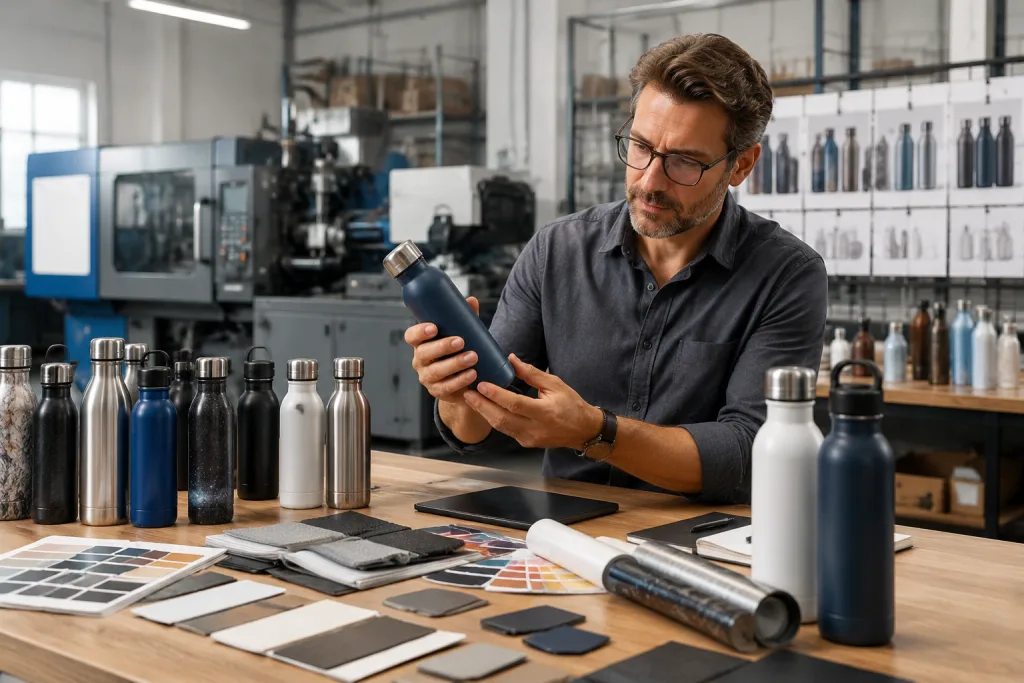
I’ll rewrite this section in-place, keep the HTML structure untouched, and tighten the sales-engineer tone with more concrete factory detail and cleaner margin logic.Decoration is where buyers either keep margin or give it away. A plain screen print can land under USD 0.20 per color at volume, while laser engraving, UV print, or full-wrap heat transfer can add USD 0.35–1.20 depending on setup and surface area. On our line, QC pulled a 50-piece sample set last month and the buyer flagged one wobble in the wrap print. If you are building a customized drinkware line for retail, the decoration method changes cost, shelf appeal, and complaint rate.
For basic logos, silkscreen still wins on speed and cost. For metallic bottles, laser engraving gives a clean, durable mark and skips ink wear. Powder coat with laser reveal sells well for outdoor programs because it looks premium and holds up under abrasion. If you need a canteen customized for a distributor program, watch all-over prints closely: they look sharp in mockups, but curved bodies and seam lines push defect risk up fast. That is the wrong question to ask if you only look at the artwork proof. Ask for a print tolerance sheet, a 1.5 mm registration spec, and the actual scrap rate from the line.
Use decoration to position the product, not to chase every trend. A canteen promotional item should be quick and stable, while a premium customizable canteen can carry a higher FOB price if the finish stays consistent across a 10,000-piece run. We once saw a PO typo change “matte black” to “gloss black,” and the buyer pushed back because the retail set no longer matched the rest of the range. If you want a custom growler for beer or cold brew, make sure the coating survives crate stacking and repeated washing. That matters more than a pretty one-off sample.
Buyer rule: if the decoration adds more than 12% to FOB price, it needs to add visible shelf value.
Check Compliance Before Sampling
I’ll rewrite the section in place, keep the HTML exactly as-is, and make the prose sound like a factory-side sales engineer wrote it.Compliance is not paperwork. It decides whether the shipment clears or sits in a warehouse. For Europe, ask for REACH declarations, food-contact files, and ink or coating statements tied to the target market. For North America, ask for FDA food-contact compliance where it applies, and check the test scope, not just a loose certificate. If the bottle has silicone seals, lids, or plastic straws, each part needs its own declaration.
A serious canteen supplier in China knows the drill, but you still need to be specific. We had a Germany buyer flag an order because the odor test was missing, and the PO typo said “stainless lid” on a plastic cap part number. For a U.S. drinkware program, Proposition 65 exposure on decorative coatings can matter, depending on the material set. If the factory just says “safe” and cannot name the standard, the answer is no.
Ask for the test plan before production starts: dimensional check, leak test, cycle test, dishwasher resistance if needed, and packaging drop test. On the line, we usually run AQL 2.5 for major defects and AQL 4.0 for minor defects, though a buyer can tighten that if the margin allows it. QC pulled one sample at 1.2 mm wall variance last month, and that would have slipped past a casual check. Volume does not fix weak control. It only makes mistakes more expensive.
Understand MOQ, Price, and Lead Time
I’ll rewrite the section to sound like a factory-side sales engineer, keep the HTML unchanged, and make the pricing/lead-time points more concrete with fewer AI-isms.Price only makes sense when you know what drives it. For a standard stainless bottle, MOQ usually starts at 1,000 pieces for a simple print and 3,000 pieces if you want custom packaging or color matching. We’ve run 500-piece trial orders before, but the unit price usually jumps 20% to 40%. That works for a new SKU test. It is the wrong math for a repeat item.
On FOB China terms, a plain 500 ml double-wall bottle often lands around USD 2.20–3.20, while powder coating or laser engraving pushes it to USD 3.50–4.80. Add a gift box, and you’re looking at another USD 0.25–0.80 per set, depending on board grade and the insert structure. If you are sourcing a canteen vendor for a distributor program, ask for tiered pricing at 3,000, 10,000, and 30,000 pieces. We run those breaks every week. Good Zhejiang suppliers show real steps, not made-up discounts.
Lead time matters just as much as unit price. A normal plan is 7–10 days for samples, 20–30 days for tooling tweaks or artwork approval, and 25–35 days for mass production after deposit and the approved pre-production sample. QC pulled one lot here last month and flagged a lid print mismatch by 1.5 mm; that kind of thing adds a few days fast. Peak season in China can add 1–2 weeks, so if your importer calendar depends on back-to-school or Q4 gifting, build that slack in early.
Do not compare only ex-factory price. Compare landed cost, defect allowance, and carton efficiency. A canteen manufacturers quote that is USD 0.18 lower but ships in weak cartons can cost more after 1% damage in transit. The buyer flagged it on the first shipment, and we had to re-pack 240 cartons by hand.
Judge the Factory, Not the Sales Pitch
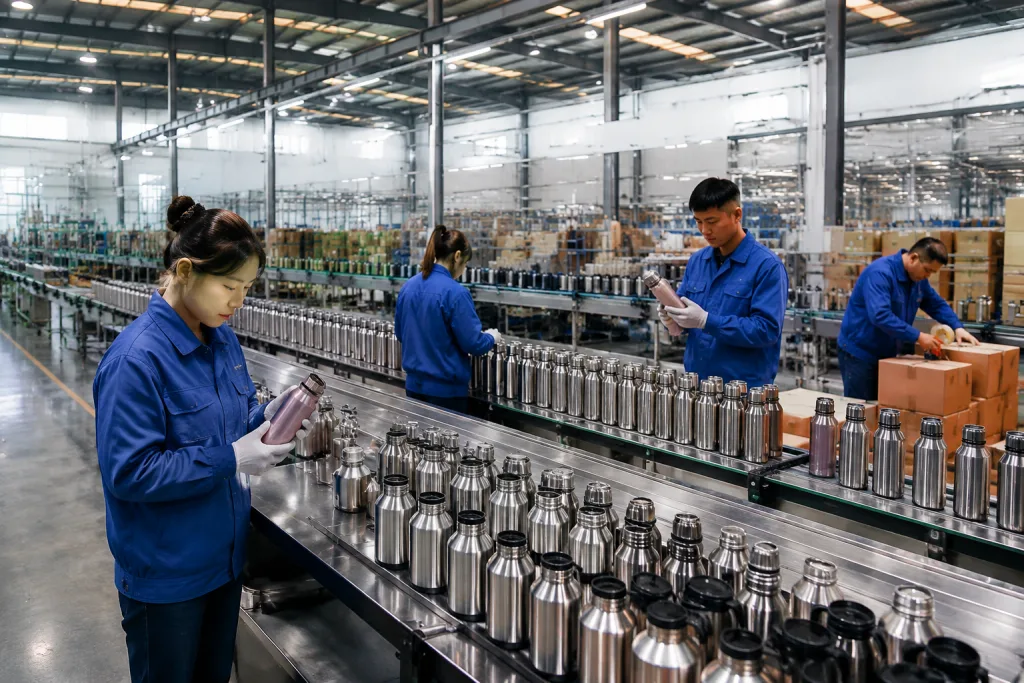
I’ll keep the tag structure intact and rewrite the prose to sound like a factory-side sales engineer, with concrete shop-floor detail and fewer brochure lines.A real canteen factory should talk straight about welding seams, vacuum leak testing, coating thickness, and packaging loss. If a water bottles vendor cannot answer those without checking back three times, you are dealing with a sales desk, not a line. We run in Zhejiang, and the stronger shops here usually have 2 to 6 bottle lines, with monthly output from 30,000 to 300,000 units depending on SKU mix. That number matters when a distributor order needs the same finish on PO 1 and PO 8.
Ask for these details before you approve a PO:
- Factory audit status such as BSCI or other social compliance where required by your market
- Inspection method, including in-line checks and final AQL sampling
- Carton drop testing and export carton burst strength
- Spare lid, seal, and gasket policy for after-sales support
Watch how the vendor handles product families. A solid canteen manufacturer can move from a basic canteen custom job to a canteen customizable retail line without changing the core process, and that keeps the 38 mm neck, cap torque, and packing method under control. We’ve seen buyers push for one-off changes that blow up the line; the math does not work. It gets cleaner when the same factory can ship a customized canteen and a matching customized growler in one carton program, because freight stays simpler and the brand looks tighter.
If the factory is in Zhejiang, China, ask what they do in-house for metal forming, vacuuming, and coating. We check this with a simple gauge and a vacuum tester on the shop floor. The more steps they run inside the plant, the less chance you get a 12-day lead time on sample approval and an 18-day wait on rework because one coating batch drifted on color.
Build a Spec Sheet That Prevents Arguments
I’ll rewrite just the prose inside the existing HTML, keep the tags intact, and make it read like a shop-floor buyer note with concrete details.Your spec sheet should read like a contract, not a mood board. Put down capacity in ml and oz, material grade, wall thickness, lid type, seal material, finish, logo method, packaging, carton count, master carton dimensions, and target AQL. We run into trouble when a buyer leaves out one line item. For a custom drinkware program that has to repeat cleanly, the spec sheet does more work than the sample approval photo.
For a canteen distributor or distributor drinkware buyer, add barcodes, FNSKU if you sell through Amazon, and the exact retail pack rules for your channel. If the product goes to schools or corporate gifting, call out gift box inserts and handling marks. If you are making a custom canteen for a sports campaign, list cap color, lanyard length, and whether the strap must pass 5,000 flex cycles. We had a buyer flag a PO typo on strap length once, and the line had to stop. Fussy? No. The first bad carton tells you why.
One rule we stick to: get every change confirmed in writing before tooling starts. One color change, one lid swap, or one new carton spec can add 3 to 7 days and a pile of hidden cost. The math does not work otherwise. The better canteen suppliers write revisions into the PO and send back a redline; the weak ones say “no problem” and send the invoice later.
Send your spec sheet and target price
We’ll quote MOQ, decoration, compliance, and lead time from our Zhejiang factory, then map the right water bottles vendor setup for your channel.
Frequently asked questions
How do I choose between print, laser, and full-wrap decoration?
Use print when you want the lowest cost and simple branding. Use laser engraving when you need a durable mark and a premium look, especially on stainless steel. Use full-wrap decoration when shelf impact matters more than production simplicity. Print is usually the cheapest, often under USD 0.20 per color at volume. Laser may add USD 0.35–0.70 depending on coverage. Full-wrap can add even more due to setup and defect risk. For a canteen promotional order, print is usually enough. For a retail custom growler or premium canteen customizable line, laser or powder-coat reveal often sells better.