Key Takeaways
- A serious canteen factory should quote MOQ, lead time, and monthly capacity; a practical baseline is 3,000 units MOQ and 30–45 days lead time.
- For custom drinkware, expect FOB pricing around USD 1.20–4.80 per unit depending on material, print, and lid complexity.
- QC should include AQL 2.5 for critical defects, leak tests on 100% of sampled lids, and carton drop checks before shipment.
- If you need a canteen distributor, canteen manufacturer, or canteen supplier relationship, compare sampling speed, REACH paperwork, and post-print color consistency, not just unit price.
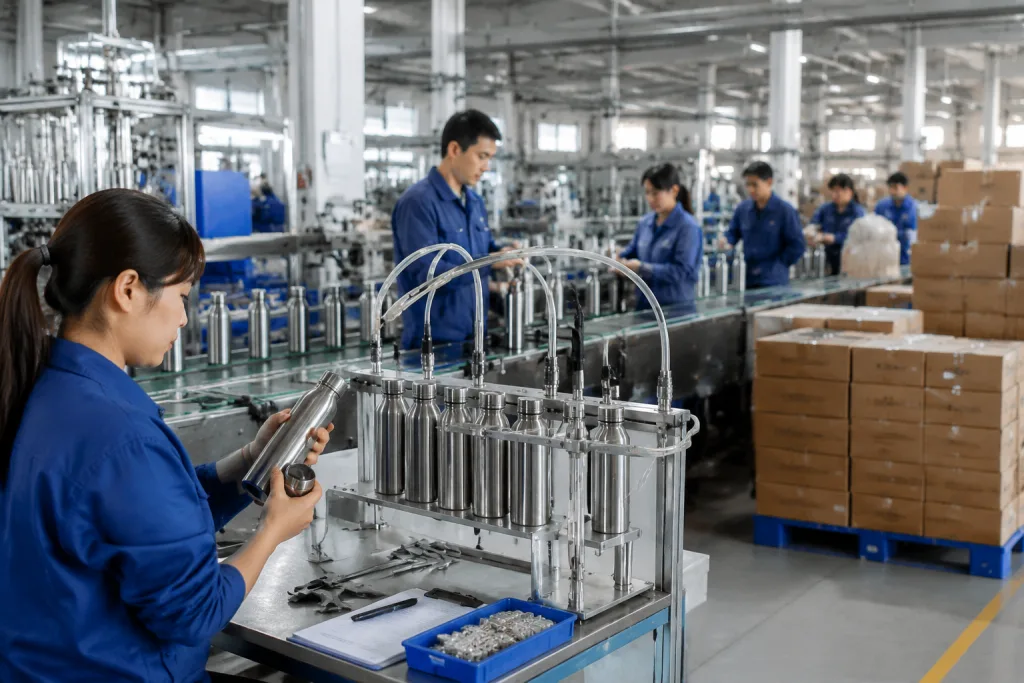
You are not buying a “water bottle.” You are buying a production run, a packing spec, and a shipment that still has to clear customs, warehouse handling, and customer complaints. That is why water bottles suppliers get judged on more than a catalog photo. If you source from Zhejiang or anywhere else in China, the real test is simple: can the factory hold tolerances, keep Pantone colors steady, and ship on schedule without burying defects under the finished carton.
The safe way to place an order is to walk it end to end: define the bottle, lock the print, check the first article, inspect the bulk run, and confirm the cartons before FOB booking. We see this fail over a 1 mm lid gap, a 0.2 mm coating swing, or one missing FNSKU label. QC pulled the sample, the buyer flagged it, and the line had to rework the lot. This is the wrong question to ask if you start with “what’s your lowest price?”
Start with the buyer scenario
I’ll rewrite the section in place, keep the HTML tags intact, and tighten the sales-engineer tone with more concrete factory-floor detail.Picture a distributor in Germany booking a 12,000-unit order for a custom canteen to sell through gyms and outdoor stores. The spec looks simple: stainless steel body, screw lid, matte powder coat, one-color logo. The real risk is not the shape. It is picking water bottles suppliers that talk fast and ship late, or that send an approval sample that does not match the mass run. We have seen that go sideways on the line.
Start with the use case. Is it a canteen promotional item for events, a retail customizable canteen, or a premium customizable drinkware line for a brand owner? The answer changes the spec sheet. A promo bottle can run with a thinner wall and a basic lid. A retail bottle needs tighter fit, better coating, and cleaner laser engraving. On one order at our Zhejiang plant, the buyer wanted a 750 ml bottle with 304 stainless steel, 0.5 mm wall thickness, and a bamboo-style lid. We quoted 5,000 MOQ, 35 days production, and QC pulled the sample through two seal compounds before sign-off. That is the level of detail a real canteen manufacturer or canteen supplier should give you.
Before you ask for price, ask for four facts: material grade, logo method, carton count, and shipment term. If those are vague, the quote is fake. A canteen vendor that cannot tell 201 from 304 stainless steel is not ready for export work. The math does not work.
Lock the product spec first
I’ll keep the tags and structure intact, rewrite the prose in a more shop-floor voice, and make the spec details sharper without adding fluff.The fastest way to blow up a custom order is to start with artwork before structure. We always ask about body material, lid type, finish, capacity, and target market first; print comes later. A custom growler is not the same job as a slim sports bottle, even if the logo panel looks close.
Use a spec sheet with hard numbers. Say 500 ml, 304 stainless steel inner wall, 201 outer shell if the price is tight, 0.4–0.5 mm wall thickness, powder coat at 60–80 micron, PP lid with a silicone gasket, and a 1.0 meter drop test for retail packs. We had a buyer flag a PO typo on neck size once, and the caps did not fit; the math does not work when the supplier is guessing. A canteen customizable order can be built to those numbers, but the supplier still has to confirm tooling, closure match, and neck diameter.
- Material: 304, 316, Tritan, or food-grade PP.
- Capacity: 350 ml, 500 ml, 750 ml, or 1,000 ml.
- Decoration: silkscreen, laser engraving, UV print, or wrap label.
- Compliance: REACH for Europe, FDA-style food contact declaration for the U.S., plus lead and phthalate limits where needed.
If you want a customized canteen that feels retail-ready, ask for a pre-production sample with the final finish and the final lid. A body sample by itself is weak. QC pulled the sample on our line last month, and the leak showed up at the cap after 12 days in transit testing, not on the bottle body.
Price the order like a buyer
I’ll rewrite the section in-place, keep the HTML tags intact, and tune the wording to sound like a buyer-side sales engineer with concrete pricing detail.Price only makes sense when you know what is inside it. A plain 500 ml stainless bottle from a Zhejiang factory may land around USD 1.20–1.80 FOB at 3,000 pieces, while a powder-coated model with laser logo and an upgraded lid can move to USD 2.20–3.60. A double-wall growler or a large customized growler can reach USD 4.00–7.50 depending on finish, vacuum performance, and the cap set. That spread is normal.
What matters is whether the supplier breaks out the drivers: raw material, print setup, packaging, testing, and carton count for export. If a quote is just “USD 2.10 each,” you still do not know whether the canteen factory has included inner boxes, spare lids, or a carton drop test. A proper quote from a canteen factory in China should show MOQ, sample cost, production lead time, and the price break at 5,000, 10,000, or 30,000 pieces. We run this check on the line every week.
For distributor canteen programs, ask for tier pricing. Distributors need margin. If your landed cost leaves only 18% gross margin, the math does not work after QC, carton rework, and inland trucking. A better target for many B2B programs is 28%–42% gross margin. QC pulled a sample with a lid typo once, and the buyer flagged it before shipment.
“Cheap per unit” is often expensive per claim. One bad lid batch can wipe out the savings from a lower FOB price.
Check samples before mass production
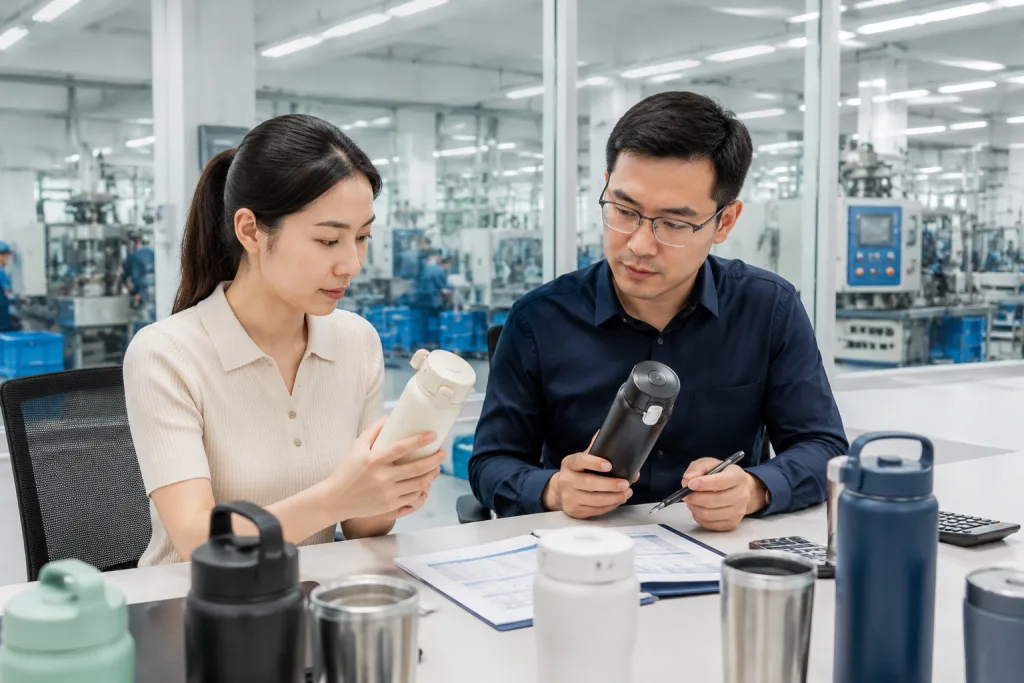
I’ll rewrite the section to sound like a factory-side sales engineer, keep the HTML exactly as-is, and tighten the language with concrete shop-floor details.Sampling is where a real canteen supplier earns the order. We run three checks every time: appearance sample, functional sample, and packed sample. The appearance sample covers Pantone match, logo position, and coating feel. The functional sample checks lid torque, leak resistance, and whether the bottle still works for the buyer’s use case. The packed sample checks carton crush strength and shelf-ready presentation.
For a canteen customizable order, we always ask for a signed sample reference. Take a photo of the logo position, measure the print height in mm, and record the lid color code on the PO. If the buyer says “same as sample” but never archived the sample, that’s a bad bet. In our Hangzhou line, the golden sample sits with the production traveler, and QC pulls the same piece for every first-article check.
Good suppliers test variant risk before the line starts. If you order a custom drinkware set with two lid colors, sample both lids, not just the best-looking one. If you order a custom growler with a carry handle, load-test the handle at 8 kg, because that’s where weak molding shows up. If you need a customized drinkware program for retail, ask for a carton-packing trial; we’ve seen label offsets of 3 mm turn into barcode scan problems at dispatch.
- Leak test: inverted for 24 hours.
- Thermal test: 6–12 hours, depending on vacuum construction.
- Torque test: repeated open-close cycles on lids.
- Color check: Delta E target below 2.0 where applicable.
Run QC like it matters
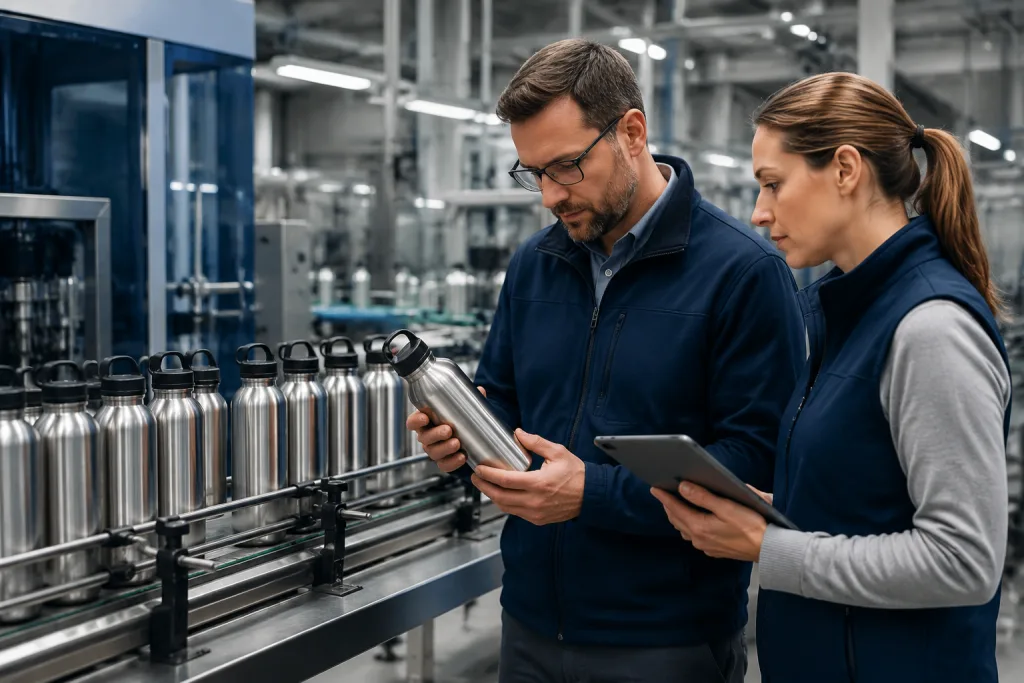
I’ll rewrite the section in place, keep the HTML structure intact, and make the QC language sound like a real factory-side sales engineer. Then I’ll give you only the cleaned HTML.Most buyer pain starts after approval, not before. That is why water bottles suppliers should show a real QC flow, not a promise on paper. For export work, AQL 2.5 is a normal starting point for major defects, with tighter control on leak-related items. On one 20,000-unit stainless order, QC pulled random cartons by lot, checked 100% of sampled lids for seal defects, and held the batch until the carton compression test passed at 25 kg.
You do not need to audit every screw cap yourself, but you should know what the factory is checking on the line. At minimum, verify weld seams, coating coverage, logo sharpness, cap fit, odor, and carton labeling. If the product is for Amazon or retail distribution, add FNSKU or UPC label verification and master carton mark checks. A distributor drinkware program breaks when labels are wrong more often than when the bottle body is wrong — we’ve seen that go sideways on a 5,000-piece PO with one typo in the barcode field.
A practical canteen distributor checklist looks like this: one signed sample, one production photo set, one pre-shipment inspection report, and one packing list that matches the order quantity within 0.5%. If the factory cannot provide those documents, the math does not work. A canteen manufacturer in China that ships to Europe and North America should also show REACH declarations, food-contact documents, and, if requested, BSCI or similar social audit records. We usually ask for the report number, not just a PDF screenshot.
Do not skip carton tests. A bottle can pass leak checks and still arrive crushed because the shipper used a weak outer carton or too much empty space. In Zhejiang, the better factories treat packaging as part of the product, not an afterthought — one drop test at 80 cm tells you more than a nice sales deck ever will.
Choose the right supplier type
I’ll rewrite the section in-place, keeping the HTML and structure intact while making the prose sound like a real export sales engineer wrote it.Not every seller does the same job. A canteen distributor can move stock fast, but a canteen manufacturer or direct factory gives you control over tooling, coating, and packaging. A canteen vendor works for mixed baskets, while a dedicated canteen supplier or canteen suppliers network can open a wider catalog but brings less engineering depth. For a lid change, a wall thickness tweak, or a packed gift set, we go factory path.
If you need a customized canteen with a special lid, the factory is the deciding factor. If you need a distributor canteen program with repeat orders and stock ready on the shelf, a distributor can save time. If you want a canteen promotional SKU for a campaign, a supplier with quick logo setup and a 1,000-piece or 2,000-piece MOQ is usually the cleaner fit. This is the wrong question to ask: “who is cheapest?” Ask which supplier type matches the buying problem.
Our Hangzhou, Zhejiang plant runs about 300,000 units a month across stainless and Tritan lines, with a normal MOQ of 3,000 pieces and lead times of 30–45 days depending on decoration and season. QC pulled a sample last week at 0.3 mm over spec on the lid seat, and that is the kind of issue a factory catches before the buyer flags it. When a retailer asks for a second shipment 18 days after the first one lands, that control matters. China has plenty of factories; Zhejiang has a lot of capable ones. The math does not work if the supplier can make one good sample but cannot repeat it.
Ask blunt questions: Do you own the tooling? What is your monthly output? How many QC staff do you assign per line? Can you support a canteen custom print change without restarting the whole order? We once saw a PO with “cantenne” in the product name and the buyer still wanted the same artwork; the factory that handled it cleanly saved the deal. Straight answers save weeks.
Send your spec and get a real quote
Share capacity, lid type, logo method, and target market. We’ll price the order, confirm QC points, and flag any risk before production starts.
Frequently asked questions
How long does production usually take in China?
A normal lead time is 30–45 days after sample approval and deposit, depending on decoration, season, and whether tooling already exists. Simple stock-body branding can ship faster, sometimes in 20–25 days. A new canteen customized project with a new lid or mold can take 45–60 days before bulk starts. If the supplier promises 10 days on a complex vacuum bottle, be careful; they may be quoting inventory they do not actually control. In Zhejiang, better factories will tell you exactly when the sample is signed, when raw material is bought, and when the line slot is reserved.