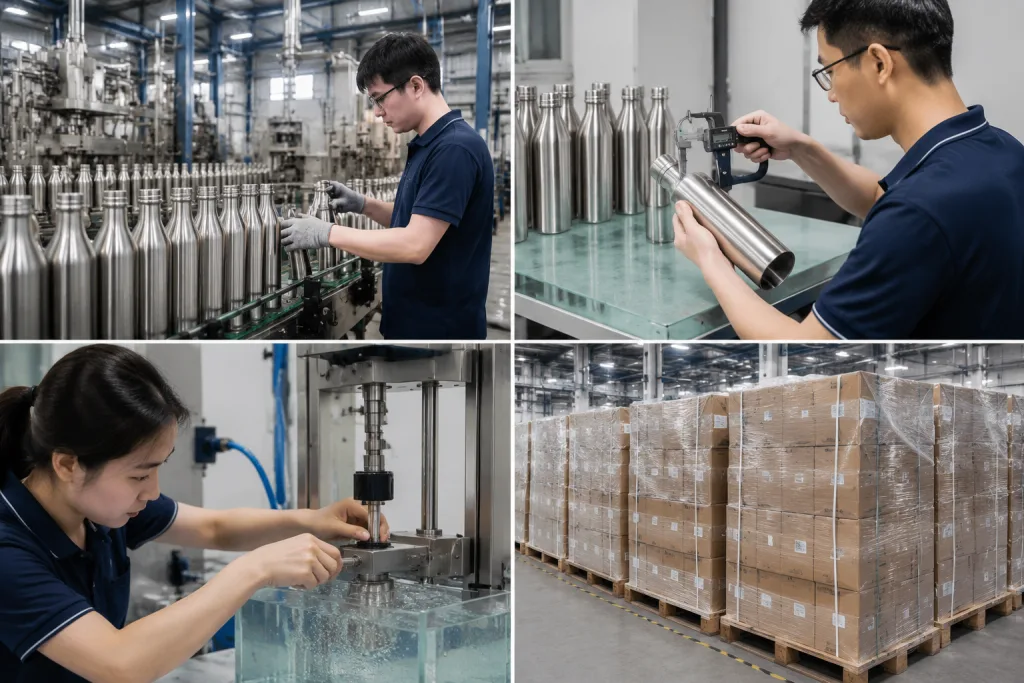
Key Takeaways
- A workable MOQ for standard custom drinkware is often 500-1,000 units; complex canteen customized runs usually start at 3,000 units
- FOB Zhejiang pricing for basic stainless bottles can sit around USD 2.10-4.80 per unit depending on steel grade, finish, and accessory count
- A serious factory should show 30,000-80,000 units/month capacity, AQL 2.5 inspection, and a clear 20-35 day lead time
- REACH, LFGB, and BPA-free statements matter, but you still need gasket, coating, and migration details before approving production
If you buy from a water bottles supplier, the sample bottle is rarely where things go wrong. The production run is. We have seen wall thickness drift by 0.2 mm, caps start leaking after 20 open-close cycles, and printed logos scratch off in carton rub tests. Lead time can jump from 25 days to 60 when the line gets busy.
Read drinkware like a procurement engineer, not a catalog shopper. Check material grade, capacity tolerance, gasket material, carton count, drop-test target, and whether you are dealing with a canteen factory, a canteen manufacturer, or a trading layer. That is the wrong place to be vague. On a 10,000-unit order, a 0.8 mm wall and a 1.0 mm wall do not price the same, and QC pulled the sample differently when the buyer flagged the PO with the wrong logo file.
Start with the shell and steel
I’ll rewrite the section in-place, keep the HTML exactly as-is, and tighten the sales-engineer tone with concrete factory details and numbers.The first line item on any bottle spec sheet is the shell. For stainless models, ask for 304 or 316 on both inner and outer walls, then pin down wall thickness. We run 0.35-0.45 mm on lightweight promo bottles and 0.50-0.70 mm when a buyer wants steadier thermal performance. If a supplier only names the grade and skips the gauge, the quote is not ready for comparison.
This is the wrong question to leave vague. 304 gives the best cost-performance ratio for mass-market custom drinkware, and that is where most orders belong. 316 earns its place in coastal shipping, salt exposure, or a custom growler that sits in rough conditions. For school, office, and retail water bottles, 304 is the baseline. A 0.2 mm change in wall thickness can shift insulation by hours on vacuum models and also changes how well the body survives carton pressure in transit.
Ask for the steel source and the forming method. On our line in Hangzhou, QC pulled the sample before packing when the neck finish was 0.3 mm off, and that saved a cap complaint later. Good canteen suppliers will tell you if the body is deep-drawn, seam-welded, or hydroformed. If your PO says “stailess” instead of “stainless,” the buyer flagged it for a reason. Thinner steel may save USD 0.18-0.35 per unit, but the math does not work if you eat damage claims and returns.
Read the lid like a failure report
I’ll rewrite the section in place, keep the HTML structure unchanged, and make the copy sound like a buyer-side sales engineer with concrete factory detail and tighter wording.Caps create most of the headaches in customized drinkware. The body can pass QC and the bottle still leaks because the lid geometry is off, the silicone gasket is undersized, or the hinge wears out after repeated opening. We run a torque check on the lid line, and the spec sheet should show lid material, gasket material, torque range, and cycle target. For a canteen customizable program, I want 3,000 open-close cycles for sport lids and 5,000 for screw caps before I trust the design for wider rollout.
Pay attention to the seal. Silicone is standard, but not all silicone behaves the same. Ask for the food-contact declaration and check whether the gasket comes out for washing; if the buyer flagged that point late, the whole order slows down. On flip lids and straw tops, we ask for a leak test at 1 meter inverted for 10 minutes, then another test after thermal cycling. Cheap canteen vendors often slip there. A bottle that passes first check can still drip after hot fill or cold soak because the parts shrink at different rates.
- Best practice: demand assembly photos for the cap stack-up, not just a sample shot.
- Red flag: a supplier cannot name the gasket material or sends “rubber” on the PO.
- Buyer impact: a faulty lid can push e-commerce returns into the 2-5% range.
If you are comparing canteen promotional models, do not pay extra for decorative lids that add weight but no function. Put the money into a better seal and parts the buyer can replace without a fight.
Capacity, tolerance, and carton math
I’ve got the section and constraints. Next I’m rewriting the prose in-place, keeping the HTML tags and the heading structure untouched.Capacity looks simple until the first shipment leaves the line. A bottle listed at 750 ml may pour 720 ml or 780 ml, depending on the shoulder shape and the measuring method. We track three numbers: nominal capacity, overflow capacity, and usable capacity. For retail packs, ±3% is common, but for distributor canteen orders we push for tighter control, because one bad spec sheet turns into buyer complaints fast.
Carton math matters just as much. A water bottles supplier should give unit carton size, master carton count, gross weight, and pallet pattern. We’ve seen a 2 mm diameter change cut a carton from 48 pieces to 36 pieces per cube. That is not a small miss. On a 20-foot container, the freight gap can run into thousands of dollars, and the buyer will flag it the minute the landed cost creeps up.
This is where a canteen distributor and a canteen factory split. The factory knows the fill line, carton compression limit, and how much headspace the bottle needs to survive vibration on a 1.2 m drop test. A middleman often only has the retail spec. For distributor drinkware programs, ask for a shipping spec sheet, not a sales brochure. We want carton drop-test results and outer box burst strength, tied to ASTM D4169-style thinking even if the plant does not print the standard name on the sheet.
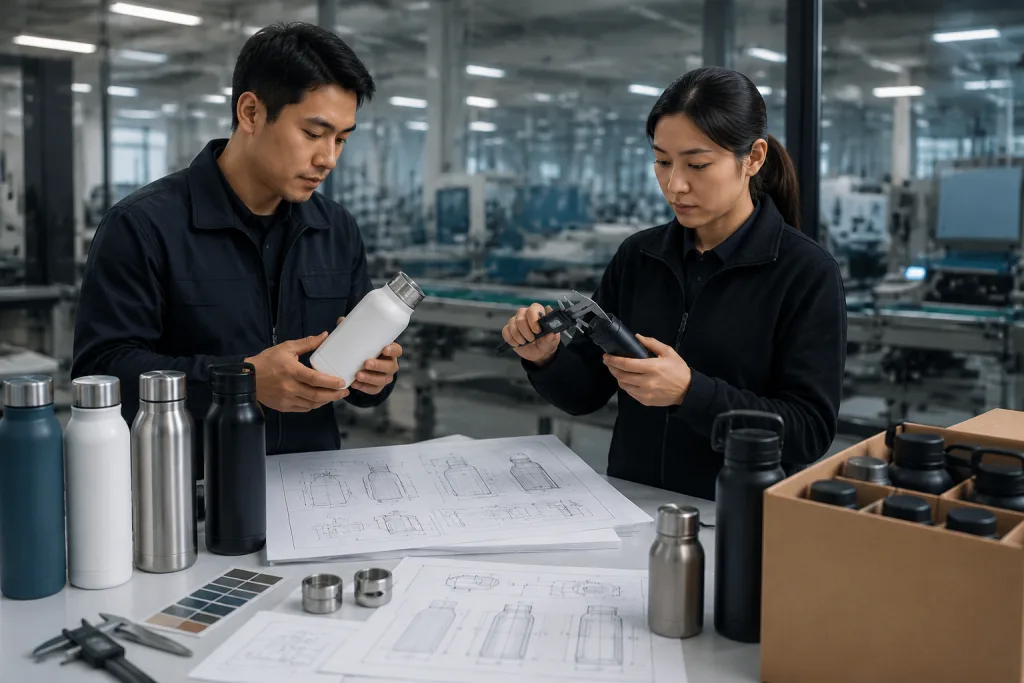
Decoration changes cost and yield
I’ll rewrite the prose in-place, keeping the HTML tags and the pricing numbers intact, and I’ll make it read like a factory-side sales engineer wrote it.Printing is a process call first, not a decoration call. Screen print, pad print, UV print, laser engraving, and heat transfer behave differently on curved steel and powder-coated shells. For a simple two-color logo, silkscreen usually wins on cost. For a premium custom canteen that needs abrasion resistance, laser engraving gives a cleaner mark. Full-color retail art is where UV print comes in, but we insist on a tighter approval round because scratches show up fast.
Ask the canteen manufacturer where the coating comes from and what cure profile they run. A soft powder coat feels good in hand, but if it chips during reverse packaging, QC will catch it before the cartons close. We’ve seen buyers blame the decorator when the real problem was a 180°C cure mismatch on the line. The buyer flagged it on a sample, and that saved a 3,000 pcs order from a mess.
On cost, decoration can add USD 0.12 for one-color print, USD 0.35-0.90 for more complex multi-step branding, and USD 0.20-0.60 for laser, depending on setup and order size. If a canteen supplier gives you a number that looks too soft, check whether artwork setup, fixture cost, and reprint allowance are inside the quote. One PO typo on “laser” versus “silkscreen” once changed the margin by 8%, so the math does not work if the spec is loose. For canteen customized programs sold through distributors, paying a bit more per unit is better than shipping a print that flakes after 30 dish cycles.
Spec sheets should tell you what survives shipping, washing, and resale. Pretty is not the same thing as profitable.
Compliance is a buying tool
I’ll rewrite the section in-place, keep the HTML tags exactly as-is, and tighten the sales-engineer tone with concrete shop-floor details and fewer generic phrases.Compliance is not file work; it is a fast filter for supplier quality. For Europe, ask for REACH statements and, where relevant, LFGB food-contact support. For North America, check FDA food-contact suitability, BPA-free declarations for plastic parts, and any state-specific requirement if you sell through retail or Amazon. If the bottle has a straw, lid insert, or grip sleeve, each material needs its own paper trail.
Do not accept a generic certificate with no product detail. A real canteen factory in Zhejiang should show batch traceability, raw material lot numbers, and the test scope. On our line, QC pulled one sample with a 0.8 mm wall-thickness mismatch, and the buyer flagged it before packing. For a branded launch, keep the approval sample, color standard, and signed test reports in one folder; that saved one customer 12 days when Amazon asked for documents.
For retailers and canteen distributors, I also ask about BSCI or a similar social compliance file if you plan to scale. It will not make the bottle better by itself, but it cuts audit friction. We have seen this go sideways when a PO typo changed the sleeve material code and the factory trace sheet no longer matched. Many factories can ship a clean sample; fewer can keep documented traceability on repeat orders. That is the gap you need to close.

MOQ, lead time, and realistic pricing
I’ll rewrite the section in place, keep the HTML exactly as-is, and tighten the sales-engineer tone with concrete factory details and cleaner pricing language.Your buying decision should start with the numbers the factory will sign off on. A Zhejiang water bottles supplier may quote MOQ 500 units for plain stock bodies with logo print, 1,000 units for color-coated custom drinkware, and 3,000 units for canteen builds that need a special lid or mold change. If someone says 100 units works for every setup, the math does not work. We’ve seen that go sideways on the line when the buyer flagged a last-minute cap change and the supplier had no backup parts.
Lead time is just as blunt. For straight orders, 20-25 days after sample approval is normal. New colors, multi-step decoration, or fresh molds need 30-45 days, and that is the honest window. Our line runs about 60,000 units per month on mainstream bottles, measured by the carton counter at packing, so repeat distributor programs can move without sitting behind tiny orders. Peak season still bites, so book the slot early.
On FOB Zhejiang terms, simple stainless bottles often sit around USD 2.10-3.20, insulated bottles around USD 3.40-6.80, and premium custom growler programs go higher based on finish and cap system. A proper canteen supplier should split out tooling, decoration, and packaging on the quotation. We had one PO with a typo on the cap spec, and QC pulled the sample before production; that saved a full batch rework. Compare canteen suppliers on the same sheet, not on the lowest first email.
If you are building a distributor canteen line, ask for a quote that shows overage allowance, AQL level, spare parts policy, and replacement terms. Price is not just unit cost. It is the cost of fixing defects without eating your margin.
Send your spec sheet for a fast quote
We review MOQ, materials, decoration, and compliance before pricing, so you get a usable offer from a Zhejiang factory, not a vague estimate.
Frequently asked questions
What MOQ should I expect from a water bottles supplier?
For stock-shaped custom drinkware, 500-1,000 units is a normal MOQ if you are using existing molds and standard decoration. Once you change the lid, body profile, or coating, the MOQ often rises to 3,000 units. For a custom canteen or custom growler with tooling, 5,000 units is common if you want a competitive FOB price. Small trial orders are possible, but the unit price usually jumps 15-30% because setup and labor are spread over fewer pieces.
How do I compare canteen manufacturers on quality?
Ask for three things: material certificates, a QC flow, and a sample approval record. A serious canteen manufacturer will show incoming material checks, in-process leak tests, and final AQL results, usually AQL 2.5 for major defects. For insulated products, ask for thermal retention data under a defined test setup, not a marketing claim. If the plant cannot explain weld quality, gasket source, or coating cure, you are not comparing manufacturers yet; you are comparing salespeople.
What is a fair lead time for customized drinkware?
For repeat orders with standard print, 20-25 days after sample signoff is fair. For canteen customizable programs with new colorways or special packaging, expect 30-35 days. New mold or new cap development usually pushes the schedule to 45 days or more. In Zhejiang and across China, factories can move quickly, but only if you approve artwork and packaging on time. Late approvals add more delay than machining does.
What compliance documents should I request for Europe and North America?
For Europe, request REACH support and, when relevant, LFGB food-contact proof for the bottle, lid, gasket, and straw materials. For North America, ask for food-contact suitability, BPA-free declarations where plastics are involved, and any testing tied to your product configuration. If you are importing through a distributor canteen channel, keep the final packing list, carton labels, and traceability records together. For Amazon or retail, that paperwork can save you from costly holds.
How should I think about price versus margin?
Do not stop at the FOB number. A bottle at USD 2.35 can become more expensive than a USD 2.75 option if the cheaper one has higher breakage, slower packing, or worse print durability. Add freight efficiency, defect allowance, and replacement cost. On a 10,000-unit order, a 2% defect rate can erase several hundred dollars of margin fast. A good canteen supplier should help you balance price, yield, and service, not just quote the lowest sticker number.