Key Takeaways
- A 5,000-unit MOQ is common for water bottles private label; below that, setup costs usually distort unit pricing.
- Leak failures often come from cap tolerance, not the bottle body; ask for 100% cap torque and vacuum or inverted-leak checks.
- A 0.35 mm stainless wall is cheaper but dents faster; 0.45 mm is a safer spec for retail and distributor drinkware.
- Lead time from a Zhejiang canteen factory is often 25-35 days after artwork approval, not after PO alone.
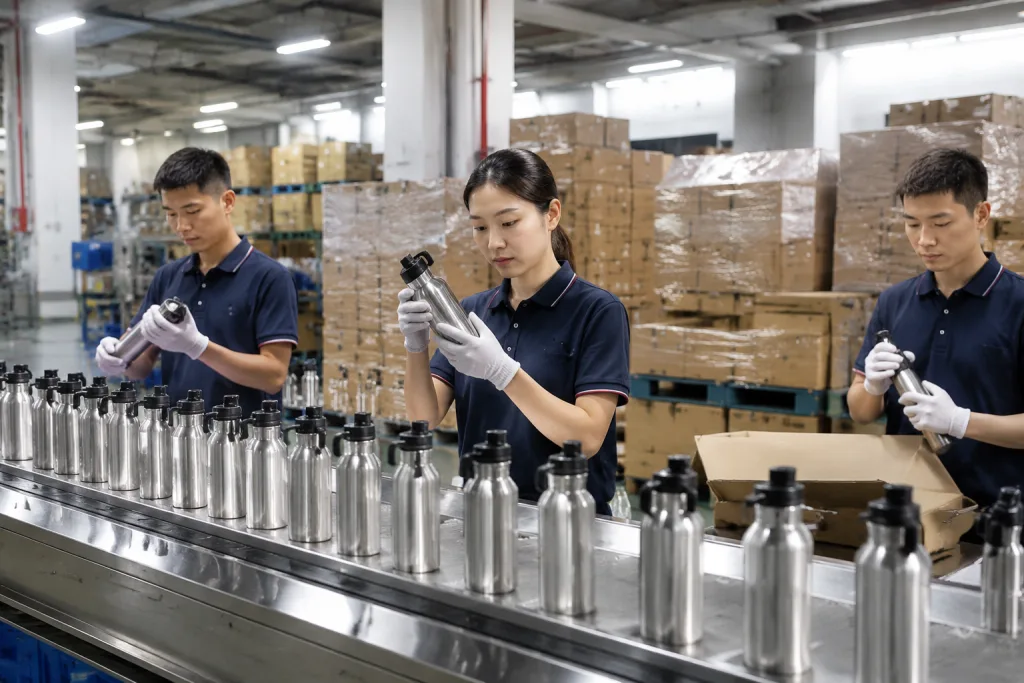
Private label water bottles look simple until the first PO hits the line. Then the leaks show up: lids failing after 1,000 open-close cycles, prints scuffing in transit, color drifts by one shade, and cartons folding before they reach the warehouse. If you buy custom drinkware for a brand, distributor line, or retail program, you are not buying a bottle. You are buying a controlled production run, and that is where the math either works or it does not.
Private label water bottles need a failure-modes mindset. The right canteen factory in Zhejiang will give you the MOQ, lead time, test standard, and weak points before you sign. We run a cap torque check at 0.45 N·m and QC pulled the sample when the seal line showed a 0.3 mm gap. The wrong supplier will promise anything, then patch it with rework and excuses. In China, especially in Zhejiang where a lot of drinkware supply chain depth sits in one province, you protect margin by spelling out what must not fail: seal integrity, coating adhesion, dimensional consistency, drop resistance, and packing strength.
Leakage starts at the cap
I’ll rewrite the section in place, keep the HTML tags unchanged, and make the copy sound like a factory-side sales engineer wrote it.The biggest private-label miss is not a paint scratch. It is a bottle that leaks in a backpack, on a pallet, or inside an Amazon FBA carton. Most buyers blame the body, but the failure usually sits in the cap stack-up: liner compression, thread pitch, gasket hardness, and torque control. If you are sourcing a canteen customizable program, ask for a closure spec, not a vague "screw lid." We have seen this go sideways on a 24 mm cap because the PO said “tight seal” and nothing else.
For a stainless or aluminum program, ask the canteen manufacturer for the gasket material, usually silicone or TPR, and the Shore hardness range. A practical target is 1,000 open-close cycles without visible set. For sports caps or flip lids, require inverted leak testing on one sample from every lot, plus a torque range printed on the inspection sheet. On our line, QC pulled the sample and logged cap torque in N·cm, then split failures by body, lid, and liner. A weak vendor says "no problem" and ships the risk to you.
If the bottle is a custom canteen for promotion or retail, add a pressure or vacuum test when the design supports it. The point is simple: if a cap fails at 0.3 bar in QC, it should fail there, not in your customer’s hands. That is the first production trap, and the math does not work any other way.
Prints fail when surface prep is weak
I’ll rewrite the section in place, keeping the HTML tags and the heading structure intact while tightening the sales-engineer voice and adding a few concrete factory-floor details.Decoration fails in more ways than buyers expect. Screen print can look fine on day one and still fail a rub test after packing, especially on powder-coated or textured surfaces. We have seen QC pull a sample at 30 rubs and the ink starts to haze. Laser engraving can be crisp but too shallow if the coat is thick. Heat transfer can ghost if the substrate is not cleaned properly. The problem is usually surface prep, not the logo file.
For custom drinkware, the canteen factory should lock the finish before decoration starts. Powder coat, spray paint, anodized aluminum, and bare steel do not take ink the same way. If you want a customized canteen with a long retail life, specify adhesion testing such as cross-hatch adhesion and alcohol rub count. We often see a 30-rub or 50-rub requirement used for basic export programs, and that is fine for low-risk orders, but if the item is going through heavy promotion, push higher and sign it off in writing. We also freeze Pantone references under D65 lighting on the line, because the buyer flagged a 1.5 delta-E shift after the first mass run, and the math does not work if you ignore it.
Practical rule: the logo should survive packing friction, not just camera lighting. If your canteen promotional item will move through wholesale and distributor drinkware channels, ask for a pre-production sample, then a golden sample signed off against the exact coating batch. We ship enough reorders to know this one goes sideways fast. Without that, your second reorder may not match the first.
Wall thickness decides dent rate
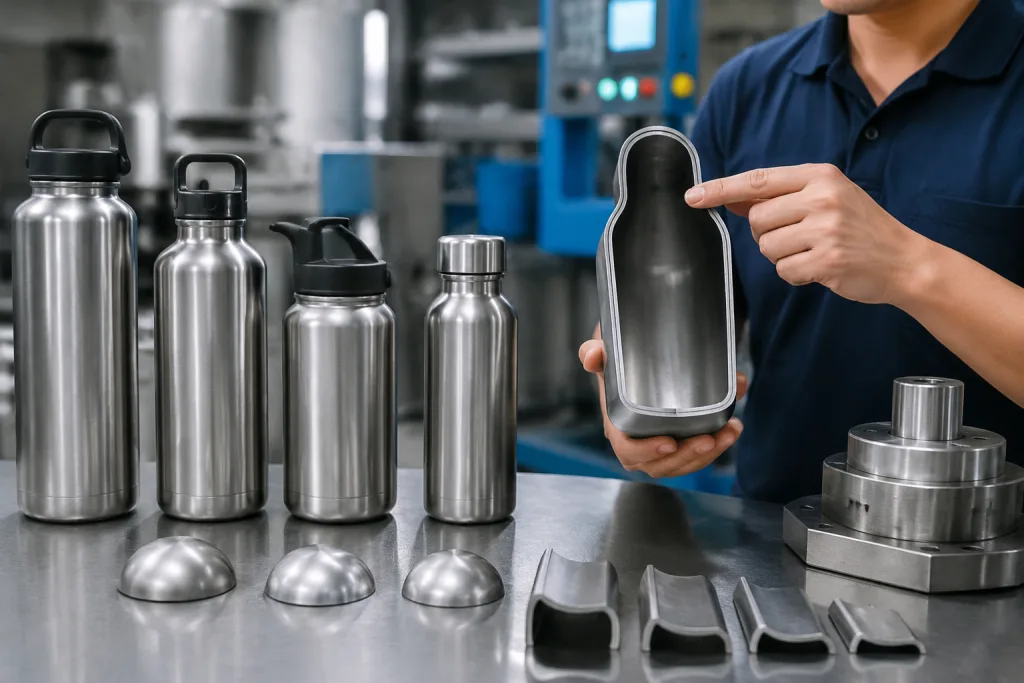
I’ll rewrite the three paragraphs in-place, keep the HTML exactly as-is, and tune the tone to sound like a factory sales engineer with a few concrete shop-floor details.Two bottles can sit side by side on a sample table and behave differently in transit. Wall thickness is the hidden variable. On stainless steel, 0.35 mm saves cost but dents easier, especially on 18 oz to 24 oz formats that go out in mixed cartons. A 0.45 mm wall usually gives a cleaner balance for retail, gifting, and distributor canteen programs. For aluminum or lightweight canteen custom runs, the gauge changes both hand feel and dent rate.
Do not let a canteen supplier stop at "food grade stainless." Ask for 304 or 316, the wall thickness by section, and where the tube thins near the shoulder or base weld. We have seen a 0.05 mm drop at the shoulder turn into a dent line after a 1.2 m carton drop. If the product is a custom growler or customizable growler, the body runs heavier and the neck and handle zones need extra checks because those spots crack on impact. QC pulled the sample, measured the wall with a micrometer, and flagged the base weld before the line packed 5,000 pcs. A disciplined factory in China will show you the thickness tolerance window and the dent test result. In Zhejiang, the better plants keep that record because they know it cuts claims later.
For private label, buying 8% to 12% more material is cheaper than eating a 3% complaint rate. The math does not lie. We run that comparison on every PO, and when a buyer tries to shave 0.02 mm off the spec, the math stops working fast.
Coatings fade faster than you think
I’ll rewrite the three paragraphs to sound like a real factory-side sales engineer, keep the HTML exactly as-is, and fold in more concrete production detail without changing the heading or tags.Color drift is one of the fastest ways to make a private-label program look cheap. A matte powder coat that passed in the sample room can come back a shade softer, a touch darker, or blotchy after mass run. The usual culprits are curing temperature, spray gun setting, or a mix ratio drift on the line. On one Zhejiang line, a 3-minute change in oven dwell time was enough to move gloss and adhesion.
Do not approve color by eye alone. Use a physical standard and ask for the same substrate, same finish, and same decoration method on the pre-production sample. If the bottle is sold as customizable drinkware, ask for the gloss value when finish matters, and write down the allowed variation. For metallic or pearl effects, put it in writing that a 2,000-unit run and a 20,000-unit run will not land in the exact same shade, only within an agreed tolerance. That is not being picky; it stops ugly disputes later. We have seen buyers flag a reorder because the PO said “navy” and the factory matched a different Pantone chip. Ask for batch retention samples too, one sealed by you and one kept at the canteen factory for the next repeat order.
When artwork covers a big area, some canteen vendors overspray to hide pinholes or dust marks. The logo looks clean on day one, then the coating chips faster around the edges. Spec the finish, not just the look. We had one 500 ml bottle where QC pulled the sample and found 0.2 mm edge build-up after an extra pass at the spray booth.
Packaging breaks the margin last
I’ll keep the HTML structure intact and rewrite the prose to sound like a real export-sales engineer: sharper, more specific, and less generic. Then I’ll check that the wording stays tight around margin, damage, and reorder control.Buyers spend weeks dialing in the bottle, then ship it in a carton that fails at the first corner hit. That is the wrong place to save USD 0.08. If you sell retail or e-commerce, packaging is part of the SKU. We’ve seen compression marks, crushed corners, and moisture damage drive claims faster than the product itself. For Amazon or direct-to-distributor runs, the real questions are drop test, carton ECT, and FNSKU placement. Pretty inserts do not carry a pallet.
A workable carton spec for water bottles private label starts with inner protection so bottles do not rub, then a master carton that holds up in stacking. Ask for ISTA-style thinking even if the factory does not run a formal lab. On one job, QC pulled the sample after a 600 mm drop because the divider shifted 8 mm; the buyer flagged it, and we changed the insert. If the cartons leave China by port, pallet height and inland humidity matter. A canteen distributor usually wants fast repack and low damage, so the carton must open cleanly without tearing print or scuffing the lid. Before you sign, the supplier should give gross weight, carton size, and units per master carton. Simple. No guessing.
Good packaging protects reorders. If a sales channel wants a custom canteen with hang tags, barcode labels, or a two-piece gift box, lock that spec into a packaging sheet. We’ve seen this go sideways on the second order when the buyer’s PO had a typo on the insert color and the factory “matched” the cheaper version. Then you eat the complaint. Keep the spec tight, keep the carton code fixed, and the line ships the same way every time.
QC fails when the checklist is vague
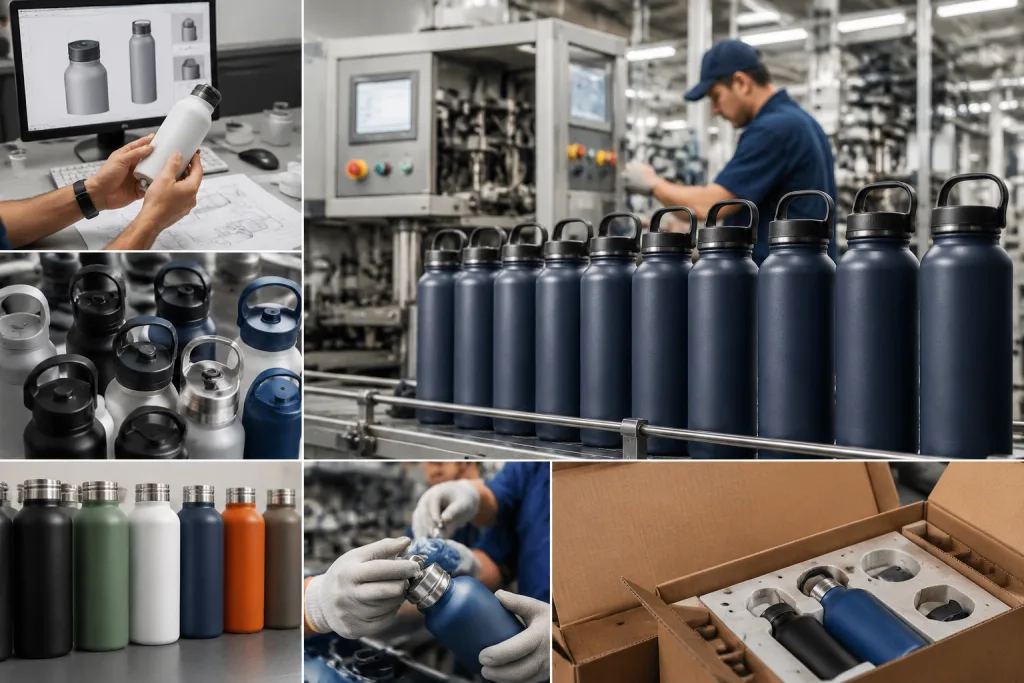
I’ll rewrite the prose in place, keep the HTML exactly as-is, and make the QC language sound like a real factory-side buyer note.The priciest defect is the one nobody defined. If the inspection sheet just says "good quality," QC checks the gloss and misses the leak test. A proper QC plan for water bottles private label needs AQL, defect buckets, and test methods. For most drinkware buyers, AQL 2.5 for major defects and 4.0 for minor defects is a normal start, but the right cutoff depends on your market and how hard you want to push claims.
Ask the canteen manufacturer to split defects into critical, major, and minor. Critical means leak, unsafe material, sharp edge, or contamination. Major means decoration mismatch, warped lid, or function failure. Minor means small print blur or a surface speck. For each shipment, we run a documented sample size, photo record, and pass/fail result. If you are buying customized canteen or customized drinkware for a chain, add random carton pulls from different pallet positions, not just the top layer. QC pulled the sample from carton 17 once and found crush marks the buyer had missed.
You do not need perfect bottles. You need predictable bottles. Predictability is what makes a canteen vendor worth renewing.
A Zhejiang factory with real export experience will not fight this QC setup. It usually prefers it, because fewer surprises mean fewer chargebacks and less back-and-forth on the line. That is the difference between a one-time order and a stable canteen supplier relationship.
Send your bottle spec, get a real quote
We’ll review your material, MOQ, finish, and packaging targets before production starts. Better to catch the failure points in Zhejiang than at your warehouse.
Frequently asked questions
What MOQ should I expect for water bottles private label?
For a standard private-label bottle, 3,000 to 5,000 units is common in China, especially for stainless steel or powder-coated models. If you want multiple colors, laser engraving, or a custom lid, the MOQ often rises to 5,000-10,000 units because each setup adds labor and scrap risk. A Zhejiang canteen factory may accept lower MOQs on stock bodies, but pricing usually jumps 15-30%. If you need a test run, ask for one size and one finish only. That keeps the first order controlled and makes the second reorder easier to scale.
How long is the lead time from a canteen factory?
Typical lead time is 25-35 days after artwork approval and deposit for common private-label drinkware. If tooling is new, color matching is strict, or packaging is custom, plan for 40-50 days. Do not count the time before sample approval, because that phase often adds 7-14 days. A good canteen manufacturer in Zhejiang will give you a calendar that separates sample, pre-production, mass production, and export packing. If they only quote "about one month," press for dates by step.
What tests should I request for a custom canteen?
At minimum, request leak testing, lid torque control, adhesion testing for decoration, and drop testing for the packed carton. For stainless steel, ask for material confirmation such as 304 or 316, plus wall thickness by spec, often 0.35 mm to 0.45 mm. For coated bottles, ask for a rub test count and a cross-hatch adhesion result. If the bottle is a canteen promotional item or distributor drinkware, add carton compression or stack testing so the packaging survives warehouse handling.
Can I mix styles in one order?
Yes, but mixing styles usually hurts price and schedule. A canteen supplier can combine colors or logo variants more easily than completely different body shapes. If you mix a custom growler, a standard bottle, and a canteen customizable lid program in one PO, expect separate tooling, separate inspection, and possibly separate cartons. That can push MOQ up by 20-40% and add 5-10 days to production. For first orders, keep one body and one closure. You will get cleaner QC and fewer surprises.
What documents should a canteen supplier provide for Europe or North America?
Ask for material declarations, REACH-compliant statements where relevant, food-contact confirmation, and factory audit documents such as BSCI if your buyer requires social compliance. For North America, many buyers also ask for testing aligned with FDA food-contact expectations or ASTM-based checks where applicable. If the product is shipped to Amazon, you may also need carton labels and FNSKU-ready packaging. A serious canteen factory in China will provide samples, inspection photos, and packing lists without drama.