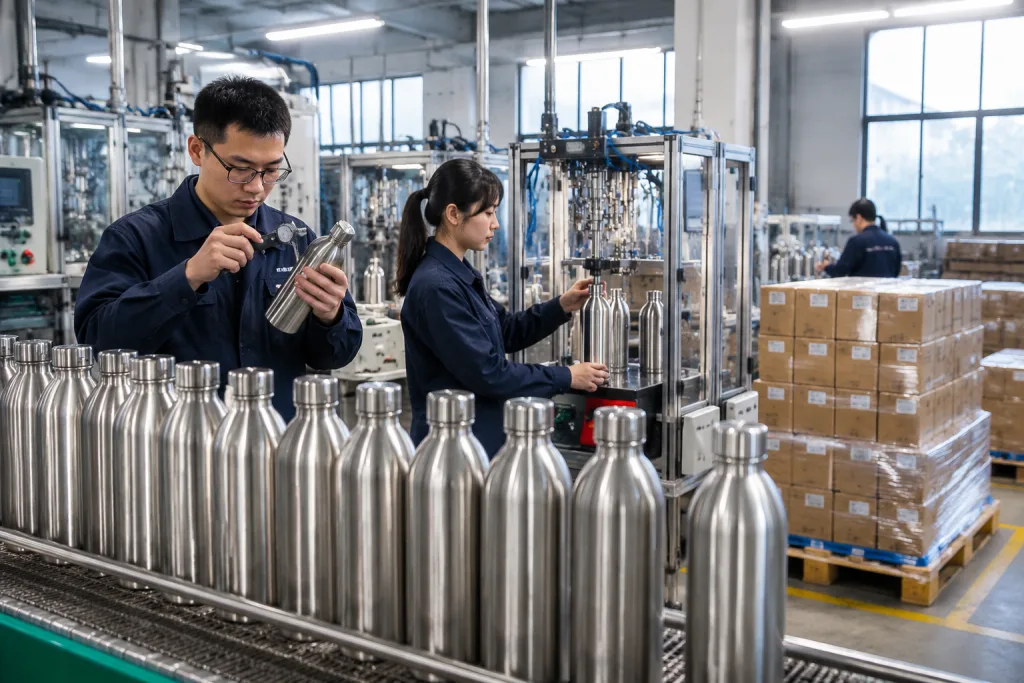
Key Takeaways
- A 0.5 mm wall on 304 stainless usually costs less than 0.6 mm, but 0.6 mm handles better in shipment and feels more premium.
- For most B2B programs, MOQ starts at 3,000 pcs and mass lead time runs 25 to 35 days after sample approval.
- FOB China pricing for standard stainless bottles often sits around USD 2.10 to 4.80 depending on finish, lid, and packaging.
- If you sell on Amazon or to retail chains, carton size, drop-test performance, and label placement matter as much as capacity.
If you are sourcing from a water bottles OEM manufacturer, the first mistake is buying from photos. A 500 ml bottle can look the same across five factories in Zhejiang, China, yet wall thickness, cap torque, leak rate, coating adhesion, and carton count can be off by a mile. We’ve seen that eat margin fast. The unit price looked fine; the rework, freight waste, and claim rate did not.
The better way to buy custom drinkware is to read the spec sheet like a shop-floor checklist, not a merch sheet. Decide first whether you need a canteen custom build, a customizable canteen for retail, or a customized drinkware program for promotions. At BottleForge in Zhejiang, we run about 800,000 units per month, with MOQ starting at 3,000 pieces for most stainless models and sample lead times around 7 to 10 days. That is a real sourcing benchmark, not brochure talk.
Spec table: where bottles differ
I’ll rewrite the prose in-place, keep the HTML structure untouched, and make it sound like a real factory-side sales engineer.When buyers ask for a water bottles OEM manufacturer, they usually mean, “Who can build to my spec and still ship clean?” That is the right question. The fastest way to compare suppliers is to line up the core specs side by side and cut the brochure talk.
Use this as your internal table before you request samples. We run this check on the line before QC pulls the sample.
- Material: 304 stainless, 316 stainless, Tritan, aluminum, or glass. For cold-chain retail, 304 usually does the job; 316 costs more and buys better corrosion resistance.
- Wall thickness: 0.4 mm, 0.5 mm, or 0.6 mm for steel bodies. The jump from 0.5 mm to 0.6 mm can add 6% to 12% to cost, but dent resistance goes up and the buyer stops flagging crushed cartons.
- Capacity: 350 ml, 500 ml, 750 ml, 1,000 ml. For distributor drinkware programs, 500 ml and 750 ml are the two SKUs we ship most often.
- Finish: powder coat, spray paint, brushed steel, electro-polish, UV print. Powder coat holds up best in daily use; on one PO, a buyer missed the word “matte” and we had to recheck the sample card.
- Closure: screw cap, flip lid, straw lid, sports lid, bamboo cap. Cap leakage is still the main failure point in customized orders, and this is where the math does not lie.
A solid canteen factory will give you these numbers without hesitation. If a supplier dodges thickness, coating type, or pack-out detail, you are not comparing apples to apples. You are comparing risk.
Best fit by buyer type
I’ll rewrite the section in place, keep the HTML exactly as-is, and tighten the sales tone with concrete factory details and buyer-side pushback.Different buyers need different bottle structures. A canteen manufacturer serving sports retail does not solve the same problem as a canteen distributor buying promotional stock for a trade show. On our line, that usually means two different neck sizes, two cap SKUs, and two QC check points. The use case drives the spec, not the other way around.
Retail and e-commerce
If you sell direct to consumers, pick a customizable drinkware line with clear shelf impact: matte powder coat, laser logo, and a rigid carton that survives parcel shipping. Amazon FBA jobs usually need FNSKU labeling, barcode placement, and carton dimensions that stay under oversize fees; we had one buyer flag a 3 mm carton increase because the freight math stopped working. A custom growler or customizable growler fits niche outdoor brands, but only if the lid seal passes a 24-hour leak test and the body finish holds up after 100 rubs.
Promotional and corporate gifts
For canteen promotional projects, buyers care more about logo area, price control, and delivery speed than technical features. A customized canteen at USD 2.10 to 3.20 FOB China can work if you keep decoration simple; on a recent 5,000-piece PO, the buyer caught a logo typo before printing, and that saved a rework week. If the end user is handing it out at an event, go for a clean print and a leakproof cap. This is the wrong question to ask if you start with fancy specs.
Distribution and wholesale
If you are a canteen distributor or distributor drinkware buyer, your priority is repeatability. Stock one or two body shapes, then build volume through color and logo variation; we run this with the same 32 mm cap across three models, so QC can hold the fit without chasing new tooling. That is where custom canteen and customizable canteen programs are easier to manage than a fully new mold, and the math works better at 10,000 units or more.
Good sourcing is not “find the cheapest canteen vendor.” It is “find the supplier that can repeat the same bottle 50,000 times without drifting.”
OEM versus ready stock
I’ll rewrite the section in-place, keep the HTML exactly as-is, and make the copy sound like a factory-side sales engineer. Then I’ll do a quick pass to ensure the numbers, cadence, and insider detail fit the brief.OEM pays off when the brand wants control over the bottle shape, lid spec, packaging print, or test report set. Ready stock ships faster, but you get the same bottle your competitor can buy tomorrow. For a water bottles OEM manufacturer, the math changes as soon as the buyer asks for one new mold line or a capped color match.
Here is the split we use on the line:
- Ready stock: 1,000 to 2,000 pcs, 7 to 15 days, logo laser or one-color print only, no tooling fee.
- Light OEM: existing mold with custom logo, Pantone color, and printed carton, usually 3,000 pcs MOQ, 25 to 35 days.
- Full OEM: new mold or lid/body change, often 5,000 to 10,000 pcs MOQ, 45 to 60 days including sampling and QC pull.
If you are testing a new market, start with a customizable drinkware program, not full tooling. We had one buyer flag a PO typo on the carton size, 38x38x28 cm instead of 36x36x26 cm, and that small miss would have killed the margin on 12,000 pcs. If the SKU works, move into a customized canteen or canteen customized launch with exclusive colorways and packaging. This is how we keep cash tied up in check, and it avoids dead stock that sits in the warehouse.
China stays the practical sourcing base for this setup because molds, decoration, assembly, and export cartons sit in one supply chain. In Zhejiang, the cluster still matters: cap suppliers are 20 minutes away, the powder coating line runs next door, and the carton vendor can turn samples in 48 hours.
Materials and compliance
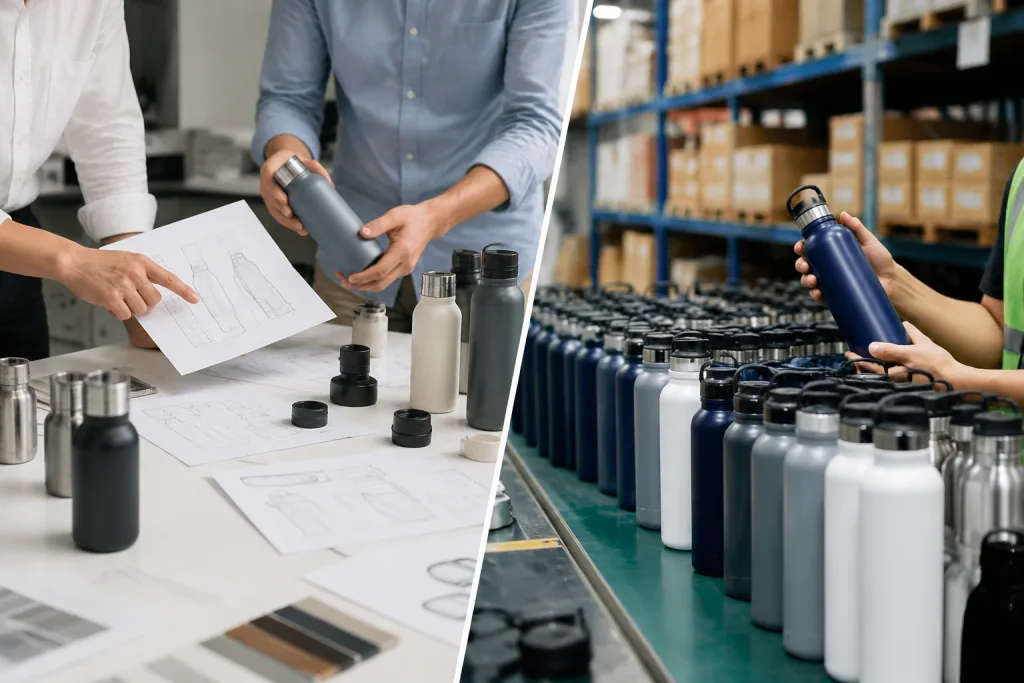
I’ll rewrite the section in-place, keep the HTML structure untouched, and tighten the language so it sounds like a factory-side sales engineer wrote it.Material choice is where buyers either save money or buy complaints later. Stainless steel, Tritan, and glass solve different jobs, and each one brings its own compliance file. We see this on the line all the time.
For metal bottles, ask for the steel grade, coating test data, and migration reports. For Europe, REACH is a must. For North America, ask for food-contact declarations and, where needed, ASTM or FDA-aligned test reports. If the bottle has a silicone gasket or straw, QC pulled the sample and checked the whole accessory set, not just the headline certificate.
What matters in practice:
- 304 stainless: standard choice for most custom drinkware, with the best cost balance for 500 ml to 750 ml bottles.
- 316 stainless: better for salty environments or premium positioning, usually 8% to 15% more expensive.
- Tritan: lighter, clear, good for sports and kids programs, and the buyer usually asks about odor and drop tests first.
- Glass: clean taste, but higher breakage risk and tighter pack-out, so this is the wrong choice if the buyer wants low claim rates.
Do not treat compliance like a sticker. A serious canteen supplier maps the test report to the exact SKU, finish, and accessory set. If the lid changes from PP to bamboo-top, the test scope may need updating. We have seen that go sideways on a PO with one small typo on the lid code, and the lab sample no longer matched the shipment.
Pricing and MOQ reality
I’ll rewrite the section in place, keep the HTML exactly as-is, and tighten the sales-engineer tone while preserving the price bands and MOQ facts.Buyers often ask for a target price before the spec is fixed. That is the wrong question. On the line, we have seen a 0.4 mm wall change, a matte spray finish, or a two-piece lid add more cost than the logo itself. A laser mark usually costs less than a 4-color wrap print, but if your brand sells on color, the bottle can look flat.
For standard stainless programs, FOB China usually falls into these bands:
- Basic 500 ml steel bottle: USD 2.10 to 2.80
- Powder-coated bottle with better lid: USD 2.80 to 3.80
- Premium insulated model: USD 3.80 to 6.50
- Specialty custom growler: USD 4.20 to 7.80 depending on volume and cap set
MOQ moves with the process. A canteen vendor with in-house printing can often take smaller runs than a pure assembler. Once you ask for a molded handle, new lid tooling, or a custom straw system, the floor jumps fast. We run 3,000 pcs as the normal entry for standard OEM work in Hangzhou, and bigger corporate orders move cleanly because the factory is set up for volume, not one-off jobs.
If your customer is a canteen distributor or a distributor canteen partner, judge landed cost, not just ex-factory cost. We saw one PO where the carton typo changed the master carton size by 15 mm, and freight climbed 8% overnight.
What to ask before sample approval
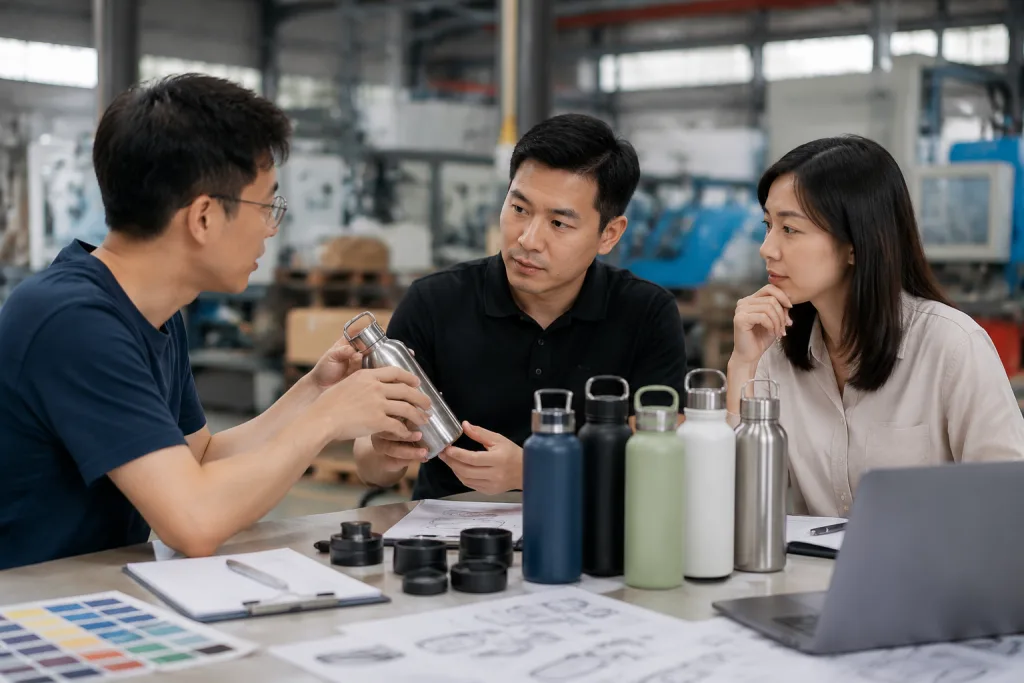
I’ll rewrite the section in-place, keep the HTML structure, and make the wording sound like a factory-side sales engineer wrote it.Samples expose weak suppliers fast. A neat sample proves little until you push for the numbers behind it. Before approval, line up the sample against the factory’s written spec sheet and ask for the same data on production, not a prettier promise.
- Actual body weight and wall thickness, not just nominal capacity.
- Leak test method, pressure level, and pass criteria.
- Drop test height and packaging setup.
- Logo method, cure temperature, and abrasion resistance.
- Carton count, inner protection, and palletization if needed.
If you are buying customizable canteen or canteen customized SKUs for retail, ask for color tolerance too. A 1-2 Pantone shift is enough to trigger complaints when a brand runs tight visual control. For distributor growler or custom growler orders, closure torque and gasket compression matter as much as the print. We’ve seen that go sideways on the line. The buyer flagged it only after the first carton was opened.
A solid factory keeps sample records, confirms AQL targets before production inspection, and checks whether the first article matched the bulk run. QC pulled the sample with a caliper on the 0.8 mm wall and a torque meter on the cap. That is basic shop-floor discipline, not a premium add-on.
Which supplier model works
I’ll rewrite the section in-place, keep the HTML structure unchanged, and tune the prose to sound like a factory-side sales engineer.You do not need every supplier type. You need the one that fits your channel. A canteen manufacturer works best when you need stable production, repeat replenishment, and process records you can audit. A canteen supplier or canteen vendors model fits mixed SKUs and light customization. A canteen factory is the better call when lead time, traceability, and repeatability sit at the top of the brief.
Use this rule of thumb:
- Brand owner: work with a manufacturer that can handle OEM, compliance, and carton control.
- Distributor: use a supplier with flexible MOQ and fast color or logo changes.
- Promotional buyer: prioritize price stability and 30-day turnaround.
- Retail chain: demand fixed carton specs, test reports, and clean re-order accuracy.
If you are comparing canteen distributors with direct factory sourcing, the lowest unit price is not always the lowest landed cost. We have seen that math go sideways when the buyer flags a packing typo after the PO is already signed. Direct sourcing from China gives you more control, but only if the factory can actually run the line. In Zhejiang, the good plants are plain to visit: one shift, one QC station, and pallets counted before lunch.
Request factory specs and pricing now
Send your target capacity, logo method, and MOQ. We’ll match you with the right OEM structure from Zhejiang, China.
Frequently asked questions
What MOQ should I expect from a water bottles OEM manufacturer?
For standard stainless water bottles, 3,000 pcs is the common MOQ. If you only need logo printing on an existing mold, some China factories can go down to 1,000 to 2,000 pcs, but unit price rises fast. Full OEM with a new lid or body usually needs 5,000 to 10,000 pcs. In Zhejiang, an organized factory may still keep sample lead time at 7 to 10 days and mass production at 25 to 35 days after approval.
How do I compare canteen manufacturer quotes fairly?
Line up the exact same spec: material grade, wall thickness, surface finish, lid type, logo method, packing, and compliance documents. A quote at USD 2.30 may look better than USD 2.70, but if one uses 0.4 mm steel and the other uses 0.6 mm with better carton protection, the cheaper one is not really cheaper. Ask for FOB China terms, sample photos, and test reports mapped to the exact SKU.
Is custom drinkware suitable for Amazon FBA?
Yes, if the factory understands FNSKU labeling, carton size, and drop-test packaging. Many Amazon buyers prefer a customizable drinkware line with one or two body sizes and tight carton control. For stainless bottles, keep outer cartons efficient so you do not trigger oversized fees. You should also confirm barcode placement and whether the inner bag, insert, or polybag meets the marketplace requirement.
What is the difference between canteen custom and canteen customized?
In buyer terms, they are close, but the practical difference is scope. Canteen custom usually means the base bottle already exists and you are changing logo, color, or packaging. Canteen customized can mean deeper changes like lid shape, capacity, finish, or accessory set. The more customized the project, the higher the MOQ and tooling risk. A custom canteen with existing tooling is faster and safer for first orders.
Which material is best for a custom growler or customized growler?
For most beer and outdoor applications, 304 stainless is the practical default. It balances cost, durability, and corrosion resistance. If the product will see salty or harsh conditions, 316 stainless is safer but costs more. Glass looks premium but increases breakage risk. If you want a customizable growler for retail, ask the factory for lid torque specs, gasket material, and pack-out details before approving samples.