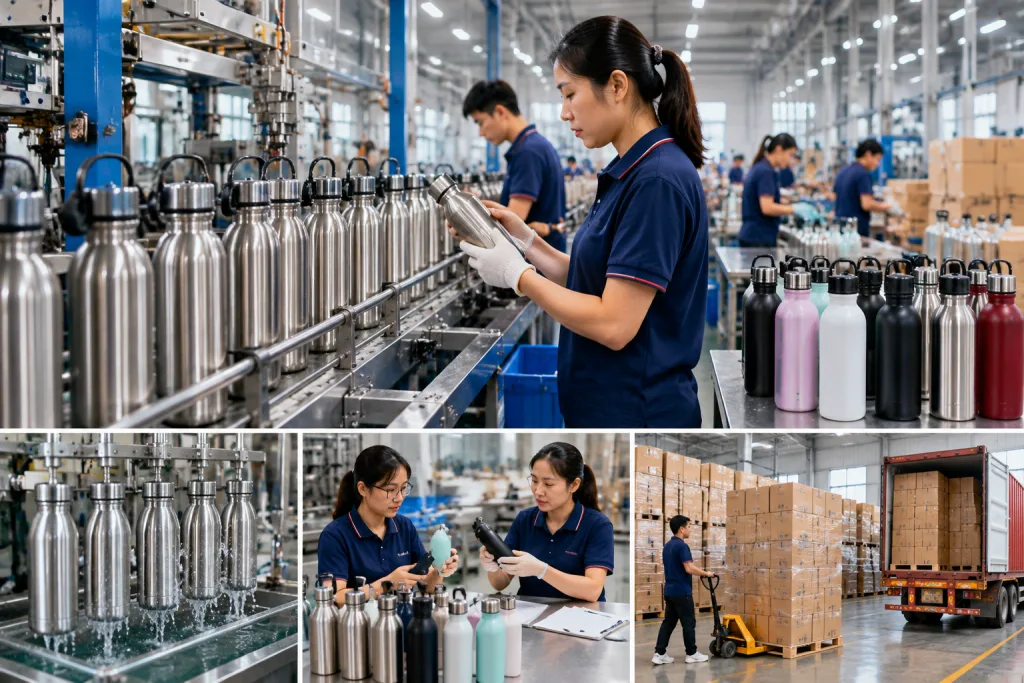
Key Takeaways
- Most water bottles manufacturers in China quote custom samples at USD 25-80 and production MOQs from 500-3,000 units.
- A solid canteen manufacturer should confirm REACH, FDA contact compliance, and AQL 2.5/4.0 inspection terms before you place PO.
- For custom drinkware, 18/8 stainless steel is common; look for 0.4-0.5 mm wall thickness on bottles and 0.5-0.7 mm on larger growlers.
- Lead times from a capable Zhejiang factory usually run 7-15 days for samples and 25-35 days for mass production.
If you are sourcing from water bottles manufacturers, the hard part is not finding a factory. The hard part is telling a real canteen factory from a trading layer that quotes low, then goes quiet when you ask for test reports, packing details, or a 30-day sample change. In Zhejiang and across China, you see the gap fast once you ask about wall thickness, cap torque, AQL, and whether they can repeat the same Pantone after 5,000 pcs.
For procurement managers, brand owners, and distributors, the good supplier answers the boring questions straight: MOQ, FOB price, lead time, and which models take customization without killing margin. That is the right filter for a custom canteen retail run, a canteen promotional order for events, or a customized drinkware line for Amazon-style replenishment. We run this every week, and the math does not work if the sample looks fine but the line cannot hold 12 days versus 18 days on delivery.
What do you really need first?
I’ll rewrite this section in-place, keep the HTML exactly as-is, and tighten the sales-engineer voice while adding concrete shop-floor detail and removing AI-style filler.Before you compare water bottles manufacturers, put the product on paper. Not “stainless bottle.” Write capacity, lid type, finish, print area, and packing. A vague RFQ usually brings vague pricing back. A spec sheet gets a real quote. If you want a canteen customizable for different channels, split the ask for retail, corporate gifting, and distributor canteen orders. We’ve seen one 500 ml bottle fail three channel tests because the carton was wrong and the logo sat too close to the seam.
Use a simple checklist:
- Material: 304 or 316 stainless, Tritan, aluminum, or glass
- Capacity: 350 ml, 500 ml, 750 ml, 1 L, or 1.5 L
- Decoration: silk screen, laser engraving, UV print, wrap label
- Closure: screw cap, flip lid, straw lid, handle lid
- Packing: individual box, master carton, barcode, FNSKU if needed
If you are buying custom drinkware for Europe or North America, ask at the start whether the factory can issue REACH declarations, LFGB-ready materials, or third-party migration reports. This is not a special favor. QC pulled a sample last week and checked the 0.8 mm wall and lid gasket before print; that kind of routine saves time. In Zhejiang, we run those steps into the export line because one missing file can push a shipment back 2-3 weeks, and the buyer will flag it fast.
Which questions expose weak factories?
I’ve got the section and the constraints. I’ll rewrite the prose in-place, keep the HTML exactly as-is, and make the questions sound like they came from someone who runs orders, QC, and shipping on a real line.The quickest way to separate a canteen factory from a trader is to ask line questions, not brochure questions. Ask how many units they ship each month, how long samples take on the bench, and how often QC pulls parts back for rework. A real manufacturer answers in numbers: 300,000-600,000 units per month, 7-12 days for samples, and a clear re-inspection rule. If the reply drifts, the math does not work.
Good questions to send in the first email:
- What is your MOQ for a custom canteen in 500 ml and 750 ml?
- Can you share the FOB price at 1,000, 3,000, and 10,000 units?
- What is the standard carton spec, drop test result, and master carton count?
- Do you work with canteen distributors and distributor drinkware programs?
- Which audits do you hold: BSCI, ISO 9001, or Sedex?
The goal is not to collect polished replies. It is to find out whether the canteen manufacturer knows export work: carton dimensions, barcode placement, and how to handle off-shelf replenishment when a buyer flags a typo on the PO. A vendor that cannot speak to those details will cause trouble later. We’ve seen that go sideways on closures too; for custom growler or customized growler projects, if they cannot explain pressure on the cap or coating wear after a 1.2 m drop test, they are guessing.
How much should custom pricing be?
I’ll rewrite the section in-place, keeping the HTML tags and structure intact while making the pricing guidance sound like a factory-side sales engineer wrote it.Price starts with tooling, resin or steel grade, decoration method, and the carton spec. For standard custom drinkware, FOB usually sits around USD 1.20-2.50 for simple single-wall bottles, USD 2.80-6.50 for insulated stainless bottles, and USD 4.50-9.00 for more complex customized drinkware with premium lids or powder coating. We ran one job last month where a custom canteen with laser logo landed 0.18 yuan below the multi-color print version because the setup was cleaner and scrap stayed low.
Do not compare unit price only. Compare landed cost. A bottle that is USD 0.30 cheaper at source can end up dearer once you add:
- higher freight from oversized packaging that pushes the carton cube up by 12%
- extra inner boxes for fragile glass or custom growler formats
- retest or rework cost after a failed Pantone match on the line
- chargebacks for missing labels or barcodes on the PO
If you are buying for a canteen promotional campaign, ask the factory to quote two versions: one economy model for volume and one upgraded canteen promotional version with better decoration. We usually push back here: the math does not work if you ask for premium looks at entry pricing. A solid canteen supplier will save cost by changing the lid insert, wall thickness, or carton style, not by gutting the product. On one 5,000-piece order, QC pulled the sample because the lid gasket was 0.4 mm off, and that kind of miss costs more than the savings. In Zhejiang, good factories know where a 5% cut is safe and where it will drive returns.

What specs matter more than the logo?
I’ll keep the HTML intact and rewrite the copy to sound like a factory-side sales engineer, with more concrete specs and one shop-floor detail per paragraph.Most buyers spend too much time on branding and too little on structure. That is the wrong tradeoff. On bottles, the first fails we see are lid fit, weld line integrity, coating adhesion, and dent resistance. On stainless runs, wall thickness drives the result. For a 500 ml bottle, 0.4-0.5 mm is normal; for a custom growler or larger insulated container, we usually quote 0.5-0.7 mm, depending on target weight. On plastic, resin grade and stress-crack resistance beat a fancy silhouette every time. QC pulled a sample last week with a 0.32 mm sidewall, and it failed the drop test in 3 hits.
Ask for these details before you approve the order:
- Material grade: 304, 316, Tritan, or BPA-free PP
- Testing: thermal retention, drop test, dishwasher resistance, leak test
- Compliance: REACH, FDA, LFGB, ASTM-relevant methods where applicable
- Inspection: AQL 2.5 for major defects and 4.0 for minor defects is common
For canteen customized projects, print durability matters more than the artwork file. A clean logo that peels after 20 dishwasher cycles burns the margin fast. We’ve seen this go sideways on a 1-color silk print that looked fine on day one and scuffed at cycle 12. If you are sourcing from canteen manufacturers in China, ask for abrasion data or a controlled rub test. The same applies to custom canteen orders for field use, where the bottle gets dropped, packed, and reused every day.
Which buyers need which factory type?
I’ll rewrite the section in-place, keep the HTML structure unchanged, and make the prose sound like a real sales engineer wrote it.Not every buyer should work with the same factory. A brand owner launching a premium line needs a canteen manufacturer that can handle product development, carton artwork, and the docs pack. A canteen distributor or distributor drinkware buyer usually cares more about 7-day replenishment, mixed SKU cartons, and repeat pricing that does not jump by 8% on reorder. A canteen supplier that runs well for one channel can miss on another. We’ve seen that go sideways on a 20,000-unit PO with one wrong carton size.
Match the buyer to the factory
- Retail brand: choose a canteen factory with mold support, custom finishing, and packaging control on the same line
- Promotional buyer: choose a canteen promotional specialist that can hit 10,000-50,000 units fast without blowing up QC
- Distributor: choose a canteen distributor-friendly plant with stable MOQ and repeat order history
- Private label: choose customizable drinkware lines with standard molds and fast artwork changes
If you are sourcing custom canteen or customizable canteen programs, ask whether the factory keeps evergreen tooling on the shelf. That is what protects repeat orders. If you are buying customized canteen items for regional channels, ask for a shelf-life view on coatings, gaskets, and printed cartons. QC pulled the sample on a 304 stainless run last month, and the buyer flagged a 2 mm logo shift before shipment. The best canteen vendors in Zhejiang do not stop at one shipment; they support the second, third, and fifth reorder without changing dimensions or shade.
What should your checklist include?
I’ll rewrite the section in-place, keep the HTML exactly as-is, and tighten the sales-engineer tone with concrete shop-floor detail and cleaner buyer language.Use a practical checklist before you approve any PO. The goal is to avoid surprise costs in rework, freight, or customer complaints. This matters when you buy from water bottles manufacturers in China, because a clean sample can still hide weak control once the line is running at 3,000 pcs a day.
- Confirm exact capacity tolerance, usually ±5% for bottles
- Approve color under Pantone or a physical master sample
- Require logo placement and size in millimeters
- Lock packaging count, carton size, and pallet plan
- Set defect limits and inspection method in writing
- Ask for replacement policy for leaking or scratched units
For canteen distributors, this checklist matters even more because the first delivery drives the next reorder. We have seen a 5,000-unit canteen distributor order turn into a returns headache from a leak rate that looked small on paper. Build the PO on facts, not trust. If a canteen supplier pushes back on written specs, that tells you plenty. Good factories like clarity; QC pulled the sample, measured the lid gap, and everyone saved time.
If you need canteen suppliers that can support mixed catalogs, ask for a weekly production schedule and a stock policy in black and white. A Zhejiang factory can run standard models and custom drinkware without drama, but only if you give stable forecasts and realistic lead times. We had one buyer flag a PO typo on carton count after the line had already printed labels, and that kind of mistake burns a week fast.
Send your RFQ with the real specs
We can quote your custom drinkware, custom canteen, or distributor drinkware program with MOQ, lead time, and packaging locked in from the start.
Frequently asked questions
What MOQ should I expect from water bottles manufacturers?
For standard models, many water bottles manufacturers in China start at 500-1,000 units per SKU. For custom molds or special lids, MOQs often rise to 3,000-5,000 units. If you want a custom canteen with unique tooling, expect a higher threshold and a mold fee. A practical Zhejiang factory will usually state MOQ by color, logo method, and packaging, not just by product. That is the answer you want.
How long does a custom drinkware order take?
Typical sample lead time is 7-15 days, depending on artwork and tooling. Mass production is often 25-35 days after sample approval and deposit. If you are ordering a canteen promotional shipment before a seasonal campaign, add time for carton confirmation, testing, and freight booking. A reliable canteen factory should tell you the critical path upfront, not after you send payment.
What documents should a canteen manufacturer provide?
At minimum, ask for commercial invoice, packing list, product photos, and test reports tied to the exact item. For Europe and North America, REACH-related declarations, food contact documentation, and audit evidence such as BSCI or ISO 9001 are common requests. If you buy distributor drinkware in the US, ask whether the cartons can carry FNSKU or retail barcodes. The right canteen manufacturer will not treat this as unusual.
Is a custom growler harder to source than a bottle?
Usually yes. A custom growler or customized growler often needs better wall control, heavier packaging, and more careful closure testing because the product is larger and more visible to damage. Expect higher freight and a more cautious QC plan. For a 64 oz model, wall thickness and dent resistance matter more than on a simple 500 ml bottle, so the factory should show you sample and production differences clearly.
How do I compare canteen suppliers fairly?
Compare them on the same sheet: MOQ, FOB price, sample time, production time, audit status, testing, packaging, and defect policy. Do not compare quote line 1 alone. A canteen supplier that offers USD 0.20 less but gives no carton spec or no leak test is not cheaper. For canteen distributors, repeat order stability is often more valuable than a one-time low quote.