Key Takeaways
- Factory-direct pricing usually saves 12-28% versus layered trading channels, but only if your spec is stable and your MOQ is at least 500 pcs.
- For print longevity, laser engraving and 1-2 color silkscreen outperform low-cost wrap labels on daily-use custom drinkware.
- 304 stainless steel at 0.5-0.7 mm wall thickness is the safe default for reusable bottles; thin-wall aluminum is cheaper but less forgiving.
- A distributor canteen order often needs mixed SKUs and lower MOQs, while a canteen factory order rewards larger runs and tighter packaging control.
If you are buying water bottles factory direct, the hard part is not finding a supplier in China. The hard part is picking the spec that fits your margin, your channel, and what your customer will actually keep. A 24 oz sports bottle, a 500 ml stainless model, and a promotional canteen can all look simple on a quote sheet, then the math turns ugly once you add MOQ, print wear, and freight per unit.
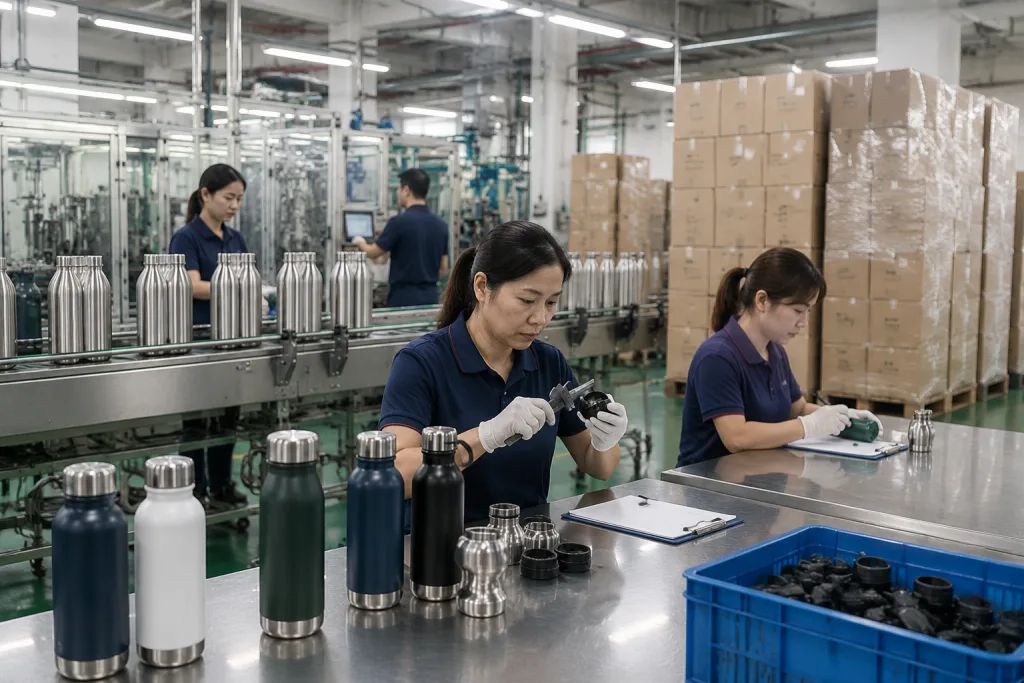
At BottleForge in Hangzhou, Zhejiang, we build for procurement teams that want numbers, not slogans. Our line runs about 120,000 units per month, standard custom orders start at 500 pcs, and normal lead time is 18-25 days after artwork approval. QC pulled the sample on a 304 stainless run last week and found a 1.2 mm lid mismatch; the buyer flagged it before mass production. If you are comparing a canteen manufacturer, a canteen supplier, or a canteen factory, this is the wrong question to ask first. The real one is simple: which spec gives you the best landed cost without returns, complaints, or dead stock?
Factory Direct Beats Middlemen When Specs Hold
I’ll keep the tags unchanged and rewrite the prose to sound like an export sales engineer, with tighter buyer language and one concrete factory-floor detail per paragraph.The phrase water bottles factory direct looks obvious on paper, but the buying math is where it gets real. If you buy through a canteen distributor or a general drinkware distributor, you pay for stock risk, re-packing, and a weak handle on origin. Go direct to a canteen manufacturer in Zhejiang or another China production hub, and you control the 304 stainless grade, coating spec, and carton build. On 1,000 to 10,000 pcs, that control changes the landed cost. We’ve had buyers flag a PO typo on cap color before the line started; that saved a wasted run.
The clean win is when the spec stays fixed: same volume, same lid, same color, same artwork. If you keep shifting cap style or try to mix a custom growler with a customizable canteen in one shipment, setup loss eats the price gap. The buyer’s pushback is usually, “Can’t you just make it work?” The math does not work. For a clean FOB quote, send the core spec first, then compare suppliers:
- Material: 304 stainless, Tritan, PP, or aluminum
- Capacity: 350 ml, 500 ml, 750 ml, 1 L
- Decoration: silkscreen, laser engraving, UV print
- Packaging: polybag, white box, color box, FNSKU label
- Compliance: REACH, LFGB, FDA, ASTM where required
A serious canteen factory in Zhejiang answers these points fast. If the supplier stalls on capacity tolerance or coating code, they are not ready for export work. QC pulled the sample, checked the lid fit at 0.3 mm, and that is the level you want before mass production. A real export partner should also spell out the defect control plan: AQL 2.5 for major defects and 4.0 for minor defects is standard for consumer drinkware.
Compare Specs Before You Compare Prices
I’ll keep the HTML structure intact and rewrite the prose with tighter buyer-side language, concrete factory details, and fewer AI-style fillers.Most buyers open with price, then the sample hits the bench and the problems show up: 420 g instead of 310 g, a lid that drips after 24 hours, or a logo that starts to dull after 60 dishwasher cycles. That is why a spec table beats a glossy catalog. A 500 ml stainless bottle with 0.6 mm wall thickness and a powder coat usually costs more than a thin plastic custom canteen, but it also takes retail handling better and feels solid in hand. QC pulled the sample, weighed it, and the scale told the story.
Use this comparison frame when you review canteen customized options against other customizable drinkware. We had one buyer flag a PO typo on the body material once—he ordered PP, the sample card said Tritan, and the math stopped working right there:
| Spec | Best For | Cost Impact | Risk |
|---|---|---|---|
| 304 stainless, 0.6 mm | Retail, corporate gifts | Medium | Low |
| PP plastic, single wall | Promotions, stadium use | Low | Medium |
| Tritan body | Premium lightweight line | Medium-high | Low |
| Aluminum body | Entry-level canteen promotional | Low | Medium |
If you are comparing canteen manufacturers, ask for drop-test data and lid torque specs. We run that check with a torque meter set at 0.35 N·m, and if the cap backs off early, the line stops. A leak rate under 1% across a 300-piece sample is fine for export work. For insulated bottles, vacuum retention matters too: 6 hours hot and 12 hours cold is acceptable for lower-tier SKUs, while higher-end custom drinkware should beat that. Do not buy on outer looks alone; the inside finish and seal ring are where the real failures happen.
Pick Materials For Margin And Use
I’ll keep the HTML structure intact and rewrite only the prose, with tighter B2B sales language and a few concrete factory-side details.Material choice sets your landed cost, complaint rate, and how fast you can restock. A canteen supplier will push the cheapest body material first, but that is not always the safest buy. We’ve seen the math go sideways when a distributor serves outdoor retail or sports channels: stainless steel and Tritan usually hold up better in packing, transit, and shelf handling than basic PET.
For a customized growler or custom canteen for gift programs, 304 stainless with a matte powder coat is the clean default. QC pulled a 20-piece sample last week with 0.4 mm coating variation, and that was still within our line standard. For promo work, a lightweight canteen custom in PP or aluminum fits better because the target cost lands around $0.65-$1.20 FOB, not $2.10-$4.80 FOB for premium insulated units. That gap matters when the PO says 5,000 pcs and the buyer later asks for 20,000.
When each material makes sense
- 304 stainless: retail, gym, and outdoor orders where dent resistance matters
- 316 stainless: salt exposure, higher corrosion resistance, tighter premium specs
- Tritan: clear body, lower weight, clean premium presentation
- PP: low-cost promotional canteen orders with a short shelf life
- Glass: strong shelf appeal, more break risk, better for controlled channels
If you want a canteen vendor that can support repeat business, pick a material your warehouse can inspect fast. Stainless gives fewer surprises than mixed plastics. A 304 tube with a clean weld seam is easier to check on the line than a blended resin part with color drift. Zhejiang factories with in-house polishing, laser marking, and coating lines usually keep tighter consistency than a split supply chain in China.
Decoration Methods Change the Buyer Math
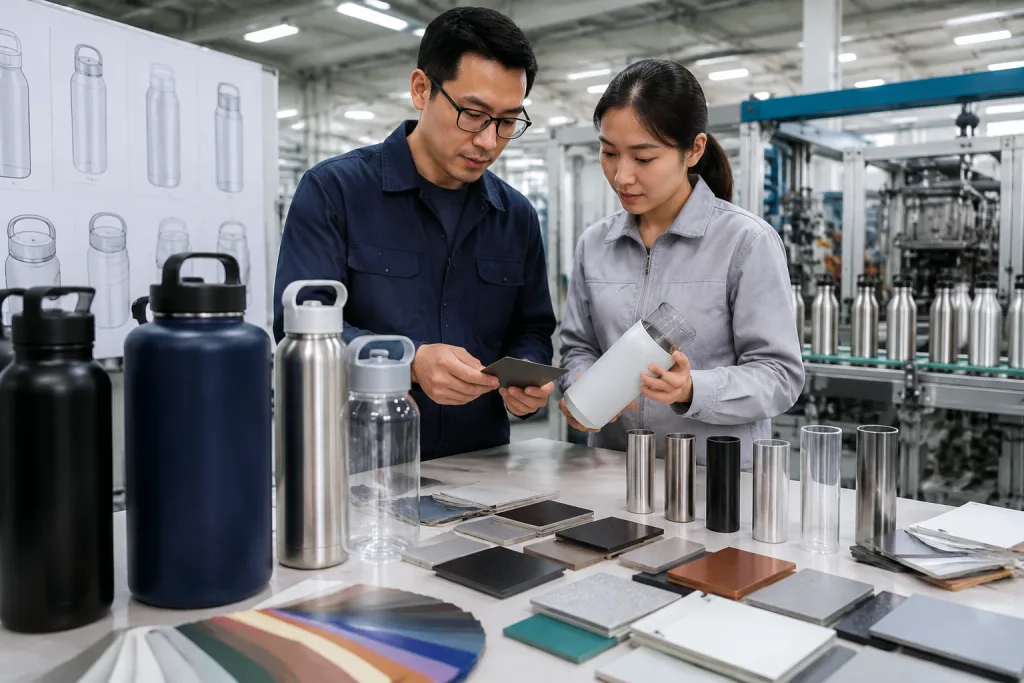
Decoration is where margin disappears. A logo that looks fine on a mockup can fail abrasion tests after a few weeks in a backpack, especially on custom drinkware for daily carry. We run silkscreen for one or two colors, laser engraving on stainless when the buyer wants wear resistance, and UV print when the artwork needs more color. The wrong pick turns into scrap.
If you are buying from a canteen manufacturer for retail, match the decoration to the use case. For a canteen customized for outdoor brands, laser engraving on brushed steel looks clean and holds up. For a promotional giveaway, single-color silkscreen keeps the FOB price down and the line moving. On a 1,000-piece order, the math looks like this:
- Silkscreen: often adds $0.08-$0.22 per unit
- Laser engraving: often adds $0.12-$0.35 per unit
- UV print: often adds $0.20-$0.60 per unit
Do not skip artwork setup. A clean AI or PDF file cuts 2-4 days from the schedule; last month QC pulled a file with a 0.3 mm stroke that would have blurred on press. If a supplier says they can do a customized canteen with no sample, push back. We have seen that go sideways. A real factory still sends a pre-production sample or digital proof before mass run. That is basic export work, not extra service.
Use-Case Fit Wins More Than Lowest Quote
I’ll rewrite the section in-place, keeping the HTML structure and making the prose sound like a factory-side sales engineer wrote it. I’ll keep the heading and tags unchanged, and tighten the copy with concrete channel details and a few shop-floor cues.A buyer guide only works when it tells you what to buy for each channel. If you buy for a distributor canteen program, you need carton consistency, spare lids, and the same pack count every run. If you are a brand owner, finish quality and shelf presentation matter more. If you supply colleges or events, price and lead time usually decide the order.
Think in use cases, not generic SKUs. A customizable canteen bottle for a corporate wellness program should stay light, wash fast, and look clean in a gift box. A customizable growler for beer or cold brew needs a tighter lid seal and a thicker wall for repeated washing. A distributor drinkware line for Amazon or wholesale needs barcode-ready packaging and carton sizes that keep freight efficient. We had one PO typo on carton height, and the line caught it before packing; that 8 mm change cut carton count from 24 pcs to 20 pcs, and the math stopped working right away.
For B2B drinkware, the lowest factory quote is often the one that misses packaging, compliance, or channel fit.
That is why water bottles factory direct only makes sense when the supplier can match product design to your channel. Zhejiang factories with export experience usually know this because they run inner boxes, drop tests, and barcode placement every week. China has plenty of capacity, but not every China factory knows distributor demands. QC pulled the sample, checked the carton corner crush, and sent it back before shipment.
What A Good Factory Quote Should Include
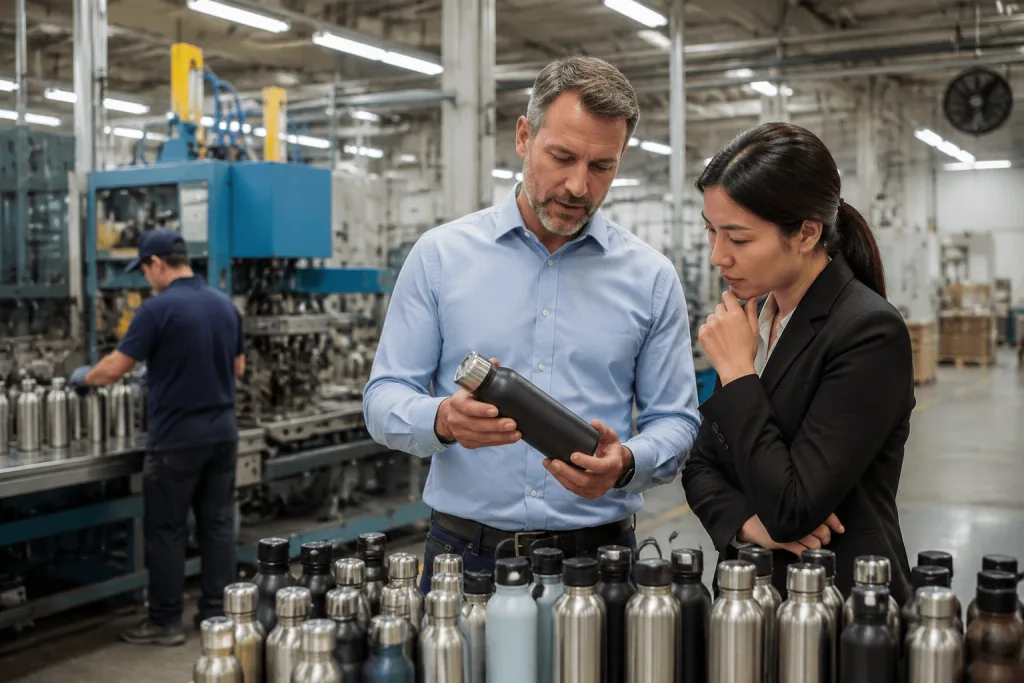
I’ll rewrite just the HTML prose, keep the tags and list structure intact, and tighten the quote language so it reads like a factory-side sales note.A solid factory quote is never just one price and a loose lead time. It should break out the line items so the buyer can compare the same spec set. We run this on the line all the time: if a quote leaves out carton count, lid style, or print area, the low number is usually missing cost.
Your RFQ should include these items:
- FOB port: usually Ningbo or Shanghai for Zhejiang shipments
- MOQ: 500 pcs per color or model is common
- Sample time: 5-7 days for standard decoration
- Mass lead time: 18-25 days after sample approval
- Packing: bulk pack or retail box, with carton count
- Compliance docs: REACH, LFGB, FDA, or test report as needed
Ask one more question: can the factory mix colors in the same order? We’ve seen buyers get burned when “yes” turns into a 3,000 pcs MOQ per shade. Some Zhejiang factories allow 2-3 colors at one MOQ, others treat each color as a separate run. The buyer flagged this on a PO last month because the color code was off by one digit, and that kind of typo changes the whole order. If the supplier has the setup, they answer straight and give the run plan, not “we can discuss later.”
Request a factory-direct quote today
Send your capacity, material, print method, and target landing cost. We’ll quote water bottles factory direct with MOQ, lead time, and packaging details.
Frequently asked questions
What is the usual MOQ for water bottles factory direct?
For standard export drinkware, MOQ is often 500 pcs per SKU, color, or print version. Some canteen suppliers will accept 300 pcs for repeat buyers, but the unit price usually rises 8-15%. If you want mixed colors, ask whether the factory counts each color separately. For custom drinkware with retail packaging, 1,000 pcs gives you better pricing leverage and more stable production scheduling in China or Zhejiang.
How do I compare a canteen manufacturer and a canteen supplier?
A canteen manufacturer controls tooling, production, and QC directly, so you usually get better spec control and faster corrections. A canteen supplier or canteen vendor may offer convenience, smaller MOQs, or mixed product sourcing, but you can lose visibility on material grade and lead time. If you need repeat orders, compare factory audit reports, monthly output, and test documentation rather than just price.
Which decoration lasts longest on customized drinkware?
Laser engraving usually lasts the longest on stainless bodies because it removes the top layer instead of sitting on the surface. On a 0.6 mm 304 stainless bottle, it handles daily abrasion well. Silkscreen is cost-effective for one-color logos, but it can wear faster if the bottle gets frequent dishwashing. UV print looks strong initially, yet surface prep and coating quality matter a lot.
Can I order a customized growler or canteen customized design in one run?
Yes, but only if the factory is set up for it. Many canteen factories in Zhejiang can combine similar bodies with different prints, caps, or box art, but they will still separate production by model. Expect a 500 pcs MOQ per version in most cases. If your order mixes a custom growler and a customized canteen, ask for separate unit pricing and carton counts so your warehouse math stays clean.
What compliance should I request for Europe and North America?
For Europe, REACH and LFGB are common requests, and many buyers also ask for material declarations. For North America, FDA-related material compliance and basic migration testing are common, depending on your channel. If your item is sold through retail or Amazon FBA, confirm label placement, carton markings, and FNSKU handling before shipment. A good factory in China should provide test reports and packing photos before balance payment.