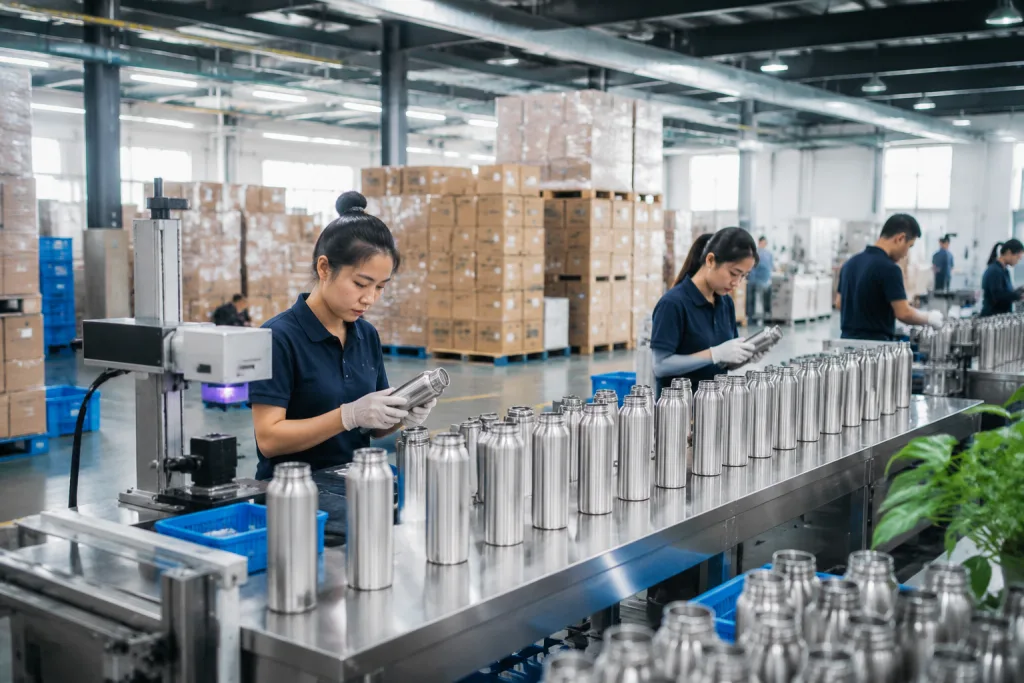
Key Takeaways
- A 500 ml stainless bottle usually lands at USD 2.10-4.80 FOB China depending on steel grade, lid, and print
- Most Zhejiang canteen factory lines hold MOQ at 500-1,000 pcs per SKU, with 20-35 days lead time after sample approval
- 316 stainless, 0.4-0.5 mm wall thickness, and a silicone-sealed lid cut leakage and dent risk fast
- AQL 2.5 for major defects is common for export, but your print registration and carton drop test should be written into the PO
If you are sourcing water bottles customized, the spec sheet matters more than the sales pitch. We have seen a bottle look clean in a catalog and then fail a 1.2 m drop test, leak in transit, or add 18% to landed cost because the print method and carton count were chosen badly. In China, and especially Zhejiang, factories can quote almost anything. Your job is to separate what the line can actually hold from what sounds good in email.
This guide reads the way a serious buyer checks a proposal: material, capacity, wall thickness, closure, decoration, packing, compliance, and MOQ. QC pulled the sample, measured the neck at 28 mm, and the buyer flagged a typo on the PO before it turned into a rework bill. We run the same review in-house. If you are buying customized drinkware for retail, corporate gifting, or Amazon FBA, the real question is not whether the bottle looks nice. It is whether the spec fits your margin, your compliance list, and your ship date.
Start with the material callout
I’ll rewrite this section in a more field-tested sales tone, keep the HTML exactly as-is, and preserve the technical numbers and tags.The first line on any serious quote is material. For water bottles customized, that usually means 304 stainless steel, 316 stainless steel, Tritan, aluminum, or BPA-free PP. Do not let that line stay vague. We run quotes off the exact grade, resin type, and build: single-wall, double-wall vacuum, or insulated. “Food grade” by itself is not enough for export buying.
For a canteen custom project, 304 stainless is the workhorse because it keeps cost and corrosion risk in check. On our line in Zhejiang, a typical 500 ml double-wall 304 bottle with a basic powder coat lands around USD 2.30-3.20 FOB at 1,000 pcs. Move to 316 stainless, and the cost goes up 15%-25%, but that spend makes sense for salty air, sports use, or a premium shelf. If you are buying a custom growler or customized growler for craft beverage branding, wall thickness and weld quality matter more than a shiny spec sheet.
- 304 stainless: best value for mainstream retail and promotional use
- 316 stainless: better corrosion resistance, higher price
- Tritan: lighter, clear, good for cap-heavy styles
- Aluminum: cheap and light, but coating quality is critical
Ask the canteen manufacturer to state the resin or steel certificate, not just the marketing name. QC pulled the sample on a 1,000 pcs order last month and the buyer flagged a vague PO note before production started. A real canteen supplier in China should show material traceability and test records. If they cannot, the math does not work.
Read capacity and tolerance carefully
I’m rewriting the section in-place and keeping the HTML structure untouched. I’ll tighten the sales-engineer tone, add a few concrete factory details, and avoid the AI filler the brief called out.Capacity looks simple until you compare mold drawings with finished samples. A 500 ml bottle on paper may come out at 520 ml or only 470 ml in hand, depending on neck design, shoulder curve, and the liner inside. That gap matters when you sell customized drinkware in Europe, where pack copy, EAN data, and buyer expectations all have to line up. For a canteen customizable program, ask for nominal capacity, usable capacity, and overflow capacity on the same sheet.
On the factory floor, we hold capacity tolerance at ±3% to ±5% for metal bottles, and a bit wider on some molded canteen customized styles. If the quote says 750 ml, ask for a dimension sheet. Diameter, height, mouth opening, and base shape all hit shelf fit and carton efficiency. We once had a buyer flag a PO because the drawing said 72 mm, but the sample measured 75 mm at the shoulder; that 3 mm pushed the carton from 24 pcs to 20 pcs and wrecked the freight math.
Practical rule: if the bottle is for e-commerce, the carton size can matter more than the bottle shape. A 2 cm change in diameter can move cube cost enough to wipe out margin.
For canteen distributors placing mixed-SKU orders, keep the range tight: 350 ml, 500 ml, 750 ml, and 1,000 ml usually cover the line. Odd sizes create trouble in forecasting and replenishment. We run into this on the packing table all the time; QC pulled a sample that was 1,020 ml against a 1,000 ml PO, and the buyer pushed back hard because the inner tray no longer fit the 6-pack master carton. In China, a canteen factory will open a new mold if you ask, but you pay in tooling, packaging, and inventory risk.
Wall thickness drives durability
I’ll keep the tags and structure, rewrite only the prose, and tune it to sound like a factory-side sales engineer. Next I’m replacing the generic phrasing with tighter export-sourcing language and one or two shop-floor details per paragraph.Wall thickness is one line buyers skip, then regret later. For stainless water bottles customized for retail or promotion, 0.4 mm to 0.5 mm is the commercial range we run most often. Thinner walls cut weight, but the dent test goes bad fast. Push much thicker, and the unit price climbs while the bottle feels dead in hand, which distributors usually push back on.
If the order is a canteen promotional item for an event, a lighter bottle is fine. If the bottle will live in backpacks, gym bags, or office desks, it needs enough stiffness to take repeated drops. A 0.45 mm 304 shell with clean drawing on the line usually gives the right mix of cost and service life. For a customized canteen with vacuum insulation, we watch weld quality and vacuum retention first; chasing wall thickness alone is the wrong question to ask. QC pulled a sample last month and the shell passed, but the seam failed after a 1.2 m drop test.
- 0.35-0.40 mm: lower cost, more dent-prone
- 0.45-0.50 mm: most balanced for export programs
- 0.60 mm+: premium feel, higher raw material cost
Ask the canteen manufacturers whether they measure thickness before forming or after forming. That detail changes the real figure. A good Zhejiang factory will answer in one sentence. On our side, we ship with a micrometer check at 3 points on the body, and if the buyer flagged a PO typo on the spec sheet, we stop and confirm before cutting tooling. A vague answer usually means the process control is weak.
Lid design decides complaint rate
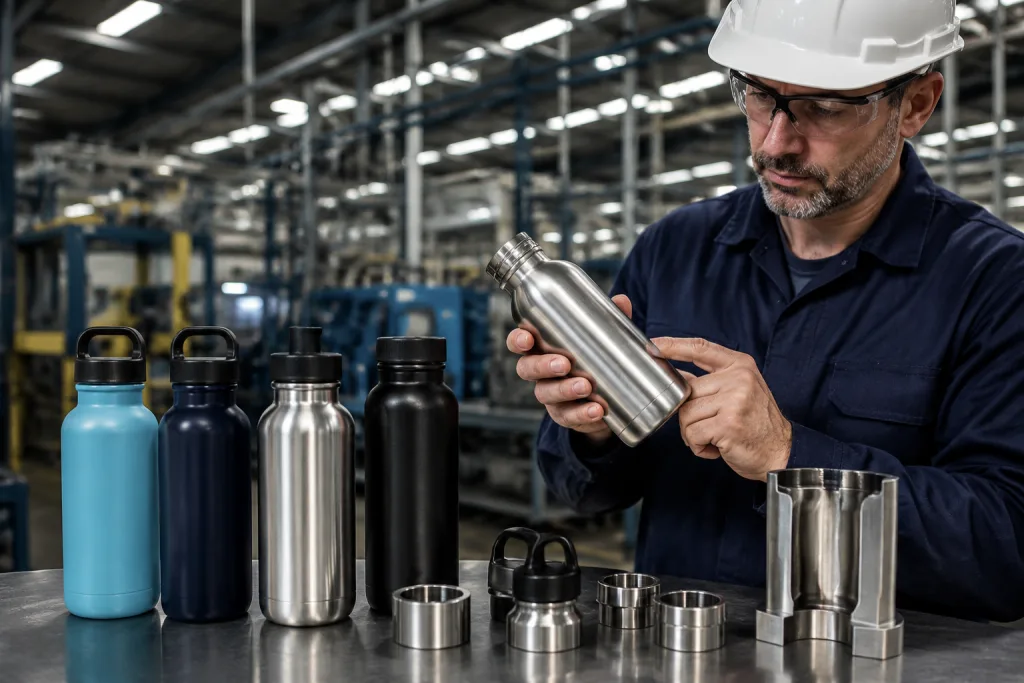
I’ll rewrite the section in-place, keep the HTML tags intact, and strip the AI-ish phrasing while adding a few factory-floor specifics.Most complaints start at the lid, not the bottle body. That is why the spec sheet has to be blunt about sealing structure, gasket material, thread pitch, and how the lid opens. A screw lid with a single silicone ring works for a lot of water bottles customized for office use. A sports lid, flip lid, straw lid, or push-button lid changes the failure rate fast.
If you are building a custom canteen for North American retail, write the lid spec like a technician, not a brand manager. State the gasket material, whether the seal ring comes out for washing, and whether QC pulled the sample through upright and inverted leak tests. For a distributor growler or customized growler program, confirm pressure tolerance if the bottle will take carbonated drink. We have seen buyers flag this after the PO is signed, then the test report quietly omits it.
A good line in the sand: 3,000 open-close cycles for mainstream consumer bottles, with the hinge or thread still running smooth after temperature cycling. On our line, we check with a torque meter and a 60°C to -20°C swing. If the vendor has no cycle data, the lid was never proven at scale. That is the wrong place to gamble on a 5,000-unit shipment to Rotterdam or Long Beach.
Decoration is where margins move
I’ll rewrite the section in place, keeping the HTML exactly as-is and tightening the sales-engineer tone. Next I’m making the prose more specific, more natural, and less generic.Decoration is not cosmetics; it moves cost and rejects. Silk screen, pad print, heat transfer, laser engraving, UV print, and powder coat each behave differently on customized drinkware. If the logo is one solid color with a clean outline, silk screen usually stays the lowest-cost option. If the buyer wants a retail look, laser engraving on brushed stainless gives a cleaner mark and holds up better, but the look is different.
For canteen customizable projects, ask for the real print area in millimeters, not “logo can be added.” A 30 x 30 mm logo and an 80 x 80 mm panel are two different jobs. On our line, decoration pricing from a Zhejiang factory often lands around USD 0.08-0.25 for single-color print, USD 0.25-0.60 for multi-color or wraparound work, and more for complex finishes. The math does not work any other way.
Buyer tip: if you are sourcing a custom drinkware range for multiple channels, standardize the decoration across SKUs. One logo method and one color palette cuts setup time and rejects; we have seen a retailer lose 2 days because the PO listed three logo positions and the buyer flagged it after sampling.
Ask for print adhesion testing, abrasion checks, and REACH compliance for the EU market. QC pulled a sample last month and the ink scuffed after 50 rubs on the abrasion tester, which is a bad sign before shipment. A canteen promotional order that looks good on day one but rubs off in fulfillment is brand damage, plain and simple.
Packaging and compliance are not optional
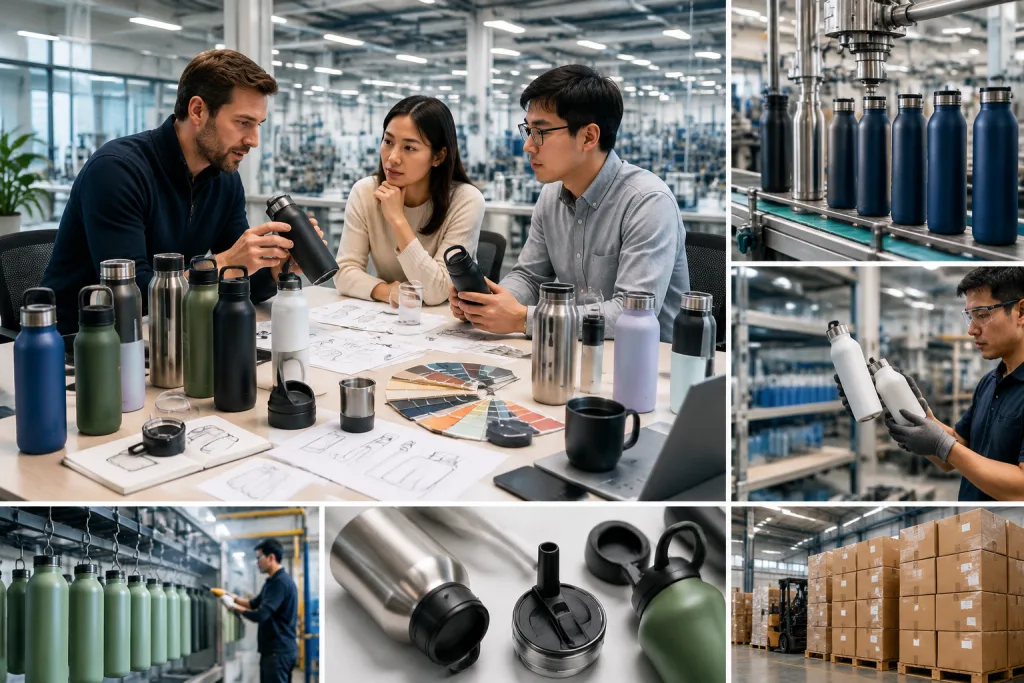
I’ll rewrite the section in-place, keep the HTML structure intact, and tighten the sales-engineer tone while preserving the technical terms and numbers.Packaging is where export buyers under-specify, then pay for it later. For customized drinkware, put the carton structure, insert type, bag material, and master carton strength into the quote from day one. If the goods go to Amazon FBA, the pack needs barcode placement, carton labels, and drop test performance that holds up on the line. For wholesale, carton count and pallet pattern drive the math.
For a canteen distributor or drinkware buyer, ask for master carton dimensions and gross weight at sample stage. A 500 ml vacuum bottle packed 24 pcs per carton can shift freight cost by 6%-10% on carton geometry alone. We’ve seen a PO typo on carton count add one full pallet, and the buyer flagged it only after QC pulled the sample. A competent canteen manufacturer in Zhejiang should show carton test results, especially if the shipment spends 25-35 days at sea and gets rehandled at destination warehouses.
- Compliance: REACH for EU, LFGB where relevant, FDA contact safety for US programs
- Quality standard: AQL 2.5 major, 4.0 minor is a common export baseline
- Testing: leak, drop, thermal retention, coating adhesion, dishwasher resistance if claimed
If you need mixed merchandising formats, the canteen supplier should support shelf-ready cartons, gift boxes, and mailer-style packs. A factory in Zhejiang with in-house packaging control usually moves faster than a plant that outsources every box. This is the wrong question to ask if someone says packaging is “just a carton.”
MOQ, lead time, and factory reality
I’ll keep the HTML exactly as-is and rewrite only the prose, with tighter factory-floor language and concrete numbers. Then I’ll sanity-check that the tags and structure stayed unchanged.This is where buyers stop guessing and ask the real question: what does the factory ship every month? A solid canteen factory in Hangzhou or nearby Zhejiang industrial zones may run 300,000 to 800,000 units a month across stainless bottles, tritans, and promo lines. That number matters. If the line is already full, your “good price” turns into a slow order.
For most water bottles customized programs, MOQ starts at 500 pcs for stock molds with basic decoration and 1,000 pcs or more for full custom color or custom packaging. Lead time usually runs 20-35 days after sample approval and deposit, and we add 7-15 days if the job needs new tooling or special finishes. QC pulled a lid sample last week with a 0.8 mm mismatch on the gasket seat, and that kind of issue is why a supplier quoting 10 days on a complex new mold is telling you a story, not a schedule.
Buyers in Europe and North America should run the numbers as a landed order, not a unit price. A canteen promotional project at USD 1.85 per piece can go sideways if the MOQ is too high, the lead time misses a 12-day launch window, or the carton spec misses retailer rules. We had one PO with a typo on the outer carton height, 31 cm written as 13 cm, and the buyer flagged it before we packed. That saved a rework. A good supplier will point out the bottleneck before you place the order, and that is worth more than a 3-cent cut.
For custom canteen and custom growler programs, start with a sample order of 2-5 pcs, then a pre-production sample, then a pilot run if the launch matters. We run that sequence for a reason: the first sample checks the logo, the second checks the cap torque, and the pilot run shows whether the cartons survive the drop test. It is the clean way to protect your timeline and keep one bad batch from turning into a container of regret.
Send your spec sheet for a fast quote
If you already know your size, material, and logo method, we can quote water bottles customized in 24 hours from our Zhejiang team.
Frequently asked questions
What is a realistic MOQ for water bottles customized?
For stock molds with simple logo printing, 500 pcs is common in Zhejiang. For custom color, custom lid, or custom packaging, plan on 1,000 pcs per SKU. If you need a new mold for a customized canteen or custom growler, some factories will ask for 3,000-5,000 pcs to cover tooling. The real answer depends on how much setup the canteen manufacturer has to do.
How much should I budget per bottle FOB China?
A 500 ml stainless bottle usually lands around USD 2.10-4.80 FOB China, depending on steel grade, wall thickness, lid style, and decoration. A basic canteen promotional item with one-color print may sit near the low end. A premium customized drinkware piece with laser engraving, powder coat, and upgraded packaging will be higher. Freight and duty are extra.
Which decoration method lasts longest?
Laser engraving is usually the most durable because it removes or marks the surface instead of sitting on top of it. For colored branding, silk screen and UV print are common, but you should ask for abrasion testing. On a canteen customizable order, I would specify the logo area, ink standard, and whether the finish must pass dishwashing or rub testing before shipment.
What certifications should I ask a canteen supplier for?
For EU-bound orders, ask about REACH and, where relevant, LFGB contact safety. For the US, ask for FDA-compliant material declarations. If the factory claims quality control, also ask for AQL inspection records, leak test reports, and carton drop test data. A serious canteen factory in China should answer these questions without delay.
How do I choose between a canteen distributor and a factory?
Use a canteen distributor if you need mixed product sourcing, smaller quantities, or faster coordination across several items. Use a canteen factory if you need tighter control on molding, decoration, and pricing. For distributor drinkware programs, the best setup is often factory direct on the main SKUs and distributor support for fast-moving add-ons. In Zhejiang, many buyers work with both.