Key Takeaways
- Start with 4 decisions: material, lid style, decoration, and compliance; those drive 80% of cost and risk.
- For most standard orders, MOQ is 3,000-5,000 units and FOB China pricing often starts around USD 0.65-2.40 per piece depending on construction.
- Plan on 20-35 days for production after sample approval; complex custom canteen or custom growler programs take longer.
- If you sell into Europe or North America, ask for REACH, FDA, LFGB, and AQL 2.5 inspection evidence before you place deposit.
If you buy water bottles customizable for a brand, retail program, event, or Amazon listing, the wrong call gets expensive fast: launch slips, margin gets squeezed, and the sample looks clean while the line starts failing on mass production. The real question is not “which bottle looks nice.” It is which bottle fits your target cost, decoration method, compliance files, and replenishment plan.
In Zhejiang and across China, factories can make almost anything sound simple. Your job is to separate what we can make from what actually makes sense for your order. A canteen factory may quote 15,000 units with a 25-day lead time, but if your art needs four-color wrap printing and REACH paperwork for Europe, the math changes. We run that check early, because a clean quote that misses carton size, lid tooling, or QC limits is the wrong quote.
Start With the Use Case
I’ll rewrite the prose to sound like a factory-side sales engineer, keep the HTML exactly as-is, and tighten the buyer logic with more concrete shop-floor detail.Before you compare caps, colors, or logo effects, lock down where the bottle will actually be used. A 500 ml school bottle, a 750 ml gym bottle, and a 64 oz promo growler are different builds, even when buyers lump them under “custom drinkware.” User behavior sets the geometry. A commuter wants one-hand opening and a seal that passes a 1-meter leak check. A retail program for outdoor stores wants drop resistance and tight carton packing. An event giveaway wants low landed cost and a print panel the decorator can hit cleanly.
Ask four blunt questions: Who uses it? How often? Will it go through a dishwasher? Will it be resold or handed out? The answers tell you whether you need a customizable canteen in stainless steel, a lightweight PETG bottle, or an insulated custom growler. We run this conversation on the line all the time, and the buyer usually flags the same thing: the “one-size-fits-all” sample looks fine until QC pulls the cap and the hand feel is wrong. In China, plenty of canteen suppliers will quote a sharp price on a universal shape. That is the wrong question to ask. A bottle that fits nobody’s hand well turns into dead stock, and we’ve seen that go sideways with a 2,000-piece MOQ before the first carton ships.
For B2B buyers, the use case also sets your risk tolerance. If the bottle is for a one-time promotion, a simpler build and a 12-day lead time can work. If it is a retail SKU, you need replacement continuity, tighter tolerances, and packaging specs that match the PO down to the carton mark. One typo on a pack list can stall a shipment for 3 days. That is how you stop treating water bottles customizable as a generic category and start buying like a pro.
Choose the Right Body Material
I’ll rewrite the prose in-place, keep the HTML structure unchanged, and make the copy sound like a real factory sales engineer wrote it. Next I’m patching the section with tighter wording, concrete shop-floor details, and fewer AI-style fillers.The body material drives cost, hand feel, and breakage rate. We run 304 stainless on premium programs because it works for insulated and single-wall builds, takes laser engraving or silk print cleanly, and holds up in repeat use. On the line, an 18/8 insulated custom canteen usually runs 0.4-0.5 mm for the inner and outer shells; single-wall promo bottles sit closer to 0.3-0.4 mm. If the buyer wants a lower unit price and lighter weight, aluminum is an option, but it dents fast and often needs a liner or coating. That tradeoff is easy to see on the drop test bench.
Plastic is not a weak choice if the spec is right. Tritan, AS, and PP each solve a different job. Tritan gives clear walls and better impact resistance; PP keeps cost down for a canteen custom program that does not need insulation; AS looks clean, then starts to lose the fight when the carton gets rough. QC pulled the sample at 1.2 mm wall thickness and 3 of 20 pieces showed stress marks after the first freeze-thaw cycle, so we pushed the buyer to change the resin. For a canteen manufacturer in Zhejiang, this is the wrong question to ask: not “which material sounds better,” but whether resin grade, wall thickness, and mold finish match the selling price.
If you are building a customized drinkware line for Europe or North America, check migration and safety requirements early. For food-contact items, ask for FDA, LFGB, and REACH documents by market before tooling starts. We once had a PO typo on a custom growler order—“304” was printed as “403”—and the buyer flagged it before production, which saved a messy rework. Material choice also changes stackability and freight efficiency, and that hits the math hard. A 304 stainless insulated bottle costs more than a molded plastic bottle, but the landed margin can still come out better if your retail target can carry it.
- Best for premium retail: 304 stainless steel
- Best for lightweight promotions: PP or Tritan
- Best for cost-sensitive bulk: single-wall stainless or PP
Lock Down Lid and Leak Risk
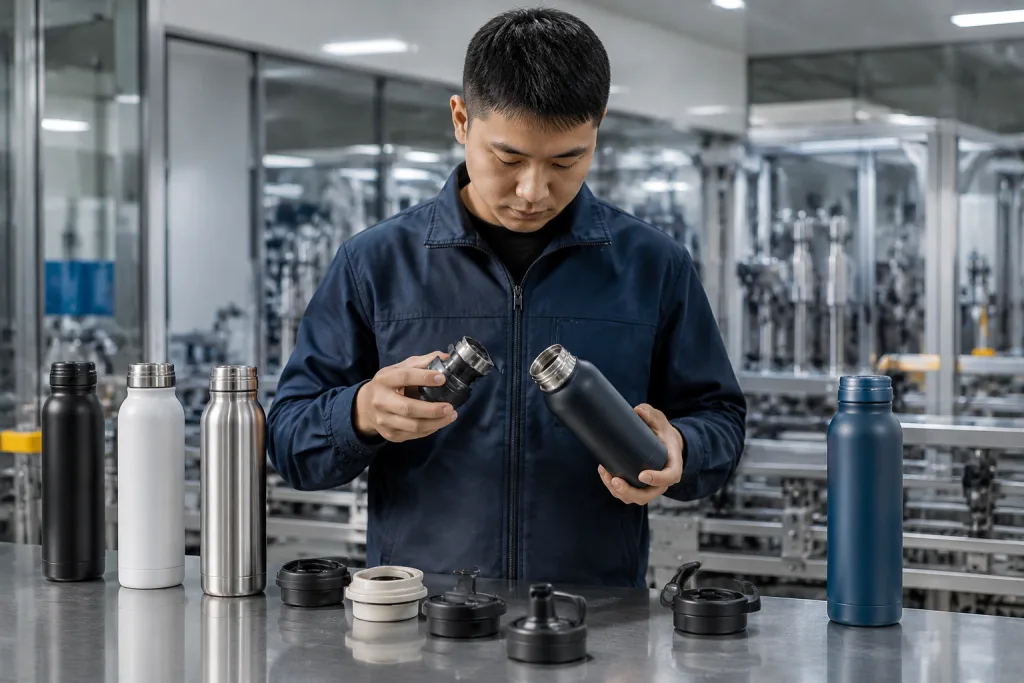
I’ll rewrite the HTML prose to sound like a factory-side sales engineer, keep the tags intact, and strip the AI-ish phrasing.The lid is where most buyer regret starts. We have seen good print work get buried by a bad cap: leaks, crossed threads, or a lid that feels flimsy in the hand. For water bottles customizable, pick the closure first and the logo method second. Flip lids are handy, but they bring more moving parts. Screw caps are simpler and cheaper. Straw lids move well in fitness, school, and youth orders, but they need cleaning checks and seal testing before you approve the PO.
On the factory floor, the lid also changes assembly time and reject rate. A canteen factory pushing 10,000 units per month can mold a plain cap without drama, but a spring-loaded or magnetic lid slows the line and lifts scrap. We ask buyers for 24-hour inverted leak tests, 1-meter drop tests, and 5,000-10,000 open-close cycles, depending on the category. The buyer flagged it once on a 0.5 mm gap at the hinge, and that tiny issue turned into a carton of returns. A failed lid costs more than a plain bottle because margin disappears fast on distributor programs.
Check the gasket first. Silicone is the standard, but the groove depth and wall thickness matter more than the word on the spec sheet. If you are buying from canteen manufacturers in China, ask for the exact seal size and hardness, not just the material name. A cap that holds a tighter tolerance beats another decoration process every time. We run spare-part checks on seal rings too, because when a gasket goes missing, the customer does not care about the print. That is where serious suppliers separate themselves from traders.
Pick Decoration for Margin, Not Ego
I’ll rewrite the section in-place, keep the HTML tags intact, and tighten the wording so it sounds like a factory-side sales engineer.Your logo method should match the target price and the art, not ego. Screen printing is still the cheapest path for flat colors and 5,000-unit runs. Laser engraving holds up on 304 stainless steel because it will not peel, but it stays one-color and reads premium. Heat transfer and UV printing handle gradients and photo detail, though they push up cost and need cleaner surface prep. On a custom canteen job, the wrong decoration call can add USD 0.20-0.80 per unit and still miss the brand brief.
For most B2B buyers, this is the wrong question to ask: “which method looks best?” Ask what survives use, fits MOQ, and leaves margin on the table. A distributor canteen order for retail may justify laser engraving or a 2-color screen print. A giveaway order usually wants a cheaper one-color print and a strong carton pack. We’ve seen full-wrap art go sideways on the curved body when the seam lands in the wrong place. Zhejiang factories can print clean work, but they need vector files and a PO that does not call the left side the “front.”
Custom logo work also sets the lead time. A simple one-color print can fit a 20-25 day production window after sample approval. A multi-color customized canteen program may need 30-35 days, plus proofing and one more QC pull if the buyer flags a shade shift. If you source custom drinkware for a seasonal campaign, decoration complexity is usually what blows the schedule. Budget for that on the first PO, not after the line is running.
Rule of thumb: if the decoration choice adds more than 8-10% to your unit cost without improving sell-through, you are buying vanity, not product.
Verify MOQ and Pricing Logic
I’ll rewrite the section in place, keep the HTML tags untouched, and make the prose read like a factory-side sales engineer wrote it.MOQ is not a random factory line. It tells you how many pieces we need to run one mold, one finish, and one decoration method without wasting time on changeovers. For a standard water bottles customizable program, 3,000-5,000 pieces per color or per design is the number we usually quote. We’ve taken 1,000-2,000 units on stock-style canteens only when the body and lid tooling already sat on the line. A true custom growler with a new lid or a special matte finish will push MOQ up fast.
Price has to be read as a ladder, not a single number. For FOB China, a basic PP bottle usually lands around USD 0.65-1.10, a non-insulated stainless bottle around USD 1.20-2.20, and a more complex insulated bottle can go above USD 2.40 depending on capacity and finish. One buyer flagged a quote at USD 0.78, then found it had no carton spec, no individual polybag, and no logo setup fee inside it. That’s the wrong question to ask if you only chase the lowest line.
As a canteen distributor or distributor drinkware buyer, ask for a tiered price sheet at 3,000, 5,000, and 10,000 units. That shows whether the factory understands scale or is just throwing numbers at you. On our side, we run a 12-day sample-to-production check on mixed-SKU orders, and QC pulled a carton sample once because the PO typo changed the inner pack from 24 pcs to 20 pcs. In Zhejiang, a good factory will tell you straight how color swaps, mixed SKUs, and carton changes affect the line; if they dodge that, we’ve seen the reorder go sideways.

Demand Compliance and QA Up Front
I’ll rewrite the section in place, keeping the HTML tags and the existing standards references intact while making the prose sound like a factory-side sales engineer wrote it.Custom drinkware is not just a design job; it is a compliance job. For Europe, we usually get REACH declarations on file and, for some builds, LFGB test reports. For North America, FDA food-contact compliance comes up a lot. If the bottle has coated stainless steel, a print layer, or a plastic lid, don’t let anyone treat the whole unit as cleared because one part passed last year. Ask for component-level traceability. We have seen a buyer skip that check and the carton was held at customs over the lid ink.
QC has to be written into the PO. For standard retail, we run AQL 2.5 for major defects and AQL 4.0 for minor defects; premium SKUs often go tighter. Ask for pre-production samples, in-line photos, and the final inspection report before balance payment. On our side, the line checks incoming 304 stainless, seal pressure, and carton count. If a supplier gets defensive about records, that is the wrong question to ask—the math does not work without paperwork.
Packaging matters too. A customized drinkware line can pass photo approval and still arrive dented if the cartons are weak. Ask for the drop-test target, the carton ECT rating, and the unit count per master carton. If you sell on Amazon or through a distributor, barcode placement, FNSKU labeling, and carton marks need to be fixed before the first batch runs. We once caught a PO typo on the carton height, 32 cm instead of 23 cm, and that would have broken the pallet plan. The win is not the bottle alone; it is the landed pack that reaches the warehouse in one piece.
Work With the Right Factory
I’ll rewrite the section in place, keep the HTML exactly as-is, and tighten the copy so it sounds like a factory-side sales engineer.The best factory is not the cheapest one. It is the one that quotes cleanly, answers fast, and hits the same quality on a reorder 6 months later. A real canteen factory in Zhejiang should show monthly output, who owns the tooling, and how the line is controlled, not talk in circles. If a plant runs 200,000 units per month across water bottles customizable, insulated bottles, and custom growler programs, that only matters if defect rates stay down and lead time stays stable.
Watch the basics: sample turnaround in 5-7 days for standard items, production lead time of 20-35 days, inspection records, and one person who actually knows export paperwork. Ask whether they work as a canteen supplier direct or through trading layers. That changes speed, accountability, and price. A direct canteen manufacturer in China should handle artwork, testing, and packaging without turning every PO typo into a new drama.
For repeat orders, consistency beats big promises. If the factory can hold color matching, keep cap fit tight, and leave the finish the same across two reorders, that plant is worth more than a vendor who only wins on a sample. We’ve seen this go sideways on canteen custom and customizable canteen programs when the buyer gets one good pilot and then the second run drifts 2 mm on the lid. That is the wrong question to ask if you only care about the first quote.
Send your specs for a fast quote
We’ll check material, MOQ, decoration, and compliance for your market, then quote the right water bottles customizable program for your channel.
Frequently asked questions
What MOQ should I expect for water bottles customizable?
For standard water bottles customizable, expect 3,000-5,000 units per design or per color. Some stock-body programs can start at 1,000-2,000 units if the canteen factory already has tooling and lids in place. A fully new customized canteen with special mold work or a custom growler cap usually needs a higher MOQ, sometimes 5,000-10,000 units. If your supplier offers a very low MOQ, ask whether they are charging extra for printing, packaging, or testing. The real question is not just the MOQ number; it is whether the factory can repeat the same quality on the second and third order.
How long does production take in China?
For a normal custom drinkware order, sample confirmation usually takes 5-7 days and mass production takes 20-35 days after deposit and artwork approval. Simple canteen promotional orders can be faster if the body and lid are stock items. Complex canteen customized programs, especially with multi-color printing, special coatings, or insulated builds, usually take longer. If you are buying from Zhejiang or another export-heavy region in China, ask the factory to separate tooling time, sample time, and production time. That gives you a real schedule instead of a marketing estimate.
Which material is best for a custom canteen?
For premium retail or long-term branded use, 304 stainless steel is usually the safest choice because it supports better durability, stronger perceived value, and more decoration options. For lower-cost promotional work, PP or Tritan can be better if weight and price matter more than insulation. A custom canteen for Europe or North America should also be checked against FDA, LFGB, and REACH expectations depending on the market. Material choice affects not only the bottle feel, but also freight cost, defect risk, and the final retail margin.
What testing should I request before ordering?
At minimum, ask for leak testing, drop testing, and material compliance documents. For many B2B buyers, 24-hour inverted leak tests and 1-meter drop tests are a practical baseline. If you are importing into Europe, ask for REACH-related declarations and, where relevant, LFGB testing. For North America, request FDA food-contact documentation. Also specify AQL levels in the PO, typically AQL 2.5 for major defects and AQL 4.0 for minor defects. A serious canteen manufacturer should have these documents and procedures ready before mass production starts.
How do I compare canteen suppliers fairly?
Compare them on five points: exact MOQ, FOB price at 3,000/5,000/10,000 units, lead time, testing capability, and packaging spec. A canteen supplier who is cheaper by USD 0.10 but omits carton protection or compliance paperwork is not really cheaper. Ask whether they are a direct canteen factory or a trading layer, because that affects accountability and reorder stability. Also check whether they can keep cap fit, print position, and color matching consistent across future production runs. That matters more than a pretty sample.