Key Takeaways
- Pantone control on custom drinkware usually needs a Delta E target of 1.0-2.0, not a vague “close match”.
- For a normal canteen custom order, expect MOQ from 3,000 units and sample lead time of 7-10 days.
- Bulk pricing for basic customized drinkware often starts around USD 1.25-2.80 per unit FOB China, depending on material and decoration.
- Your PO should name color code, finish, carton spec, AQL level, and packaging FNSKU or retail barcode handling.
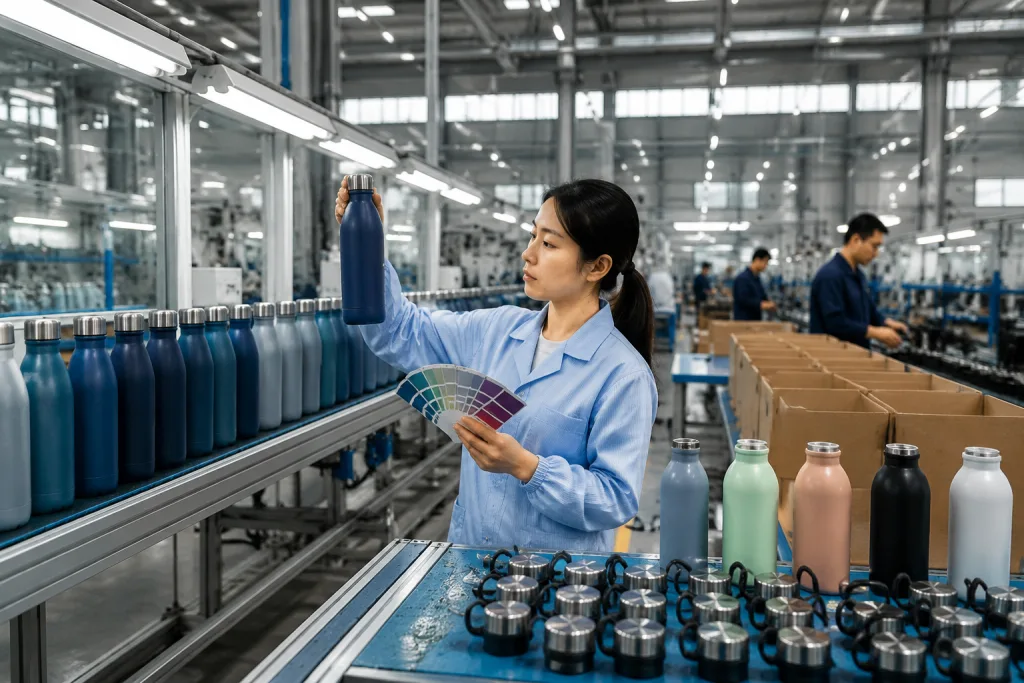
When you ask for water bottles custom pantone, you are not buying color alone. You are buying a repeatable production result that holds up through resin variation, coating thickness, print method, and the line lighting in QC. Skip the details and the “same” blue can move 1.5 to 3.0 Delta E between sample and bulk. That is enough to trigger a chargeback or a rework. In Zhejiang and across China, the factories that get this right treat color as a process, not a promise.
The buyer mistake is simple: they send a logo, say “match Pantone,” and wait for magic. That is the wrong question. Better buyers lock down the substrate, finish, tolerance, sample approval path, and PO line items before production starts; we’ve seen one typo on a PO turn a matte bottle into a gloss one. If you source custom drinkware for retail, ecommerce, or a canteen promo run, that discipline saves money. At BottleForge Industrial in Hangzhou, our standard MOQ starts at 3,000 units, typical lead time is 25-35 days after sample approval, and monthly output runs above 500,000 units across stainless and Tritan programs.
Start With the Use Case
I’ll rewrite the section in a more field-tested sales voice, keep the HTML intact, and tighten the color/material guidance so it reads like factory-side advice.Before you send a canteen factory a Pantone, decide what the bottle has to do. A 500 ml powder-coated stainless bottle for a distributor program behaves nothing like a 1 L Tritan custom growler or a lightweight giveaway canteen. Same Pantone, different result. On matte powder coat, the color reads deeper; on gloss paint, it pops harder; on anodized aluminum, it can turn a shade duller. That is not a factory excuse. It is the material on the line.
Write the job in plain terms: retail shelf, corporate gift, sports event, or Amazon FBA. Then lock down the bottle shape, lid type, and surface finish. A canteen distributor needs a color that stays consistent under store lights and in product photos. An enterprise buyer usually pushes us harder on scuff resistance. If the bottle will get handled all day, we run a rub test of at least 1,000 cycles and check for edge fade. For a customized growler, ask where the decoration sits: under coating, over coating, or on a sleeve. That choice moves the cost more than the Pantone code does.
We see RFQs that say “custom drinkware, blue, logo printed.” That is too loose. If you want a canteen supplier or canteen vendors to quote cleanly, give the end use, target price, and sales channel. The buyer flagged one PO last month because “navy” was written with no code, and the sample came back in the wrong tone. China factories can move fast, but they need a target. In Zhejiang, the best quote comes from the buyer who thinks like production, not a shopper.
Write a Clean RFQ
I’ll rewrite the section in place, keep the HTML structure untouched, and tighten the RFQ language so it reads like a factory-side sales engineer wrote it.A clean RFQ cuts one revision round, sometimes two. Keep it short, not sloppy. State the bottle type, capacity, material, lid, Pantone reference, logo method, packaging, destination port, and annual volume. If you are comparing canteen suppliers or canteen manufacturers, make sure every factory is quoting the same build. Otherwise the price gap means nothing.
For water bottles custom pantone, give the color standard in one of three forms: Pantone Solid Coated number, physical swatch, or approved master sample. If you need a tolerance, write Delta E ≤ 2.0 for coated metal and Delta E ≤ 1.5 for injection-molded caps. That range works for most custom canteen jobs. Also say whether the color goes on the full body, only the lid, or both. We have seen two-tone canteen customized orders need separate coating runs, and the line adds USD 0.08-0.25 per unit fast.
Typical RFQ line items:
- Bottle type: stainless steel, Tritan, aluminum, or glass
- Capacity: 400 ml, 500 ml, 750 ml, or 1 L
- Pantone code: exact number plus finish reference
- Decoration: silk screen, laser engraving, UV print, or heat transfer
- Packaging: bulk pack, color box, mailer box, or retail set
- Compliance: FDA, LFGB, REACH, BPA-free, ASTM where relevant
If you are a distributor canteen buyer, ask for FOB pricing, not just EXW. FOB Ningbo or FOB Shanghai is easier to compare against other canteen distributors and canteen vendors in China. A Zhejiang factory that sends a clean FOB quote is usually organized; one that throws back a random unit price is not. QC pulled this same issue on a 500 ml sample last month when the PO typo said “5000 ml.”
Lock the Pantone Sample
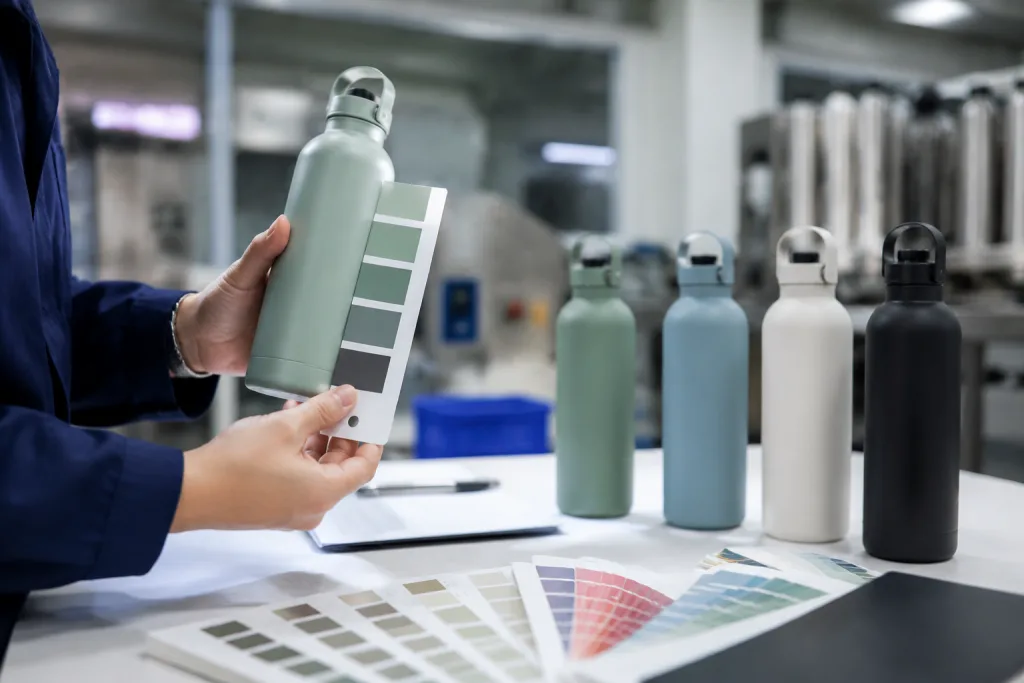
I’ll keep the HTML structure intact and rewrite the prose in a more shop-floor, sales-engineer voice. Then I’ll tighten the color-approval language and keep the numbers/codes unchanged.The sample stage is where most color fights get stopped, or started. Do not approve a photo. Approve a physical sample under daylight D65 or in an agreed viewing booth. Ask the factory to run a pre-production sample on the same base material, same coating line, and same decoration process you want for bulk. If they change paint systems later, the Pantone match drifts. We have seen that go sideways on a 3000-piece run when QC pulled the sample and the body shade was off by one step.
For water bottles custom pantone, we run a simple sample chain: first the color swatch, then the blank bottle sample, then the decorated sample. If the order is over 10,000 units, ask for two retained masters, one kept by you and one sealed at the canteen manufacturer. A Zhejiang factory that knows the drill will accept it. At BottleForge, our sample lead time is normally 7-10 days, and we log each sample by mold, coating batch, and print ink lot. That traceability saves arguments later.
Buy the sample like you plan to buy the bulk, or the bulk will teach you a lesson.
The color approval should lock more than the Pantone code. Put down gloss level, surface texture, and the acceptable variance. A matte finish at 10-15 GU looks less saturated than a gloss finish at 70+ GU. On customized drinkware, that changes the whole shelf read. If you are ordering customized growler or custom canteen lines, say whether the logo can sit a little darker or lighter than the body. We usually see buyers allow a 5-8 percent shift in logo contrast so the mark stays readable, and the math does not work any other way.
Build the Sample PO
I’ll rewrite the section in place, keep the HTML structure intact, and tighten the sales-engineer tone with more concrete factory detail and fewer AI-style phrases.Once the sample is approved, issue a small PO that matches the mass order as closely as possible. This is where smart buyers get specific. A sample PO is not just “1 sample bottle.” It should list the bottle spec, Pantone code, logo file version, sample fee, shipping method, and approval deadline. If the design will go through multiple canteen distributors or retail channels, write the packaging version on the PO too. We’ve seen a buyer leave that out, then the art team changed the carton art twice and the line had to stop.
Sample PO line items:
- 1 to 3 units pre-production sample
- Unit sample fee: USD 35-120 depending on tooling and print setup
- Artwork setup fee, if any
- Courier cost by DHL or FedEx
- Approval deadline and revision limit
For a canteen customizable or customizable canteen program, ask the factory to confirm whether the logo method matches production. Laser engraving on stainless is clean and stable, but it will not show the Pantone body color. Silk screen on coated bottles gives stronger branding, but ink opacity and curing can change the look. If the buyer flagged a full-color logo on a brushed 304 stainless bottle, this is the wrong question to ask on sample day; the method needs to match the real run, not a showroom piece. QC pulled the sample, and if the print is not set up the same way, the approval means nothing.
Do not approve until you see three checks on the bench: color consistency under daylight, logo position within ±1.5 mm, and lid/body fit with no wobble. A factory that handles canteen customized projects well will already record those numbers before you ask. We run this with a steel ruler and a go/no-go gauge, because the math does not work if the cap rocks or the print sits off-center. In China, the gap between an average supplier and a serious canteen factory is usually whether they write down the check sheet first, then ask for your signature.
Run the Bulk Trial
I’ll rewrite the section in-place, keep the HTML exactly as-is, and tighten the sales-engineer tone with more factory-floor detail.Bulk production should begin with a first-article check, not a full-speed run. For orders above 5,000 units, ask for an inline start-up report covering coating thickness, print alignment, and cap torque. On a painted stainless body, we run coating at 25-35 microns for a durable consumer finish. Too thin, and the Pantone looks washed out; too thick, and the fit starts drifting.
For custom canteen, customizable growler, and distributor growler orders, ask the factory to keep one ink batch or coating batch for the whole color lot. That cuts shade drift. If the run spans 2 or 3 production days, spell out whether the lot can be split. We’ve seen this go sideways when a buyer left it open and QC pulled the sample from a different shift. A Zhejiang canteen factory should hold color variation within the agreed Delta E range across the order, but only if you lock the rule before the line starts.
Bulk PO line items:
- Product name, capacity, and material
- Pantone code and finish type
- Decoration method and artwork version
- MOQ and overrun allowance, usually 2-5 percent
- Packaging spec, carton count, master carton mark
- Inspection standard: AQL 2.5 major, 4.0 minor is common
- Incoterms: FOB, CIF, or DDP if negotiated
A practical buyer also asks for production photos, carton drop-test confirmation, and pre-shipment inspection rights. If the order is for Amazon, add FNSKU labels, suffocation warnings, and carton barcode placement to the PO; a typo there costs a day on the packing line. If it is for a canteen promotional campaign, list gift-box inserts and spare lids as separate line items. The math doesn’t work any other way, and that is where hidden cost creeps in.
Check Quality Before Shipment
I’ll rewrite the section in place, keeping the HTML structure and tightening the sales-engineer tone. I’m checking the phrasing for concrete QC detail, cleaner buyer language, and the Pantone/shipment points you want.Color approval is only one part of quality. We check leak performance, coating adhesion, odor, and finish durability before anything leaves the line. For stainless and Tritan custom drinkware, the basic test set is a 24-hour inversion leak test, a 1-meter drop test, and a dishwasher resistance check if the product claims it. A proper canteen supplier in China documents the results; we do not ship on promises.
Keep the inspection simple. For a 3,000-10,000 unit order, pull 80-125 pieces depending on lot size, then run the AQL plan. Check the Pantone match under natural light and under LEDs, because the buyer flagged too many “good in the workshop, bad in store” cases. On textured powder coat, QC should look at whether the print sinks into the texture valleys or blurs the logo edge. We’ve seen that go sideways on the first carton.
What to verify before release:
- Color consistency across random samples from different cartons
- No pinholes, dust points, or coating runs
- Lid seal passes pressure and inversion tests
- Carton labels match PO and shipping marks
- Compliance docs are complete: REACH, LFGB, FDA, or ASTM as required
If you are a canteen distributor or distributor drinkware buyer, this is where you confirm spare parts too. A missing cap gasket on a 20,000-unit order costs pennies and creates a customer complaint that lands back on your desk. We run into this a lot. Good canteen manufacturers in China plan for the gasket pack; the weak ones call it “not important.” That is the wrong question to ask.
Negotiate the Real Price
I’ll rewrite this section in-place, keeping the HTML structure intact and tightening the pricing language so it sounds like a factory-side sales engineer.People ask for a unit price too early. The better question is the landed cost for the exact spec you want. For water bottles custom pantone, a simple coated stainless bottle usually lands at USD 0.95-1.80, a Tritan bottle with logo at USD 1.40-2.60, and a premium insulated model at USD 2.20-4.50, depending on wall structure, vacuum performance, and packaging. Pantone color can add USD 0.03-0.15 if the line needs a dedicated coating run or special ink. We ran that job last month; QC pulled the sample, and the buyer flagged a 1.2 mm coating variance before mass production.
When you compare a canteen vendor, canteen supplier, or canteen factory, make them separate tooling, sample fees, decoration, packaging, and inland trucking. That is the only clean comparison. If one quote comes in 8 percent lower but hides a carton upgrade, a double-wall insert, or a test fee, the math does not work. You are not saving money. You are paying it later. We’ve seen buyers chase the lowest PO and then find a typo on the carton spec after the deposit clears.
Useful price drivers:
- Material: stainless 304, Tritan, aluminum, or glass
- Body finish: matte, gloss, soft-touch, or powder coat
- Decoration area: full wrap or one-panel print
- MOQ: 3,000 units usually beats 1,000 on unit cost
- Packaging: bulk pack versus retail box
- Destination: FOB China versus DDP North America or Europe
If your project is a customized canteen line for retail or corporate gifting, do not chase the lowest quote from random canteen vendors. On our line, stable output beats a cheap number every time. The right canteen manufacturer will show where the price is firm and where there is room to move. This is the wrong question to ask if you only want the headline number.
Send your Pantone spec and get a quote
We can review your RFQ, match the finish to the material, and quote factory-direct from Zhejiang with clear MOQ, sample, and bulk terms.
Frequently asked questions
How do I make sure the Pantone color matches in bulk?
Use a physical sample approved under D65 light, then lock the same material, finish, ink, and coating batch for production. Ask for a written tolerance such as Delta E ≤ 2.0 for the bottle body and ≤ 1.5 for caps. For a 3,000-unit order, request first-article photos, one retained master sample, and random carton pulls during packing. That is how serious canteen manufacturers in China control drift.
What MOQ should I expect for water bottles custom pantone?
A practical MOQ is 3,000 units for most custom drinkware programs, especially when you want a dedicated color run or custom logo setup. Some canteen suppliers will quote 1,000 units, but the unit price usually rises 15-30 percent. For a customized canteen with special packaging, expect MOQ to climb to 5,000 units unless the design is very standard.
How long does the sample and bulk process take?
A normal timeline is 7-10 days for samples and 25-35 days for bulk after sample approval. If the order needs a new mold, special lid, or a nonstandard Pantone coating, add 7-15 days. A Zhejiang canteen factory with stable lines can often hit these dates if you approve artwork and packaging quickly.
What should be on the PO for a custom canteen order?
Include product name, capacity, material, Pantone code, logo file version, decoration method, packaging spec, carton count, AQL standard, Incoterms, and shipment marks. If you are ordering for Amazon, add FNSKU labels and retail barcode requirements. A clean PO reduces errors more than a long email thread.
Can you do custom canteen, custom growler, and other customized drinkware in the same color?
Yes, but only if the substrate and finish are similar. A stainless custom growler and a Tritan canteen customizable bottle may share the same Pantone reference, yet the final appearance will still differ because gloss, texture, and material reflect light differently. If the brand needs one exact look across all SKUs, test each SKU separately before bulk release.