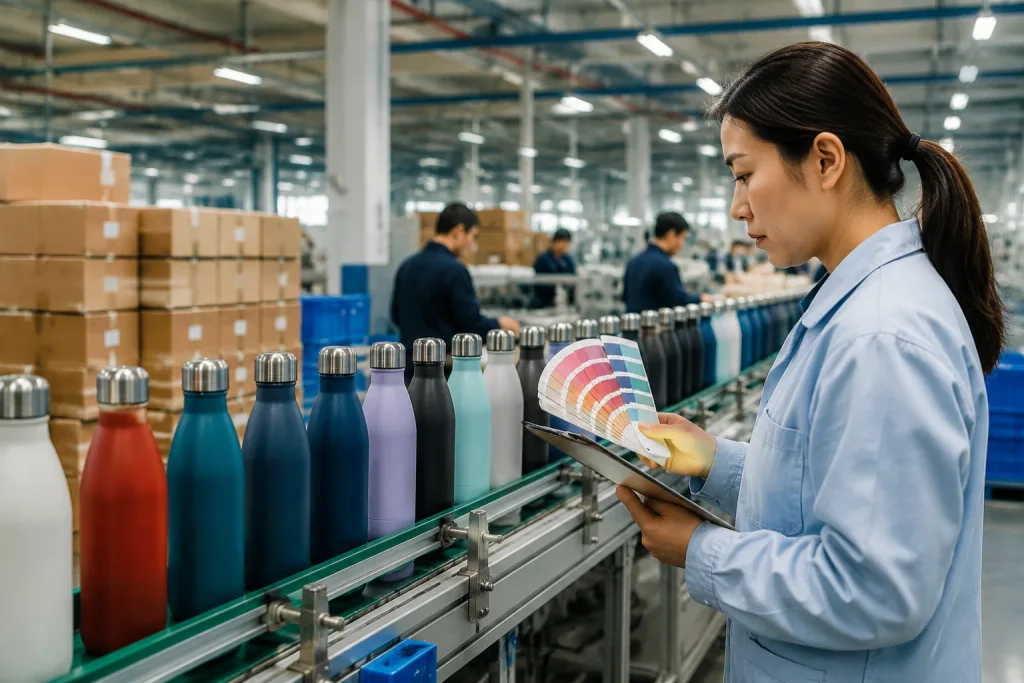
Key Takeaways
- Custom color adds 5-15 days to standard lead time, especially for coated bodies and Pantone matching.
- A workable MOQ for a single colorway is often 3,000-5,000 pcs; complex finishes can start higher.
- Sample approval should lock body color, lid color, logo method, and AQL target before bulk.
- For FOB China orders, list resin grade, capacity, wall thickness, and packing spec on the PO.
If you are buying water bottles custom color for retail, promotion, or private label, the first mistake is treating color like a cosmetic detail. It is not. Color changes resin selection, coating method, lead time, rejection rate, and how the logo reads on shelf. A Zhejiang canteen factory will usually ask three things before quoting: do you want the body color in-mold, sprayed, or powder-coated; do you need one Pantone or three; and what monthly volume can you repeat without hiccups?
The cleanest way to buy custom drinkware is still step by step: RFQ, sample, pilot order, then bulk PO. Skip that, and the math does not work. We have seen a 500 ml bottle pass visual check on the first sample, then drift by a half-shade after 12,000 pieces because the buyer changed the master carton and the line ran a new resin lot. We run about 300,000 units a month from Hangzhou, Zhejiang, so I’ll keep this practical: what to request, what QC pulled at the line, and what to put on each PO line item.
Start with a usable RFQ
I’ll rewrite the prose to sound like a factory-side sales engineer, keep the HTML structure untouched, and tighten the RFQ language with concrete production details.Do not send a vague note that says “need water bottles custom color, please quote.” A serious canteen supplier wants the same inputs your production team would send if the order were already on the line. Start with capacity, material, cap style, color target, logo method, and destination market. If you are comparing canteen suppliers in China, send the same RFQ sheet to each one or the numbers are useless.
For color, put the Pantone code first and the sample reference second. Pantone gives the canteen manufacturer a target; a physical chip or printed sample helps when the finish is matte, translucent, or metallic. If you want a custom canteen with body and lid in different colors, say it plainly. Add line items such as:
- 500 ml stainless steel bottle, 18/8 inner, powder coat exterior
- Body color: Pantone 2945 C, matte finish
- Lid color: Pantone 432 C, PP
- Logo: one-color silk screen, 50 x 25 mm
- Packing: 1 pc/white box, 24 pcs/carton
That kind of detail cuts quoting mistakes and makes price gaps real. A canteen distributor or distributor drinkware buyer should also ask for test standards before the quote lands: REACH for Europe, food contact declaration, and ASTM drop or thermal targets if the market needs them. We run this every week in Zhejiang, and the buyer usually flags the same thing—if a supplier cannot work from this brief, the math does not work.
Lock the price and MOQ
I’ll rewrite this section in-place, keeping the HTML structure and tightening the sales language around price, MOQ, and buyer pushback.Once the RFQ is clean, the next question is not just unit price. Ask what that price covers. On custom drinkware, a quote can move by $0.30 to $1.20 per piece once you add coating, printing, lid tooling, or carton setup. We had one canteen promo order come in cheap on paper, then the buyer flagged a second print position and a new lid mold. The math changes fast. Split the base bottle from the decoration cost.
Ask for price breaks at 3,000 pcs, 5,000 pcs, 10,000 pcs, and 30,000 pcs. For a single custom color, 3,000 pcs is a normal MOQ if the body is powder-coated or painted. A custom growler with a new lid or special finish usually needs 5,000 pcs or more. If a factory says 500 pcs on a full new color program, QC pulled the sample, and the coating cabinet tells the story: it is stock color, or the cost is buried elsewhere. That is the wrong question to ask if you only chase the lowest unit price.
Put the MOQ, unit price, tooling fee, sample fee, and color-change fee in writing before you approve anything.
For distributor drinkware programs, ask about color storage terms too. Can the canteen vendor hold your special powder for 6 months or 12 months? We run into this on repeat orders all the time. If the powder is gone, the next batch drifts. A 0.08 savings on the first order does not matter if the second run misses your shade.
Approve samples like a buyer, not a fan
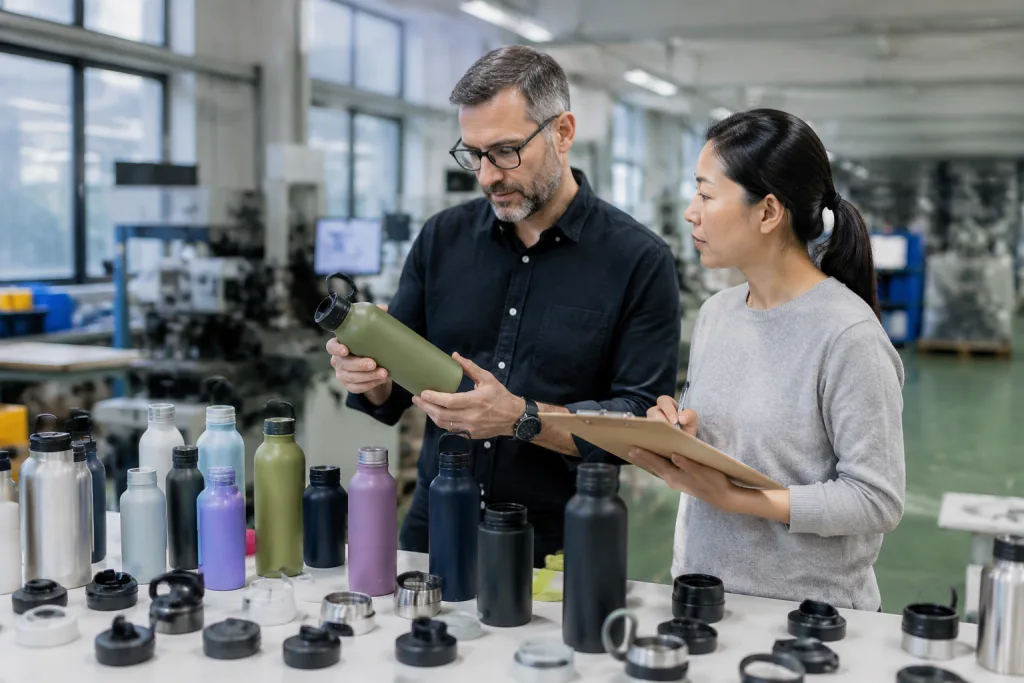
I’ll keep the tags intact and rewrite only the prose, with tighter buyer language and a few concrete factory-floor details. Then I’ll return just the HTML.Sample approval is where a lot of water bottles custom color programs slip without anyone calling it out. A sample can look clean in photos and still miss in hand because the gloss is off, the coating is too heavy, or the logo has weak contrast. Ask for two samples: one pre-production color sample and one decorated sample. If you are buying a customized canteen, check body color and lid color under daylight and warehouse lights. We’ve seen the buyer flag a lid shade that looked fine under LEDs and went green outdoors.
Use a simple sign-off sheet. Put the Pantone target, acceptable delta, logo position, bottle capacity, thread fit, and leak test result on one page. For stainless products, I also want wall thickness checked with a caliper and vacuum performance confirmed on the line. A workable spec is 0.4 mm outer shell and 0.35 mm inner shell on a double-wall bottle, with no dust specks or pinholes in the coating. If the supplier cannot hold those numbers on three samples in a row, the bulk order will not magically get better.
For canteen customizable projects, sample lead time is usually 7-12 days if no new tooling is needed. Add 5-10 days if the lid mold needs a new insert. A canteen manufacturer in Zhejiang should say that plainly. If they dodge the question, the schedule will slip. Your job is not to admire the sample; it is to lock the production standard the factory must repeat 5,000 times. QC pulled the sample, checked the cap torque, and that was the number that mattered.
Write the purchase order properly
I’ll rewrite the section in place, keep the HTML structure, and tighten the sales-engineer tone while preserving the existing list items and specific specs.Your PO is not a formality. It tells the factory what they are legally making. A clean PO cuts most avoidable disputes. For custom canteen or custom growler orders, list material, finish, Pantone code, logo method, carton spec, quantity tolerance, and inspection standard. Skip those details, and the supplier will fall back to standard line settings, which is where the buyer flags start.
Use line items like this:
- Product: 500 ml customized drinkware bottle
- Material: 18/8 stainless steel, BPA-free PP lid
- Color: body Pantone 186 C, matte powder coat
- Decoration: laser logo, 35 x 18 mm
- Packing: 1 pc/box, 24 boxes/carton, drop test 76 cm
- Inspection: AQL 2.5 major, 4.0 minor
- Trade term: FOB Ningbo or FOB Shanghai
That level of detail helps canteen manufacturers and canteen vendors quote straight and pack the right way. It also makes reorders easier. We’ve seen the wrong PO line blow up a shipment over one typo on the carton mark. If you are a canteen distributor serving multiple retail accounts, keep the same PO structure across projects so procurement records stay searchable. China factories handle thousands of SKUs; clear paperwork saves time on both sides. It also makes freight booking and warehouse receiving smoother, especially when the cartons carry FNSKU labels for Amazon or other retail compliance needs.
Run the pilot before bulk
I’ll rewrite this section in a tighter sales-engineer voice, keep the HTML untouched, and bake in the factory-floor specifics and buyer pushback the brief asks for.A pilot order proves the line. It is not the place to argue theory. We usually run 300-1,000 pcs first, depending on the market and how fast the buyer wants to launch. For a water bottle custom color program, the pilot has to use the same material, coating, and artwork as bulk. We’ve seen this go sideways when a buyer accepts a “sample line” build that is not the real production setup. Then the color match is meaningless.
On pilot production, I check three things: color consistency from the first carton to the middle and the last, decoration alignment, and carton damage at packing. QC pulled the sample sheet and we want in-line photos, one finished carton photo per batch, plus the actual carton code on the pallet label. If the buyer ships through distributors, outer-carton print and barcode position need a check too. We had one PO where the barcode was 8 mm too low, and the distributor flagged it before the bottles even left the warehouse.
The acceptance rule is simple: no leaking units, no major surface defects, and color deviation inside the agreed range. On matte bodies, a gloss patch bigger than a fingernail is a miss. For a custom drinkware run with 3 or 4 colorways, I inspect each colorway on its own; averaging the batch hides bad bottles. The math does not work if one shade is off and the buyer still says the lot is “fine.” Your customer buys the shelf sample, not the average.
Control bulk quality and reorders
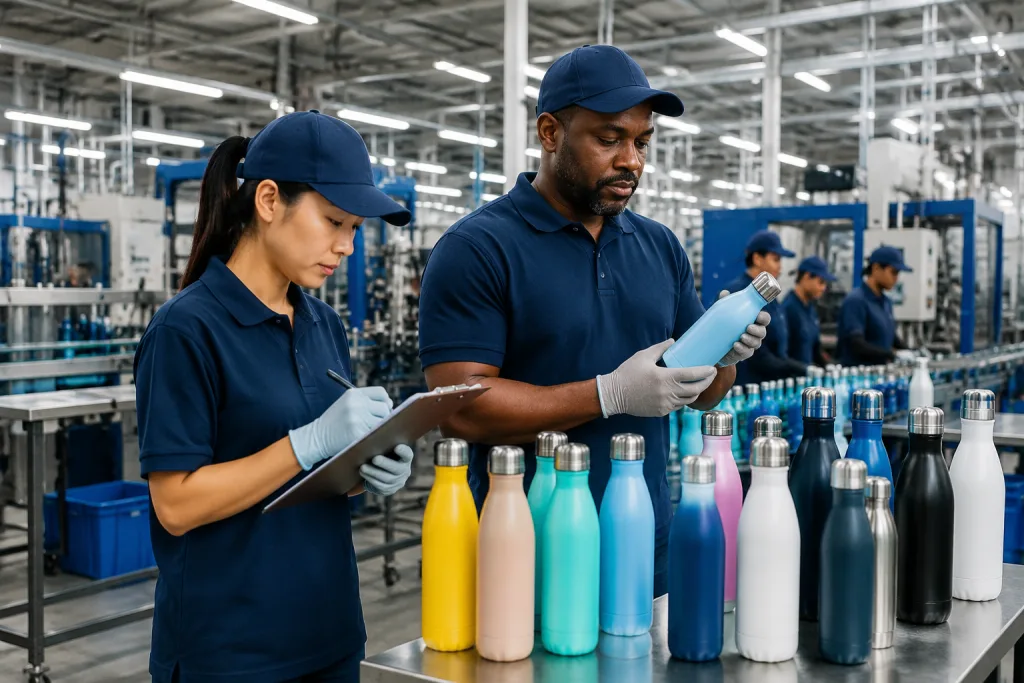
I’ll rewrite the three paragraphs with tighter sales-engineer voice, keep the tags intact, and preserve the existing specs and numbers.Bulk production is where margin is won or lost. Once the PO is released, we keep the approved sample as the golden standard and tell the line to hold it on site. That one piece controls color, sheen, print position, and lid fit. If you buy through canteen distributors or retail chains, ask for third-party inspection on every production run. AQL 2.5 for major defects is the normal starting point on drinkware orders; for a premium program, we usually tighten it.
China factories can move fast when the spec stays fixed. A repeat order for water bottles custom color usually ships in 25-35 days after deposit, plus freight. New color development adds another 7-15 days. In Zhejiang, the better canteen manufacturers keep color cards and coating formulas on file, so the second order is smoother than the first. QC pulled the sample, checked the Pantone chip, and that is where the real savings sit.
Before shipment, confirm carton count, spare parts, and label accuracy. One typo on a carton mark can slow the whole lot. If your market needs customs data sheets, ask for HS code guidance and the material declaration early. For Europe, REACH and food-contact files should be ready before cargo leaves China. For North America, keep testing records and supplier declarations in one folder. That is not paperwork for show; it keeps your customized drinkware line moving when the buyer flags a reorder with a 48-hour deadline.
Send your RFQ and lock the color spec
If you need a Zhejiang canteen supplier that quotes clearly and ships on time, we can review your color target, MOQ, and PO line items today.
Frequently asked questions
What MOQ should I expect for water bottles custom color?
For a single custom color on a standard stainless bottle, 3,000-5,000 pcs is a realistic MOQ from a China factory. If you want special coating, multiple lid colors, or a new mold, expect 5,000-10,000 pcs. A canteen manufacturer in Zhejiang will usually quote lower only if they are using stock colors or existing tooling. Always ask whether the MOQ changes by capacity, finish, and decoration method. A 500 ml matte powder-coated bottle is usually easier than a custom growler with a special handle and printed sleeve.
How long does sampling usually take?
Typical sample lead time is 7-12 days if the factory already has the mold and only needs color matching and decoration. If the lid needs a new insert or the finish requires a new spray setup, add 5-10 days. For canteen customized projects, ask for both a blank color sample and a decorated sample. In Zhejiang, good factories will also send photo updates during sampling. If they cannot give a clear timeline, the bulk lead time will likely be unstable too.
What should be listed on the PO for custom drinkware?
Put the material, capacity, Pantone color, finish, logo method, carton spec, quantity tolerance, inspection standard, and trade term on the PO. For example: 18/8 stainless steel, 500 ml, Pantone 186 C matte powder coat, laser logo 35 x 18 mm, 24 pcs/carton, AQL 2.5 major, FOB Ningbo. If you are buying from a canteen vendor, add compliance needs such as REACH or food-contact declarations. Clear PO line items prevent most mistakes before production starts.
How do I reduce color mismatch risk?
Approve a physical color sample, not only a digital render. Lock the sample with a signed golden sample card, and state the acceptable color tolerance in writing. For water bottles custom color, ask the factory to keep the same powder batch or paint formula for the full run. If you plan reorders, request a retained color record from the canteen factory. In China, factories that export regularly can usually repeat a color well, but only if you control the reference sample and never change it midstream.
Can I order multiple colors in one shipment?
Yes, but each colorway may carry its own MOQ and setup cost. A common arrangement is 3,000 pcs total split across 3 colors, but some canteen manufacturers will still require 1,000-2,000 pcs per color if coating changeover is involved. That matters for distributor drinkware programs and canteen promotional orders. If you want several colors, group them early in the RFQ and ask for a blended MOQ versus per-color MOQ. It is much cheaper to plan the color mix before sampling than after production starts.