Key Takeaways
- Water bottles bulk orders fail most often at lids, seal geometry, and decoration, not bottle shape.
- For stainless bottles, specify 0.4-0.6 mm wall thickness, 18/8 steel, and lid torque checks.
- Ask for AQL 2.5 general inspection, REACH-compliant materials, and drop-test data before approval.
- A 3,000-piece MOQ and 25-35 day lead time are normal for custom drinkware in Zhejiang.
You can buy water bottles bulk at a low unit price and still lose money. The quote is not the problem. The damage starts after the order lands in Zhejiang, after the mold is approved, after a carton splits on a pallet, and after a buyer flags a lid leak in transit. In B2B drinkware, the bottle is rarely the expensive part. The gap between sample and mass run is where the cash goes.
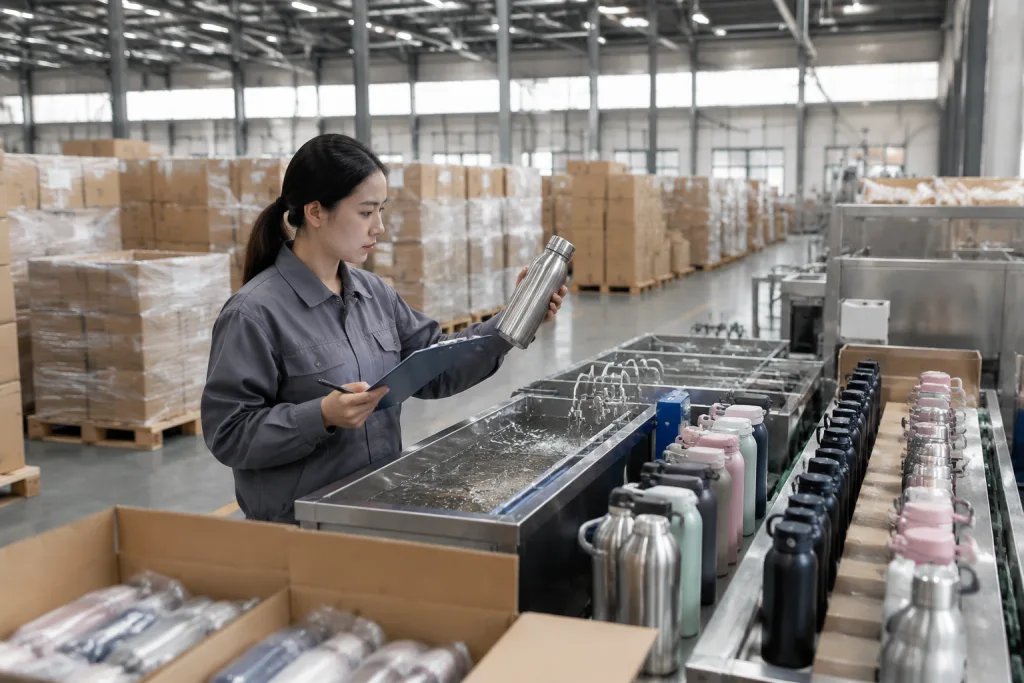
If you source from China or Zhejiang, think like a production engineer, not a catalog buyer. A clean spec cuts leakage, odor, finish mismatch, and print failure before they hit your warehouse. At BottleForge Industrial in Hangzhou, we run 180,000 units a month across stainless and plastic lines, with a common MOQ of 3,000 pieces per SKU and a 25 to 35 day lead time. QC pulled the sample with a 1.2 mm lid gap once, and we caught it before shipment. That scale matters because the same mistake will repeat fast when you buy in volume.
Where bulk orders usually break
I’ll keep the HTML intact and rewrite the prose with tighter, more specific sourcing language. Next I’m checking for any repo instructions, then I’ll patch just this section.No code changes beyond the section rewrite. I’m treating this as a straight content edit and will return only the updated HTML.Most sourcing problems start when buyers treat every bottle like the same commodity. It is not. A water bottles bulk program usually breaks at four spots: forming, sealing, decoration, and packing. If one of those slips, defect rates move from a workable 1-2% to 5-8%, and that is enough to wipe out margin on a private-label PO.
The first failure mode is dimensional drift. A lid that fits the sample but not the run usually means the neck finish tolerance was never locked. Ask for neck OD/ID tolerance in mm, not “fits well.” The second is seal compression. A silicone ring that is too soft can pass a hand test and still leak under 1.5 bar pressure or after a 1-meter drop. The third is decoration failure. Screen print can look clean on day one and still scratch off after 50 rub cycles if the ink system is wrong. The fourth is carton weakness. For export, a 5-ply master carton with a stated edge crush test target is not optional if you want fewer claims.
When you buy from China, especially Zhejiang, the supplier should show you how each failure is controlled on the process sheet. We run the line this way for a reason. If they cannot explain torque, cure time, or drop behavior, they are selling you a picture, not a product.
Lids and seals cause leaks
I’ll rewrite the section in place, keep the HTML exactly as-is, and tighten the language so it sounds like a factory-side sales engineer wrote it.Leakage costs the most. Customers can see it, and you cannot talk your way out of it. If you are buying bulk drinkware, lock the lid spec before you argue about color or logo. We have seen a CAD thread pass on paper and miss after the mold shrank 0.3 mm, which is enough to leave a 500 mL bottle loose or make a cold-weather cap crack on the line.
Write the seal as a measured part, not a guess. For silicone gaskets, ask for Shore A hardness in the 45-60 range and food-contact compliance to FDA or LFGB based on your market. For flip lids and screw caps, we run a 100% leak test on production; if the order is large, use a valid AQL 2.5 plan with tilt, pressure, and inverted hold checks. For a bulk canteen or canteen wholesale order going to outdoor retail, add hot-water and cold-water cycling, because thermal expansion will expose weak threads fast.
Buyer spec that works:
- Neck finish tolerance: ±0.2 mm
- Seal hardness: 45-60 Shore A
- Leak test: 30 minutes inverted, no drip
- Drop test: 1 meter, 6 faces, no seepage
This looks fussy. The math does not care. A clean spec costs less than one return pile and the PO typo we once caught on a 12,000-piece cap order.
Materials and odor control
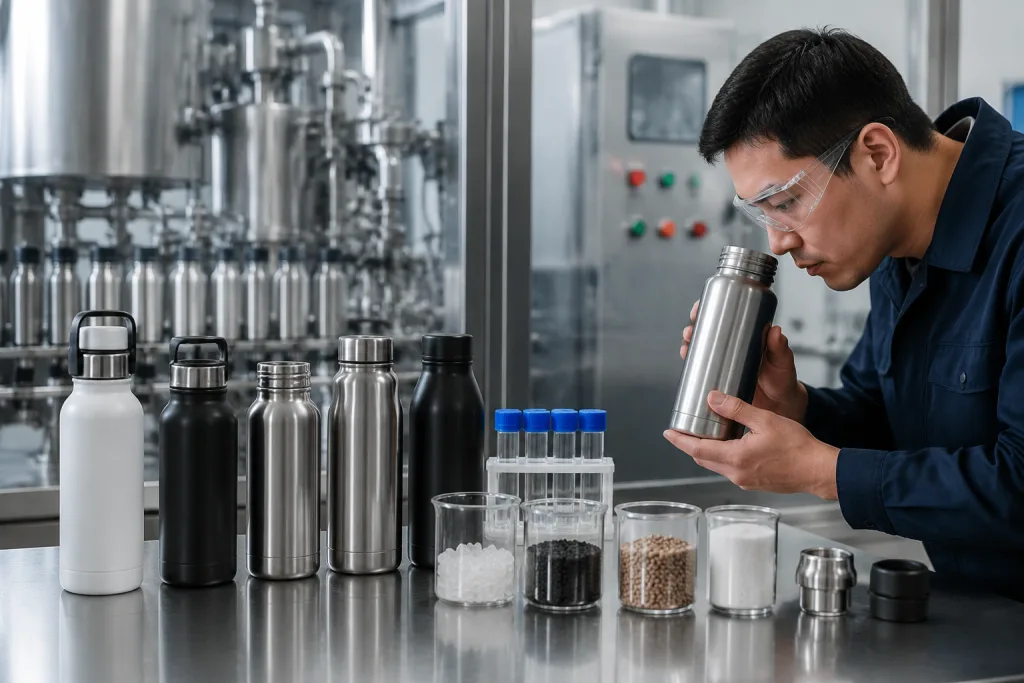
I’ll rewrite the three paragraphs in place, keeping the HTML intact and tightening the language to sound like a factory-side sales engineer. Then I’ll sanity-check that the tags and the original technical numbers/certs are preserved.Odor complaints kill repeat orders. Buyers read smell as contamination, and we’ve seen a carton rejected on opening before anyone touched the bottle. This shows up a lot in low-cost drinkware wholesale programs when resin choice, pigment load, and washing are left loose. A bottle can pass food-contact paperwork and still carry packaging oil, recycled polymer, or mold-release smell from the line.
For plastic bottles, ask for the exact resin grade, not just “Tritan,” “PP,” or “AS.” That’s the wrong question to ask if you want a clean retail shelf. On one 20,000-piece run, QC pulled the sample after a buyer flagged a faint machine-oil note, and the fix was a post-mold wash plus longer air drying. For premium retail positioning, ask for migration-compliant material declarations and UV air treatment after molding. For stainless products, 304 stainless is the base line; 316 is the better call for salty water or acidic drinks. Wall thickness matters too. A 0.4 mm single-wall bottle behaves differently from a 0.6 mm double-wall shell after drawing and polishing. Thin walls save weight, but they raise dent risk and make coating flaws easier to spot.
If you are comparing a best wholesale drink bottle option, ask for odor testing after 24 hours at 60°C. We run that test because it exposes weak resin picks and sloppy cleaning faster than a casual sniff sample. The math works, and the market notices.
Decoration fails after shipping
I’ll rewrite the section in place, keep the HTML tags untouched, and tune the prose to sound like a real export sales engineer.Printing and branding failures show up fast when buyers approve artwork on a smooth sample, then the production run lands on a different surface energy or cure window. We see this on the line. That is where wholesale drinkware orders lose shelf appeal. A logo that flakes on the third dishwasher cycle already looks like a claim, even if the bottle body passes drop test.
For screen print, ask for the ink system, cure temperature, and abrasion resistance number, not just a pretty mockup. For laser engraving, require a sample on the exact steel finish, because matte, polished, and powder-coated tubes react differently to the beam. If you are running retail beer tumbler bulk or beer tumbler wholesale, check artwork position after thermal cycling; curved walls can make a straight logo look off by 2 mm. The same rule applies to alcohol flask bulk and alcohol flask wholesale jobs, where edge wrap and cap alignment matter more than on a straight bottle. We’ve seen buyers flag a PO typo on the print position and the whole carton plan went sideways.
Good decoration is not the prettiest proof. It is the one that survives 50 abrasion rubs, two carton drops, and a week in a delivery van.
In Zhejiang, a factory that knows its business will quote decoration tolerance in mm and setup loss as a percentage. That is the number you want. If the supplier only talks about color count, the math does not work. QC pulled the sample, checked a 0.3 mm offset, and that told us more than any sales deck.
Cartons and transit damage
I’ll rewrite the section in-place, keep the HTML exactly as-is, and tighten the prose so it reads like a factory-side sales engineer wrote it.We see this a lot: the buyer blames bottle quality, but the carton was the weak link. Water bottles are awkward in transit. They’re tall, smooth, and often stuffed with caps or straws that rattle around. One bad carton spec can turn a single pallet problem into a full-container claim. For export from China, we start with the outer carton first, not the bottle.
Ask for burst strength, drop height, and divider layout. For growler bulk, beer growler bulk, or wholesale growler orders, the glass or heavy stainless weight needs tighter partitioning than a standard sports bottle. On beer growler in bulk and beer growler wholesale bulk shipments, we often push an internal tray or molded pulp insert; it cuts corner crush when the pallet gets handled hard. The buyer flagged one 40HQ load because the wrap was only three turns and the top tier sat 120 mm too high. The math does not work.
- Use 5-ply master cartons for heavy units
- Require corner compression data, not just “strong box” language
- Specify pallet pattern and stretch wrap layers
- Add a carton drop test at 80 cm for export routes
Packaging is part of the product spec. We run QC on cartons for the same reason we check lids: if the claim cost is higher than the bottle cost, the box already failed.
MOQ, lead time, and supplier control
I’ll rewrite the section in-place, keeping the HTML exactly as-is and tightening the sales-engineer tone with concrete factory detail and cleaner sourcing language.Buyers usually push for the lowest MOQ and the shortest lead time, but that is the wrong question to ask first. The real check is whether the factory can hold process control at your volume. For a Zhejiang supplier, a custom MOQ is often 3,000 pieces per design, and tooling plus sample sign-off can take 7 to 12 days before the line starts. If you want three lid colors or two bottle finishes, the MOQ jumps fast because each variant adds setup loss and extra QC work.
Get specific with the supplier. Ask if they run in-line inspection or only final inspection. Ask for AQL 2.5 on major defects and 4.0 on minor defects, plus lot-code records you can audit later. Ask for BSCI, ISO 9001, REACH, and ASTM-related test support if your channel needs it. We have seen this go sideways when a buyer accepted a clean sample but never asked for traceability from resin or steel coil to finished carton. If the factory cannot show that chain, the math does not work.
At BottleForge Industrial in Hangzhou, we keep it simple: 180,000 units per month, OEM sampling in 5 to 7 days, and standard export production in 25 to 35 days depending on decoration. QC pulled the sample on a 500 ml run last week and flagged a lid torque issue before packing started. That is the kind of operating rhythm you should compare against, because steady output protects margin when the season gets busy.
Specialty formats need their own specs
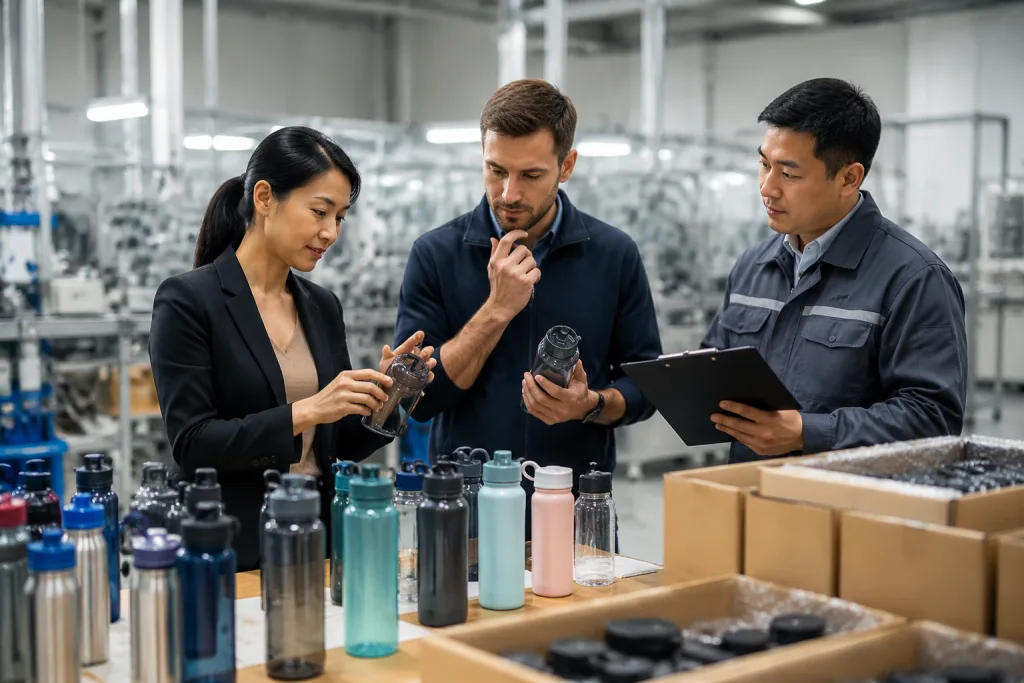
I’ll rewrite the section in place, keeping every tag and the heading structure intact, while tightening the sales-engineer tone and adding a few concrete factory-floor details.Not every bottle runs like a basic sports model. A canteen bulk order for outdoor retail, a wholesale canteen program for promotions, or an alcohol flask in bulk project for gift channels each has its own failure point. Wrong lid, wrong finish, wrong pack-out. QC pulled a sample on the line last month and the buyer flagged a cap that looked fine in photos but failed after 3 open-close cycles.
For canteens, we watch cap retention and shoulder deformation, usually on 1.0 mm wall parts after the drop test. For flasks, the problem is leakage at the closure and poor polish on the seam; we have seen a 0.3 mm burr turn into a return claim. For growlers, it comes down to weight, handle strength, and whether the glass breaks or stainless dents in transit. If you are buying growler wholesale or wholesale growler units for brewery retail, lock down closure torque and carbonation retention target. If you need alcohol flask wholesale bulk or beer tumbler wholesale bulk, ask for packaging separation and scratch resistance, because these pieces get gifted and then examined under light.
Do not throw these products into one generic RFQ. The math does not work. We quote a 500 ml flask, a 32 oz growler, and a canteen on different tooling and pack-out assumptions; last week one PO even came through with “stainles” on the spec line, and the buyer had to resend it. A good supplier in China prices each format separately because the production risk is different. That is a good sign.
The spec sheet that saves margin
I’ll keep the HTML structure intact and rewrite the prose to sound like a factory-side sales engineer, with tighter, more specific sourcing language.The lowest quote is usually the one hiding the most gaps. A solid spec sheet for water bottles bulk should pin down dimensions, material grade, wall thickness, lid torque, leak test limits, decoration method, carton strength, and the test standard. We’ve seen a buyer lose 8 points of margin because the cap spec was missing by 0.2 mm. Send a file that leaves no room for guesswork.
Use these fields in every RFQ:
- Capacity in mL or oz
- Material and grade, such as 18/8 stainless or food-grade PP
- Wall thickness, for example 0.4 mm or 0.6 mm
- Closure type and seal hardness
- Decoration method and abrasion requirement
- Pack-out, carton count, and pallet height
- Inspection standard and AQL target
We run the same check on the line whether the order comes from Zhejiang or overseas. If you are comparing beer growler wholesale, beer growler in bulk, or beer tumbler in bulk options, the spec sheet decides the result, not the sales quote. A buyer once sent a PO with the wrong carton count by typo, and QC pulled the sample before packing started. That is the wrong question to ask if you want margin intact.
Send your bottle spec, not just a price target
If you want stable quality on water bottles bulk, we can review your drawing, choose the right material, and quote by MOQ, lead time, and test standard.
Frequently asked questions
What MOQ should I expect for water bottles bulk orders?
For custom water bottles bulk orders, a practical MOQ is often 3,000 pieces per SKU in Zhejiang. Simple stock-style products can go lower, but once you add custom color, logo, or a special lid, 3,000 is a normal starting point. If you split the order across two colors or two cap styles, some factories will treat each variant as its own MOQ. Tooling, print setup, and packing changes drive that threshold. For private label, ask for MOQ by decoration method, not just by bottle body, because laser, silk screen, and pad print often have different setup economics.
How do I avoid leaks in bulk drinkware shipments?
Lock the thread tolerance, gasket hardness, and test method before production. For bulk drinkware, I would specify ±0.2 mm on the neck finish, a silicone seal at 45-60 Shore A, and a 30-minute inverted leak test. For pressurized or travel use, add tilt and drop checks at 1 meter. If the supplier only sends a photo approval, that is not enough. Ask for lot-based records, because a lid that passes on day one can fail after mold wear or a resin change. In China, strong factories document these checks by batch code.
Is REACH enough for Europe, or do I need more?
REACH is the baseline for materials entering the EU, but it is not the only control you should care about. For drinkware wholesale, also ask for food-contact declarations, migration test support, and if your retailer requests it, LFGB or other market-specific evidence. For stainless products, confirm the steel grade and surface finish. For plastic, confirm resin traceability and post-processing cleaning. A compliant declaration without batch traceability is weak. If you sell in Europe, keep the supplier file organized by lot, because customs or retail QA may ask for supporting documents later.
What tests should I request before I approve production?
At minimum, request dimensional checks, leak testing, drop testing, and decoration abrasion testing. For stainless water bottles bulk, also ask for weld seam inspection, vacuum retention if it is double-wall, and carton compression data. A sensible QA plan uses AQL 2.5 for major defects and separates critical defects like leakage from cosmetic ones. If you are ordering from Zhejiang, ask the factory for pre-production samples, golden sample approval, and a pilot run of at least 50 pieces before full mass production. That gives you enough signal to catch process drift before 3,000 or 10,000 units are made.
Which product types need extra caution in bulk sourcing?
Anything with a difficult closure or heavy form factor needs extra care. That includes bulk canteen, canteen wholesale, growler bulk, beer growler wholesale, alcohol flask wholesale, and beer tumbler wholesale bulk orders. These products are more sensitive to seal compression, denting, seam finishing, and transit damage. Glass growlers need stronger inserts and better carton design; stainless growlers need weld and polish control; flasks need tighter leak control around the cap. If the product will be gifted or resold in retail, scratch resistance and box presentation become part of the quality spec, not just packaging.