Key Takeaways
- A realistic MOQ for custom water bottle wholesale is often 1,000-3,000 units per SKU, with lead time around 25-40 days after sample approval.
- For double-wall stainless bottles, 0.5 mm inner wall and 0.4-0.5 mm outer wall are common; thinner than that usually means more dents and more rejects.
- For FOB China pricing, basic single-wall bottles can start near USD 1.20-2.20, while insulated models often land at USD 3.80-7.50 depending on finish and lid.
- A factory in Zhejiang with 300,000+ units per month and AQL-based QC is a safer bet than a trader guessing at stock from three different workshops.
You have a real PO to place: 8,000 units for a retail launch, 500 samples for the sales team, or a mixed container for Amazon and DTC. That is where water bottle wholesale gets messy fast. Specs drift. Closures leak on the line. Cartons crush in transit, and the supplier who looked fine on paper suddenly misses the label date by 6 days.
If you buy in Europe or North America, the job is not just chasing the lowest FOB. You need a factory in China that holds tolerances, clears REACH or food-contact checks, and keeps the schedule. In Zhejiang, where a lot of the serious drinkware capacity sits, the real gap shows up in details like 0.8 mm wall thickness, 25 N cap torque, carton count, and whether the plant can run 50,000 units a month without making it up as it goes. QC pulled the sample here, and the buyer flagged a 2 mm print shift. The math does not work if the factory cannot repeat that run.
Start with the order, not the product
I’ll rewrite the section in-place, keep the HTML structure untouched, and make the copy sound like a factory-side sales engineer wrote it.Most buyers start with a bottle concept. That is the wrong order. Start with the order shape first: quantity, channel, target landed cost, and what the end customer actually does with the bottle. A gym chain wants 180 g weight and quick carton packout. A corporate gift buyer wants logo sharpness and low reject rate. An Amazon seller wants stable carton size and FNSKU-ready packing. A brewery placing beer growler wholesale needs a different cap seal and pressure rating than a standard hydration bottle run.
For water bottle wholesale, lock these four items first: capacity, material, closure, and decoration. A 500 ml stainless bottle with powder coating is a different sourcing job from a 750 ml Tritan bottle with a flip lid. If you also need bulk drinkware across several SKUs, split the order by use case instead of forcing one platform bottle to do everything. We have seen that go sideways. On our line, QC pulled a 12 oz sample because the lid torque slipped after 80 cycles. In China, especially Zhejiang, factories quote faster when your brief is tight. A clean brief can cut 3-5 days of sample ping-pong and trim 10-15% of avoidable corrections.
- Define your channel: retail, corporate, promo, or e-commerce.
- Set a target FOB range before asking for samples.
- Decide if you need canteen wholesale, wholesale drinkware, or a mixed drinkware wholesale program.
- Write the spec sheet in numbers: capacity, gauge, finish, lid type, and packaging count.
Choose the right bottle structure
I’ll rewrite the section in place, keep the HTML structure unchanged, and tune the prose to sound like a sales engineer at a bottle factory.Structure drives the order, not the logo. For a standard best wholesale drink bottle, buyers usually end up between stainless steel, Tritan, aluminum, glass, or plastic. We run stainless as the safest all-round pick for premium water bottle wholesale because it takes powder coat, vacuum insulation, and repeat branding without drama. At the line, 304 stainless is the first checkpoint; for lower price points, PET or Tritan ships lighter, but it gives you less room on heat and scratch resistance.
Here is the shop-floor view. Single-wall stainless bottles work for sports promotions and canteen bulk orders, and the math is clean. Double-wall vacuum bottles make sense when the buyer wants drinks cold for 12-24 hours or hot for 6-12 hours. If the order is bulk growler or wholesale growler for beverage retail, we specify a wider mouth, a tighter sealing ring, and a cap that survives truck vibration. For alcohol flask bulk or alcohol flask wholesale bulk, the body is smaller, but QC still checks leak performance and finish like it is a premium run.
Typical build choices
- Single-wall stainless: lighter carton, lower cost, no insulation claim.
- Double-wall vacuum: stronger margin, heavier shipping weight, tighter tooling tolerance.
- Tritan or PET: low weight, good for branded hydration lines, weaker heat resistance.
- Glass with sleeve: clean presentation, higher breakage control needed.
Do not accept “food grade” as the full spec. Put the steel grade, coating type, and test standard on the PO.
Price the order like a buyer
I’ll keep the tag structure, tighten the pricing logic, and swap in more buyer-floor detail without changing any numbers or list structure.Buyers burn cash when they stack factory quotes with no landed-cost model. A bottle at USD 1.65 FOB can beat USD 1.40 if the low quote needs bigger cartons, throws up more breakage on the line, or forces a pricier lid. For water bottle wholesale, run pricing at 1,000, 3,000, and 5,000 units so you can see where tooling, print setup, and carton cost stop moving.
From China, a plain 500-750 ml single-wall stainless bottle usually sits at USD 1.20-2.20 FOB. A powder-coated vacuum bottle with laser logo often lands at USD 3.80-7.50 FOB. We had one buyer flag a PO typo on the lid spec, and the re-quote moved the order by 11%; that is the wrong question to ask if you only stare at unit price. If you move into beer tumbler bulk or beer tumbler wholesale bulk, the price swings on insulation, lid build, and whether the body needs a non-slip base or matte finish. For beer growler in bulk, the wider mouth and thicker wall can add 8-15% to the unit price. Alcohol flask wholesale bulk uses less metal, but the math still shifts once decoration and leak testing go in.
- Ask for separate lines: bottle body, lid, logo, color, packaging.
- Request FOB China and EXW if you want to compare logistics properly.
- Check mold or tooling charges up front; some are refundable above 10,000 units.
- Use a landed-cost worksheet that includes duty, ocean freight, and carton damage allowance.

QC the sample before you approve
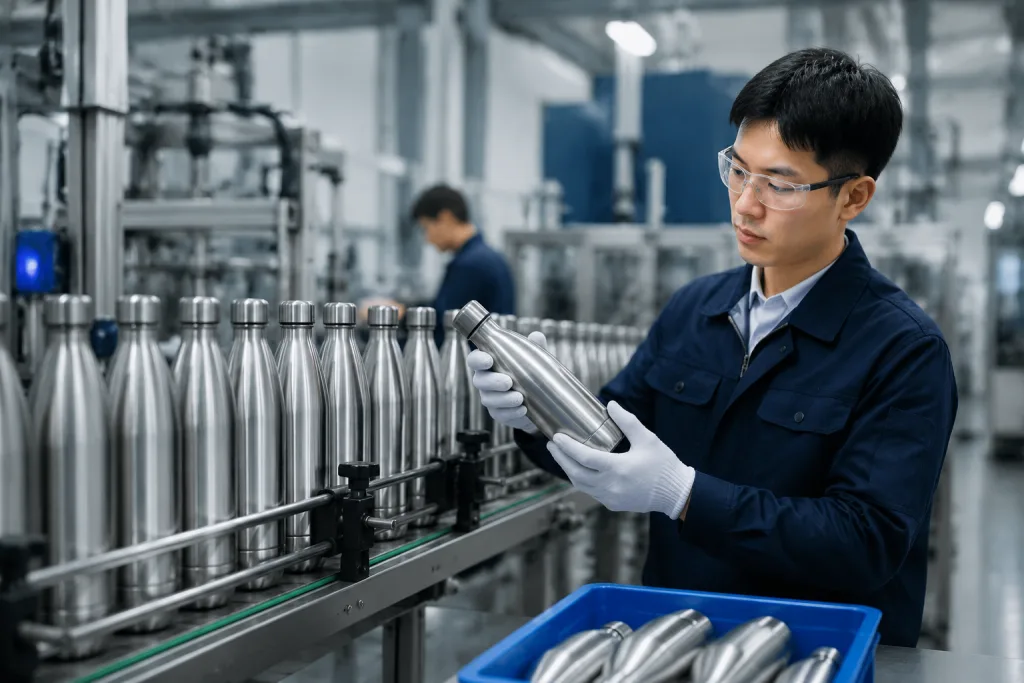
I’ll rewrite the section in-place, keep the HTML structure intact, and make the prose sound like a factory-side sales engineer wrote it.The sample is where bad orders get stopped. A Zhejiang supplier worth your time will expect a hard sample review, not a photo OK. Check thread fit, lid torque, coating adhesion, logo alignment, weight, and odor. On drinkware bulk orders, we also check that the cap stays put in normal hand use and that the finish does not chip at the rim or base—QC pulled the sample off the line for a 0.3 mm rim nick before we approved a lot once.
Use numbers, not feelings. A stainless bottle body should stay inside your agreed wall thickness tolerance, often ±0.05 mm on critical parts. Vacuum performance should hit the stated hold time, not a brochure line. If the order is a wholesale canteen or canteen bulk item, check carry handle strength and lid hinge cycles on the bench. For a growler wholesale order, fill and invert it for at least 30 seconds, then run the same test again after cold conditioning. We normally run AQL 2.5 for appearance and 4.0 for minor function checks, but if this is premium retail, tighten that before the PO is cut; the math does not work later.
- Test logo abrasion with a cloth rub and tape pull.
- Leak-test 100% of samples, then a production-lot subset.
- Measure actual weight against the approved sample sheet.
- Confirm packaging fit with real shipping cartons, not loose unit boxes.
Run production without surprises
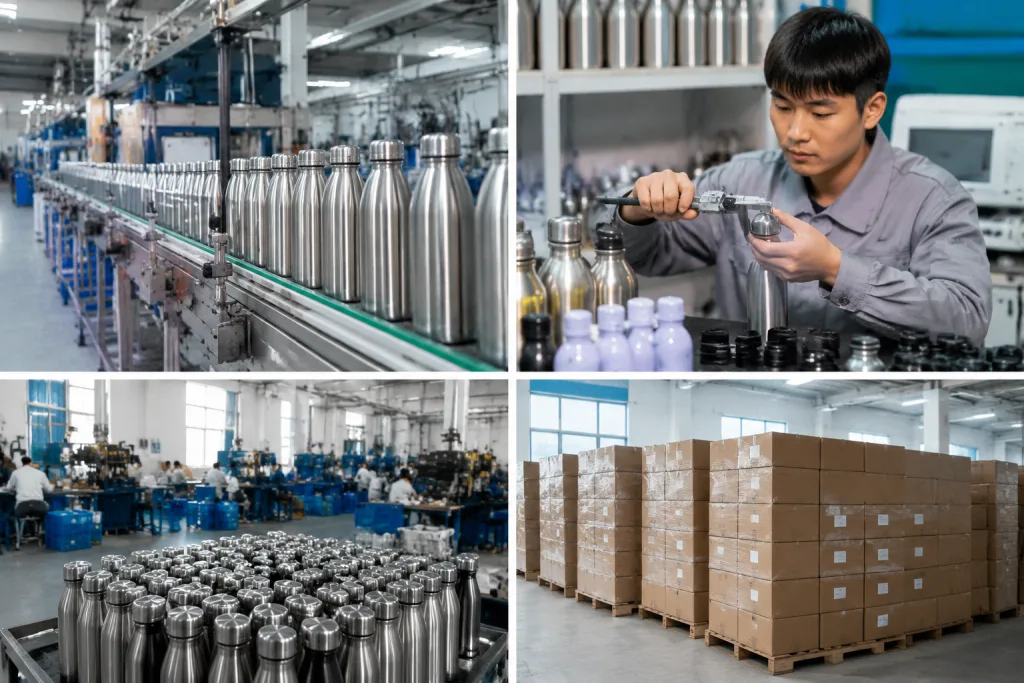
I’ll rewrite this section in-place, keep the HTML exactly as-is, and tighten the prose so it reads like a factory-side sales engineer wrote it.Once the sample is approved, production discipline matters more than sales talk. Ask for a pre-production sample, a first-article check, and a schedule broken down by process: tube cutting, forming, welding, polishing, coating, printing, assembly, and final packing. A factory in Hangzhou or the wider Zhejiang supply base that runs 300,000 units per month should be able to give you a daily output plan that adds up. We run into trouble when a supplier cannot say how many pieces move through each line.
For beer tumbler wholesale bulk or beer growler wholesale bulk, watch the coating booth and lid assembly station. For alcohol flask in bulk, count the small parts; missing caps are a common failure point, and QC pulled the sample more than once for that. For canteen wholesale programs, carton mix-ups beat bottle defects as the real headache. You want PO-level traceability: one order number, one carton label format, one packing list. Ask for production photos at 30%, 60%, and 100% completion. That is standard buying behavior when goods ship from China to Europe or North America.
Most factory delays do not start in production. They start when the buyer approves a sample without a complete packing spec.
Ship, label, and receive cleanly
I’ll rewrite the section in-place, keep the HTML structure intact, and tighten the prose so it sounds like a factory-side sales engineer.Shipping eats margin in silence. A bottle that looks cheap at FOB can turn expensive once you add oversize cartons, pallet rules, and sloppy outer packing. For water bottle wholesale, we ask for carton compression tests, master carton drop checks, and a packing plan matched to the destination channel. If you sell on Amazon, the case pack needs to fit FNSKU rules and warehouse intake. If you supply a distributor, keep the inner pack standard so they can move stock without relabeling every unit.
For wholesale drinkware and drinkware wholesale programs, check whether lids go on the line or ship loose. That changes labor, breakage, and how fast the warehouse runs. Ask for carton dimensions before you book freight. A 5-8% cut in carton volume often beats a 3-cent unit price drop. We saw one buyer push back on this, then his freight quote jumped because the outer box was 12 mm too tall. For North America, keep the file stack clean: commercial invoice, packing list, HS code, material declaration, and any REACH or FDA papers your importer asks for. In Europe, do the same for food-contact compliance and traceability. China can make the product well; the paperwork still has to clear customs.
- Confirm inner box count, master carton count, and pallet pattern.
- Request barcode placement and case labeling before mass packing.
- Align shipment timing with your warehouse appointment window.
- Keep 2%-3% overage if you expect retail unit damage or launch sampling.
Send your spec, get a real quote
Share your target MOQ, capacity, logo method, and destination market. We’ll turn it into a clean China sourcing plan with pricing, lead time, and QC checks.
Frequently asked questions
What MOQ should I expect for water bottle wholesale?
For most custom water bottle wholesale programs, a realistic MOQ is 1,000-3,000 units per color or SKU. Simple print-only jobs can sometimes start at 500 units, but once you add custom lids, special coating, or multi-color packaging, the minimum rises. In Zhejiang, factories with stable lines usually prefer a full-run order because setup time matters. If you need several SKUs, it is smarter to split by body style and decoration method than to force one SKU to carry all the volume. That usually keeps your first order financially sane.
How long does production usually take in China?
For a standard order from China, sample approval to shipment is often 25-40 days. Plain stock-style drinkware bulk orders may be faster, around 18-25 days, while vacuum bottles with custom coating or printed packaging can run 30-45 days. If you need mold work, add 15-25 days. A factory in Zhejiang with 300,000 units monthly output can move fast, but only if artwork, packaging, and compliance documents are frozen early. Any late change to logo size, carton count, or lid color can easily cost a week.
What QC checks matter most for bulk drinkware?
The most important checks are leak testing, logo placement, surface finish, and carton integrity. For stainless bottles, also check wall thickness, lid torque, and vacuum performance if it is insulated. AQL 2.5 is common for appearance and general defects, but premium retail buyers often tighten acceptance on cosmetic marks. If you are ordering canteen bulk or growler bulk items, focus on hinge durability and seal fit because those failures show up after use, not at first glance.
How do I compare pricing across different bottle types?
Compare on the same basis: material, capacity, decoration, packaging, and shipping term. A bare FOB quote does not tell you much. For example, a single-wall bottle at USD 1.50 FOB can become more expensive than a USD 1.85 bottle if the cheaper one needs stronger packaging or has a higher defect rate. For beer tumbler bulk, beer growler wholesale, or alcohol flask wholesale bulk, ask for separate costs for body, lid, finish, and print. That is the only way to know whether the supplier is truly competitive.
Can I mix different product categories in one order?
Yes, but do it carefully. Many buyers combine water bottle wholesale with canteen wholesale or wholesale drinkware in one shipment to improve freight efficiency. The catch is that each structure has different tooling, QC, and packaging needs. A mixed order works best when the factory already runs related items like bulk canteen, bulk growler, and drinkware wholesale on the same line family. If you try to mix unrelated products too early, you usually create delays in sampling and carton planning. Start with one anchor SKU, then add a second only if the factory proves control on the first.