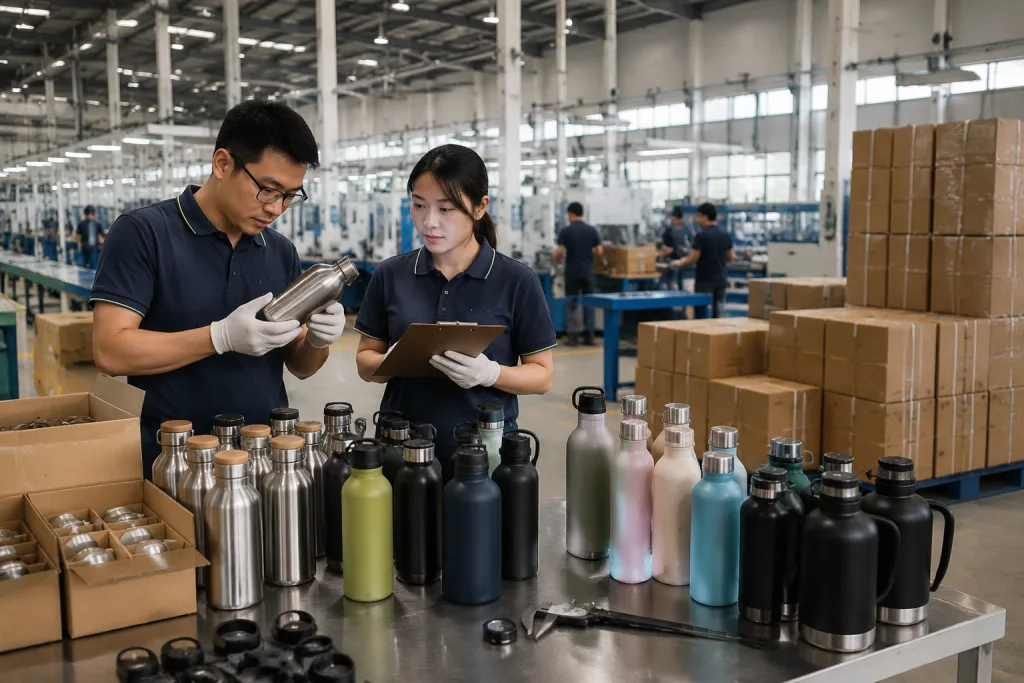
Key Takeaways
- A 0.4 mm wall thickness often costs less than 0.6 mm, but it changes dent resistance and vacuum performance.
- A 1,000-piece MOQ is normal for a canteen supplier in China; printed samples usually add 7-12 days.
- FOB Ningbo or Shanghai pricing for a basic 24 oz bottle can start around USD 2.10-3.80 depending on material and decoration.
- REACH, LFGB, FDA, and AQL 2.5 are the spec lines that separate a reliable canteen manufacturer from a risky one.
If you buy drinkware for retail, promotions, or private label, the weak point is rarely the bottle shape. It is the spec sheet. Two water bottle vendors can quote the same 24 oz stainless bottle and still ship different results once you check 304 stainless, coating thickness, lid gasket size, packing method, and carton count.
That is why good B2B buyers read every line like a PO. In Zhejiang and across China, a solid canteen factory gives real numbers: MOQ 1,000 pieces, 35-45 day lead time, monthly output above 500,000 units, and compliance files that match your market. QC pulled the sample, the buyer flagged a 2 mm lid gap, and we fixed it before mass production. If those details are missing, you are not comparing offers; you are guessing. And that math does not work for custom drinkware.
Read the steel first
I’ll keep the HTML intact and rewrite the prose to sound like a factory-side sales engineer, with tighter wording and one concrete production detail per paragraph.Start with the steel grade, because that choice sets heat retention, weight, and reject rate. For stainless steel drinkware, 304 is the usual baseline for food-contact parts, while 316 handles salty water and acidic drinks better. If a water bottle vendor only writes “stainless steel,” that is not a spec; that is a sales line.
For custom canteens, wall thickness matters just as much as the alloy. A single-wall promo canteen can run at 0.4 mm and keep cost down, but a vacuum bottle usually needs 0.5-0.6 mm inner and outer walls to survive deep drawing and laser welding without oil-canning. We saw that on the line last month: the buyer pushed for thinner steel, QC pulled the sample, and the dent test failed after one drop from 1.2 m. That is how a run ends up at USD 2.60 FOB instead of USD 3.40 FOB.
- 304 stainless steel: standard for most customized drinkware.
- 316 stainless steel: better for premium custom growler or acid-resistant use.
- 0.4 mm wall: lighter, cheaper, easier to dent.
- 0.5-0.6 mm wall: stronger, better for vacuum and reusable retail packs.
Ask for the material certificate and the internal contact grade in writing. We have seen buyers skip that step and get burned by mixed lots; the math does not work when one PO says 304 and the mill sheet says nothing. If a canteen manufacturer dodges that request, they are hiding sourcing problems, not guarding a secret.
Check the lid and seal
I’ll rewrite the section in place, keep the HTML exactly as-is, and strip the AI-ish filler while adding a few concrete factory details.The lid is where a lot of distributor complaints start. A bottle can look clean on the sample table, then leak in transit because the gasket is 0.3 mm too thin or the thread pitch drifts on the line. We need the lid material, seal type, and cycle life in writing. Silicone gaskets are standard; they should seat flat, with no pinch marks or twist. PP lids keep cost down, but if the cap has a hinge or button, QC pulled the sample after 500 open-close cycles and checked for wear.
For canteen customized projects, spell out the closure by use case. Sport lids, bamboo caps, flip tops, and screw caps each change how the bottle is used and how it fails. A canteen promotional bottle for events can live with a basic cap. A custom canteen for retail cannot ship with a lid that rattles or cracks after one season. If you are sourcing from canteen vendors in China, ask for torque specs and the leak-test method, not a product photo. The buyer flagged a PO typo on the cap code once, and the whole order had to wait at packing.
Practical rule: if the lid is not documented, assume you will pay for the first leak complaint.
- Silicone gasket: the safer choice for leak control.
- PP cap body: low cost, fine for mass promotions.
- Leak test: ask for a 24-hour inversion test or pressure test data.
- Cycle test: 500-1,000 openings for retail-grade lids.
Decide on finish and color
I’ll rewrite the prose only, keep the HTML intact, and tighten the language so it sounds like a factory-side sales note.Surface finish drives shelf appeal and claim rates. Powder coating is the practical pick for most water bottle vendors because it gives better grip and covers light scratches. We usually see 60-80 microns on the line. Go thin and the finish scuffs fast; go thick and edges plus threads start chipping. Gloss, matte, rubberized, and metallic all feel different in hand, but the spec sheet needs coating type, curing temperature, and salt spray resistance if the bottle goes outdoors.
For canteen customizable and customizable drinkware programs, color matching matters more than buyers expect. Pantone matching works, but the buyer should lock down the acceptable delta-E tolerance and the MOQ, whether that is 1,000 or 3,000 pieces. One Zhejiang canteen supplier can turn samples fast, but fast is the wrong goal if the brand needs the same shade across three reorder cycles. We’ve seen that go sideways. If the finish is critical, ask for a signed color master sample and file it with the PO.
Decoration method changes the result too. Silkscreen is the low-cost choice for one-color artwork. Laser engraving gives a cleaner mark on premium stainless. Full-wrap UV printing works for custom drinkware, but check abrasion resistance before you sign off. QC pulled the sample with a scuff test pad at 500 rubs, and that told us more than the sales sheet. For a detailed decoration comparison, see silkscreen vs laser engraving on drinkware.
Treat capacity as a commercial decision
I’ll rewrite the section in-place, keep the HTML structure intact, and tighten the sales-engineering tone with concrete factory details and cleaner commercial language.Capacity is a commercial call, not just a spec line. It changes carton count, freight math, and how the buyer sells the bottle. A 500 ml bottle is easier to carry and packs cleaner. A 750 ml or 32 oz bottle gives better shelf value and cuts refill complaints. Growler programs usually sit at 64 oz or 128 oz, but the right volume depends on beer retail, outdoor, or office gifting. We’ve seen a 12 mm difference in body diameter push the packing from 24 pcs/carton to 20 pcs/carton, and the buyer flagged it fast.
For custom growler and customizable growler projects, weight is where the deal goes sideways if the body is overbuilt. Too heavy, and users leave it behind. Too light, and it feels cheap on the shelf. The best canteen manufacturers balance base thickness, shoulder geometry, and cap reinforcement to hit the right feel. On the line, QC pulled the sample at 412 g filled weight against a 368 g target, and that gap would have changed freight class and hand feel at the same time. When you review samples from a canteen factory, weigh the filled bottle, not just the empty shell. The math does not work any other way.
- 500 ml: practical for travel and corporate gifting.
- 750 ml / 24-32 oz: strong retail volume for custom canteen programs.
- 64 oz growler: common for premium beverage resale.
- 128 oz growler: niche, but useful for distributor growler lines.
MoQ and lead time drive real cost
I’ll keep the HTML tags intact and rewrite only the prose, with tighter sales-engineer wording and concrete factory details.Buyers often fixate on unit price and miss the cash tied up in timing. A canteen distributor can quote a low FOB price, but if the MOQ is 5,000 and the lead time is 60 days, your money sits on the water bottle line too long. On custom drinkware jobs, we usually see a workable MOQ at 1,000-3,000 pieces per color or design; a new lid tool, laser engraving, or Pantone ink match can push it up. We’ve seen buyers push back on that number, and the math still doesn’t work if the order is too small.
Lead time needs to be split into sample development, sample approval, mass production, and shipping. On our Zhejiang line, QC pulled the sample in 7-10 days, production runs 25-35 days, and ocean transit to North America or Europe adds another 20-35 days. If a supplier says the whole job is 15 days, they are almost certainly quoting stock goods, not custom drinkware. Fast is fine. Stable spec first.
Ask the vendor to quote bottle body, lid, decoration, packaging, and freight separately. That is the clean way to compare canteen suppliers. It also shows whether the seller runs the factory schedule or is just moving mixed stock. We’ve seen a PO typo on lid color turn into a 2,000-piece delay because nobody split the quote cleanly.

Packaging and compliance decide market access
I’ll rewrite the prose in-place, keep the HTML exactly as-is, and make it sound like a factory-side sales engineer wrote it. Then I’ll do a quick pass to strip any leftover filler or AI phrasing.Many first-time importers leave packaging to the end, then the carton splits in transit or the retail buyer kicks back the label. We see that on the line. For private label custom drinkware, carton count, drop-test tolerance, and insert quality decide whether the shipment lands clean or comes back for rework. A typical master carton should use a 5-ply export box, with inner dividers cut to stop finish rub. If you sell on Amazon, each unit also needs an FNSKU label and a suffocation warning that matches the marketplace file. If you sell through distribution, case pack and pallet count change warehouse speed just as much as the bottle itself.
On compliance, do not accept vague promises. The math does not work. For Europe, ask for REACH and LFGB where applicable. For the United States, request FDA-related material confirmation and check whether inks, coatings, and lids are food-contact safe. QC pulled the sample last week and found a lid print typo on a PO, which is the sort of thing that turns into a claim later. For quality control, AQL 2.5 is a common inspection benchmark for major defects, but you can tighten that for premium accounts. A good canteen factory in China knows these terms and sends the paperwork without drama.
If you need a sourcing framework that covers documents, inspection, and factory vetting, use our drinkware sourcing guide from China. It is the fastest way to separate real canteen manufacturers from brokers.
Buy by channel, not by guesswork
I’ll keep the HTML exactly as-is and rewrite only the prose with a more field-tested sales tone, adding a few concrete factory details while stripping the AI phrasing.The right spec changes by channel. A promo campaign needs low cost, quick printing, and plain packing. Retail asks for cleaner finishing, stronger cartons, and fewer cosmetic marks. Distributor programs want repeat orders, shared artwork files, and color hold across batches. That is why the same water bottle vendors can be a bad fit for one channel and a solid fit for another.
For canteen promo orders, a 304 stainless body with one-color silkscreen and a standard PP lid is usually enough. For distributor canteen programs, we ask for color control, barcode-ready cartons, and lead times in writing. For custom canteen retail, the real question is whether the factory can hold the mold for reorders and keep the same lid parts in stock across runs. We run these jobs in Zhejiang every week, and a 0.5 mm shift on the lid ring is enough for the buyer to flag it.
- Promotional: lowest cost, simple structure, fast turnaround.
- Retail: cleaner finish, tighter packaging, stronger QC.
- Distribution: repeatability, carton discipline, and stable lead times.
When you compare canteen distributors and canteen vendors, channel fit beats a low quote. We’ve seen a cheap offer turn into a resale headache after QC pulled the sample for a print offset, and the math just doesn’t work.
Send your spec sheet for a direct quote
We’ll check material, lid, coating, packing, and MOQ against real factory capacity in Zhejiang before you place the order.
Frequently asked questions
What MOQ should I expect from water bottle vendors in China?
For custom drinkware, a realistic MOQ is usually 1,000-3,000 pieces per design or color. A basic canteen supplier may accept 500 pieces for stock bodies, but custom lids, Pantone matching, or new molds can push it to 5,000. In Zhejiang, many factories quote 7-10 days for samples and 25-35 days for mass production once art is approved. If a vendor offers 100-piece MOQ on a fully custom stainless bottle, check whether they are using existing inventory rather than true customization.
How do I compare FOB quotes correctly?
Compare the quote line by line: body material, lid, decoration, packing, and carton count. A 24 oz bottle can look like USD 2.10 FOB from one canteen manufacturer and USD 3.20 from another, but the cheaper one may use thinner steel, a simpler lid, or no export carton testing. Ask for the same Incoterm, usually FOB Ningbo or FOB Shanghai, and confirm whether the quote includes one-color printing, polybag, and standard carton. Without that, you are not comparing apples to apples.
What compliance documents should I ask for?
For Europe, request REACH and, when relevant, LFGB for food contact. For the U.S., ask for FDA-related material declarations and ink/coating confirmation. If your program uses retail packaging, also request carton drop-test records and an inspection standard such as AQL 2.5. A serious canteen factory or canteen distributor should provide these without delay. If they cannot, that is a warning sign, especially for customized drinkware going into retail or marketplace channels.
Is a powder-coated finish worth the extra cost?
Usually yes. Powder coating improves grip and reduces visible scratches, and the finish often runs around 60-80 microns. On a retail canteen custom order, that can improve shelf appeal enough to justify a unit price increase of USD 0.15-0.40 depending on color and batch size. For canteen promotional items, a simpler finish may be enough. For premium customized canteen or customized growler programs, the coating is part of the product value, not decoration.
How do I choose between a canteen factory and a distributor?
If you need stable reorders, better pricing, and control over specs, buy from a canteen factory in China when possible. If you need small quantities, mixed SKUs, or fast stock sourcing, a canteen distributor may be easier. The tradeoff is control: direct factories usually offer clearer material data, more flexible tooling, and better long-term cost. Distributors can be useful for pilot orders, but for distributor drinkware programs of 3,000 units or more, factory direct usually wins on consistency and margin.