Key Takeaways
- A 500 ml stainless bottle usually starts at MOQ 500-1,000 pcs and FOB USD 2.30-5.80 depending on finish.
- Double-wall 18/8 stainless at 0.4-0.5 mm wall thickness holds temperature better and reduces dent returns by 15-25%.
- Typical production lead time from a Zhejiang canteen factory is 20-35 days after sample approval, not counting transit.
- AQL 2.5 for major defects and 4.0 for minor defects is a practical baseline for custom drinkware orders.
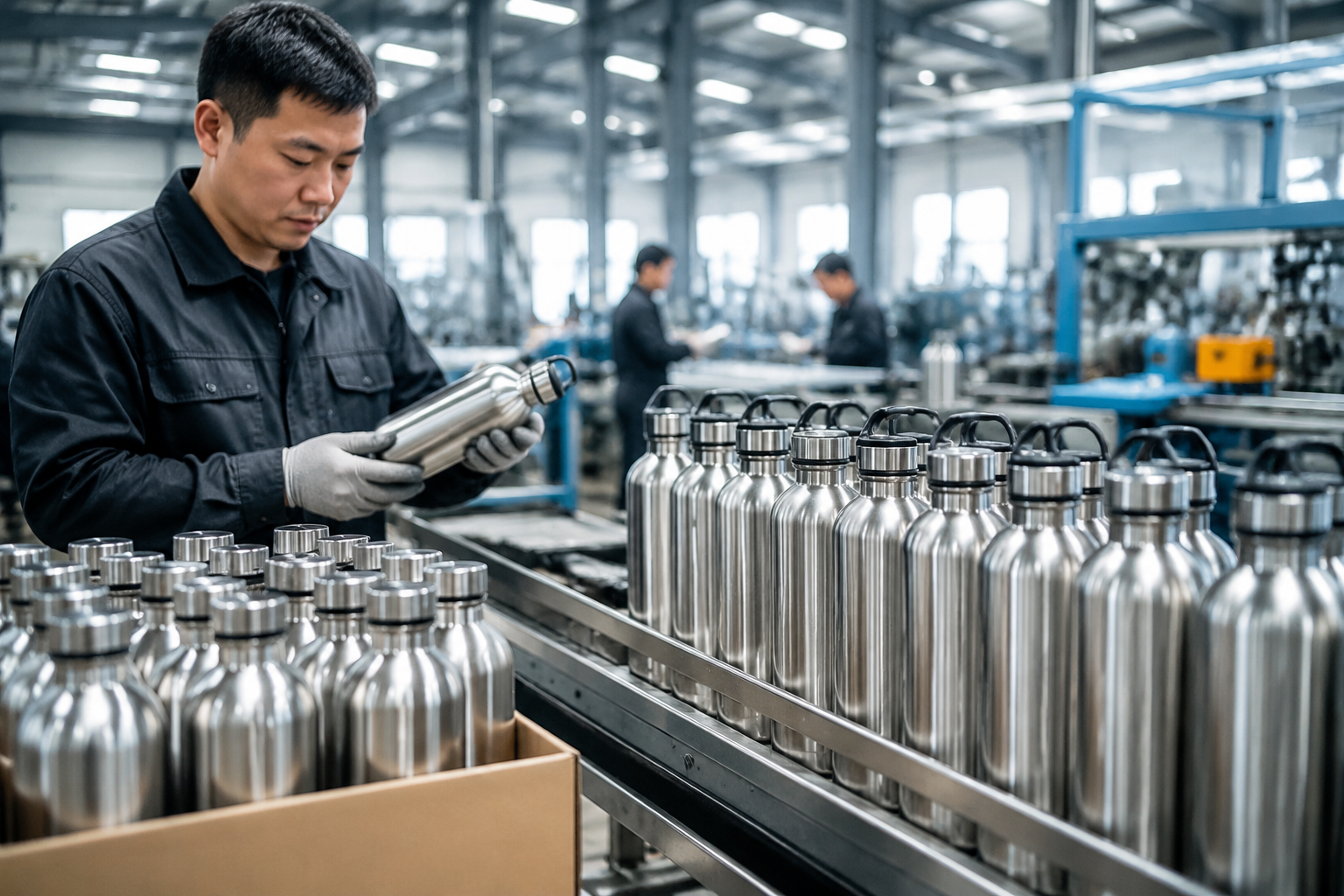
Buy from a water bottle vendor and the sample usually looks clean. The problems show up on the line: a 0.3 mm spec drift, a print window that shrinks by 8 mm, or a lid that comes back loose after 12 carton drops. We check the sheet line by line for a reason. In Zhejiang and across China, plenty of factories can make a bottle that looks the same; the real test is whether they hold that spec at 3,000 units, 10,000 units, and 50,000 units without the buyer flagging the rework.
If you are sourcing custom drinkware for retail, corporate gifting, or Amazon, you need to think like a procurement manager and a packaging engineer at the same time. A good water bottle vendor should talk through wall thickness, coating adhesion, closure fit, REACH compliance, and carton drop performance with the numbers in front of them. We’ve seen this go sideways when the PO says “matte black” and the buyer expected a specific Pantone. That is the standard you should expect from any canteen supplier, canteen manufacturer, or canteen factory in China.
Start With the Use Case
The first line on any spec sheet should be use case, not color or logo. A bottle for gym retail, a canteen giveaway, and a custom growler for beverage brands are different jobs, even if the shape looks close. If you sell into retail, you watch finish consistency, carton presentation, and barcode placement. If you buy for events, you want fast turnaround, a lower MOQ, and decoration that still looks fine after a few drops on the floor. If you run a distributor canteen or distributor drinkware program, re-order stability matters more than a one-off sample win.
This is where a lot of buyers burn cash. They ask a canteen vendor for the lowest unit price, then find the lid works for a handout but not for daily hydration. The right first question is scenario: hot or cold, food-safe or not, kids or adult, indoor or outdoor, and whether the bottle must fit a car cup holder. We run that check before decoration for a reason. A trade-show handout can land 20-30% cheaper than a retail-ready model, but the math does not work if you expect the same wear life. QC pulled the sample, and the wall thickness told the story.
Buyer impact: when the use case is clear, our factory quotes the right structure and you stop paying for features you will never use.
Material and Thickness
I’ll rewrite the prose in place, keep the HTML structure intact, and tune the tone to sound like a factory-side sales engineer.Material is where the cost sits. For stainless steel, 18/8 or 304 grade is still the default for most custom drinkware, and 316 only makes sense when the buyer needs better corrosion resistance or the liquid is harsher. For plastic, Tritan and food-grade PP are common, but clarity, odor control, and heat resistance differ a lot. Glass bottles look premium, and we ship them that way, but breakage and pack-out cost come up fast.
Ask your canteen manufacturer for the exact wall thickness, not just “premium stainless.” A single-wall bottle may run 0.3-0.4 mm; a double-wall insulated bottle often sits at 0.4-0.5 mm on the inner and outer shells. That 0.1 mm changes dent resistance, weight, and hand feel. We had a buyer flag print distortion after 3 months, and QC pulled the sample: the line was 0.35 mm, so the math did not work. That was a structure issue, not a printing issue.
If you are sourcing a customizable canteen or customizable growler, material choice also affects compliance. Ask for REACH declarations for Europe and, if you sell into the US, confirm FDA food-contact documents. A canteen factory in China that handles export should hand over those papers without drama. We run this check on every export lot, and a missing test report is where orders go sideways.
What to check:
- 304/18-8 stainless for mainstream insulated bottles
- 0.4-0.5 mm wall thickness for better rigidity
- Food-grade PP or Tritan with test reports for plastic parts
- REACH, FDA, and LFGB support when needed
Capacity and Dimensions
I’ll rewrite the section in place, keep the HTML exactly as-is, and tune the prose to sound like a factory-side sales engineer.Capacity is not a marketing number. It decides carton count, shelf fit, cup-holder clearance, and how often the buyer actually carries the bottle. A 500 ml bottle sells easier in corporate gifting and school programs because it is compact and cheaper to ship. A 750 ml or 1,000 ml bottle fits sports and outdoor retail, but the carton grows fast. For one e-commerce run, a 20 mm height change forced us to redraw the outer carton and recheck the drop test.
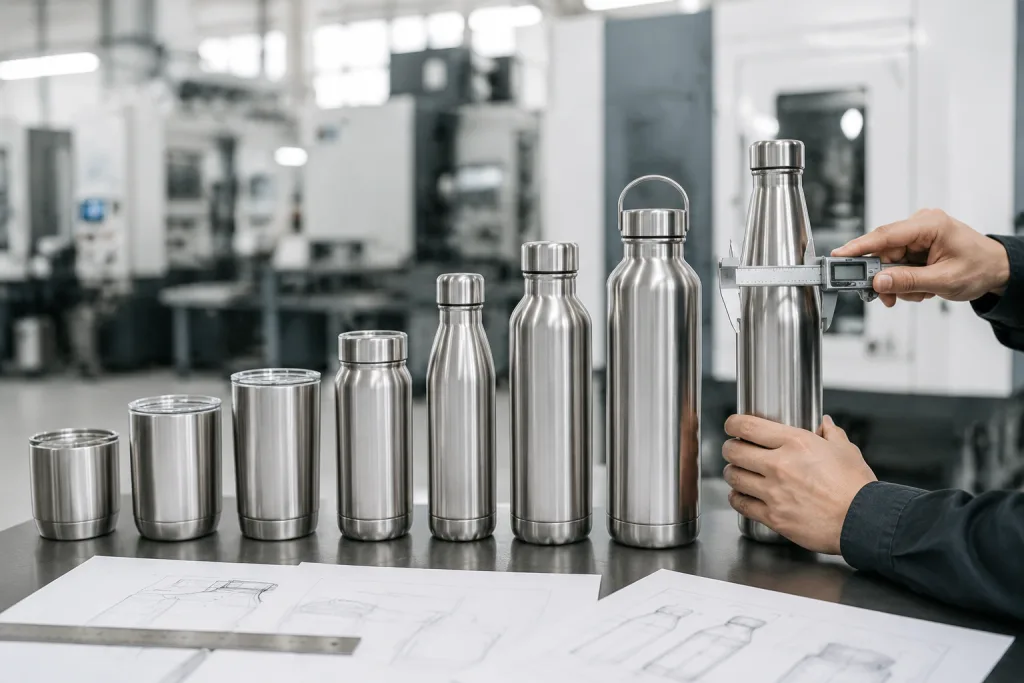
Do not stop at milliliters. Ask for the real dimensions in mm: body diameter, total height with lid, and mouth opening. QC pulled the sample on our caliper bench once and found a 2.5 mm gap between the drawing and the finished lid stack-up. A wide-mouth bottle is easier to wash, easier to fill with ice, and fits a custom growler-style product better. A narrow-mouth bottle cuts spills and works better for commuting. If the bottle must fit a 70-75 mm cup holder, tell the canteen supplier before tooling starts. After the mold line is locked, late changes cost time. Sometimes they mean a full tool revision.
For distributor canteen programs, fixed dimensions matter because pallet and carton optimization can cut freight cost by 8-12%. We run this calculation on every 20GP load, not as a guess. Ask the Zhejiang water bottle vendor for the master carton spec with the bottle spec. That is where the hidden cost sits, and the math does not work if you skip it.
Lids, Threads, and Leak Risk
I’ll rewrite the section in-place, keeping the HTML tags and the heading structure intact, while making the sales-engineering tone sound like a real factory-side buyer discussion.The lid decides whether an order turns into repeat business or a complaint ticket. We’ve seen a bottle pass print inspection and still fail because the thread pitch drifted, the silicone ring came in 0.3 mm undersize, or the cap torque wasn’t set on the line. A canteen factory should talk closure testing first, not cap style. Screw lids, flip lids, straw lids, and sports lids all fail in different ways once cartons hit the truck.
For leak control, ask for the torque range and the drop test standard. Our usual export check is 1.0-1.5 m drops on corners and edges, then a leak test after temperature cycling. If you are selling a customized canteen with an insulated lid, confirm the seal ring material and its Shore hardness; the word “silicone” on a quote does not solve the problem. If the ring runs too soft, it deforms in hot-fill or when air freight swings pressure.
Buyers sourcing canteen customizable gift sets often skip lid replacement. That is the wrong question to skip. If you are building a canteen promotional program, ask whether spare lids come from the same mold and whether the vendor tracks lot numbers by batch. We keep spare parts on the shelf for a 5,000-unit run, because that is how you protect re-orders and avoid field failures when the buyer flags a cap issue six months later.
Practical rule: if the lid is not tested separately, the bottle is not truly tested.
Decoration Choices That Survive
I’ll rewrite the prose in place, keep the HTML exactly intact, and tighten the buyer-facing language so it reads like a factory-side sales engineer wrote it.Printing is wear, not decoration. Screen print is still the cleanest route for many custom canteen and custom drinkware orders because it stays sharp on flat walls and mild curves, and the line can run it fast. Laser engraving holds up well on stainless steel when the buyer wants a permanent mark. UV print opens up more color, but it needs the right coating and a clean wipe-down before the job starts. Heat transfer and 360-degree wrap graphics work for retail, though they add setup steps and more chances for rework.
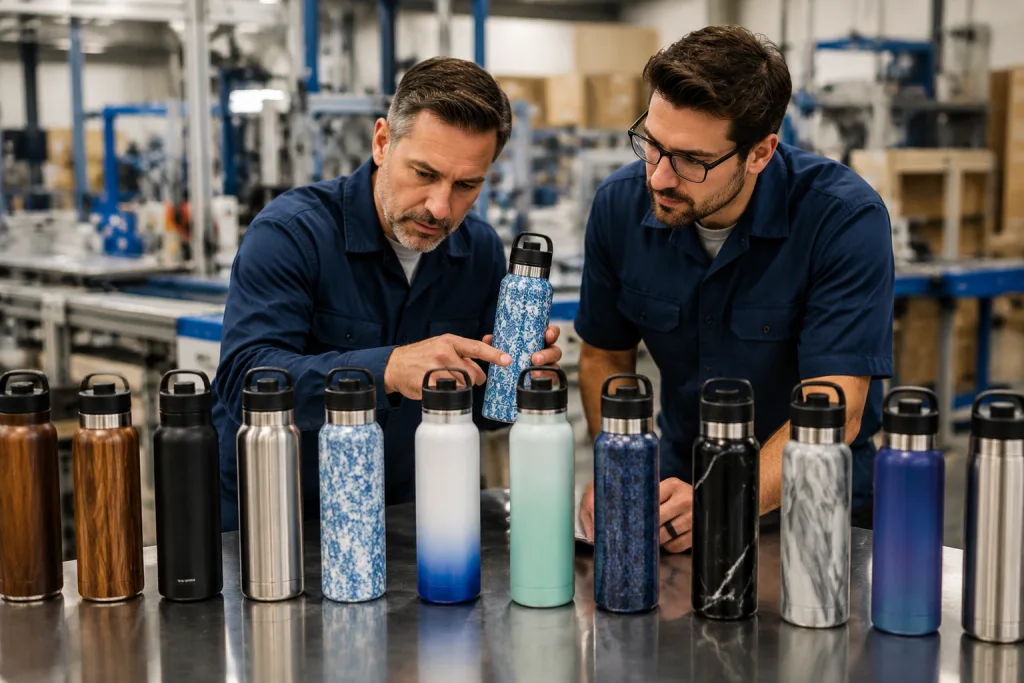
Your canteen manufacturer should quote print limits in mm, not sales talk. A 25 x 25 mm logo is straightforward; a 220 mm wrap on a taper body is where registration starts to drift. If you need a canteen customized for retail, ask for a print proof on the actual body shape, not a flat mockup from Illustrator. We’ve seen the buyer flag the logo only after approval, when it lands too close to the shoulder or breaks on the curve. That is the wrong time to discover it.
Cost still matters. In China, standard one-color screen print can land under USD 0.20-0.45 per piece at volume, depending on quantity and setup. Laser engraving costs more, but it skips ink wear and keeps the mark after 200 washes. For a canteen promotional campaign, cheap is not the same as smart if the item goes through daily dishwashing. We run the same check on the line: if the decoration does not match the price point and use case, the math does not work.
Best fit by order type:
- Canteen promotional: one-color screen print or pad print
- Custom drinkware retail: laser engraving or premium UV print
- Custom growler: engraving or durable wrap graphics
MOQ, Pricing, and Lead Time
I’ll rewrite the section in-place, keep the HTML intact, and tighten the sales-engineer tone with concrete factory details and cleaner pricing language.Price only matters after you lock the MOQ and the lead time. A Zhejiang canteen plant like ours can run 300,000-500,000 units a month across mixed bottle lines, but that does not let one PO cut the queue. For a standard stainless bottle, MOQ usually starts at 500 or 1,000 pcs per color or per design. Once you move to a new cap or a fresh mold, MOQ can jump to 3,000 pcs. If a supplier offers 200 pcs on a fully customized bottle, the buyer should ask what is actually changing. We see that question save deals.
FOB price changes with the build. A basic stainless single-wall bottle may sit around USD 1.80-3.20, while a double-wall vacuum model with powder coat and a branded cap can run USD 2.30-5.80 or more. A laser logo, gift box, or extra carton insert adds cost fast. That part is normal. The wrong move is hiding mold fees, sample charges, or a carton upgrade until after artwork is approved. We had a PO last month with a typo on the carton spec, and QC pulled the sample before the line ran 5,000 pcs.
Lead time from sample approval to shipment is usually 20-35 days for standard orders, and 35-50 days for more complex customization. If a factory promises 7 days for a new tool and a full run, you are looking at stock, not a real custom bottle. We ship fast when the spec is clean and the buyer signs off on the artwork the first time. A 12-day schedule vs 18 days is a real discussion; “soon” is not. In China, speed exists, but only when the drawing, cap, and carton are already settled.
Quality Control That Protects Margin
I’ll rewrite the section in-place, keep the HTML structure intact, and tighten the sales-engineer tone with more concrete factory details.Quality control is where a serious water bottle vendor protects margin. We run incoming material checks, in-process checks on the line, and final packing inspection; if a supplier cannot walk you through all three, the cheap quote will get expensive fast. A normal export spec uses AQL 2.5 for major defects and 4.0 for minor defects, unless your channel asks for tighter control. We’ve seen buyers lose money on scratches, cap misfit, coating bubbles, and logo shift of 1.5 mm because nobody set the rule before production started.
For beverage containers, the usual failures are plain enough: paint chips, weak vacuum retention, lid leaks, uneven engraving, and carton crush. QC pulled the sample and found a 12-day vacuum drop test that failed at day 8, which is the kind of number that kills repeat orders. A good canteen supplier should test vacuum insulation, drop strength, and odor before shipment. If the order goes to Europe or North America, ask for FDA, LFGB, and REACH support, plus lot-level traceability; that is the only way a distributor canteen program has a real recall trail.
Do not skip packaging. A bottle can pass inspection and still show up damaged because the inner tray is too soft or the divider is 2 mm short. We ship a lot of export cartons, and the buyer flagged it when the master carton edge crush score was not matched to the route. Ask for polybag thickness, divider strength, and carton edge crush details. The factory should know whether your move is LCL, FCL, or straight to an Amazon prep center. If they have done Amazon FBA drinkware before, they should already know FNSKU placement, suffocation warnings, and carton labels; this is not the place for basic coaching.
Good QC conversation includes:
- Inspection standard: AQL 2.5 / 4.0
- Functional checks: leak, vacuum, torque, drop
- Documentation: lot traceability, compliance files
- Packing: inner protection, carton spec, master carton marks
Send your bottle spec for a fast quote
We’ll check MOQ, print limits, packing, and lead time before quoting. If you need a Zhejiang canteen manufacturer that speaks in numbers, not guesses, start here.
Frequently asked questions
What is a normal MOQ for a custom water bottle order?
For a standard stainless bottle, many factories in Zhejiang and other parts of China start at 500-1,000 pcs per design or per color. If you need new tooling, a special lid, or a complex print wrap, MOQ can move to 3,000 pcs. For a canteen customizable project with existing stock shapes, you may get lower entry quantities, but the unit price usually rises. A serious water bottle vendor should tell you exactly what is stock, what is semi-custom, and what is fully customized before you send artwork.
How much should I budget for a custom drinkware bottle?
A basic single-wall bottle can start around USD 1.80-3.20 FOB, while a double-wall insulated model with branding often lands around USD 2.30-5.80 FOB. Add more for special coating, gift packaging, or multi-color decoration. If you are buying a canteen promotional item, budget tightly on the product but do not cut corners on packaging, because damaged cartons increase your real landed cost fast. Ask for a quote that separates bottle, decoration, packaging, and freight assumptions.
What documents should a canteen manufacturer provide?
For Europe, ask for REACH support and, when relevant, LFGB. For the US, ask for FDA food-contact documentation. If you need a retail or distributor drinkware program, request test reports, material declarations, and lot traceability. A good canteen factory should also provide inspection records, carton specs, and a packing list template. If they supply Amazon sellers, they should know FNSKU labeling and carton barcode requirements. Good paperwork is not optional; it is part of the product.
Which decoration lasts longest on stainless bottles?
Laser engraving is the most durable because it is permanent and does not depend on ink adhesion. For color branding, screen print is reliable when the bottle is handled normally and washed by hand. UV print looks strong visually, but you need the right coating and prep. If you are sourcing customized canteen products for daily use, ask the factory for abrasion expectations and real sample photos after washing. For a custom growler or premium retail bottle, engraving usually gives the cleanest long-term result.
How long does production usually take in China?
For a standard order from a Zhejiang canteen supplier, expect 20-35 days after sample approval. Complex lids, new molds, or special surface finishes can extend this to 35-50 days. Transit is separate, so your total timeline depends on FOB port, shipping mode, and customs. If you need a distributor canteen launch date, build in time for artwork approval, pre-production sample checks, and one inspection cycle. Fast production is possible in China, but only when the spec is frozen early.