Key Takeaways
- A serious water bottle supplier should quote MOQ by SKU, often 500-3,000 units, not give vague promises.
- For stainless canteen custom projects, 304 steel at 0.4-0.5 mm wall thickness is a safer baseline than thin, unstable builds.
- Lead time matters: 25-35 days is normal for repeat orders; 35-50 days is common for new decorated custom drinkware.
- Use case beats price: distributor drinkware, canteen promotional, and custom growler programs need different lids, coatings, and test packs.
If you buy drinkware for retail, promotions, or private label, the wrong supplier usually looks fine on a sample and gets expensive on the first shipment. The issue is not “finding a factory”; it is telling a solid water bottle supplier from a canteen manufacturer that can hold tolerances, repeat decoration, and ship on time from Zhejiang or anywhere else in China. We’ve seen buyers approve a 350 ml sample, then the 500 ml production run comes in with a lid gap the QC caliper catches in 12 seconds.
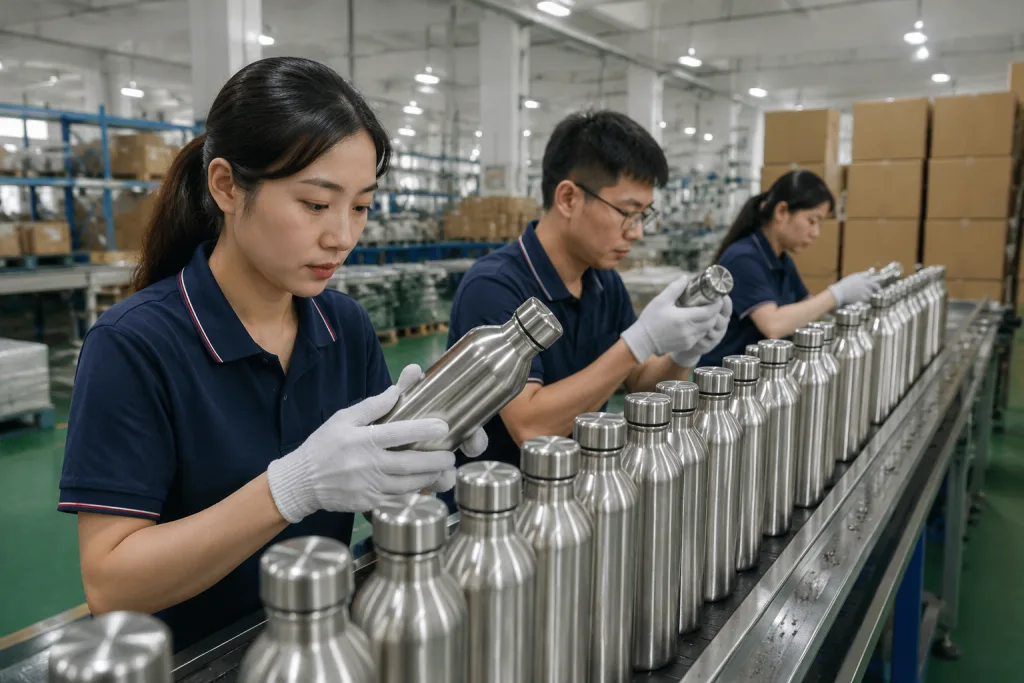
The fastest way to compare options is spec, not website copy: steel grade, wall thickness, coating system, lid fit, test standard, MOQ, and whether the factory can support customized drinkware at scale. At BottleForge in Hangzhou, Zhejiang, we run 500,000 units a month across stainless bottles, tumblers, and canteen custom projects, and the line tells the truth fast. A buyer once pushed back on our 5,000-piece MOQ; we showed the 304 stainless coil traceability sheet and the math held up.
Spec Table Before Sales Talk
I’ll keep the HTML exactly as-is and rewrite only the prose for a sharper factory-side sales tone. Next I’m replacing the vague phrasing with concrete checks, numbers, and buyer-floor details.Buyers waste time comparing water bottle suppliers from catalog photos instead of build data. We run the quote off a simple head-to-head grid, and the weak spots show up fast: missing test reports, thin walls, shaky lid tooling, or print that looks clean on a mockup but cracks after 500 cycles. For B2B drinkware, the spec sheet is the product. A decent canteen factory puts it on the table early.
Use this comparison frame on every quote:
- Body material: 18/8 stainless, 304 stainless, Tritan, aluminum, or glass
- Wall thickness: 0.4 mm, 0.5 mm, or double-wall vacuum construction
- Finish: powder coat, spray paint, brushed, UV print, laser engraving
- Compliance: REACH, LFGB, FDA, ASTM, food-contact declarations
- Commercial terms: MOQ, FOB Ningbo or Shanghai, lead time, carton pack, spare parts
When a canteen supplier answers these numbers fast, you are dealing with a real factory or an export team that knows the line, not a paper middleman. In Zhejiang, that split decides whether your launch runs clean or turns into a re-order headache. We’ve seen buyers skip carton load data, then the pallets tip at 1.2 m drop-test; that math doesn’t work. If a canteen vendor cannot state the leak test at 24 hours or the drop test at 1.2 m, leave it off the shortlist.
Stainless, Tritan, Or Glass?
I’ll rewrite the prose only, keep the table/tag structure intact, and tighten the material guidance so it sounds like a factory-side sales note.People get burned by chasing the “cheapest bottle” and skipping the channel match. If we run private label hydration for a retailer, stainless is the safer volume bet. For schools, gyms, or outdoor promo programs, Tritan usually ships easier because it is lighter and takes abuse better in day-to-day carry. For premium gifting, glass and stainless both sell, but the carton needs to survive a 1.2 m drop test or the buyer will flag it fast.
| Material | Best use case | Typical MOQ | Buyer risk |
|---|---|---|---|
| 304 stainless | Retail, sports, corporate gifts | 500-1,000 pcs | Cheap steel substitutions |
| Tritan | Lightweight daily carry, schools | 1,000-3,000 pcs | Scratch resistance, odor claims |
| Glass | Premium lifestyle, tea, office | 500-2,000 pcs | Breakage, packaging cost |
| Aluminum | Budget promotional canteen promotional runs | 3,000+ pcs | Lining quality and denting |
For stainless bottles and custom canteen work, get the steel grade and wall thickness in writing. QC pulled one sample at 0.35 mm when the PO called for 0.4 mm, and that gap is enough to trigger a claim. A real canteen manufacturer in China will tell you straight whether the inner wall is 304, the outer wall is 201, or the body is full 304. That is the number that matters, not the render. If your buyer is a distributor, hold the line on spec consistency. Mixed-material claims usually end in warranty noise.
MOQ Versus Lead Time
I’ll rewrite the section in place, keep the HTML structure intact, and make the wording sound like a factory-side sales engineer wrote it.MOQ is not a random number; it tells you how the line is set up. A canteen factory quoting 200 units across every print method is usually hiding wash losses, screen setup, and packaging waste inside the unit price. We run it differently: stock body, one-color print, multi-color print, and custom lid tooling should each have their own MOQ. That is the real production price. QC pulled a sample with a crooked 3 mm logo once, and the buyer flagged it before we shipped.
For standard private label bottles, our working range is 500-1,000 pieces for laser engraving, 1,000-3,000 pieces for screen print or full-color wrap, and 3,000-5,000 pieces for deep custom molds. Lead time has to match the job: 7-10 days for blank stock, 15-25 days for simple logo work, 35-50 days for canteen projects with new lids or molded parts. If a supplier promises a full custom launch in 12 days from China, the math does not work. We have seen that go sideways on a PO typo alone.
“Fast” only matters if the cartons arrive with the right lid torque, correct artwork, and no leakage.
Good water bottle suppliers will tell you if they can stage production. That matters when you need 2,000 units in week one and the rest later for distributor replenishment. In Zhejiang, a factory with 8-12 assembly lines can split the run; a small canteen vendor usually cannot. Ask how many units per month they ship, not what the homepage says. One month we checked a line that claimed 80,000 pieces and only pushed 32,400 after QC counted pallets.
Decoration Methods That Hold Up
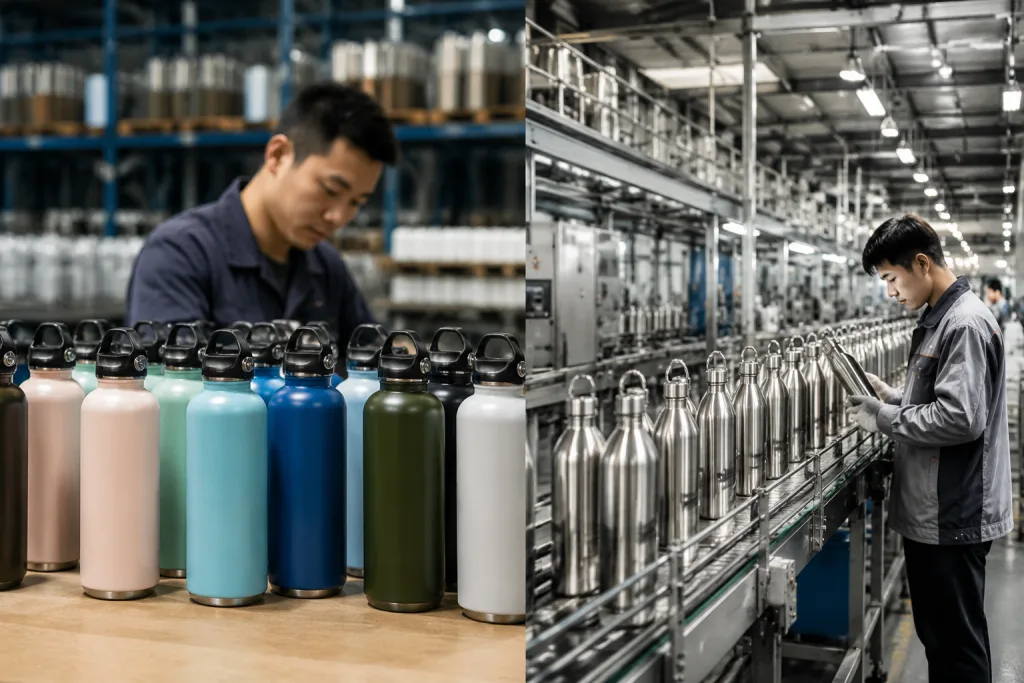
I’ll rewrite the section in place, keep the HTML structure intact, and strip the AI-sounding phrases while adding a few factory-floor details and tighter B2B language.Decoration is where a lot of custom drinkware jobs go wrong quietly. The sample passes. Then the first 5,000 pieces come off the line with scratches, edge lift, or shade drift. You do not want that after the retailer has already listed the SKU.
For B2B buying, judge decoration on durability and cost:
- Laser engraving: clean, hard-wearing, a strong fit for premium custom canteen and custom growler runs
- Silkscreen printing: low cost for 1-2 spot colors, but it gives up fast under heavy abrasion
- UV print: holds graphics better on flat or lightly curved panels, good for custom drinkware branding
- Heat transfer: works for full-wrap art, but you need wash-cycle proof, not a sales promise
- Emboss/deboss: premium feel, higher tooling cost, best for programs that stay in range for years
If you are comparing canteen custom offers, ask for adhesion tests and a 50-cycle handwash or dishwasher reference, based on the channel. We had a buyer flag a Pantone typo on a PO once, and QC pulled the sample before the line ran 20,000 pcs. That kind of mistake costs a week. A canteen distributor selling corporate gifts needs logo placement that repeats within 1 mm. A retailer selling premium hydration products needs color matched to the approved pre-production sample, not “close enough.” In China, plenty of factories can print a nice first sample; fewer keep color stable across 3 batches. That is the real test.
Use Case Wins The Comparison
I’ll rewrite the section in-place, keep the HTML structure untouched, and tighten the prose so it reads like a factory-side sales note.The right supplier for a marathon promo is not the right supplier for a premium outdoor line. Match the bottle to the channel. We see this go sideways when a buyer tries to force one SKU into three jobs.
Distributor drinkware: choose a stable stock body, low-risk print, and carton packs that stack clean on a 600 mm pallet. For canteen distributors, replenishment speed and spare lid availability matter more than fancy extras.
Canteen promotional: choose lower unit cost, simpler decoration, and a spec that holds up in mass handout. The math does not work if you pay for premium polish on a giveaway order.
Retail/private label: choose a canteen customizable platform with tighter finishing, better coating, and barcode-ready packaging. If the item goes on Amazon, we run FNSKU labels, carton drop testing, and clean insert logic; QC pulled one sample last month with a 2 mm print shift, and the buyer flagged it fast.
Outdoor and fitness: choose leak resistance, one-hand drinking, and a lid that survives repeated opening. A customizable canteen for this channel should be judged on cap torque and hinge life, not just looks.
Premium gift or brewing segment: custom growler and customized growler projects need heavier gauges, stronger handles, and packaging that protects the finish. A 0.5 mm body with a reinforced handle ships better than a weak, shiny build, and we’ve seen a loose handle turn into a claim after 12 days in transit.
Compare canteen suppliers this way and the decision gets clear. The cheapest quote is rarely the best distributor canteen choice, and the prettiest sample is not always the one that makes margin.
Factory Checks That Save Orders
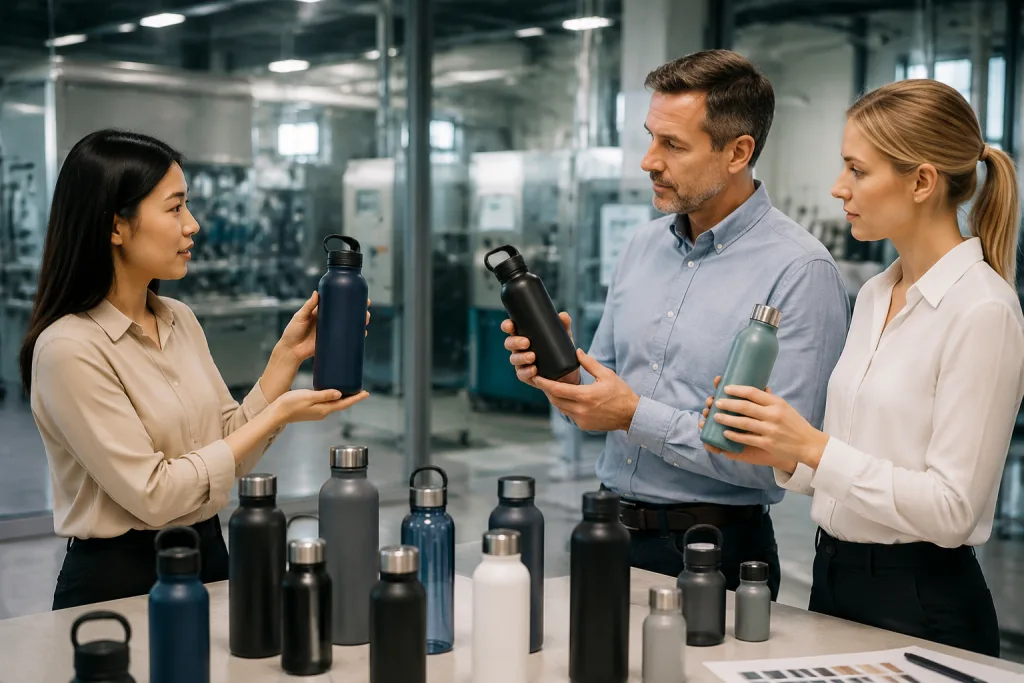
I’ll rewrite the three paragraphs in place, keeping the HTML exactly intact and tightening the sales-engineer tone with concrete factory-floor detail.Before you place a PO, check the factory like an auditor, not a shopper. Ask for BSCI, ISO 9001, and the food-contact file for your market. For Europe, ask straight for REACH and LFGB support. For the U.S., ask for FDA-related declarations and recent third-party test reports. If the sales rep gets fuzzy, that is your answer.
Ask about the QC plan too: incoming material check, in-process inspection, and final AQL level. We usually see AQL 2.5 for critical defects and 4.0 for minor defects, but the real test is whether the team can walk you through it without guessing. QC pulled the sample, checked lid torque at 0.8 N·m, ran a vacuum leak test, then dropped the carton from 76 cm. That is the sort of detail that saves an order.
Check whether the supplier is the real factory or just a trading desk with a nice nameplate. A true canteen factory in Zhejiang or elsewhere in China can point to molding, polishing, coating, assembly, and packing on one line. We have seen buyers get burned by a PO typo that sent the wrong cap color into a subcontract shop. If you need speed, control, and consistent canteen output across seasons, this is the wrong question to ask to a middleman.
Request specs before you request a sample
Send your target price, MOQ, and use case. We’ll match you to the right China production route, not just a pretty bottle.
Frequently asked questions
How do I compare water bottle suppliers quickly?
Ask for five numbers first: MOQ, lead time, material grade, wall thickness, and test standard. A serious quote usually shows 500-1,000 pcs MOQ for basic logo work, 25-35 days for repeat orders, 304 stainless or Tritan by spec, and AQL or leakage test details. If the supplier cannot give those, they are not ready for B2B volume.
What is a normal MOQ for custom drinkware?
For stock bodies with logo decoration, 500-1,000 pieces is common. For more complex custom drinkware with new lids or molded parts, 3,000 pieces is a realistic starting point. For a custom growler or fully customized canteen, tooling can push MOQ to 5,000 units or more. Anything far below that often means higher unit cost or limited control.
Should I choose a canteen manufacturer or a distributor?
If you need repeatable specs, better control, and lower long-term pricing, go direct to a canteen manufacturer or canteen factory. If you need mixed SKUs, smaller volumes, or fast market testing, a canteen distributor may help. For brand owners, direct factory sourcing in China usually gives better margin, but only if the factory can handle your artwork, packaging, and quality checks.
What documents should I request before ordering?
Request material declarations, REACH or LFGB support for Europe, FDA-related food-contact paperwork for the U.S., and a production quality plan. Also ask for carton specs, test photos, and sample approval records. If the order is for Amazon, confirm barcode placement, FNSKU labeling, and carton dimensions before production starts.
How do I avoid decoration problems on canteen customized orders?
Lock the Pantone reference, decoration method, and placement before mass production. Ask for a pre-production sample and a photo approval of the first decorated unit. For canteen customized projects, laser engraving is usually the safest for durability, while silkscreen is better for low-cost logos. Always ask the supplier to confirm scratch resistance and wash-cycle performance in writing.