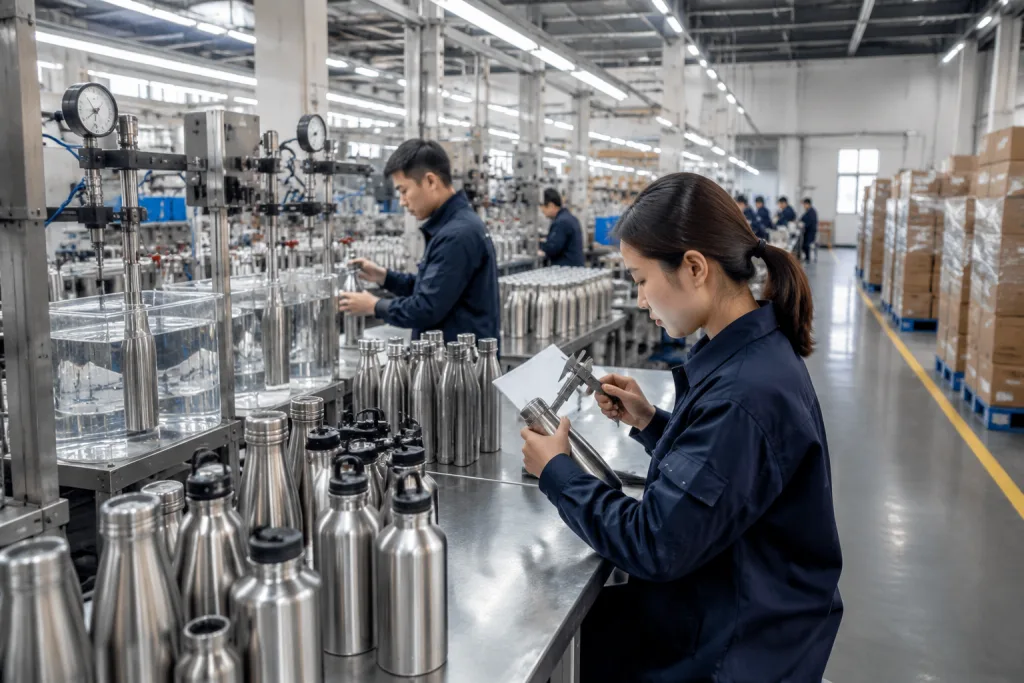
Key Takeaways
- A 0.2-0.5 mm tolerance mistake on caps, threads, or seals can cause mass leakage.
- For decorated custom drinkware, print registration should be locked within ±1.0 mm and verified on first articles.
- AQL 2.5 is common for general appearance, but leakage and food-contact defects should be treated as critical at 0.0.
- Typical MOQs in Zhejiang start around 500-1,000 pcs per SKU, with 25-35 day lead times after sample approval.
If you buy for water bottle distributors, the hard part is not finding a factory in China. The hard part is stopping a 2 mm print shift, a 0.3 mm lid mismatch, or a coating that fails 500-cycle dishwasher testing from turning into rejected cartons and freight claims. We’ve seen a clean PO get burned over that kind of miss.
Most of the damage shows up before mass production starts, not after. Good buyers in Zhejiang ask straight questions: what breaks first, where the tolerance stack lands, what the AQL 2.5 check actually covers, and which defect stays on samples only. If you run custom drinkware, canteen custom, or a custom growler program, that is the right lens. A canteen factory in China can ship 30,000 to 80,000 units per month, but only when the spec is tight and QC pulled the sample against the same drawing the buyer flagged on the PO.
How to Vet a Factory in Zhejiang
I’ll rewrite the section in-place style, keep the HTML exactly as-is, and make the prose sound like a factory-side sales engineer with more concrete operating detail.You do not need a glossy pitch; you need proof the factory can repeat output. A serious canteen factory in Zhejiang should state monthly capacity, line count, labor mix, and normal lead time without blinking. If they cannot tell you whether their usual lead time is 25 days or 45 days, the schedule is not under control. On our side, QC pulled a leakage sample at 2 a.m. and the buyer still asked for the same answer twice. That is the right test.
Ask for documents distributors can use on day one: BSCI or equivalent social compliance, REACH or food-contact support, photo logs from the line, and a sample inspection report. A good canteen supplier should also say what happens when a batch fails: rework, segregate, or remake. We have seen this go sideways when a PO had one wrong digit in the carton count and nobody caught it until packing. For water bottle distributors buying multiple SKUs, consistency beats a low quote. A factory shipping 60,000 units per month with a 25-35 day lead time and leakage under control is the better bet.
- Confirm whether the factory is the maker or only a trading layer.
- Ask to see calibration records for gauges, torque tools, and thickness testing.
- Request a real QC report with defect photos, not just a pass/fail stamp.
- Verify that the same line can handle both standard and customized drinkware programs.
The lowest FOB price is irrelevant if the product fails at destination.
Send your spec, get a cleaner quote
We can review your bottle spec, flag the failure points, and quote a production-ready program for Zhejiang export supply.
Frequently asked questions
What MOQ should water bottle distributors expect from a China factory?
For standard custom drinkware, a practical MOQ is 500-1,000 pcs per color or SKU. For more complex decorated items like a custom growler or double-wall insulated bottle, 1,000-3,000 pcs is more common because setup, print screens, and carton planning take time. In Zhejiang, a capable canteen manufacturer will often quote 25-35 days after sample approval, but that assumes artwork is final and materials are in stock. If you want mixed colors or mixed lids, ask whether the MOQ applies per variant or per order total; that detail changes landed cost fast.
How do I stop leakage claims on customized canteen orders?
Lock the closure system in writing: lid type, gasket material, torque range, and a 24-hour inverted leak test. For bottled products, ask the canteen supplier to run samples at the same torque used in production, usually around 1.2-1.8 N·m for many screw caps. Make leakage a critical defect at 0.0 in your QC plan, not an AQL 2.5 item. If the bottle has a straw, flip cap, or press-fit insert, test those separately because each part adds a new failure point. You should also request packed-unit testing, not only bare bottle testing.
What documents should I ask a canteen distributor or factory for?
At minimum, ask for a product spec sheet, material declaration, REACH support where relevant, food-contact compliance documentation, and a QC report with AQL results. If you sell into retail or e-commerce, also ask for carton dimensions, gross weight, FNSKU or barcode placement, and master carton marks. For a canteen promotional program, request artwork approval, Pantone references, and a first-article photo set. A real canteen factory in China should be able to provide these without weeks of delay. If they cannot, the order will likely be managed informally, which is where mistakes start.
Is laser engraving better than silkscreen for custom canteen branding?
It depends on the use case. Laser engraving is usually more durable for metal surfaces because it does not rely on ink adhesion, so it is a strong option for a customized canteen or distributor drinkware line that will be handled hard. Silkscreen is often cheaper and allows more color, but you should require rub testing and cure validation. For coated bottles, adhesion failures can show up within 100-200 wash cycles if the ink or curing process is weak. If the order is promotional and price-sensitive, silkscreen may be fine; if the bottle is for repeat retail use, engraving is usually safer.
How do I compare FOB pricing from different canteen vendors?
Compare more than the unit price. Check whether the quote includes inner boxes, master cartons, inserts, print setup, and testing. A difference of USD 0.18 per piece on a 10,000-piece order can disappear if one vendor charges extra for packaging or if the other has a 3% leak rate. Ask every canteen vendor to quote the same spec: wall thickness, decoration method, carton rating, and inspection level. The most useful comparison is landed cost after defect allowance, not just FOB Ningbo or Shanghai. A cheaper quote from China can still be the expensive choice if it causes chargebacks or returns.