Key Takeaways
- A 0.8 mm wall on single-wall stainless is common; double-wall insulation often starts at 0.4–0.5 mm inner and outer shells
- For a 3,000–5,000 unit MOQ, FOB China pricing can land around USD 1.85–4.20 depending on lid, finish, and decoration
- Leak testing should be defined at 30–60 seconds inversion plus 1,000–2,000 cycle lid torque checks, not just visual inspection
- Lead times from a Zhejiang canteen factory are often 25–40 days after sample approval, with 150,000+ units/month capacity on common SKUs
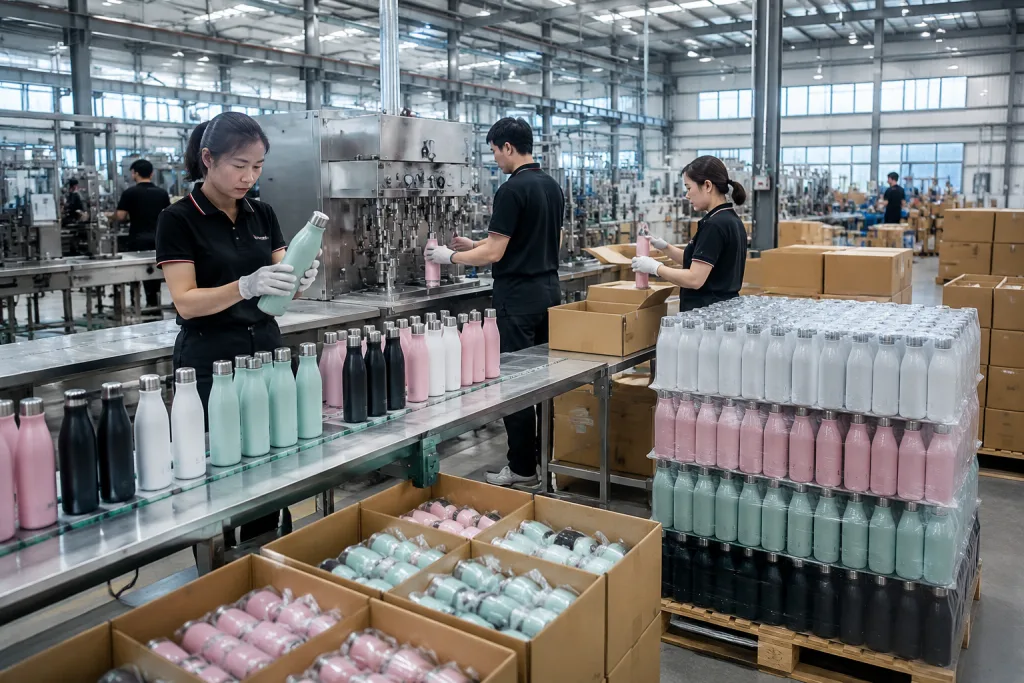
If you buy for a water bottle distributor program, the costly miss is usually the one that passes the first sample and fails after 3,000 units. We have seen coating chip at the carton edge, lids start weeping at the torque line, laser logos fade after 5 wash cycles, and a “500 ml” bottle come in at 470 ml because the cavity was drawn for mold ease, not usable volume. QC pulled the sample, checked the cap torque at 18-22 N·cm, and the buyer flagged it before the PO shipped.
So the job is not to chase the lowest FOB quote. It is to write a spec that shuts down those failure modes before they hit your warehouse. At BottleForge in Zhejiang, we run both sides of the table: the line wants a clean process, distributors want margin, steady QC, and fewer claims. That is the wrong question to ask: “Can you make it cheap?” Ask for wall thickness, lid seal, print hold, and carton test data. China ships excellent custom drinkware, but only when you pin down the details early.
Where bottle programs usually fail
I’ll rewrite the prose in place, keep the HTML tags untouched, and make it read like a factory-side sales engineer wrote it.The first failure mode is not a bad bottle. It is a weak brief. A water bottle distributor sends a target price, a logo file, and one reference photo, then expects the canteen factory to fill in the blanks. That is how we end up with mixed lid fit, powder coat that measures 18 μm on one side and 32 μm on another, and a decoration method that looks clean on the sample but starts peeling on the line.
Write the purchase order like you are handing it to QC. Put down material grade, wall thickness, lid type, coating system, and the exact usable volume tolerance. For stainless custom drinkware, ±3% on capacity and ±0.3 mm on wall thickness is a sane spec. For a customized growler, state the neck finish, seal material, and whether it needs carbonation resistance. If you are buying distributor drinkware, this is a QC checklist, not a brochure.
The problems show up fast in Zhejiang because the line runs hot. A canteen manufacturer may ship 80,000 to 150,000 units per month across different models, so one vague line in the PO gets copied into thousands of cartons. We’ve seen a buyer flag a carton typo on a 20,000-piece order after tooling was already cut, and the math did not work. If you ask for canteen customizable packaging or canteen promotional bundles, lock the carton spec, drop test target, and barcode placement before the first sample leaves the bench.
Leakage is a spec problem
I’ll keep the HTML unchanged and rewrite only the prose to sound like a factory-side sales engineer, with concrete test details and fewer AI-ish phrases.Most leak complaints come from three places: gasket geometry, thread pitch drift, or a lid that looks universal and is not. We run this on the line all the time. A custom canteen program should never assume one closure fits every bottle neck. If the cap loads unevenly, you get slow seepage after courier drops or a 10°C to 40°C swing.
Put the test method in writing. For flip lids and screw caps, ask for inverted leak testing for 30 seconds at room temperature, then repeat after a 24-hour hot-fill or cold-fill hold. For insulated bottle programs, ask for torque retention after 1,000 opening cycles; for heavy-use distributor canteen lines, 2,000 cycles is the safer call. We had a buyer flag a PO once because the spec said “leakproof” but never stated the cycle count. The math does not work if you sell into Amazon or retail and accept even a 0.5% leak rate.
Do not skip gasket material. Silicone is the safer pick for customized drinkware, but cheap blends can flatten after repeated wash cycles. QC pulled the sample last month and the gasket had already taken a set after 20 dishwasher runs. If you are sourcing canteen suppliers in China, ask for food-contact declarations aligned with REACH and FDA, plus a gasket compression spec. That single line can save a full container of claims.
Decoration that survives handling
I’ll keep the tags and structure intact, then rewrite the prose to sound like a buyer-side sales engineer from the floor. I’m aiming for tighter language, concrete test details, and no AI-style filler.Decoration failures usually stay quiet until the cartons move. The sample looks clean, the first 200 pieces pass, then the logo starts rubbing thin in carton abrasion or after one dishwasher run. That is why the decoration has to survive the way the line actually ships, not just the way it looks under shop lights. A canteen promotional item should not depend on a print method that flakes when the buyer starts handling it.
Laser engraving holds up better than most coatings, but it is not the right call for every colored body. Silk screen is cheaper at scale, yet a 3-color logo can drift if the jig and squeegee pressure are not controlled. We run cross-hatch adhesion checks on powder coat, and we ask for a 50-cycle dishwasher test on the exact finish, not a “similar” one. If you are buying canteen customized runs for outdoor retailers, spell out the failure point: logo still legible after 500 abrasion cycles or 3 washes, whichever comes first.
Price matters, but the wrong method gets expensive fast. In Zhejiang, a one-color silk screen on stainless usually adds USD 0.10–0.25 per unit, while laser marking often adds USD 0.18–0.40 depending on the surface and run size; the math does not work if you need a reprint after the first shipment. We saw a PO once with the logo file named wrong, and QC pulled the sample before the line started—saved the buyer a full redo. If you want the tradeoff laid out clearly, compare methods before you lock the PO at silkscreen vs laser engraving.
Capacity lies and dimensional drift
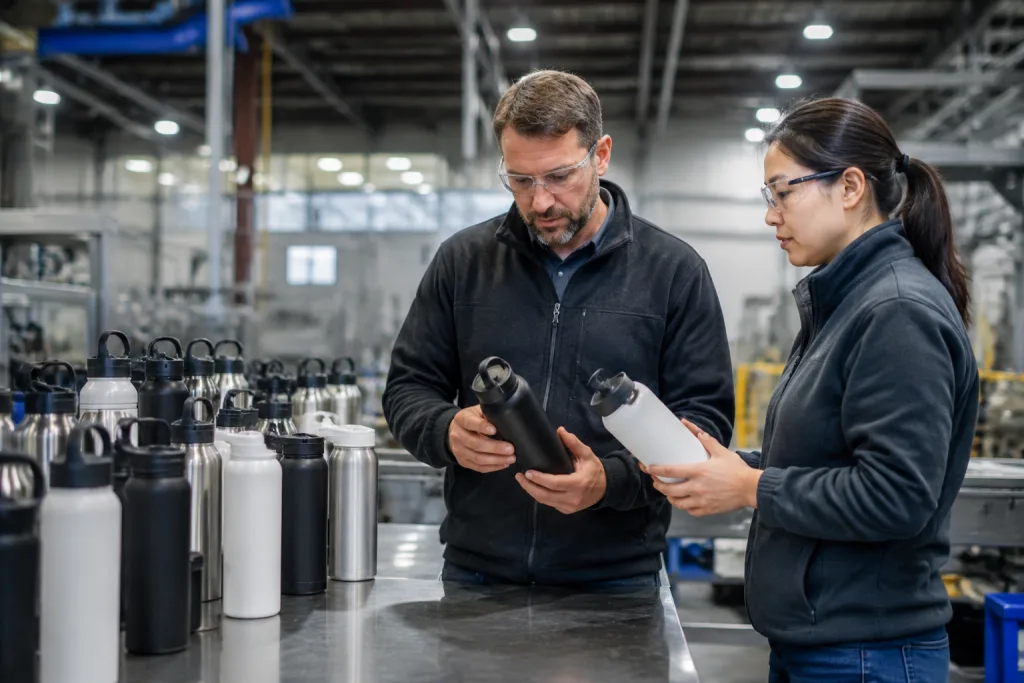
I’ll rewrite the section in place, keeping the HTML tags and the heading structure unchanged, and I’ll make the prose sound like a distributor-side sales engineer wrote it.Another failure mode is the bottle that ships short on real volume. We see this when a factory quotes nominal size instead of usable fill volume. A 32 oz custom drinkware SKU that only takes 28.5 oz to the shoulder turns into a refund headache fast, and shelf planning goes sideways for the buyer. On one run, QC pulled the sample and the mold line was clean, but the body taper cut the fill line by almost 4 oz.
Ask for three numbers: brimful capacity, recommended fill capacity, and net weight. For stainless single-wall models, a net weight band of ±8% works; for insulated models, we hold it tighter because the vacuum shell shifts when forming drifts. If you are sourcing a customized growler, spell out the headspace for beer or carbonated drinks. A 3% capacity miss sounds small until you ship 20,000 units and the labels are all wrong.
This is where canteen manufacturers and canteen suppliers show their level. A solid canteen factory in Zhejiang should send a pre-production sample, a golden sample, and a dimensional report before mass production starts. We’ve seen this go sideways when the buyer flagged a 0.8 mm lid gap, and the line kept running anyway. If they cannot hold the neck finish or lid alignment within 0.5 mm, the math does not work for distributor stock.
Packaging breaks margins quietly
I’ll rewrite the prose only, keep the HTML structure intact, and make the section sound like a factory-side sales engineer wrote it.Packaging failures are quiet, then they hit the margin. The bottle lands in one piece, but the carton shade is off by a panel, the inner tray buckles, or the barcode will not scan for FNSKU relabeling. We’ve seen a buyer lose two weeks on this. If you sell into North America or Europe, packaging is part of the product, not a side job.
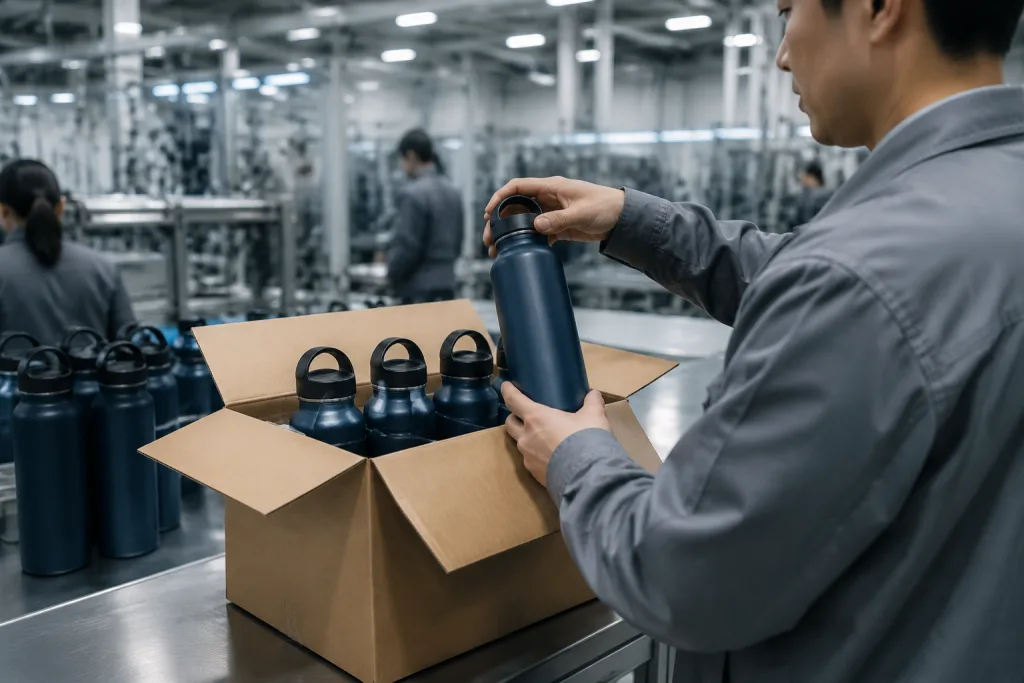
For export cartons, we ask for a 3-layer or 5-layer corrugated spec based on the lane, a 60–80 cm drop test target, and compression data if the pallets will be double-stacked. On one PO, the buyer flagged a 12 mm typo in the case pack count, and the line had to stop. If you need Amazon-ready units, lock in FNSKU placement, suffocation warning, and case pack count before we run the first sample. A canteen vendor who guesses these points pays for it at the fulfillment center.
Packaging also moves the damage rate. A 1.5 mm EVA insert cuts bottle shift inside the carton for insulated bottles, and a plain polybag with a divider is enough for low-cost canteen promo items. Do not spend on glossy print if the box cannot survive transit. QC pulled the sample, and the corner crush was already showing after one drop. Ask for Amazon FBA drinkware requirements when your channel includes marketplace fulfillment.
How to buy from Zhejiang without surprises
I’ll rewrite the section in-place, keep the HTML structure intact, and tighten the sales-engineer tone with more concrete factory detail.Zhejiang has no shortage of bottle factories, but the strong ones run like process shops, not trading desks. If you shortlist a canteen factory or canteen manufacturer, ask for the monthly capacity on your exact SKU, not the plant total. We have seen a line quote 120,000 units/month for plain stainless bottles and 40,000 units/month for vacuum insulated models; if they cannot answer at line level, they do not control the line tightly enough.
Build your RFQ around failure points: material certificate, vacuum hold standard, coating adhesion, leak test method, carton spec, and AQL. For mass inspection, AQL 2.5 is common for major defects and 4.0 for minor defects, but a strict channel may need tighter terms. Ask for BSCI, REACH, and ISO papers where they matter, especially if your customized drinkware goes into EU retail. We run caliper checks on neck finish at 0.2 mm; that beats a glossy promise. China delivers value when the buyer flags the details early.
“Cheap units get expensive fast when the claim rate hits 2% and the retailer starts charging back.”
If you are still comparing canteen distributors, canteen suppliers, or canteen vendors, check sample consistency across two production dates. Same mold, same 500 ml body, same lid torque. That tells you more than a pitch deck. The wrong question is, “Which sample looks best?” A distributor canteen program needs repeatability, not one perfect piece and a messy shipment.
Send your spec sheet for a quote
Get a production-minded review, FOB pricing, and QC checkpoints before you place a canteen distributor order from China.
Frequently asked questions
What MOQ should I expect from a water bottle distributor factory in China?
For standard stainless bottles, a realistic MOQ is 3,000–5,000 units per design and color. For more complex insulated or customized growler models, MOQ often rises to 5,000–10,000 units because of tooling, lid sourcing, and packaging setup. In Zhejiang, a capable canteen factory may offer lower trial MOQs on stock shapes, but pricing usually improves at 10,000+. If you need mixed colors, keep each color within one Pantone family and expect separate runs unless the factory has a strong in-line finishing setup.
How do I stop leak complaints on custom drinkware?
Write the leak test into the PO. Use inverted leak testing for 30–60 seconds at room temperature, then repeat after hot-fill or cold-fill conditioning. For insulated bottles and canteen customizable programs, add a torque retention test at 1,000 cycles; for tougher distributor canteen use, go to 2,000 cycles. Also specify gasket material, usually silicone, and ask for sample lids from the same mold cavity as production. A good canteen manufacturer should provide a sealed sample report, not just a photo.
What is a fair FOB price for a canteen custom order?
For a 500–750 ml stainless custom canteen, FOB China often falls around USD 1.85–4.20 depending on single-wall or vacuum construction, lid complexity, and decoration. A basic single-wall unit with one-color print may be near the low end; a powder-coated double-wall insulated model with laser logo and premium lid will sit higher. Shipping, duties, and carton upgrades can add another 15–35% landed cost. Ask for a line-item quote so you can compare canteen suppliers on the same basis.
What certifications do EU and North American buyers usually request?
For export drinkware, buyers commonly request food-contact compliance aligned with REACH, plus FDA-related declarations for the US market. Many retailers also ask for BSCI, ISO 9001, and material traceability. For metal bottles, request stainless grade confirmation, usually 304 or 316 where appropriate, and finish compliance for coatings and inks. If your canteen promotional order includes children’s use, tighten your testing requirements further. A serious canteen vendor should be able to show test reports, not only a certificate list.
How long does a custom run take from Zhejiang?
After sample approval, common lead time is 25–40 days for mainstream SKUs. If tooling is new, add 10–20 days for mold work and first article approval. A canteen manufacturer with a 150,000 units/month line may move faster on repeat orders, but decoration, packaging, and peak season can extend timing. Build in 7–10 days for pre-shipment inspection and carton rework if needed. If your distributor drinkware program has a hard launch date, lock the specs before you ask for the production slot.