Key Takeaways
- Start with usage, not decoration: a 500 ml bottle for retail and a 1 L canteen custom order need different wall thickness, caps, and carton packs.
- For most water bottle custom runs, MOQ starts at 1,000-3,000 pcs and lead time is 25-45 days after sample approval.
- Ask for AQL 2.5 inspection, REACH paperwork, and lid torque or leak tests before you approve mass production.
- A China-based canteen factory in Zhejiang should quote FOB, sample fee, and decoration cost separately so you can compare true landed cost.
Buying water bottle custom for a brand, distributor, or retail program gets risky fast when one loose choice on capacity, powder coating, or lid seal turns into 3% claims and 4,800 pieces sitting in a warehouse. We see it on the line: a 750 ml bottle passes the showroom check, then QC pulls the sample after the torque tester shows a weak flip lid at 8 kgf·cm. The sample looked fine. The carton did not.
The fix is a tighter brief, not a prettier mockup. Lock the material, lid type, coating spec, print area in mm, and target landed margin before sampling starts. In Zhejiang, we run faster when buyers confirm 304 stainless, straw lid or screw cap, and silk screen or laser logo upfront; that can mean 12 days to sample approval instead of 18 days with back-and-forth revisions. Ask for creativity too early and the math doesn't work. Buy custom drinkware by deciding what the bottle must do, what it must survive, and what price it must hit after freight, duty, and decoration.
What are you buying, exactly?
Most sourcing headaches start with a vague brief. “We need a water bottle custom project” tells the line almost nothing. We need the use case first: daily retail, outdoor promo, fitness resale, employee gift, or canteen stock. Each one changes the material, mouth size, carry loop, and whether you should pick a stainless bottle, Tritan bottle, or aluminum-style canteen custom build. Last week QC pulled a 500 ml sample because the buyer had copied the wrong lid code on the PO. It happens.
Use this checklist before you ask for a quotation:
- Capacity: 350 ml, 500 ml, 750 ml, 1 L, or 1.2 L
- Material: 304 stainless, 316 stainless, Tritan, AS, aluminum, or glass
- Decoration: silk screen, laser engraving, UV print, wrap decal, or embossed logo
- Performance: cold-only, hot-and-cold, leakproof, or carbonation-safe
- Packaging: gift box, polybag, insert card, or bulk carton
If your buyer is asking for a canteen customizable program, spell out whether custom means logo only or mold change. Logo-only jobs move fast. A new mold for a customized canteen or custom growler can add 25-40 days before sampling settles, and that is before we sign off the first leak test. In China, factories quote those two cases differently, and the math does not work any other way. A serious canteen manufacturer will also tell you if the shape still holds at 0.4 mm, 0.5 mm, or 0.6 mm wall thickness.
Which bottle spec fits your market?
The right spec depends on the sales channel, not the shiny render on the buyer deck. For mass retail, we usually steer buyers to 500 ml or 750 ml because the bottle sits cleanly in a 72 mm shelf slot, fits a gym bag side pocket, and packs tighter in a 24 pcs export carton. For outdoor and promo programs, a 1 L custom canteen or custom drinkware bottle with a wide mouth works better for ice cubes, powder drinks, and a larger logo area. QC pulled one 1 L sample last month because the buyer’s artwork wrapped 3 mm too close to the shoulder. Small detail. Big headache.
Here is the split we run into on real orders:
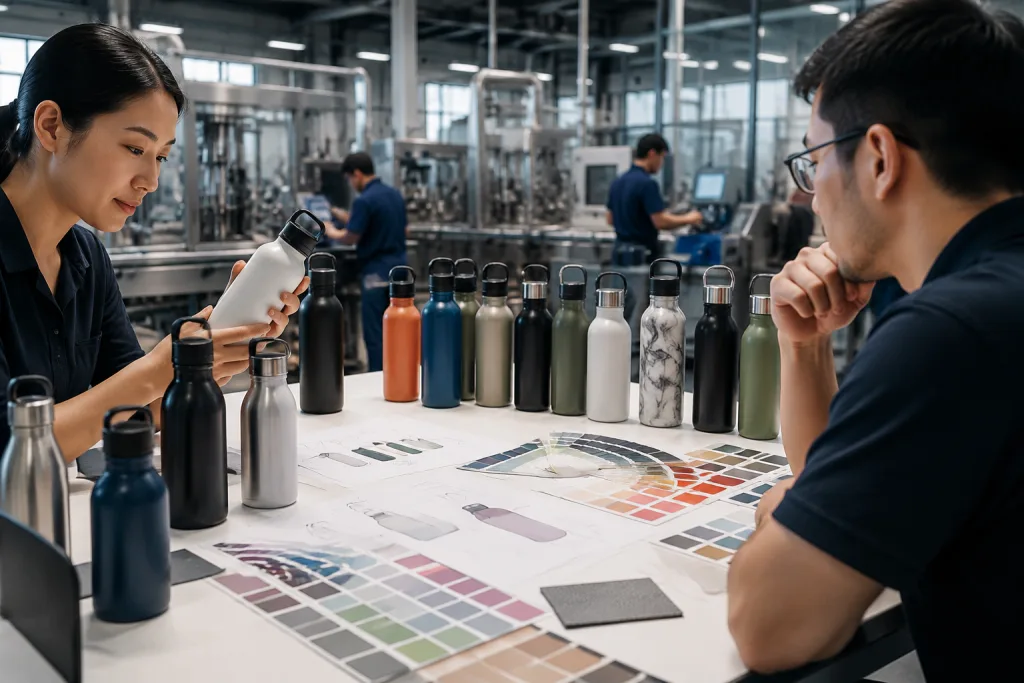
- Retail and e-commerce: 500 ml with matte powder coating, laser logo under 45 mm wide, white, black, or sand colorways that photograph cleanly
- Promotional: canteen promotional orders at 3,000 pcs MOQ, screen print, 1-color decoration, unit price kept tight for event budgets
- Sports and travel: flip lid with carry loop, 100% upside-down leak test on the line, 1.2 m drop test requested by stricter buyers
- Premium gifting: double-wall stainless, rigid gift box, engraved logo, 24-hour cold retention on select builds with pre-shipment test photos
If you need a customizable growler for beverage resale, check the closure and pressure tolerance first. A growler is not just a larger bottle; this is the wrong question to ask. It needs a tighter neck finish, stronger cap sealing, and carton protection that survives stacking at 12 kg per master carton. If you are buying from a canteen supplier in Zhejiang, ask for photos of the actual production line, not only the sample room with clean lights. We have seen a factory quote 200,000 units per month, then miss delivery because lid stock arrived 12 days late and the coating line could only finish 18,000 pcs per shift. For distributor drinkware programs, bottlenecks beat brochure language every time.
For a simple product mix, review stainless drinkware options and match the structure to your target shelf price first. We usually start with the carton size, target FOB, and one buyer pushback from the last PO, because the math does not work if the bottle looks good but ships with 30% empty carton space.
How much customization is too much?
The fastest way to burn margin is to customize every part. A custom canteen with a new body mold, dyed lid, two print locations, and a special gift box looks good on paper, then the tooling quote lands and the scrap rate starts talking. If the buyer only needs branding, we keep the body standard and put the money into the finish. That is how we get steadier yield and a cleaner reorder at 3,000 pcs, not 300.
For most B2B buyers, the clean order is:
- Lock capacity and lid style
- Pick one decoration method
- Approve one body color
- Check the carton drop test
- Run 300-500 pcs before the full PO
A laser-engraved canteen usually stays calmer than a fully printed curved bottle; the logo does not wear as fast, and color matching is less touchy. On the line, we see fewer rejects when the same cap fits 2-3 SKUs, and QC pulled that sample faster because the parts list stayed simple. If a distributor wants one bottle for three chains, one lid platform and a few body options make sense. Chasing a unique part for each chain is the wrong question to ask.
Do not pay for tooling if a standard mold already gives you 90% of the look. We have seen buyers spend on a new mold, then come back at 10,000 pcs and ask why the math does not work. A factory that ships B2B volume in Zhejiang will call that out before you sign.
For logo choices, compare print methods in silkscreen vs laser engraving before you freeze your artwork. We once caught a PO typo on the carton spec, and that saved a reprint run at 2,000 boxes.
What should your quote include?
A usable quotation is more than a unit price. If a supplier sends only one EXW number, this is the wrong question to ask: “Is this cheap?” You still do not know what is included. We quote the bottle body, lid, logo print, inner packing, sample fee, and lab test charge as separate lines, because QC will later check those against the PI and carton mark. Last month a buyer flagged a PO where “matte black” was typed as “matt black”; small typo, big risk on the coating line.
Ask for these line items every time:
- FOB or EXW price per piece
- MOQ by color and by logo version
- Sample lead time and sample charge
- Mass production lead time in days
- Carton spec, units per carton, and gross weight
- Test standards: leak, dishwasher, coating adhesion, and REACH if needed
For most export orders from China, the practical MOQ is 1,000 pcs for a simple one-color bottle and 3,000 pcs if you want several Pantone colors or mixed lids. A Zhejiang canteen manufacturer should tell you whether the order fits an open production window or needs a new slot. Ask directly. If the coating line is booked, a 30-day promise turns into 45 days after the powder booth schedule is checked. We’ve seen this go sideways when PP lids arrived 6 days late and the line had to switch to another SKU. Reliable canteen manufacturers confirm parts availability, mold status, and carton size before they confirm the ship date.
If you are not sure how MOQ affects your unit price, see MOQ explained for custom drinkware and compare your forecast to the factory’s minimum run. The math doesn’t work if your forecast is 600 pcs but the spray line needs 1,000 pcs to run one color without wasting powder.
What quality checks stop claims?
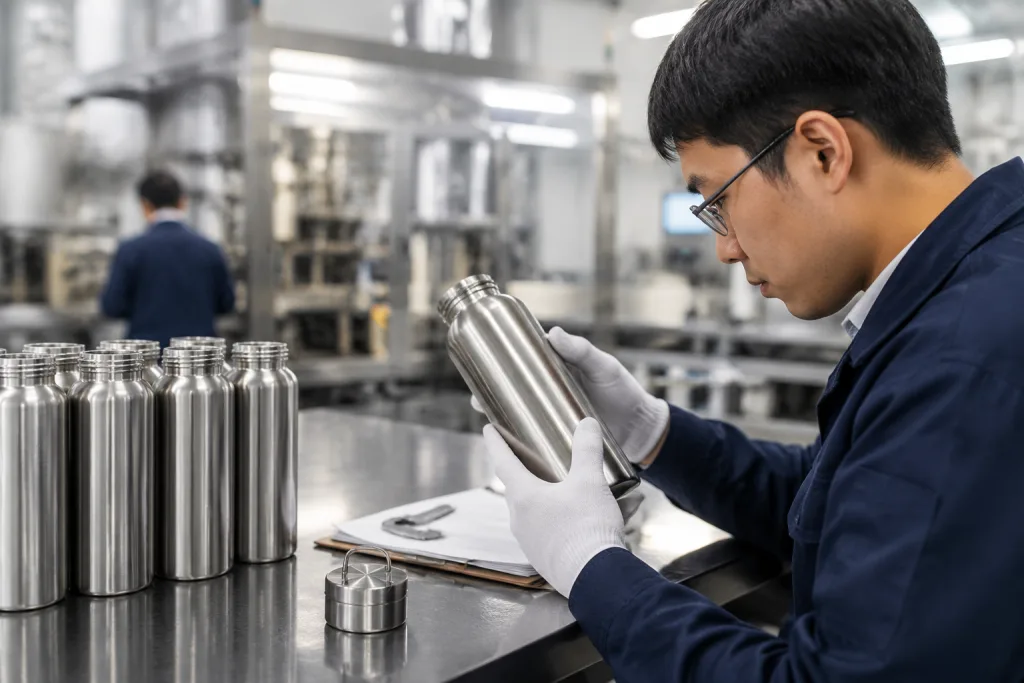
You do not need an in-house lab, but you do need inspection with names, dates, and photos. The leak should be caught at the water-pressure bench, not after retail packing is sealed. For water bottle custom orders, we ask for 2 pre-production samples, in-line checks at 30% production, and final random inspection before cartons close. If the supplier cannot show the inspection sheet, caliper readings, and leak-test photos, the quote is not complete.
At minimum, your checklist should include:
- AQL 2.5 for major defects and AQL 4.0 for minor defects, with the defect photos tied to carton numbers
- Leak testing on a sample from each carton or production lot, run with water filled to the neck and inverted for 30 minutes
- Cap torque and closure cycle checks, using a torque meter instead of “hand feel” from the operator
- Logo adhesion or rub testing after 24 hours cure time, especially for powder-coated bottles where ink can lift at the shoulder
- Material declaration for stainless steel, silicone, or plastic parts, matched against the PO and gasket color on the approved sample
For customized drinkware sold into the EU or North America, REACH, LFGB, FDA claims, and BPA-free statements need backup files. This is where buyers get caught. A sample passing one quick test does not prove the bulk order uses the same gasket, ink, or plastic straw. QC pulled the sample last month on a 304 stainless order and found the lid gasket changed from translucent silicone to white TPE without notice. A good canteen manufacturer keeps traceable records on gasket material and ink type. A better one knows which inks survive 500 dishwasher cycles and which ones belong only on hand-wash promo bottles. The difference shows up fast on a customized growler or a hot-fill bottle.
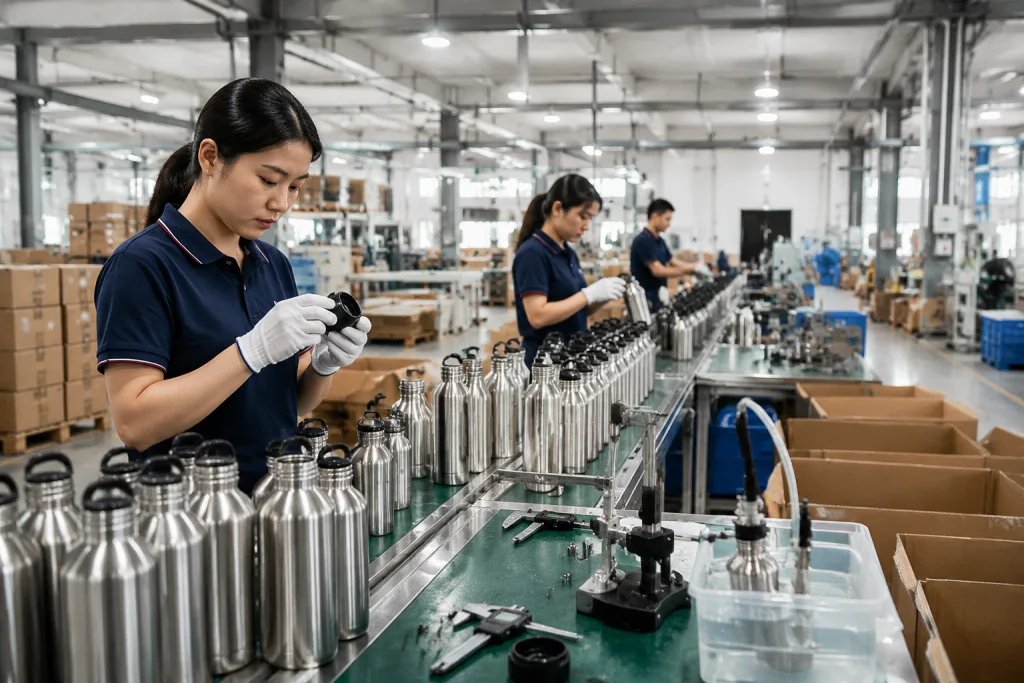
When you source from China, ask for actual inspection photos from the line in Zhejiang, not stock images from a showroom. We ship from Hangzhou, and real line photos show carton marks, workbench dust, torque meter readings, and the day’s production board. Pretty showroom photos do not tell you if the line is stable. We have seen this go sideways when a buyer approved a perfect sample, then flagged 6 leaking caps after arrival because no one checked the sealing ring during assembly.
How to buy from China with less risk
Buying from China gets risky when it is treated like a one-email order. Run it like a procurement job. First check factory fit: a Zhejiang canteen line shipping 200,000 units per month still means little if its lid tooling is 0.3 mm off your drawing, the powder coat fails the tape test, or the carton spec pushes freight above your target. We’ve seen this go sideways. Capacity without line control just creates faster mistakes.
Use this buying sequence:
- Shortlist 3 suppliers that already run your product type, not just similar bottles in a PDF catalog
- Send each one the same spec sheet, same AI logo file, and same packing request, then watch who spots the missing Pantone code
- Compare FOB, sample fee, mold cost, and lead time against the same MOQ, for example 3,000 pcs instead of one quote at 1,000 pcs and another at 5,000 pcs
- Check audit proof such as BSCI or ISO if your customer asks for it, and ask for the latest report date, not a cropped certificate photo
- Lock one golden sample and one written defect standard before mass production; QC should pull the sample at the line, not from a showroom shelf
For a canteen distributor or distributor drinkware buyer, the better supplier is the one that answers ugly questions without dancing around them. Can they hold the same color across 5,000 pcs using one powder batch? Can they replace a lid part in 7 days, not 18 days after the vessel leaves Ningbo? Can they pack a custom growler with a 5-layer export carton and PE bag so the shoulder does not scuff? If the answer sounds soft, your warehouse will inherit that problem. A practical canteen supplier will also push back when one customized canteen should be split into two SKUs; sometimes the math does not work on one overloaded line.
Use the factory’s actual capability list and shipping rhythm, not just the catalog. Ask what they ran last Tuesday: bottle size, finish, daily output, and the AQL finding if QC pulled a batch. That is how we avoid buying a clean sample from one bench and receiving a weak shipment from another.
Send your bottle brief today
We will confirm MOQ, lead time, and the right custom drinkware spec before you waste time on samples that cannot scale.
Frequently asked questions
What MOQ should I expect for water bottle custom orders?
For a standard water bottle custom run, expect 1,000-3,000 pcs MOQ depending on decoration and color. One-color silk screen on a stock body is usually the easiest entry point. If you want a custom lid, dual-color body, or specialty packaging, MOQ can move to 5,000 pcs. A good canteen factory in China should split the quote by body, lid, and print so you can see where the cost really sits. For repeat orders, the second run is usually faster and 3-8% cheaper because setup is already fixed.
How long does a custom drinkware order take from sample to shipment?
A typical custom drinkware order takes 7-14 days for samples and 25-45 days for mass production after sample approval. If the project needs new tooling, color matching, or a customized growler shape, add 15-25 days. In Zhejiang, experienced canteen manufacturers often shorten the wait if the lid and body already exist in stock. Freight timing is separate, so do not promise a shelf date until you have factory completion plus export booking. If you are hitting a seasonal launch, leave a 10-day buffer.
What is the safest decoration method for a custom canteen?
Laser engraving is usually the most stable for stainless steel because it does not depend on ink thickness or exact Pantone match. Silk screen is fine for one or two colors if the surface is flat and the cure time is controlled. UV print gives more color freedom but needs tighter abrasion checks. For canteen promotional orders, many buyers choose one-color print to protect margin. If you are making a canteen customizable product for premium retail, ask for rub testing after 24 hours and a second test after 72 hours.
How do I compare canteen suppliers in China fairly?
Compare them on the same spec sheet, same artwork, and same trade term. Ask for FOB price, sample fee, carton data, and test reports. Then check whether the canteen supplier can confirm AQL 2.5 inspection, leak test records, and material traceability. A canteen vendor with a low unit price but vague packing is usually more expensive once claims and rework are counted. If one supplier is in Zhejiang and another is elsewhere, that is fine, but the line item structure must still be identical before you compare.
Can a distributor buy mixed styles in one order?
Yes, but only if the parts platform is shared. A distributor canteen program can mix colors, logos, or box styles under one body mold to keep inventory under control. If you mix too many body shapes, the MOQ multiplies and the cost climbs fast. For distributor drinkware, I usually suggest one lid platform and 2-3 body variations maximum. That keeps reorders manageable and reduces packaging confusion in the warehouse. If you need a custom growler, keep it as a separate SKU because the neck and closure requirements are different.