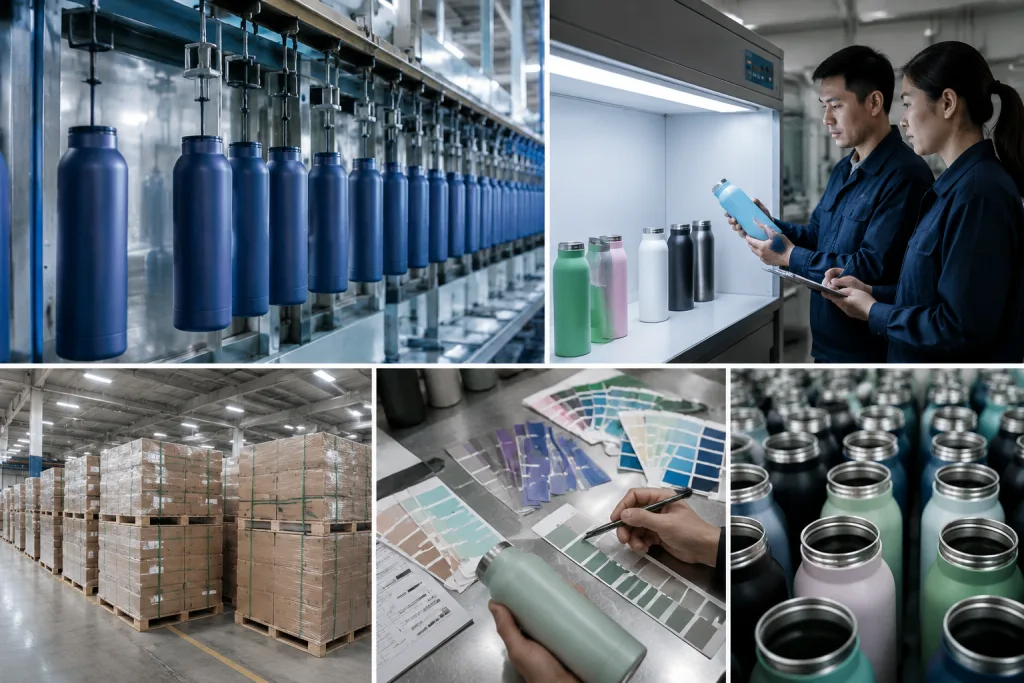
Key Takeaways
- Target ΔE under 2.0 for visible Pantone work on custom drinkware
- Lock one golden sample under D65 and TL84 before mass production
- Expect MOQ from 3,000 pcs and 25-35 day lead time for custom canteen runs
- Use AQL 2.5 for major defects and keep a sealed master sample for every reorder
Pantone looks simple until the first production run. The sample you sign off in the office can come back warmer, duller, or a bit muddy after it leaves the line. That is not a cosmetic issue. It means the substrate, coating, and curing cycle were never locked down for repeatable custom drinkware in China.
If you buy from a canteen factory, color name alone is not enough. You need a spec a canteen manufacturer can repeat batch after batch: exact Pantone reference, finish, gloss, tolerance, inspection light, and retained sample. Our Hangzhou, Zhejiang line runs 300,000 units per month, MOQ starts at 3,000 pieces, and lead times sit at 25-35 days, so we watch consistency harder than promises. QC pulled the sample under 6500K light last week, and the buyer flagged a 0.5 gloss shift on one lot. In Zhejiang, the factories that stay in business control the details.
The substrate is not neutral
I’ll rewrite the prose only, keep the HTML tags intact, and make it sound like a factory-side sales engineer. Next I’m producing a clean version with tighter, more concrete wording.The first failure mode is simple: you think Pantone is the color, but the substrate changes the result. Bare stainless, powder-coated stainless, PP, Tritan, and silicone bounce light in different ways. A deep blue on glossy powder coat can look nearly black on brushed metal, while the same Pantone on matte plastic reads softer and lighter. We see this on the line all the time. If you are buying a custom canteen or customizable drinkware, the factory cannot ignore that physics.
That is why a serious canteen supplier asks for more than a Pantone code. Start with the surface: glossy powder coat, satin powder coat, soft-touch finish, UV print, or wet spray. Then lock the color to that exact surface. If you want a red body with a white logo, say whether the white sits on the same coat or on a separate print pass. The buyer flagged this on a PO once, and the match still came out off by a half-shade. Otherwise, the canteen manufacturer may match the chip and miss the bottle.
Use this rule: one color, one substrate, one finish. If the bottle body is 304 stainless with a 0.6 mm wall and the cap is PP, do not expect both parts to age or reflect the same way. QC pulled the sample and the cap looked warmer under the same light box. A good canteen factory will tell you where the limits are before tooling starts.
The sample was approved in bad light
I’ll rewrite the section in-place, keep the HTML exactly as-is, and strip out the AI-ish phrasing while adding a few concrete factory-floor details.Second failure mode: the sample looked right because the room was forgiving. Office lamps run warm, windows throw daylight across the table, and buyers judge color from memory instead of a standard. That is how a canteen customized in Pantone 186 comes back as a softer red once it lands at your warehouse. If you want repeatable results, approve it under controlled light, not beside a laptop.
Ask the canteen supplier to compare samples in a D65 light cabinet, then check again under TL84 if you sell into retail channels. We keep one sealed golden sample, one production reference, and one signed approval sheet with the exact Pantone, gloss level, and finish. On our line, the buyer once flagged a PO typo on the color code, and that one digit turned into a full recheck. If you buy from a canteen vendor in China, have them label the retained sample with date, project code, and batch number. Without that, every reorder turns into an argument.
Practical target: agree on the color under D65, and define an acceptable deviation of ΔE < 2.0 for the final pieces. For premium custom drinkware, I would rather see ΔE 1.5 than a vague “close enough.”
This is where a lot of canteen distributors lose a week. They approve a nice hand sample, then the factory reproduces the process correctly but not the feel. The math does not work. Feel is not a spec, and QC pulled the sample on a 0.8 mm coating shift for a reason.

Decoration shifts the color story
I’ll keep the HTML structure intact and rewrite the prose to sound like a factory-side sales engineer, with tighter, more concrete language. Then I’ll return only the cleaned HTML.The third failure mode is decoration. We’ve seen a bottle body hit Pantone dead on, then the logo print, laser mark, or overmold shifts the whole read. A white logo on a dark shell does more than add contrast; it lifts the perceived brightness. On coated stainless, laser engraving can cut through to a lighter underlayer and leave a patchy halo. If you are ordering a custom growler, custom canteen, or customized growler for retail, treat the decoration method as part of the color spec.
Silkscreen, heat transfer, pad print, UV print, and laser engraving all behave differently on the line. A heavier ink deposit can cover a small body drift; a thin laser mark shows it fast. That is why we point buyers to silkscreen vs laser engraving before they lock the order. If the design has two colors, ask for a printed proof with real Pantone chips in hand, not a PDF on a monitor. The buyer flagged a “match” once from a laptop screen; QC pulled the sample and it was off by a mile.
- For dark bodies, ask for an underbase if the logo has to stay bright.
- For metallic finishes, confirm whether the logo goes before or after clear coat; 0.2 mm makes a difference.
- For soft-touch surfaces, ask whether the ink survives 50 wash cycles; we’ve seen that claim fall apart in-house.
In practice, a canteen manufacturer that handles custom drinkware well will tell you when laser is safer and when print is safer. Take that advice. It saves the 2nd reorder and the PO typo that turns a matte black run into a mixed batch.
Small process drift becomes a big batch
I’ll rewrite the section in-place, keep the HTML tags untouched, and tighten the copy so it sounds like a factory-side sales engineer.The fourth failure mode is process drift. A sample can look spot-on because one operator loaded the powder 3% heavier, the oven sat at 6°C lower, or the line moved slower for that shift. In mass production, that luck is gone. We run 10,000 bottles on the same Pantone, and the hard part is holding the shade, not matching one hero sample. In Zhejiang, the better plants track powder lot, cure time, and line speed; the weak ones just say “looks close” and hope the buyer won’t notice.
Ask for controls a real bottle line can defend: powder batch number, cure temperature window, line speed, and inspection frequency. For coated stainless, we expect the oven to stay within ±5°C of the target cure curve. For plastic parts, the masterbatch lot should be logged and the shade checked every 2-3 hours; QC pulled the sample on our last run and found a 1.2 ΔE shift after a hopper change. If the supplier cannot show that data, the math doesn’t work — they are selling hope, not repeatable customized drinkware.
When you inspect, use AQL 2.5 for major defects and 4.0 for minor ones, then mark color as a major defect if it exceeds the agreed ΔE. That forces the distributor and the factory to speak the same language. We’ve seen this go sideways on a PO typo where the buyer wrote Pantone 186 C as 186 U, and the rework added 12 days. The next reorder is where most buyers get burned.
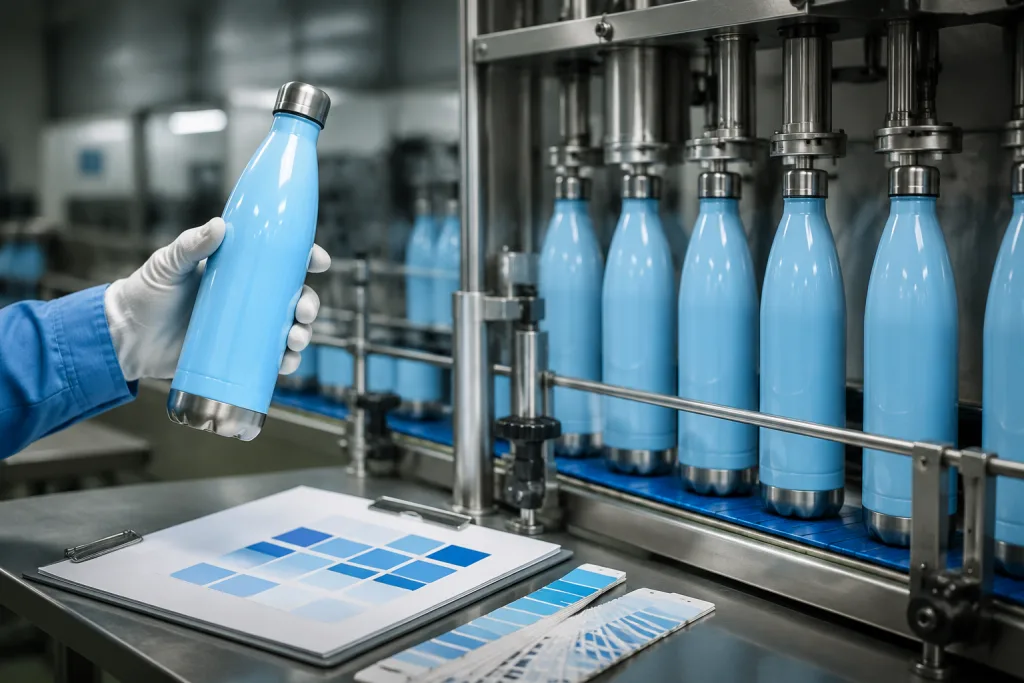
Your spec sheet must block excuses
I’ll rewrite the prose in place, keep the HTML structure intact, and tighten it so it sounds like a buyer-side spec note from the factory floor.The failure usually starts in the PO, not on the line. If the spec sheet is loose, every miss gets argued later. A real custom canteen order should read like a control sheet, not a mood board. Call out the exact Pantone code, finish, gloss level, artwork method, packaging, test standard, and acceptance tolerance. We’ve had a buyer flag a 0.8 mm cap mismatch because the drawing only said “close fit.” For a distributor drinkware buyer, this is how you keep repeat orders steady across seasons and sales channels.
At minimum, lock these fields:
- Pantone reference and acceptable ΔE
- Surface finish: gloss, satin, or matte
- Material: 304 stainless, 18/8 stainless, PP, Tritan, or silicone
- Testing: REACH, FDA, LFGB, ISO 9001, and any drop or dishwasher requirement
- Packaging: polybag, egg-crate, insert card, and carton drop test standard
If you sell a canteen promotional line, keep the same bottle family and change only color or logo. That is the right math for a custom drinkware program; changing the mold every season blows up cost and timing. On our side, QC pulled the sample into the color cabinet and matched against a D65 light box before sign-off. For a distributor canteen program, ask the canteen supplier to archive one master sample for each SKU and each reorder. If they also offer custom logo decoration options and you need planning help, review MOQ guidance for custom drinkware before you issue the PO. The buyer who writes the spec wins the color game.
Send your Pantone, get a real production plan
Share the color code, finish, and target quantity. We will spec the bottle, confirm the tolerance, and keep the reorder process clean.
Frequently asked questions
Can a factory match Pantone exactly on a water bottle?
Not always, and you should not expect it on every substrate. On powder-coated stainless, a strong match is usually realistic, but on brushed metal, translucent plastic, or textured silicone, the same Pantone can read differently. A good target for custom drinkware is ΔE under 2.0, with premium programs aiming closer to 1.5. Ask for one golden sample made on the same production line, under the same finish, and approved under D65 lighting. If the canteen manufacturer promises exact visual identity without mentioning substrate and gloss, that is a warning sign, not a capability statement.
What is a reasonable MOQ for custom Pantone bottles?
For most Pantone-controlled runs, 3,000 pieces is a realistic starting point in China. Some canteen suppliers will quote 1,000-2,000 pieces, but color consistency and setup cost usually get worse at that level. If you need multiple colors, expect each Pantone to behave like a separate SKU, which can push the MOQ up. For a canteen factory in Zhejiang with stable coating lines, 25-35 days is a normal lead time after sample approval. If the supplier can make 300,000 units per month, you still need to reserve production time early for seasonal distributor canteen programs.
Should I use silk screen or laser engraving for Pantone bottles?
If the logo must stay sharp and high-contrast on a colored body, silk screen is usually the safer route because it gives you ink coverage and a controllable color layer. Laser engraving is cleaner for premium metal looks, but it reveals the base material and can change how the body color is perceived. For customized drinkware with a strict brand color, the body Pantone and the decoration method should be approved together. Ask for actual production proofs, not digital mockups. If the canteen vendor cannot show how the mark behaves on the real finish, you are still in guesswork mode.
How do I control color across repeat orders?
Keep a sealed master sample, a signed approval sheet, and the exact process data from the first run. That means Pantone code, finish, gloss, coating type, curing temperature, and decoration method. On repeat orders, ask the canteen manufacturer to reference the same retained sample before production starts. For larger programs, request batch records and spot checks every 2-3 hours. If you work with a canteen distributor, make sure the reorder spec is copied exactly, not rewritten from memory. Most color drift on repeat business is caused by weak documentation, not by the factory suddenly forgetting how to spray.
What tests should I ask for on custom canteen orders?
Start with material compliance: REACH for Europe, FDA for the US, and LFGB if you need stricter food-contact proof. Then add the practical checks: adhesion test, dishwasher resistance if needed, drop test, and carton compression if you ship by the pallet. For color work, define the lighting condition, the acceptable ΔE, and whether major defects follow AQL 2.5. If the item is a custom growler or decorative canteen promotional product, also ask how the finish holds after repeated wash cycles. A polished sample means little if the coating fails after 30 dishwasher runs.