Key Takeaways
- Stainless steel bottles usually start at 3,000 units MOQ with 35-45 day lead time in Zhejiang factories.
- For retail margin, a $2.20-$4.80 FOB band is realistic for many custom drinkware programs, depending on material and finish.
- Laser engraving is cleaner for premium canteen customized orders; screen print is cheaper for canteen promotional runs.
- AQL 2.5/4.0 inspection, REACH, and food-contact compliance should be checked before you confirm PO.
When you buy water bottle custom made programs for retail, events, or private label, the real call is not “which bottle looks nice.” It is whether the bottle survives a 1.2 m drop, prints cleanly on the line, clears compliance, and still leaves margin after freight and duty. We have seen buyers fall in love with a render, then the sample scuffs in transit and the math breaks. That is the wrong place to start.
At BottleForge in Zhejiang, we see the same pattern every week: brand owners want a premium hand-feel, distributors want pricing they can repeat, and procurement wants no surprises on PO 45021. A canteen factory in China can run 3,000-unit MOQ on some lines, 35- to 45-day lead time, and 300,000 units per month capacity, but a 0.3 mm wall change or a bad logo file can still slow the launch. So the real question is which custom drinkware format fits your channel, your decoration method, and your target FOB. QC pulled the sample on that last point.
Spec table first, not slogans
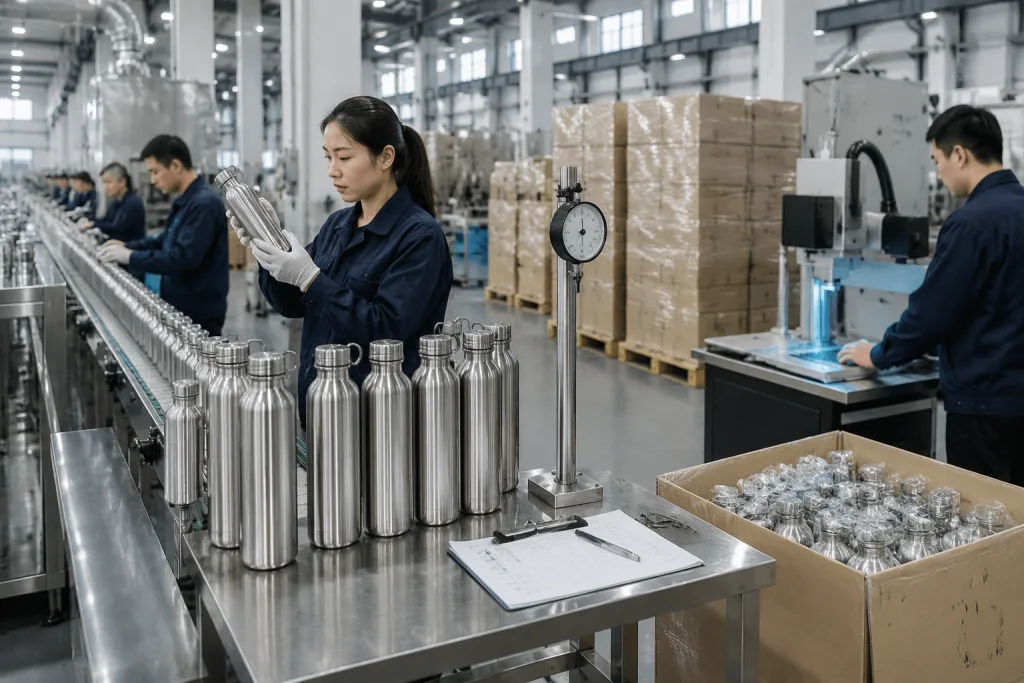
If you are comparing water bottle custom made options, put the spec table first and skip the sales copy. The same shape can behave differently once you line up wall thickness, lid type, print method, and carton packout. On our line, QC checks wall thickness with a caliper before we release the sample, because a bottle that looks clean online can still fail in transit or print with haze. A cheap-looking bottle can work well for distributor orders if it ships flat and the logo stays sharp. A premium-looking one can turn into a headache when the coating chips or the lid leaks after 5,000 cycles.
| Format | Best use case | Typical MOQ | Typical FOB | Lead time |
|---|---|---|---|---|
| Stainless steel insulated bottle | Retail shelves, corporate gifting, premium canteen orders | 3,000 pcs | $3.20-$6.80 | 35-45 days |
| Single-wall aluminum bottle | Promo campaigns, sports accounts | 5,000 pcs | $1.10-$2.30 | 25-35 days |
| Tritan / copolyester bottle | Gym, outdoor, family channels | 3,000 pcs | $2.00-$4.20 | 30-40 days |
| Glass bottle with sleeve | Wellness shops, café programs, lifestyle retail | 2,000 pcs | $1.80-$3.90 | 30-40 days |
This is where a lot of buyers overpay. They start by asking for the most customizable drinkware shape, and the math does not work. We usually push back and lock the use case first: shelf display, promo giveaway, or daily carry. In Zhejiang, the buyer flagged a PO typo on decoration height once, and we burned two days resetting the silk-screen jig. That tells you whether the canteen manufacturer should chase insulation or impact resistance, and whether the unit price needs to sit under a promo budget. It also tells your canteen supplier whether to push a molded logo for long runs or silk screen for faster color work. If the numbers miss the channel, the design is the wrong place to start.
Stainless, aluminum, Tritan, or glass
I’ll rewrite the section in place, keep the HTML structure unchanged, and tighten the sales language so it reads like a factory-side buyer guide.The choice between stainless steel, aluminum, Tritan, and glass comes down to durability, unit cost, and how the bottle will be judged on shelf. For most B2B buyers, stainless steel is the safest pick if you need a premium custom canteen or customized growler program that will survive real use. An 18/8 stainless body with 0.5 mm to 0.6 mm wall thickness and double-wall vacuum construction gives better heat retention and a stronger retail story, but it also pushes up landed cost. We run this check on the line with a caliper, and the math does not work if the buyer wants retail-grade finish at promo pricing.
Use-case fit
- Stainless steel: best for premium retail, offices, and distributor canteen programs where margin can absorb higher freight and carton weight.
- Aluminum: good for canteen promotional campaigns when unit cost matters more than insulation.
- Tritan: a solid choice for lightweight custom drinkware and family-friendly bottles; check food-contact claims carefully.
- Glass: works for premium shelf appeal, but it needs stronger packaging and a lower damage tolerance.
If you are a canteen distributor, stainless can still be the better commercial choice even with a higher FOB. We’ve seen this go sideways with cheap alternatives: fewer returns, less denting, and better perceived value usually win. For a canteen vendor serving sports clubs, aluminum or Tritan may move faster because the product price stays accessible. A canteen factory in China will often offer the same cap platform across several bodies, which helps control parts cost. Ask for part commonality. QC pulled the sample, and one PO typo on the cap code once cost us a week.
Lids, coatings, and decoration
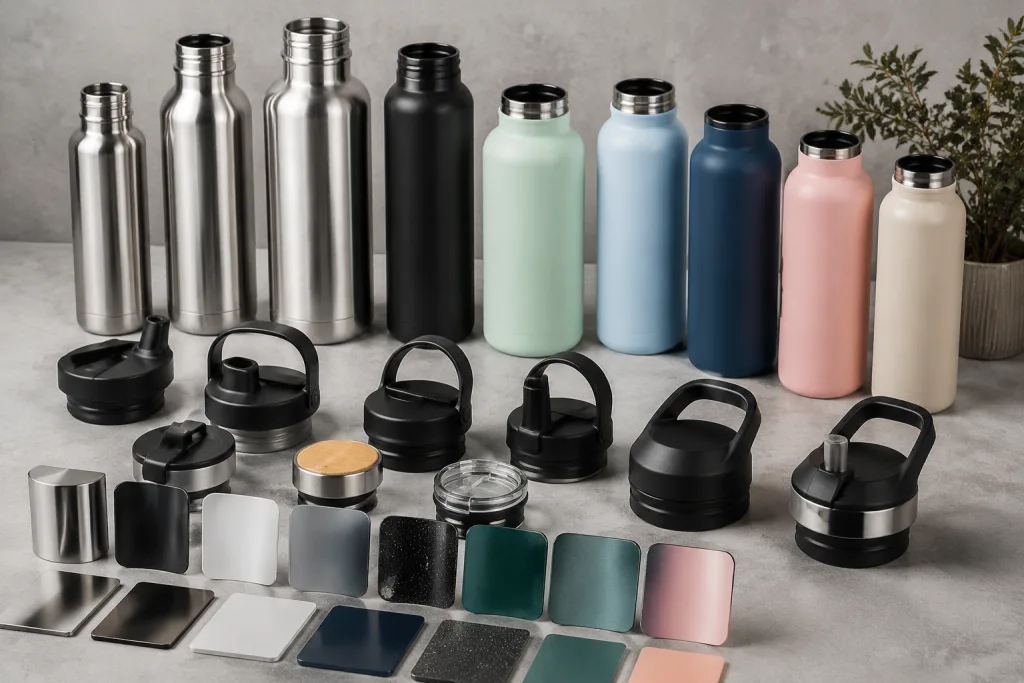
I’ll rewrite the section in place, keeping the HTML tags and structure unchanged while stripping the AI-ish phrasing and adding a few factory-floor specifics.Most sourcing mistakes happen at the top of the bottle, not the body. The lid drives leak risk, user complaints, and pack-out pain. A screw-on PP lid is cheap and steady, but a flip lid or straw lid can add $0.20 to $0.90 per unit once you count tooling and assembly. For canteen customized programs, that gap can push you into a different retail band.
Decoration changes the math too. Silk screen is still the workhorse for canteen promotional orders because it runs fast and stays cheap on the line. Laser engraving costs more, but on stainless steel it gives the cleanest premium finish. Powder coating helps grip and scratch resistance, yet we ask for a cross-hatch adhesion test and salt spray data if the bottle will move through cartons and trucks for weeks. On a Zhejiang canteen manufacturer line, coating consistency is a QC issue, not a beauty issue. We want a sample from the same line, not a hand-finished showroom piece.
Practical rule: if decoration is more than 8% of your FOB cost, the artwork is probably overbuilt for the channel.
That rule saves cash on custom canteen, customizable canteen, and customized canteen jobs where the buyer asks for five colors, four print positions, and a logo the size of half the bottle. We’ve seen that go sideways more than once.
MOQ and pricing by channel
I’ll rewrite the prose for a sharper B2B sales-engineer tone, keep the HTML and table structure intact, and preserve the existing numbers/specs.MOQ has to fit the way you sell. A distributor moving pallet stock through wholesale accounts does not buy like a DTC brand testing a new bottle. Add three colors, two lid types, and a gift box, and the MOQ goes up fast because we run extra line changeovers and tie up component stock. On the Hangzhou floor, the clean price usually comes from fewer SKUs and one carton spec.
| Channel | Recommended spec | MOQ logic | Target FOB |
|---|---|---|---|
| Retail / Amazon | Stainless steel vacuum bottle | 3,000-5,000 pcs per color | $3.80-$6.50 |
| Promotional | Single-wall aluminum or Tritan | 5,000-10,000 pcs | $1.10-$2.80 |
| Distributor stock | Repeatable lid + body platform | 2,000-3,000 pcs per SKU | $2.20-$4.20 |
| Corporate gifting | Laser-engraved stainless | 3,000 pcs | $4.00-$7.20 |
For a canteen supplier, the wrong question is “What is your cheapest bottle?” The buyer should ask, “What does the repeat order cost after we lock the spec?” We saw a PO go sideways once because the lid code changed by one digit and the carton size shifted 8 mm; QC pulled the sample and the margin disappeared. If the first order is a custom canteen promotion and the second order is distributor replenishment, keep the same cap and the same carton. That is how you hold margin. A Zhejiang line can repeat that well if the buyer stops changing details every round.
Compliance and test points
I’ll rewrite the section in-place, keep the HTML exactly as-is, and tighten the language so it sounds like a real factory-side buyer note.Compliance is where buyers lose days. A bottle can look clean on the shelf and still fail on packaging, coating, or the material claim. For Europe and North America, ask for food-contact declarations, REACH evidence, and test reports tied to FDA or the right ASTM method. If the bottle has a straw, lid seal, or powder coating, list each part in the test scope. We had one PO that said “lid included” and the buyer flagged it because the seal material was never named.
The factory side matters just as much. At BottleForge, we run the line with documented inspection steps and final checks set to AQL 2.5 for major defects and 4.0 for minor defects on common drinkware orders. That does not save a bad design. It does keep shipment risk under control. A good canteen factory should show incoming inspection, in-process checks, and final packing controls. If they cannot, you are buying hope, not supply. QC pulled one sample last week with a 0.3 mm lid gap; that is the kind of miss that turns into a return.
- Request material certificates for stainless, PP, Tritan, and silicone parts.
- Confirm carton drop-test expectations if you ship FBA or long-distance retail.
- Ask whether the print will survive 50+ wash cycles or if hand-wash only applies.
- Check whether the lid gasket is replaceable; that affects warranty claims.
These points are not theory. A canteen vendor in China that skips them can wipe out a 12% margin with one bad lot, and we have seen that go sideways fast.

Which custom canteen wins
I’ll rewrite the prose in-place, keep the HTML exactly as-is, and tune the wording to sound like a real sales engineer. No structure changes.The best call depends on what you sell, not what looks good in a sample room. If you want shelf appeal and repeat use, stainless steel usually wins. If you need a cheap giveaway, aluminum or basic Tritan does the job. If you’re selling to café or wellness retail, glass can work, but you pay for heavier cartons and tighter packing. That is the real game for water bottle custom made sourcing: match the spec to the channel.
For a custom growler or customizable growler program, stainless with a wide mouth and leak-resistant lid is usually the safest route. We ran a 64 mm mouth sample last month, and QC pulled the lid twice because the gasket sat 0.5 mm off. For a custom canteen in outdoor retail, impact resistance and shoulder shape matter more than fancy decoration. For a customizable canteen aimed at distributors, one body, two lid options, and one packing standard keeps the reorder path clean. A strong canteen manufacturer in China should tell you why one spec wins instead of trying to push every SKU as a premium one.
My view is plain: pick the spec that protects repeat orders. A one-off hero sample is easy. A scalable canteen customized line with stable QC, sensible MOQ, and clean decoration is what pays the bills in Zhejiang factories and in your market.
Source your custom bottle with real specs
Send your target price, capacity, and channel. We’ll match you with a practical custom drinkware spec from Zhejiang, not a guess.
Frequently asked questions
What MOQ should I expect for water bottle custom made orders?
For standard stainless steel custom drinkware, 3,000 pieces per SKU is common in China, especially in Zhejiang. Promotional aluminum bottles can go to 5,000 or even 10,000 pieces because setup is simpler. If you need multiple colors, lids, or gift boxes, the MOQ rises fast. A practical rule: every extra variable can add 500 to 1,000 pieces to the workable order size. If a canteen supplier promises very low MOQ with many custom parts, check whether the price and lead time are real or just a sample quote.
What is a realistic FOB price for a custom canteen?
For a basic canteen promotional bottle, $1.10-$2.30 FOB is realistic. For a stainless vacuum canteen customized for retail, $3.20-$6.80 FOB is more typical depending on capacity, coating, and decoration. Laser engraving usually adds less than full-color print if the logo is simple, but the body material changes the base cost more than the logo does. Ask for pricing by component so you can compare canteen manufacturers on the same basis, not on a bundled number that hides the real cost drivers.
How long does production usually take in China?
For a stocked or simple custom canteen, 25-35 days is common. For insulated stainless bottle programs with new artwork or special lids, 35-45 days is more realistic. If tooling or new molds are needed, add 15-25 days before mass production. In Zhejiang, a canteen factory with strong scheduling can hold to the quoted window, but only if you approve artwork, packaging, and testing quickly. Delay on your side usually costs more time than the plant itself.
Which decoration method is best for canteen customized orders?
Laser engraving is the cleanest option for premium stainless drinkware because it does not rely on ink adhesion. Silk screen is better for canteen promotional orders where price matters and the logo is simple. UV print can work for colorful branding, but it needs more care on abrasion and washing. If your bottle will be used daily, ask for a rub test and wash-cycle guidance. A canteen manufacturer should tell you the expected logo life in cycles, not just show a pretty sample.
How do I choose between a canteen supplier and a canteen distributor?
If you need a fully custom shape, exact packaging, or compliance paperwork, go directly to a canteen manufacturer or a factory-backed supplier. If you need fast stock rotation, a canteen distributor can be useful, but custom options are usually narrower and pricing is less transparent. For B2B drinkware, direct factory sourcing in China usually gives better control on MOQ, carton spec, and repeat orders. Use distributors when speed matters more than customization depth.