Key Takeaways
- A realistic water bottle bulk price can shift by 12% to 30% once you specify 304 steel, gasket grade, print method, and AQL 1.5.
- For a Zhejiang factory running 600,000 units/month, MOQ is often 3,000 pcs and lead time is 30 to 45 days after sample approval.
- Most leaks come from the cap, thread, or gasket, not the bottle body; specify 100% leak testing for critical SKUs.
- Packaging and freight can add USD 0.18 to USD 0.65 per unit, so compare FOB quotes only after carton, test, and label details are fixed.
The fastest way to overpay on water bottle bulk price is to chase the lowest unit cost on the quote sheet. We’ve seen a USD 0.18 “saving” disappear after QC pulled the sample and found a 0.38 mm wall instead of the 0.45 mm spec, lids with loose threads, and 5-layer cartons that crushed under a 12 kg stack test. Cheap is easy. By the time the cartons reach your warehouse, the real bill is returns, repacking labor, and a buyer asking why the bottle dents after one drop.
If you buy drinkware wholesale, think like the guy standing beside the line, not a catalog shopper. In Zhejiang factories, a stable quote usually comes down to written specs: 304 stainless, wall thickness in mm, powder coating target, silicone gasket hardness, leak-test method, and packout drawing. That applies to a stainless bottle, bulk canteen, bulk growler, or alcohol flask wholesale bulk program. The wrong question is “what is your best price?” We ask what can fail first, then we price the bottle that survives AQL 2.5 inspection and the buyer’s warehouse handling.
Why Cheap Quotes Break First
Most buyers ask for a water bottle bulk price, get three numbers, and compare them as if the bottles were the same. They are not. One quote may cover 18/8 stainless steel, a 0.5 mm body, laser logo, and individual polybags. Another may switch to 201 steel, thinner walls, offset printing, and a low-grade cap gasket. On paper the gap looks small. On the line, that turns into a leak claim or a dented body, and QC pulled the sample with a caliper in under 2 minutes.
The cost stack is plain: material, tooling, labor, surface finish, testing, packaging, and inland freight. If a supplier in Zhejiang gives you a very low FOB China price, ask what they cut. Usually it is inspection time, coating thickness, or carton strength. We ship 600,000 units a month, and we still see bad goods when the RFQ is sloppy. That is the wrong question to ask.
- Ask for BOM detail: steel grade, lid material, gasket material, and finish.
- Lock the test standard: AQL 1.5 for critical dimensions, leak test on every lot.
- Compare like for like: same capacity, same print, same box count, same carton spec.
If you source drinkware wholesale, drinkware bulk, or wholesale drinkware for multiple channels, build the quote around a signed sample, not a photo. We had a buyer flag a PO typo last month, 500 ml written as 50 ml, and the carton spec had to be reissued before the line could run. That one sheet saves more money than chasing the lowest unit price.
Leaks Start At The Lid
For stainless bottles, the failure we see most is not the cup body. It’s the lid. A cap can pass a quick desk check and still leak because the thread pitch is off by 0.2 mm, the silicone gasket is too soft, or the injection gate leaves a 0.3 mm burr near the drinking port. We had QC pull 32 samples from a 3,000 pcs pilot run last month; 5 leaked after the bottle sat upside down for 20 minutes. That is where bulk canteen and canteen wholesale orders get expensive. One weak cap design can turn 8,000 units into replacement stock. The same risk hits wholesale canteen, canteen bulk, and bulk drinkware programs using travel lids or screw caps.
Spec the closure like a bought-in safety part. Ask for the gasket material, usually food-grade silicone at 50 to 60 Shore A, not “rubber” written on a PO with no grade. For vacuum bottles, confirm the neck seal width in mm and check the inner weld line under a borescope or strong inspection lamp. We run a water leak test and torque check before mass production; for thermal bottles, we also check heat retention against the approved sample after 6 hours. If a supplier cannot show these records, the math doesn’t work. Your water bottle bulk price is just hiding risk in the lid.
What to tighten in your RFQ
- Leak test: 100% for premium SKUs, or at minimum AQL 1.5 sampling, with bottles inverted for 20 minutes after cap assembly.
- Thread fit: no wobble, no cross-threading, and no visible flash; ask the line to check with a go/no-go thread gauge, not just by hand feel.
- Cap cycle: at least 5,000 open-close cycles for reusable products, then QC should inspect gasket compression and hinge whitening.
Cheap lids are the fastest way to turn a good bottle into a return.
This hits harder on wholesale drinkware sold under your brand. The customer blames your logo, not the gasket supplier in Ningbo. We’ve seen this go sideways when a buyer saved USD 0.06 on a flip lid and spent 12 days sorting claims instead of shipping the next replenishment order.
Coatings Fail Under Real Use
Surface finish is where buyers lose control of cost fast. Powder coating, spray paint, UV print, and rubberized coating each move the final water bottle bulk price by about USD 0.08 to 0.45 in the quotes we run. A cheap offer often means 35 μm powder on the bottle body; it passes the photo sample, then chips after 6 dishwasher cycles or rubs through when cartons shift 12 mm on a loose pallet. We have seen this go sideways. If the item sits in retail, one dent on the shelf can stop the buyer from reordering.
Specify coating thickness and adhesion, not just Pantone color. For powder coat, 60 to 80 μm is a practical commercial range, and QC should check it with a coating thickness gauge before packing. For premium retail drinkware wholesale programs, ask for cross-hatch adhesion testing and a minimum salt spray result if the bottle will sit in humid storage or ship to coastal markets. For logos, silkscreen is not always the cheaper answer after returns. If the print must survive rubbing, laser engraving or a two-pass screen print is often the better buy; QC pulled one sample last month where a one-pass white logo lost edges after 200 rubs with a cotton cloth. This is why 8 out of 10 serious brands define the use case before they lock custom logo work.
For beer tumbler bulk, beer tumbler in bulk, or beer tumbler wholesale bulk orders, coating matters because condensation and ice water expose weak finishes within days. For alcohol flask bulk and alcohol flask in bulk, the surface has to handle pockets, bags, and point-of-sale trays; the buyer flagged scratches on a black flask sample after only 3 loose pieces were carried together in a carton insert. In Zhejiang, a good factory will match the coating method to the sales channel, not just copy the color chip. The math doesn't work otherwise.
Format Choice Changes The Price
We do not price every bottle the same way. A straight water bottle, a bulk growler, and a beer growler wholesale program stress different parts of the line. Growlers need thicker walls, stronger necks, and cleaner welds because the opening is wide and the carry load climbs fast. Alcohol flasks need a cap that seals, odor control, and a finish that will not chip after repeated handling. Canteen and flask shapes look simple from the outside, but the forming tolerance is tighter than most buyers expect.
If you are comparing bulk growler, growler wholesale, growler bulk, beer growler bulk, beer growler in bulk, or beer growler wholesale bulk quotes, ask for wall thickness and carry-test data, not just a low number. For a 64 oz growler, 0.5 mm 304 stainless is a safer baseline than a vague "food-grade steel" note. On one run, QC pulled the sample and the buyer flagged a loose cap after 200 open-close cycles. For an alcohol flask wholesale program, a 0.4 to 0.5 mm body with a tight cap and gasket beats a shiny finish every time. The math does not work if the supplier shaves structure to win the water bottle bulk price.
The same logic applies to bulk canteen, wholesale canteen, and wholesale canteen SKUs sold as promotional items. If the job is outdoor use or gifting, buyers care more about dent resistance and lid reliability than a 3% price cut. We have seen this go sideways when a 1.2 mm dent on the body turned into a rejection at packing. On the floor, that kind of issue shows up fast.
Packaging Quietly Changes Landed Cost
Packaging is where 7 out of 10 first-time buyers get burned. The bottle quote looks fine, then the supplier adds inner boxes, dividers, shrink film, carton labels, pallet wrap, and export checks. That is not padding in most cases. We have seen a 1 m drop test save a shipment of coated bottles from dents, and a weak carton can wipe out the savings from a cheap factory price.
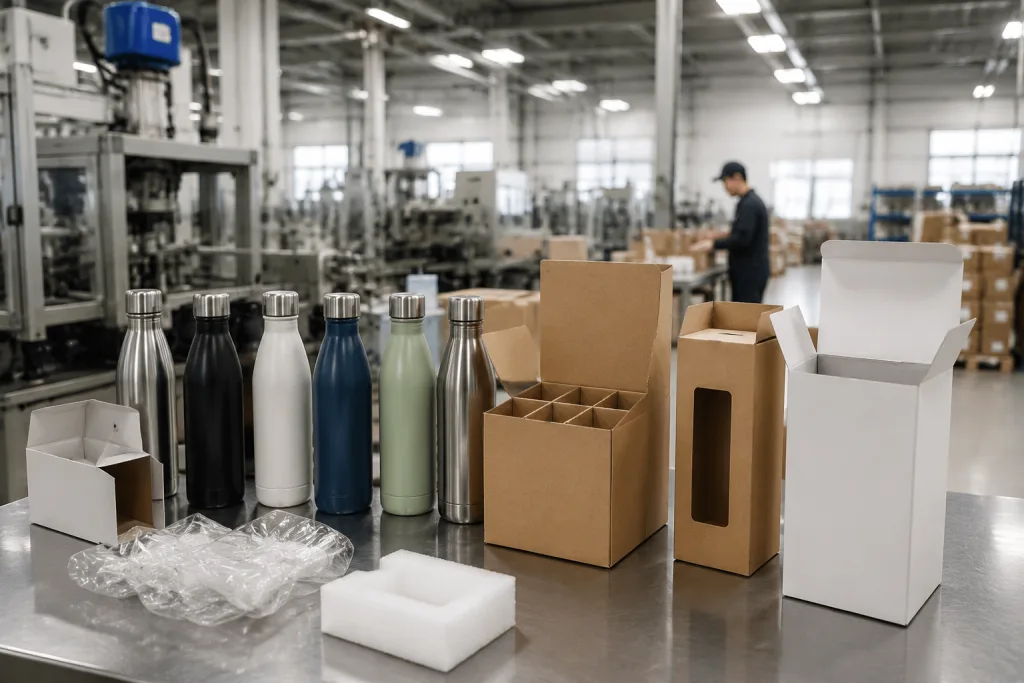
Ask for carton construction, not just carton size. A real export pack for wholesale drinkware usually needs a 5-ply outer carton, partitions for glass or coated surfaces, and a box that passes a 1 m drop test. If you sell on Amazon, add FNSKU labels, suffocation warnings where required, and pallet specs before mass production. This is the wrong question to ask after production starts. The line will already be running, and relabeling 12,000 units is nobody’s idea of a good week.
- Carton spec: 5-ply, with burst or ECT rating written on the PO.
- Packout: unit pack, inner pack, master carton, pallet count, and carton weight in kg.
- Moisture control: desiccant when the route goes through humid ports like Shenzhen in summer.
For drinkware wholesale and drinkware bulk orders moving through China export channels, the packaging line belongs in the quote from day one. QC pulled the sample, checked the carton corners, and one PO typo on carton count has already delayed a buyer by 5 days. Without that line item, your landed cost is fiction.
Build A Quote That Survives China
Send an RFQ to a Zhejiang factory and skip the words "best price". That phrase causes trouble. Ask for a controlled quote: capacity in ml, 304 stainless or other steel grade, powder coating thickness, lid style, logo method, sample approval step, AQL standard, carton count, and Incoterms. Last month we saw a PO typo change “matte black” to “matt black,” and QC pulled the sample because the finish did not match the signed color chip. If the supplier sends back one number with no breakdown, you do not have a commercial offer. You have a guess.
A solid sourcing file should include a golden sample, target tolerance on capacity and weight, and a written change-control rule. Capacity tolerance of ±5% is normal on 18 oz and 32 oz drinkware SKUs, but do not let the line change it without your approval. We run most custom bottle jobs at 3,000 pcs MOQ per design, with 30 to 45 days after pre-production sample sign-off; if someone offers 18 days instead of 35 days, ask which step is being skipped. The math often does not work. Check the caliper readings, carton drop-test notes, and packed weight before you compare unit prices.
The same discipline works across categories. Stainless bottle, canteen wholesale lot, alcohol flask wholesale bulk order—the quote should read like a manufacturing spec, not a sales flyer. We have seen this go sideways when the buyer only chased the lowest water bottle bulk price and forgot to define leak rate, coating scratch limit, or lid torque. Define the failure modes first. Then the factory can price the right product and we ship fewer surprises.
Get a clean quote, not a guess
Send your target spec and we’ll map the water bottle bulk price against materials, QC, and packaging so you can buy with fewer surprises.
Frequently asked questions
What drives water bottle bulk price the most?
Material and closure quality usually move the price first. A 304 stainless bottle with a proper silicone gasket and laser logo can be 12% to 25% higher than a thinner, lower-grade build. Packaging adds another USD 0.18 to USD 0.65 per unit depending on carton style, inner box, and palletization. If you are comparing FOB China offers, make sure the capacity, wall thickness, coating, and print method are identical. A supplier in Zhejiang can quote a very low number by changing just one hidden variable, so ask for a full BOM and a signed sample before you compare.
What MOQ should I expect from a China factory?
For standard stainless bottles, MOQ is often 3,000 pcs per color or design. For more complex bulk growler or custom-logo programs, 5,000 pcs is common if tooling changes are needed. A Zhejiang factory with around 600,000 units per month output may still keep MOQ high on new molds because setup time matters more than raw capacity. If you need mixed SKUs, ask whether the factory allows shared carton art or shared lid components. That can reduce the buy-in without weakening the product spec.
How do I avoid leak problems in wholesale drinkware?
Put the lid and gasket in the spec, not just the bottle body. Ask for gasket material, torque range, thread tolerance, and a leak test method. For premium retail orders, many buyers require 100% leak testing before packing. At minimum, use AQL 1.5 sampling and keep a golden sample signed by both sides. If you buy canteen wholesale, wholesale canteen, or bulk drinkware for outdoor use, demand a tilt test and an upside-down hold test. Most failures start at the closure, not the steel shell.
Which product is best for the lowest wholesale unit cost?
The simplest straight-wall bottle usually gives the lowest unit price, but only if you keep the print and packaging simple. A budget canteen or basic drinkware wholesale item will price lower than a growler wholesale or alcohol flask wholesale bulk order because the geometry is simpler and the cap system is less demanding. Still, the lowest sticker price is not always the best wholesale drink bottle if it creates returns. If the market is retail or corporate gifting, spend the extra USD 0.20 to USD 0.40 on coating and carton strength.
How long does production usually take?
For a normal stainless bottle order, expect 30 to 45 days after sample approval. If you need new tooling, special coating, or a custom lid, add 10 to 20 days. Shipping from China to Europe or North America adds more time depending on route and season. Do not promise retail launch dates until you confirm production, packing, and freight separately. In Zhejiang, faster schedules are possible, but only if the factory already has the same mold, same steel, and same print method in place.