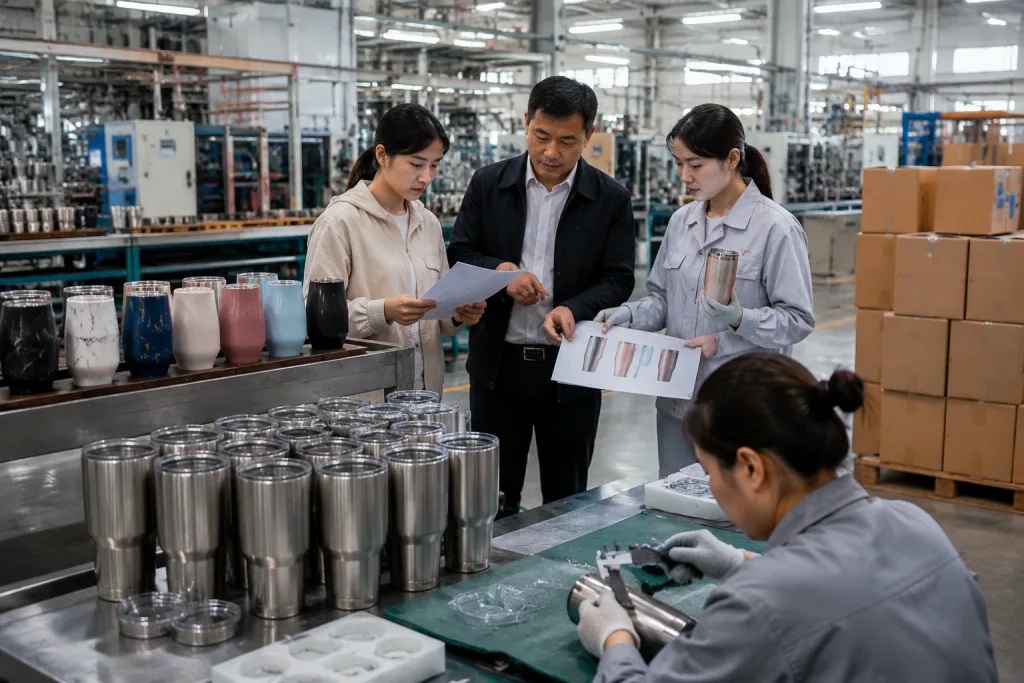
Key Takeaways
- Start RFQs with capacity, steel grade, wall thickness, finish, logo method, MOQ, and target FOB price
- A realistic custom wine tumbler sample cycle is 7-12 days after artwork approval
- Bulk orders should lock AQL level, carton marks, barcode files, spare parts, and shipment terms before deposit
- BottleForge monthly capacity is about 600,000 stainless drinkware units with 1,000 pcs MOQ for standard wine tumbler bodies
A vendors wine tumbler order looks simple until the RFQ turns into 18 unclear emails: capacity, lid fit, powder coat color, logo method, carton marks, barcode stickers, and who pays when samples fail. This is the wrong question to ask after the quote lands. QC pulled the sample, checked the lid gap with calipers, and the buyer still found the PO had two different capacities on it. If you are buying for retail, events, or distributor drinkware programs, vague specs cost more than a higher unit price.
At BottleForge Industrial in Hangzhou, Zhejiang, we see the same pattern from new buyers in Europe and North America. We run the line with the same issue every week: the factory can make the tumbler, but the order only works when China production, inspection, and shipping are all reading the same numbers. A carton mark typo or a missing barcode spec can hold up a 5,000-unit run fast. Use the process below as a practical PO-building path, not a brochure.
Build the RFQ like a PO
Your RFQ should read like the first draft of a purchase order, not a loose “best price” message. A vendors wine tumbler inquiry that says only “12 oz, logo, need best price” usually gets a safety quote, maybe off by USD 0.18-0.35 per pc once the real lid, coating, and carton details show up. We see this weekly. A solid canteen supplier or tumbler factory will either fill in the blanks or send back 6 questions. Both cost time; last month one buyer lost 4 working days because the PO later changed “black” to “Pantone 426C matte powder coat.”
For a 12 oz stainless wine tumbler, state the body shape, lid type, insulation target, stainless grade, finish, logo method, packaging, target market, and test requirements. Be specific. If you need REACH or LFGB food-contact support for Europe, say it at RFQ stage so the factory can check coating powder, silicone ring, and lab slot before quoting. If the order ships to the US, mention FDA food-contact expectations and whether ASTM-style labeling applies to your channel. QC pulled one sample here with a 0.32 mm inner wall against a requested 0.4 mm spec; that small gap changes both cost and buyer trust.
A clean RFQ line item can look like this: 12 oz double-wall stainless wine tumbler, 304 inner / 201 outer, 0.4 mm inner wall, clear sliding lid, matte powder coat, 1-color silkscreen logo, individual white box, 24 pcs master carton, FOB Ningbo, target 3,000 pcs. That gives China production planners something measurable. The line can check welding, vacuum test time, coating rack fit, carton CBM, and MOQ in one pass. No guessing.
If you also buy canteen custom or custom growler products, keep those as separate RFQ lines. Do not combine a wine tumbler, customizable canteen, and customized growler into one blended price; the math does not work. Different molds, lids, packing sizes, and inspection points change the cost. A canteen manufacturer may quote one price range, while a wine tumbler line uses different tooling and coating racks. We run growlers on wider fixtures, and the buyer flagged it once when a “same finish” request produced a 2 mm color band near the base after curing.
At this step, your draft PO should already include: SKU name, capacity, material, finish, decoration, packaging, MOQ, Incoterm, requested delivery date, and compliance documents. You can revise later, but every missing item becomes a negotiation after the supplier has already anchored the price. We have seen this go sideways over small details, like “gift box” typed as “white box” on the PO or 12 days requested when the coating line needed 18 days. Better to write the RFQ like money is already attached.
Price the real specification
The cheapest quote is cheap for a reason: the supplier priced a thinner cup or a simpler build. For vendors wine tumbler programs, 0.32 mm versus 0.40 mm stainless wall thickness changes the hand feel, and QC will see the dents after the 80 cm drop check on the rubber mat. A basic push lid also prices differently from a sliding AS lid; we have had buyers flag 14 lid complaints in one 3,000 pcs promo run when the lid spec was left vague.
For reference, a typical FOB Ningbo price for a 12 oz double-wall stainless wine tumbler from Zhejiang, China may sit around USD 2.10-3.40 at 3,000 pcs, depending on finish, logo, lid, and carton. Powder coating costs more than plain paint, but it survives the cross-hatch tape test better on the line. Laser engraving is clean and durable. On dark powder coat, QC pulled the sample under a D65 light box because the logo looked gray, not silver, and the buyer wanted stronger contrast before bulk.
Ask each canteen vendor or tumbler supplier to split the price into the parts that change the real cost. Body shell, lid set, surface finish, logo process, retail packaging, lab testing, barcode labeling, and inland freight should not sit inside one lazy “unit price” line if you are comparing serious quotes. We see this go sideways with canteen distributors and distributor growler programs when margin is 8-12% and the buyer changes the SKU carton after the PO is typed.
Your price comparison table should include these PO line items:
- Base product: capacity in oz or ml, steel grade such as 304 stainless, insulation structure, lid type with material, and body weight in grams.
- Decoration: silkscreen with color count, laser engraving size, heat transfer artwork coverage, or full-wrap print with seam tolerance.
- Packaging: polybag thickness, kraft box or color box paper weight, insert card size, and master carton strength for export stacking.
- Compliance: REACH, LFGB, FDA food-contact declaration, BPA-free lid material, and the exact test report name your retailer asks for.
- Logistics: FOB port, carton dimensions in cm, gross weight in kg, and pallet option if your warehouse rejects loose cartons.
Do not push for a final price before these details are fixed. A canteen factory or tumbler line can tighten the number once the specification is real. If you force a target price first, the math does not work; the factory will cut cost from the coating, the carton, the lid, or the inspection plan. We once saw a PO typo change “0.40 mm” to “0.30 mm,” and the buyer only caught it after the pre-production sample felt too light.
Lock artwork before sampling
Sampling is where custom drinkware jobs lose 14 days fast. We make the sample, the buyer flags the logo as 3 mm too tall, the brand team changes PMS 7494C to PMS sage green, then purchasing asks why ship date moved from May 12 to May 26. Treat sample approval like a controlled production step, with its own PO line items and one named approver.
For a vendors wine tumbler sample, send vector artwork in AI, EPS, or PDF format. Include Pantone Coated references for printed logos and a separate note for body color. If you want a matte sage green powder coat, do not write “green.” That note is how jobs go sideways. Use a Pantone target or send a physical swatch by DHL. Powder coat and plastic lid colors will not match 100% because the resin, coating thickness, and surface gloss read differently under a D65 light box. A normal acceptable visual tolerance is roughly Delta E 1.5-2.5 for controlled coating, but most promo buyers we ship for still sign a physical color sample instead of paying for lab readings.
Sample PO line items should list sample quantity, decoration method, body color, lid color, packing mockup, sample charge, courier account, and approval deadline. Add the print area in mm too; QC pulled one wine tumbler sample last month because the PO said 55 mm logo height while the artwork proof showed 48 mm. For standard bodies, BottleForge usually needs 7-12 days for decorated samples after artwork confirmation. New mold or special lid development can take 25-40 days before you see a first sample.
If your program includes a canteen customizable set, customized canteen, or customizable growler in the same seasonal range, approve each product separately. This is the wrong place to save one approval round. A logo that looks balanced on a wine tumbler can look undersized by 8-12 mm on a custom canteen or custom growler. Cylindrical products also stretch wrap artwork near the curve, so ask for a digital placement proof and print area size in millimeters before the line burns screens.
Do not approve samples by photo alone if the finish matters. Photos hide orange peel, thin laser marks, lid looseness, and 1 mm dents near the bottom seam. For orders above 5,000 pcs, approve at least one physical golden sample and keep one signed duplicate at the factory in China; we tape the signed card to the sample box so incoming QC has something real to check against.

Write bulk PO terms clearly
The bulk PO is where sourcing turns into work orders on the line. Your supplier should not dig through 17 email replies to confirm lid type, barcode position, or carton mark. Put it in the PO. QC pulled a wine tumbler sample last month with the barcode 8 mm too low because the buyer approved it in WeChat but never added it to the PO. This protects you, and it protects the canteen manufacturer or wine tumbler factory from accidental changes.
A strong bulk PO for vendors wine tumbler orders should include SKU code, product description, approved sample reference, quantity, unit price, total amount, payment terms, Incoterm, delivery date, inspection standard, packaging specification, and required documents. Don’t leave “as discussed” anywhere. We run new B2B buyers on 30% deposit and 70% before shipment in most cases, with the balance paid after pre-shipment photos or inspection booking. For larger distributor drinkware programs with 3 clean orders and no payment delay, terms can be discussed, but the math doesn’t work on open credit for a first container.
MOQ matters. BottleForge’s MOQ for standard wine tumbler bodies is 1,000 pcs per color, with practical pricing usually improving at 3,000 pcs and 5,000 pcs. For a canteen promotional order, MOQ can change by body size and decoration method. A stock-color canteen with laser logo is easier to schedule than a custom-matched powder coat at 1,000 pcs, because the powder room loses time cleaning the spray gun and booth between colors. A customized growler with special cap or handle can require higher MOQ because accessories are purchased in batches, often 2,000–3,000 sets per hardware run.
Your PO line items should not say only “customizable drinkware.” Use exact product names: 12 oz wine tumbler, 20 oz travel tumbler, 32 oz custom canteen, 64 oz distributor growler. If you are a canteen distributor managing multiple customer logos, create one line per logo and per carton mark. Simple rule. One logo, one line. We’ve seen this go sideways when a PO listed 4 logos under one SKU, then the packing team mixed 96 pcs of Logo B into cartons marked for Logo A.
Define overrun and underrun tolerance. For stainless drinkware, ±3% is common on some promotional orders, but retail programs often require exact quantities. If exact quantity matters because FNSKU labels or retailer routing are fixed, write “no overrun without written approval.” The buyer flagged this on a 2,400 pcs order after Amazon labels were printed, and the extra 72 pcs had nowhere to go.
Control production before inspection
Inspection should not be your first quality control step. By the time AQL inspectors arrive, the factory has already coated the bodies, printed the logo, packed the inner boxes, and taped the master cartons with a 48 mm BOPP gun. Too late. If the logo sits 8 mm too low on 8,000 pcs, the inspection report only puts a stamp on an expensive rework bill.
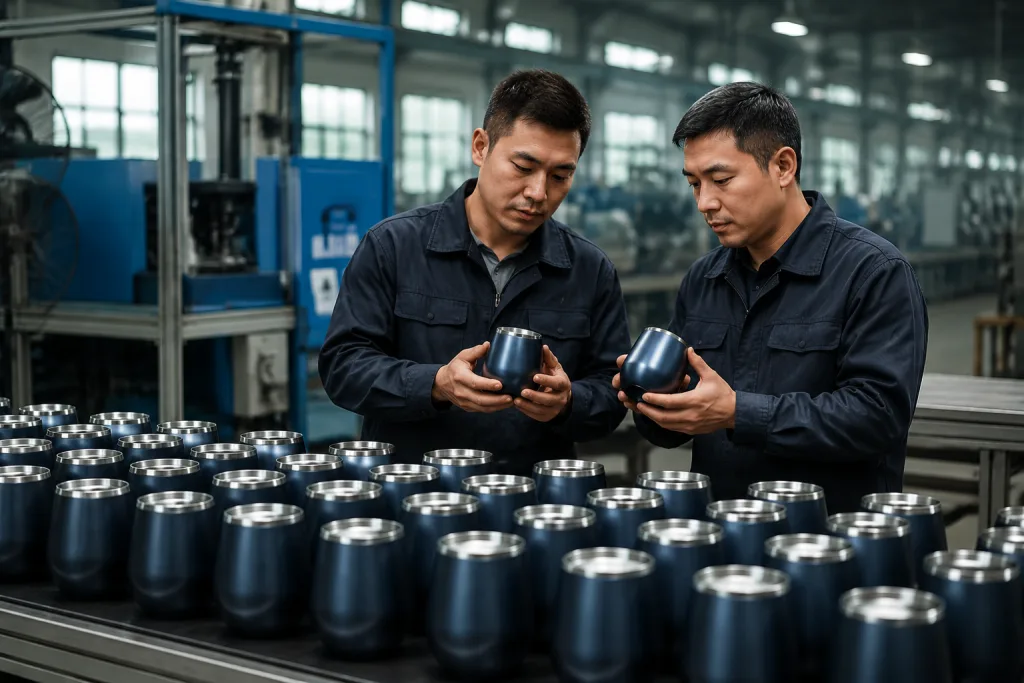
Ask for a pre-production sample made from bulk materials before mass production starts. The sales sample does not count. The PP sample should use the confirmed 304 stainless steel coil, the same powder code from the coating room, the actual silk screen mesh or laser power setting, the bulk lid, and the export packing. For a vendors wine tumbler order, sign off lid fit with a go/no-go check, mouth rim polish by hand feel, vacuum performance after the 24-hour hot water test, coating appearance under a light box, and logo location measured from the rim in mm before the line runs.
A practical control plan needs three gates, not one last-minute inspection. Start with incoming material checks for stainless sheets, lids, silicone rings, and 5-layer cartons; our QC pulled one carton lot last May because the flute collapsed under a 12 kg stack test. Then check in-line after forming, vacuuming, coating, and decoration, with the inspector standing near the conveyor instead of waiting in the sample room. Final random inspection still matters, based on AQL. B2B buyers often set AQL 2.5 for major defects and 4.0 for minor defects, with critical defects at 0. For food-contact drinkware, critical issues include sharp edges, oil marks inside the cup, severe leakage, and wrong material.
BottleForge production capacity is about 600,000 stainless drinkware units per month across wine tumblers, sports bottles, canteen products, and growlers. Capacity helps, but this is the wrong question to ask if the coating line is already booked. Peak season before Q4 can fill coating and printing lines 30-45 days ahead. We have seen September orders go sideways when a buyer approved a complex custom color, then pushed for a 15-day bulk lead time after the powder supplier gave us 7 days just for matching. If your canteen suppliers promise 15-day bulk lead time during September for a complex custom color order, ask which line number is open, how many workers run that shift, and whether your job is before or after the next 20,000 pcs bottle order.
Whether you source from a canteen factory in Zhejiang or another region of China, require production photos at fixed points: raw body after polishing, coated body before logo, decorated body with a ruler beside the print, packed inner box, and sealed master carton with shipping mark visible. Simple habit. It catches errors before they become container-level mistakes, like the PO typo we once saw where “matte black” became “matte blank” and QC flagged it before 320 cartons were sealed.
Prepare cartons for your channel
Packaging is not a decoration add-on; we treat it as part of the product spec. A vendors wine tumbler for corporate gifting can ship in a 350 gsm kraft tuck box. A retail SKU usually needs a color box, hang tag, warning label, UPC, FNSKU, suffocation warning on polybags, and carton marks that match the routing guide line by line. The buyer flagged this twice last year because the FNSKU was 4 mm too close to the box seam. If you sell through marketplace fulfillment, carton dimensions and label placement matter as much as the tumbler.
For Amazon-style FBA prep, confirm the individual barcode type, scannable size, country of origin marking, carton weight limit, and whether each unit needs an insert card. We run a 10-scan check with a Zebra scanner before mass packing; if QC pulled the sample and the code reads only 7 out of 10 times, the line stops. For North American wholesale, you may need “Made in China” on the product, box, or both depending on your customs broker’s advice. For Europe, check packaging waste rules and local language text before printing 10,000 boxes.
PO line items for packing should list inner box material, box artwork version, master carton ply, pieces per carton, carton dimensions, gross weight, shipping mark, pallet requirement, barcode file name, and spare carton percentage. A 24 pcs master carton for 12 oz tumblers is common, but this is the wrong question to ask if your retailer caps cartons at 13.6 kg. The math doesn’t work with thick color boxes. Keep cartons under 15 kg when manual handling is expected, and ask the factory to weigh a packed sample carton on a platform scale before sealing 600 cartons.
If you are buying a canteen promotional range, use the same carton logic across custom canteen, customizable canteen, and customized canteen SKUs. Warehouse staff should not need to decode five mark formats at 6 a.m. on a receiving dock. For distributor canteen or distributor drinkware orders, add the customer PO number and SKU on at least two carton sides; we usually print 80 mm-high side marks so they stay readable after pallet wrap. If you split shipment by customer, the packing list must match carton sequence exactly.
Do not let the supplier create carton marks at the last minute. Send a template. We’ve seen this go sideways over one typo on a PO: “WT-12BK” became “WT-12KB,” and QC caught it only after 180 master cartons were taped. A good canteen vendor will follow your template; a busy factory shipping 20 containers that week will otherwise use its standard format.
Ship only after documents match
Before balance payment, check the goods against the inspection report and export documents line by line. Boring job. Still, this is where we catch the problems that turn into customs holds or warehouse arguments. For a vendors wine tumbler order, the commercial invoice must match the PO product name, quantity, unit price, Incoterm, and currency. Last month QC pulled a sample from carton 18 and the PO said “12oz matte black,” while the carton mark said “350ml black powder coated.” That typo would have followed the shipment all the way to the buyer’s 3PL. The packing list also needs to match carton count, gross weight, net weight, and dimensions in cm. If the shipment includes custom growler or canteen manufacturer SKUs, split them into separate lines so the receiving team does not count 24-carton mixed pallets by hand.
For FOB Ningbo or FOB Shanghai shipments, confirm the forwarder booking at least 7 days before the cargo ready date. We ship through Ningbo often because trucking from Hangzhou to Ningbo port usually runs 3.5 to 4.5 hours, while Shanghai can eat a full day if the G60 traffic is bad. Zhejiang factories often ship through Ningbo because inland trucking is efficient from Hangzhou, Yongkang, and nearby drinkware clusters. If your forwarder changes the vessel closing time from Friday 16:00 to Thursday 11:00, the factory needs notice before cartons leave the warehouse. Once the line has wrapped pallets with 18 kg cartons and the forklift has loaded the truck, the math does not work.
Common pre-shipment PO line items include final inspection release, balance payment trigger, export carton photos, HS code confirmation, commercial invoice, packing list, bill of lading instructions, certificate of origin if required, and test reports. This list is too long to leave in email chat. Put it on the PO. For custom drinkware, also request the final artwork file and production photos for your internal records, including one close photo of the logo at 30 cm and one full-carton photo showing the shipping mark. We had a buyer flag two matte black finishes after six months because one reorder used PMS Black 6C artwork and the older file was named only “black logo final.ai.” Production photos saved that discussion from turning into a claim.
If you work with multiple canteen manufacturers, canteen vendors, or canteen distributors, standardize the document checklist. One supplier may run clean welding and polishing but send sloppy paperwork. Another may send perfect documents with inspection photos so vague that you cannot see the rim, lid thread, or silicone ring. We see this go sideways when a buyer uses 4 suppliers and each one names the same 20oz tumbler differently on the invoice. Your job is to cut that variation before it reaches your warehouse, not after your receiving clerk opens 60 cartons with a box cutter.
The reorder should be easier than the first order. Keep the approved sample number, PO, inspection report, carton mark, and artwork version in one folder. Add the lid spec too: slider lid, straw lid, or press-fit lid changes the carton layout fast. When you come back for 5,000 pcs of the same wine tumbler or add a distributor growler to the range, your canteen suppliers in China can quote faster and make fewer assumptions. We run reorders faster when the buyer sends sample tag A-2411, artwork V3, and carton size 52 x 36 x 29 cm instead of saying “same as last time.”
Send your wine tumbler RFQ for factory review
Share capacity, logo files, quantity, packing, and target delivery date. We will return a practical FOB quote and sample plan.
Frequently asked questions
What MOQ should I expect for vendors wine tumbler orders?
For standard stainless wine tumbler bodies, a realistic MOQ is 1,000 pcs per color at BottleForge. Pricing becomes more efficient around 3,000 pcs because coating, logo setup, carton printing, and QC time spread over more units. If you need a custom Pantone powder coat, special lid color, or retail color box, MOQ may rise to 2,000-3,000 pcs. For mixed-logo distributor drinkware orders, we can sometimes keep the body MOQ at 1,000 pcs but require separate logo setup charges for each design.
How long does a custom wine tumbler order take from sample to shipment?
For an existing 12 oz or 14 oz wine tumbler body, sample production usually takes 7-12 days after artwork and color approval. Bulk production is typically 25-35 days after deposit and signed pre-production sample. Add 5-10 days if you need printed color boxes, complex full-wrap decoration, or third-party testing. New mold work is different: expect 25-40 days for tooling and first sample before bulk timing even starts. During Q4 peak season, confirm line availability before issuing the PO.
Which logo method is best for a wine tumbler?
For B2B custom drinkware, laser engraving is the most durable option and works well on powder-coated stainless bodies. It usually costs around USD 0.10-0.25 per logo depending on size and production quantity. Silkscreen is better for solid brand colors and lower cost, but it can scratch if the coating or ink system is poor. Heat transfer and full-wrap printing are useful for colorful retail artwork, though setup cost and defect risk are higher. Always approve a physical sample before bulk.
Can one supplier handle wine tumblers, canteens, and growlers?
Yes, if the supplier has the right production network and QC system. BottleForge handles wine tumblers, custom canteen lines, sports bottles, and customized growler programs from Zhejiang, China. The important point is to quote each product separately. A canteen factory may use different forming equipment, caps, silicone seals, and carton sizes than a wine tumbler line. If you combine all items into one vague “customizable drinkware” request, you will get weak pricing and unclear lead times.
What quality standard should I put on the PO?
Use a written AQL standard. A common setup is critical defects 0, major defects AQL 2.5, and minor defects AQL 4.0 under ANSI/ASQ Z1.4 or ISO 2859 sampling. Define critical defects clearly: sharp edges, leakage, wrong material, contamination, broken lid, unreadable barcode, and wrong logo. Add functional checks such as vacuum insulation, lid fit, coating adhesion, and carton drop condition if relevant. The PO should state whether inspection happens before balance payment and who pays for reinspection if the first inspection fails.