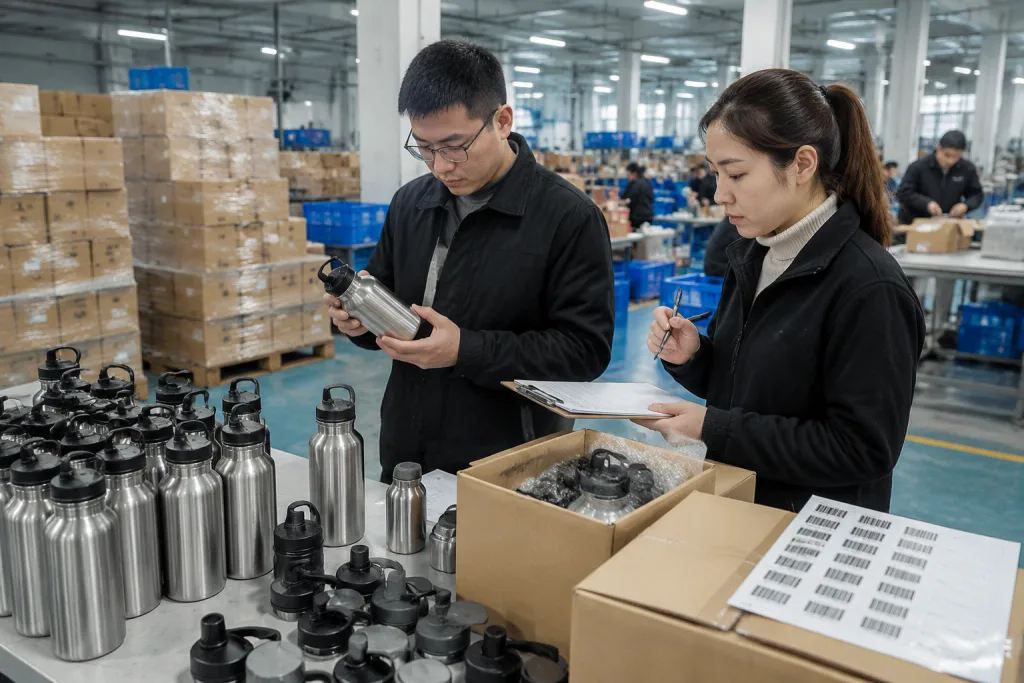
Key Takeaways
- A usable RFQ for vendors water bottles should include 8 line items: capacity, material, lid, logo, color, packaging, carton spec, and target market.
- A low unit price means little if tooling, setup, and test fees add 15-30% after the quote.
- For custom canteen samples, expect 1-3 pieces, 7 days, and another 3-5 days for courier transit.
- A PO should lock product code, AQL 2.5/4.0, carton marks, and the exact FOB port before bulk production starts.
If you buy vendors water bottles for a brand, chain, or distribution business, finding a supplier is the easy part. Getting 3 quotes that match is where orders get messy. One seller prices only the bottle, one buries logo cost in a setup line, and one gives a cheap number that changes after your team asks for inner boxes, export cartons, drop test, or FDA paperwork. We saw this last month on a PO where the buyer wrote “matte black” in the email but “gloss black” on the artwork sheet; QC pulled the sample before mass production, which saved 3,000 wrong bottles.
Serious buyers treat custom drinkware as a sourcing job, not a catalog click. In Zhejiang, China, a good canteen factory should ask the same questions your own team asks: capacity in ml, material grade, logo process, lid structure, packing method, and 90-day forecast. At our Hangzhou facility, we run 120,000 units a month, with MOQ 500 pcs per SKU, sample lead time around 7 days, and bulk lead time of 20-35 days. The line checks mouth diameter with a digital caliper before lid fitting, because a 0.3 mm miss can turn into leakage complaints. Ask for that level of detail before money changes hands. If a quote skips it, the math doesn't work.
Start with a quote buyers can compare
The first step is not asking for a price. That is the wrong question to ask first. Start with an RFQ a canteen supplier can quote without filling in blanks. If your email says "need custom drinkware for retail," we have to guess the body size, lid, print area, carton pack, and test market; last month QC pulled a 750 ml sample that measured 742 ml to the fill line, and that 8 ml gap changed the buyer's label claim. Send a clean brief, and you can compare canteen manufacturers on the same basis instead of sorting through 6 quotes built on 6 different assumptions.
Your RFQ should cover the product and the commercial side. Keep it tight. We run faster when the spec sheet matches the drawing:
- Capacity: 500 ml for promo runs, 750 ml for outdoor retail, or 1 L for gym and travel channels
- Material: 18/8 stainless steel for vacuum bottles, Tritan for clear bodies, or aluminum for lightweight promo canteens
- Construction: single wall for low-cost orders, double wall for better hand feel, or vacuum insulated when the buyer needs a 6-hour heat claim
- Lid: screw cap with silicone ring, sports cap with push-pull nozzle, bamboo lid with laser logo, or loop lid for carabiner use
- Decoration: silkscreen for 1-2 color logos, laser engraving for stainless steel, UV print for full-color marks, or wrap print when the artwork crosses the seam
- Packaging: bulk pack at 24 pcs per carton, gift box for retail shelf, or e-commerce mailer for drop-test handling
- Target market: EU with LFGB wording, US with FDA wording, or both if the same SKU must pass two document checks
- Incoterm: EXW for buyer-arranged pickup, FOB Ningbo for our usual loading route, or FOB Shanghai when your forwarder consolidates there
In Zhejiang, China, a reliable canteen factory will answer faster when you show the spec. We ship from this region every week, and the line manager can check a 0.5 mm wall-thickness callout on a digital caliper before sales promises anything. That is how you filter out canteen distributors who only relay catalog data. If your brand needs a canteen custom order, a customizable canteen, or a customized growler for beverage retail, the RFQ is where you stop a product from becoming a headache. We've seen this go sideways over a missing carton mark.
Read pricing as landed cost
Unit price is just one line on the quote sheet. We read it as landed cost. A USD 2.10 bottle looks fine until the buyer adds USD 45 logo screen charge, USD 80 sample courier, 0.6 mm retail box board, master carton printing, and an SGS or Intertek test report. QC pulled one order last April where the PO said “gift box included,” but the supplier quoted bulk pack; the real cost landed at USD 2.55 before freight. For vendor water bottles, comparing the lowest headline price is the wrong question to ask.
Ask every canteen manufacturer to break out these lines, one by one:
- Product unit price by decoration method, such as laser logo, silkscreen, or powder coat
- Tooling or mold fee, if any
- Logo setup fee per color, including screen plate charge
- Sample cost and courier cost, with lead time in days
- Inner box, carton, and barcode labeling, including carton size and kg per master carton
- Lab test or compliance report fee
- FOB port and pallet requirement
A plain stainless canteen might quote at USD 1.85 FOB. Add matte powder coat, one-color silkscreen, and a 350 gsm retail carton, and the customized canteen often moves to USD 2.35-2.80. A custom growler with a carry handle and leakproof lid goes higher because we run more lid parts through the assembly line, and a 0.3 mm silicone gasket out of tolerance can fail the leak test. If you buy as a canteen distributor or distributor drinkware importer, ask for price breaks at 1,000, 3,000, and 5,000 pcs, with the same packing and logo spec. That shows whether the factory wants repeat orders or is just trying to win one PO.
Treat sampling like a gate, not a formality
A sample is not a souvenir. It is the gate. If you skip it, you are buying from a photo and a polite promise, and we have seen that go sideways on custom drinkware. A serious canteen supplier should send a pre-production sample or a decorated reference sample that sits close to bulk production. If the decoration, lid, or finish is new, ask for a blank sample first, then a final decorated sample; on our line, QC pulled one matte black bottle last month because the Pantone mark on the PO had one digit wrong.
This is where buyers find out whether the canteen factory can build what it quoted. The math does not work if the quote says 0.5 mm body steel and the sample checks at 0.38 mm on a digital caliper. Check the sample against measurable points:
- Capacity tolerance: usually within ±5%
- Wall thickness: confirm 0.4-0.6 mm on stainless steel bodies, measured at the cut edge or rim
- Leak test: 24 hours inverted at room temperature, with the cap torqued the same way bulk users will close it
- Drop test: 1.0 m to 1.2 m depending on packaging, carton corner first if retail packs are included
- Print alignment: no ghosting, blur, or color shift; check the logo seam side too
If you are ordering a canteen promotional item, a custom canteen for a sports brand, or a customizable growler for beverage retail, test the real use case. Cold water first. Does the cap seal after 2 hours in a fridge? Does the coating scratch after one day in a backpack with keys? Does the lid still close after 50 open-and-shut cycles? Approve the sample only after product, packaging, and artwork match together. Anything less leaves room for bulk to drift, and the buyer usually flags it only after 18 cartons are already opened in the warehouse.

Put the PO in writing, line by line
The purchase order is where 6 out of 10 avoidable disputes start. If the PO is thin, the factory fills the gaps with shop-floor guesses, and those guesses usually favor the line speed. Your PO should read like a control sheet, not a friendly email confirmation. We once had QC pull a 750 ml sample with 0.35 mm wall thickness because the PO only said “standard bottle”; that is the wrong way to buy from a canteen vendor in China when customs documents and sailing dates are already fixed.
Put these PO line items in every order:
- SKU or product code, matching the PI and carton mark exactly
- Exact capacity and material, such as 750 ml and 304 stainless
- Decoration method, artwork file version, and Pantone reference; write “laser logo V3” if V2 was rejected
- Color code and finish type, including powder coating, gloss paint, or raw stainless
- Packaging structure, carton quantity, and carton mark, down to 24 pcs/ctn if that is what the warehouse booked
- Inspection standard, usually AQL 2.5 major and 4.0 minor
- Lead time, payment terms, and ship window, such as 35 days production plus ETD week 42
- FOB port, booking responsibility, and document list, including Ningbo or Shanghai if your forwarder cares
If you sell through Amazon or a distributor drinkware channel, add FNSKU, barcode placement, and master carton labeling. The buyer flagged this on us once because the FNSKU was on the gift box bottom, while their warehouse wanted it on the side panel within 20 mm of the barcode edge. If you are ordering a customized canteen for retail, state whether hang tags, QR inserts, or gift boxes are included. For a distributor canteen program, write whether mixed colors are allowed within one PO or only one color per carton. One sentence prevents a rejected shipment. Good canteen manufacturers in Zhejiang will run from this kind of PO without drama. Weak suppliers argue later that the carton spec was not clear.
Check compliance before cargo leaves China
Compliance is not paperwork for its own sake. It decides whether your container clears at Hamburg or sits for 9 extra days while the importer argues with customs. If your market is Europe, ask for REACH test coverage and, when the bottle touches food or drink, LFGB. For North America, ask for FDA food-contact declarations plus the lab report, not just a one-page statement. Kids bottles need CPSIA-related items checked before we run bulk; last March QC pulled a 350 ml straw bottle sample because the printed age grade on the color box did not match the PO. For coated metal drinkware, confirm the powder coat, UV ink, and curing record are fit for export.
Buyers sometimes miss the factory side. A stable canteen factory should carry ISO 9001 or similar process control, and in Zhejiang we see about 6 out of 10 export canteen suppliers keep BSCI or an equivalent social audit ready for retail accounts. That matters when your brand owner asks for the audit pack on a Friday afternoon. It happens. For the physical shipment, lock carton drop testing, moisture protection, and pallet rules before loading; our line normally checks 5 cartons per SKU after the 80 cm drop test. AQL inspection helps, but this is the wrong question to ask if the spec sheet is loose. AQL 2.5 cannot fix a missing wall-thickness target in mm.
One practical rule: if you are ordering customized drinkware or a customized growler at scale, do not approve bulk until artwork, compliance files, and packaging match the signed sample. We ship what is approved, so the approval file has to be boring and exact. If the supplier refuses to document test data, treat it as a red flag; we have seen this go sideways when a buyer accepted a “food safe” claim with no lab name, no date, and no sample photo. A solid canteen distributor or canteen manufacturer knows the difference between a sales claim and a file your retailer’s compliance team can actually use.
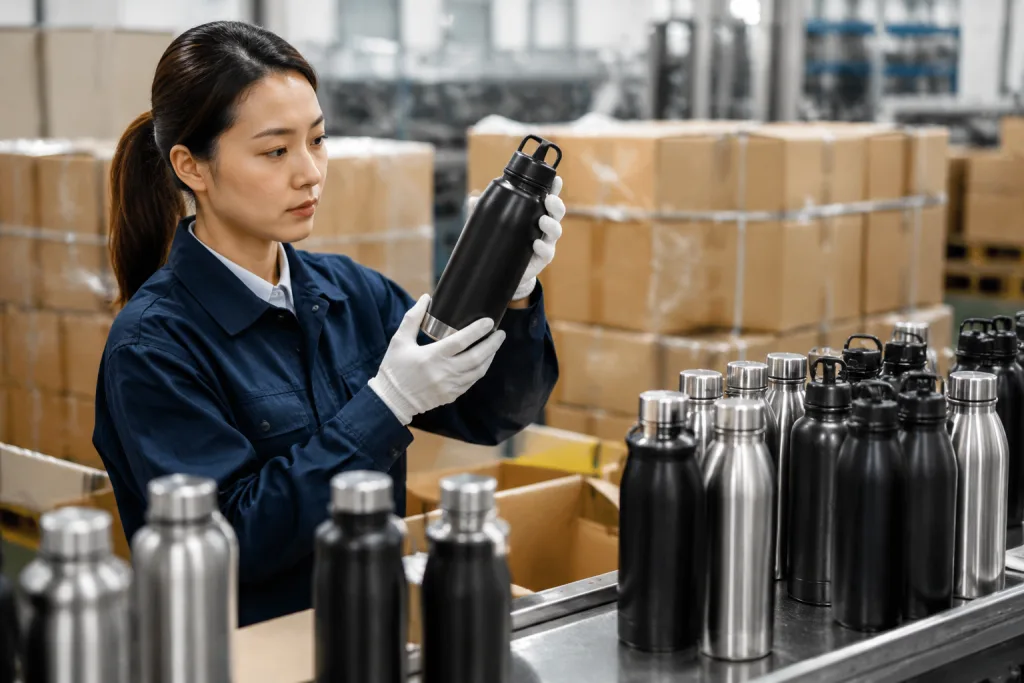
Know when a factory beats a distributor
We do not send every buyer to the same source. If you are locking one SKU, holding 5,000 pcs, and need print placement held to 1 mm on the pad printer, a factory is the cleaner path. If you are mixing 8 to 20 SKUs, chasing quick top-ups, or do not want to manage every carton, a distributor can fit better. The wrong move burns weeks, not just margin.
Use the source that matches your buying model:
- Brand owner: go direct to the factory when you need custom canteen development, PMS-controlled artwork, and a 3,000 pcs MOQ that keeps the math intact
- Distributor: use canteen distributors when you need mixed cartons, 200–500 pcs top-ups, or one PO split across several styles
- Retail buyer: choose a canteen supplier that can handle barcode labels, carton marks, and compliance files without sending you back for every small typo on the PO
Our view is plain: if repeat orders matter, go direct to the factory. If you only need one replenishment, a distributor can do the job. We have seen this go sideways when a buyer chased the lowest quote and then found the second run had a different lid color and a 4 mm logo shift. In Zhejiang, the better line usually gives you sample sign-off, stable output, and a fast re-quote; the weaker seller just relays messages. For vendors water bottles, that gap shows up after the first shipment, when the reorder lands and you need the same customized canteen three months later without rebuilding the spec from zero.
Send your RFQ and get a factory quote
Share capacity, material, logo file, packaging, and target market. Our Zhejiang team can usually return a clean FOB quote within 24 hours.
Frequently asked questions
What MOQ should I expect from a canteen factory?
For standard vendors water bottles, a realistic MOQ is 500 pcs per SKU and color. For more complex custom drinkware with matte coating, multiple logo colors, or special lids, 1,000 pcs is more common. If you need mixed colors or mixed cartons, ask early because that can change the packing plan. A Zhejiang canteen factory with stable lines may offer lower sample quantities, but bulk pricing usually improves only after 3,000 pcs. Always confirm whether MOQ is per design, per color, or per shipping carton, because those are not the same thing.
How much should samples cost for custom canteen orders?
A plain sample often costs USD 20-50 plus courier, while a decorated custom canteen sample can reach USD 50-120 depending on logo setup and finish. If you need a customized growler or vacuum insulated item with a new lid, the sample fee can be higher because the factory has to set up decoration and testing. Many canteen suppliers deduct the sample fee from the first bulk order once the order passes approval. Ask whether the sample is a blank reference piece, a pre-production sample, or a final decorated sample, because that changes what you are paying for.
What should be on a PO for customized drinkware?
Your PO should include SKU, capacity, material, decoration file, Pantone color, packaging, carton quantity, AQL level, lead time, payment terms, and FOB port. If you are buying through a canteen vendor for e-commerce, add barcode location, FNSKU, and carton marks. If you skip these items, the factory will fill in the blanks. For distributor drinkware programs, also state whether mixed colors are allowed and whether the packaging is retail-ready. A strong PO is the easiest way to avoid disputes later.
Which compliance documents do I need for Europe or North America?
For Europe, ask for REACH coverage and, for food-contact stainless drinkware, LFGB when your customer requires it. For North America, request FDA food-contact declarations and supporting test reports. If the item is for children, add CPSIA-related checks. A canteen manufacturer in China should also be able to provide material specs, coating details, and if needed BSCI or ISO 9001 information for retail audits. Do not accept a test report that does not match the exact item, lid, coating, and logo system you ordered.
Can I source mixed styles from one canteen distributor?
Yes, but mixed assortments usually cost more per unit and need tighter packing rules. A canteen distributor can often combine several styles into one shipment, which helps if you need a broad range of customizable drinkware or a smaller test program. The tradeoff is less control over exact material, lead time, and long-term consistency. If you plan repeat orders of the same custom drinkware, a direct canteen factory is usually stronger. If you need one shipment with 4-6 styles and quick consolidation, a distributor can be practical.