Key Takeaways
- Specify 304 stainless steel at 0.45-0.55 mm inner wall thickness for most 500-750 ml bottles
- Use AQL 2.5 for major defects and AQL 4.0 for minor cosmetic defects
- Plan 35-45 days production lead time after PP sample approval for 5,000-20,000 units
- Test vacuum performance with 95°C water and a 6-hour temperature drop record before shipment
A vacuum bottle order usually goes wrong before anyone notices. The sample holds temperature, the quotation looks clean, and the carton photo passes on WhatsApp. Then QC opens 32 cartons from the shipment and finds weak heat retention, logos tilted 1.5 mm, powder coating scratched at the shoulder, or lids leaking after 14 days in a warehouse test.
If you are comparing vendors vacuum insulated bottle programs in China, capacity and color are the wrong questions to ask first. At BottleForge Industrial in Hangzhou, Zhejiang, we run custom drinkware, custom canteen, and distributor drinkware orders where the same problems show up on the line: drawings missing logo tolerance, QC limits softer than AQL 2.5, and no drop test or hot-water retention check before mass production. We’ve seen this go sideways.
Vacuum Failure Is Usually Invisible
The first failure mode in a vacuum insulated bottle is not a leak or a dent. It is heat loss. We see it when a bottle looks clean on the packing table, then the buyer flags that 95°C coffee drops too fast after launch. QC pulled the sample with a Fluke probe last month; the shell had no scratch, but the vacuum layer was weak after a tiny TIG weld burn mark near the base. Poor welding, oil left before evacuation, or loose vacuum sealing can all pass a quick visual check.
For vendors vacuum insulated bottle sourcing, ask the canteen manufacturer to put the heat retention test method on the PI or QC file, not just say “tested” in an email. A practical benchmark for a 500 ml double-wall stainless bottle is filling with 95°C water, closing the lid for 6 hours at 20°C room temperature, and recording final water temperature with the probe inserted 30 mm below the water surface. Depending on neck size and shape, 7 out of 10 solid narrow-mouth designs should still hold 60-68°C after 6 hours. Wide-mouth bottles and custom growler formats lose heat faster, so comparing them with narrow-mouth travel bottles is the wrong question to ask.
Spec the material clearly. For Europe and North America, most buyers use SUS304 for the inner wall and SUS304 or SUS201 for the outer wall, though 304/304 is safer for premium customized drinkware. Wall thickness normally sits around 0.45-0.55 mm for mainstream bottles; our incoming team checks it with a digital micrometer before the line starts. Too thin saves cost but raises dent risk. Too thick pushes weight and freight cost up, and the math does not work when the carton hits 14 kg instead of 11 kg.
At our Zhejiang facility, routine production capacity is about 600,000 stainless drinkware units per month, with MOQ from 1,000 units per color for standard shapes and 3,000-5,000 units for custom molds. The canteen factory should show vacuum test records by batch, with date, line number, and final temperature, not just a certificate copied from an old order. We ship enough repeat programs to know this goes sideways when the PO says “keep hot 12 hours” but the approved sample file only records a 6-hour test.
Leak Complaints Start At The Thread
Most buyers blame the lid when a bottle leaks. Sometimes they are right. In our line checks, though, 7 out of 10 leak complaints start at the thread fit between the bottle mouth and cap. If the thread is loose by even 0.15 mm, the silicone gasket will not compress flat. If it is too tight, the end user over-torques the lid, crushes one side of the seal, and then the bottle leaks in a backpack. QC pulled one sample last month where the cap passed by hand, but the thread gauge showed the mouth was drifting after polishing. That order was a 5,000 pcs canteen promo run, and the math does not work if 3% come back.
For a custom canteen or customizable canteen project, lock the lid system before you approve artwork. A flip lid needs a different gasket seat than a screw cap; a straw lid has another weak point at the vent hole. We run food-grade silicone in the Shore A 50-60 range for most bottle seals, but we still test compression on the actual cap, not a drawing. Ask whether the gasket is removable. Removable seals clean better, but consumers lose them. We have seen this go sideways when a buyer asked for a loose pull-out gasket to reduce mold complaints, then retail customers started emailing photos of missing seals after 12 days on shelf.
A basic leak test is not enough. Fill the bottle to 80-90% capacity, close it, invert it for 30 minutes, then shake it horizontally for 30 seconds. For sports bottles and kids bottles, add a drop test: 1.0 m onto a rubber mat or plywood surface, three positions, then repeat the leak test. Simple test. Good filter. Our QC bench uses a 1.0 m marked steel ruler taped beside the mat, and the cap is checked again with a torque meter after impact. This is not lab theatre; it catches weak caps before the buyer turns them into chargebacks.
If you are a canteen distributor selling through retail or marketplace channels, packaging orientation matters. Bottles lie on their side in warehouses for weeks, and one carton can spend 32 days from Ningbo to Hamburg before anyone opens it. A sample that survives five minutes upside down on a desk is not the same as 24 cartons bouncing from China to Hamburg, Rotterdam, Los Angeles, or Toronto. We ship with random cartons rotated during pre-shipment inspection, because the buyer flagged a side-leak issue once after the PO even had “lid color: balck” typed wrong and nobody caught it until packing day.
Coating Defects Hide Under Good Lighting
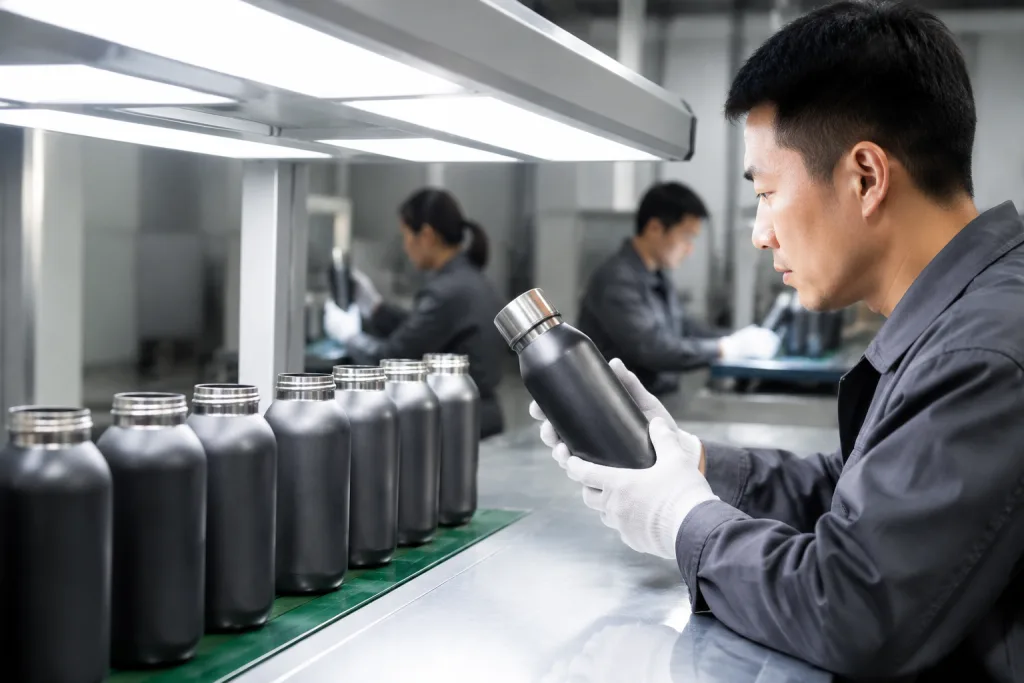
Powder coating sells bottles, and it also causes plenty of inspection arguments. We see 6 common claims on the line: orange peel, pinholes, dust spots, weak edge coverage, color drift, scratch marks from carton rub. The trouble starts when the PO only says “matte black” or “Pantone color.” Too loose. Last April, QC pulled 32 pcs from a 1,200 pc lot and the buyer flagged 9 for tiny silver dots near the shoulder weld; under the 6500K inspection lamp they looked clean, but at a 45° angle they were obvious.
For customized canteen and customizable drinkware orders, control the coating with a physical color chip or an approved pre-production sample. Pantone helps the sales chat move faster, but powder on 304 stainless steel will not match paper exactly. State that ΔE should be within an agreed tolerance when measured by colorimeter; 14 of our B2B buyers use ΔE less than 1.5-2.0 for strict brand colors and give looser limits for seasonal shades. We run the BYK colorimeter on the curved sidewall, not the flat base, because the base reading often lies.
Test scratch resistance before mass production. A cross-hatch adhesion test based on ISO 2409 is a good first gate, but the math does not work if you wait until 20,000 pcs are already coated. For premium distributor growler and customized growler products, ask for a tape pull result at grade 0-1. You can also require a 3H pencil hardness check on powder coating, though real abrasion still depends on resin mix and oven cure; we normally log 185°C for 18 minutes on the curing chart.
Do not ignore the bottom edge. Many bottles look clean on the sidewall but chip at the base after carton vibration, especially when 24 pcs sit in a 13 kg master carton for a 19-day sea shipment. Ask for a silicone boot if your bottle is sold as outdoor gear, or request thicker coating around the base if the design allows it. In China production, small coating changes can affect cost by USD 0.08-0.25 per unit, which is still cheaper than a retail return. We have seen this go sideways when a buyer saved USD 0.12 and then rejected 7% after a drop test.
Logo Processes Fail Differently
Logo defects do not come from one cause. We see 6 repeat offenders on the line: weak ink adhesion after the MEK rub, registration off by 0.8 mm between colors, uneven laser burn, artwork scaled too large for the print window, curved-wall distortion, and placement drift from the bottle jig. A canteen customized for brand campaigns needs a decoration spec as tight as the bottle spec. QC pulled the sample last month because the logo sat 4 mm closer to the base than the approved photo.
Silkscreen printing works well for one- or two-color logos on straight bottle sections, especially 3,000–10,000 pc canteen promotional runs and distributor drinkware orders where the unit math matters. The common failure is ink lifting on powder coating or the operator chasing a logo around the curve. Ask for a 3M tape test after 24 hours of curing and lock the placement tolerance, such as ±1.5 mm horizontally and vertically for standard bottles. We run this with a simple bottle cradle and a printed centerline; without that jig, the math doesn't work.
Laser engraving lasts longer than ink on powder-coated stainless steel and usually looks cleaner, but “laser means premium” is the wrong question to ask. Contrast changes by coating color, watt setting, and travel speed; black powder at 35W behaves nothing like cream powder at 28W. On raw stainless steel, laser marking can look too quiet unless the artwork has weight. For a custom growler or customizable growler, avoid tiny text below 1.5 mm stroke width; QC will flag it because it fills in or disappears at normal shelf-viewing distance.
For large all-around artwork, heat transfer or water transfer can beat screen print, but sampling must include a curvature check on the real bottle, not only a flat PDF. We have seen a 92 mm wide badge look balanced on the dieline, then stretch across the shoulder of a tapered bottle once wrapped. A responsible canteen manufacturer should send a dieline and a marked bottle photo before final approval. If your canteen suppliers skip that step, expect placement disputes later; we have watched buyers reject 1,200 pcs over a logo that rotated 6 mm from the handle line.
Compliance Paperwork Can Be Too Thin
Buyers often write “FDA certificate” or “LFGB certificate” on the RFQ like one PDF covers the whole order. Wrong question. Compliance follows each food-contact part: 304 stainless body, powder coating, lid plastic, silicone gasket, ink, and sometimes the color box. Last week QC pulled a 750 ml canteen sample where the body report was current, but the PP lid report was 19 months old and the silicone gasket was missing from the test scope.
For Europe, ask for LFGB, REACH, and the right food-contact migration testing by material and color. For the United States, buyers usually ask for FDA food-contact compliance, and drinkware for children can trigger CPSIA-related checks depending on product design and age grading. If the bottle is for kids, ASTM F963 can apply when it has cartoon prints, straw accessories, or child-targeted packaging. We’ve seen this go sideways: a buyer approved a general stainless steel report, then their retailer flagged the painted cap during incoming inspection with a 0.5 mm coating chip near the hinge.
Social compliance matters for bigger retailers. BSCI, Sedex, or ISO 9001 audits do not prove the bottle is food-safe, but they cut procurement risk. BottleForge Industrial operates from Zhejiang, China, and we normally prepare test reports and factory audit files during quotation review, not after the deposit lands. On our line, the document pack sits with the BOM, color chip, and pre-production sample tag, because a missing audit date can delay booking by 12 days vs 18 days during peak season.
For private label custom drinkware, put compliance ownership in the purchase order. State who pays for third-party testing, which lab is accepted, and whether failure means remake, refund, or corrective action. Spell it out. A testing budget of USD 300-1,200 per material set is easier to approve before production than arguing after 3,000 pcs are packed in export cartons; we once had a PO typo listing “silicon” instead of “silicone,” and the buyer flagged it after lab submission.
Carton Damage Is A Product Problem
Export packaging gets treated like the last line on the PI. Bad habit. If 2% of bottles arrive dented, the buyer will not accept “carton damage” as an excuse. We had QC pull 80 pcs from a 3,000 pcs canteen distributor order last season; 6 had shoulder dents from a soft corner hit. For that kind of program, the outer carton is part of the product, not a shipping detail.
For vacuum bottles, we usually run one unit in a polybag or tissue wrap, then a white box or color box, then a 5-ply export carton. Heavy custom growler orders need stronger cartons and molded pulp or EPE protection, especially above 1.2 kg per unit. If you sell through e-commerce, ask for a drop test based on ISTA-style handling, with 10 drops from 760 mm if single units ship directly to consumers. The line can pack it fast, but the math does not work if FedEx turns your color box into the test lab.
Carton specs should list flute type, gross weight limit, carton dimensions, and sealing method. Keep gross weight under 15 kg where possible for manual handling; our packers start complaining when a master carton hits 17 kg, and they are right. A carton with 24 bottles may look efficient on FOB quote sheets, but if it crushes at the lower pallet layer, your savings disappear. For Amazon-style inbound programs, label accuracy is also critical: FNSKU, carton labels, suffocation warnings, and pallet labels must match the routing plan. We once saw a PO typo where “FNSKU” became “FNSK”; the buyer flagged it before booking, lucky for everyone.
For FOB Ningbo or Shanghai shipments from Zhejiang, the truck ride to port is short, usually 3 to 5 hours from Hangzhou, but ocean freight is still rough. Humidity, container stacking, and warehouse handling punish weak packaging. If your customizable canteen has a matte coating, add abrasion protection between units. A small separator or better inner box can prevent the circular rub marks that buyers often mistake for coating failure; we have seen this go sideways after QC found grey rings on 18 pcs from one lower-layer carton.
AQL Needs Real Defect Definitions
AQL only works when critical, major, and minor are written in plain language before the first bottle hits the line. If you skip that, the inspector makes the call, the factory pushes back, and you are stuck sorting it out after the goods are already packed. For vendors vacuum insulated bottle orders, we pin the defect sheet to the carton sample table before pilot run, not after.
Critical defects cover sharp edges that can cut a hand, confirmed leakage, the wrong food-contact material, heavy contamination, and broken parts that stop the bottle from working. Major defects cover failed heat retention, dents you can see from 1 meter, crooked logos beyond tolerance, cap failure, wrong color, missing accessories, and barcode or FNSKU errors. Minor defects cover small specks, slight color shift within limit, or scratches under 3 mm outside the main logo zone; QC pulled a sample with a 2.2 mm mark last week, and that stayed in minor, which is the right call.
Most buyers start with AQL 0 for critical, 2.5 for major, and 4.0 for minor. That works for custom drinkware if the spec sheet is tight. For a $12 retail bottle, we usually push harder on major defects or add 100% leak testing on the line; for a low-cost canteen promo run, forcing a premium AQL on a 5,000-piece order just blows up the math.
Plan the pre-shipment inspection when 80% of the goods are packed and all 100% are produced. For new canteen vendors, we add an in-line check at 20-30% production so coating, logo, and lid issues get caught while there is still time to fix them. Last month a PO typo on the lid color delayed a run by 2 days; that sort of miss is cheaper to catch at the line than in the warehouse.
Send Your Bottle Spec For A Practical Factory Review
Share capacity, lid type, target price, artwork, and market. We will flag production risks before you pay for tooling or mass production.
Frequently asked questions
What MOQ should I expect from vendors vacuum insulated bottle factories?
For standard stainless steel bottle shapes, a realistic MOQ is 1,000 units per color with existing molds. If you need a custom canteen shape, exclusive lid, or private mold, expect 3,000-5,000 units minimum and tooling costs from about USD 1,500 to USD 8,000 depending on complexity. A simple logo change on an existing 500 ml or 750 ml model is much easier than changing the neck, base, or lid thread. For mixed colors, many China factories still require 1,000 units per color because powder coating setup creates waste and cleaning time.
How much does a customized vacuum insulated bottle cost FOB China?
For a 500-750 ml double-wall stainless bottle, FOB China pricing often falls around USD 3.20-6.80 per unit for normal B2B specifications, depending on steel grade, coating, lid type, packaging, and logo method. A basic silkscreen logo may add USD 0.08-0.20 per unit. Laser engraving often adds USD 0.15-0.45. A color box can add USD 0.18-0.60. A customized growler or 1.9 L insulated jug costs more because material weight, lid structure, and carton strength increase. Treat very low quotes carefully; they usually remove thickness, QC time, or packaging strength.
How do I compare canteen manufacturers without only choosing the lowest price?
Ask each canteen manufacturer for the same technical quote sheet: steel grade, wall thickness, capacity tolerance, lid material, gasket material, coating method, logo process, packing details, lead time, AQL level, and test reports. Then compare unit price against those fields. A USD 0.25 cheaper bottle may use thinner 201 outer steel, weaker coating, or a lighter carton. Also ask for recent production photos and batch QC records. A serious canteen factory in Zhejiang or other China manufacturing regions should answer in numbers, not just say “good quality.”
What lead time should a distributor canteen order plan for?
For existing molds with one logo and standard packaging, plan 7-10 days for sampling and 35-45 days for mass production after deposit and PP sample approval. Add 5-10 days if you need custom color matching, complex packaging, or multiple logo positions. New mold projects can take 60-90 days before mass production because drawing, tooling, trial samples, and corrections take time. A distributor canteen launch should also add ocean freight time: roughly 25-40 days to many European ports and 18-35 days to North America, depending on route and season.
Should I use one canteen supplier or several canteen suppliers?
For your first custom drinkware program, one qualified canteen supplier is usually easier to control. You get one PP sample standard, one AQL defect list, and one packaging method. For annual demand above 100,000 units, a backup supplier makes sense, but only after you standardize drawings, materials, and QC documents. Splitting a 5,000-unit order between two canteen suppliers often creates color mismatch, logo variation, and higher inspection cost. If you need risk control, qualify a second supplier with a pilot order of 1,000-2,000 units before moving core volume.