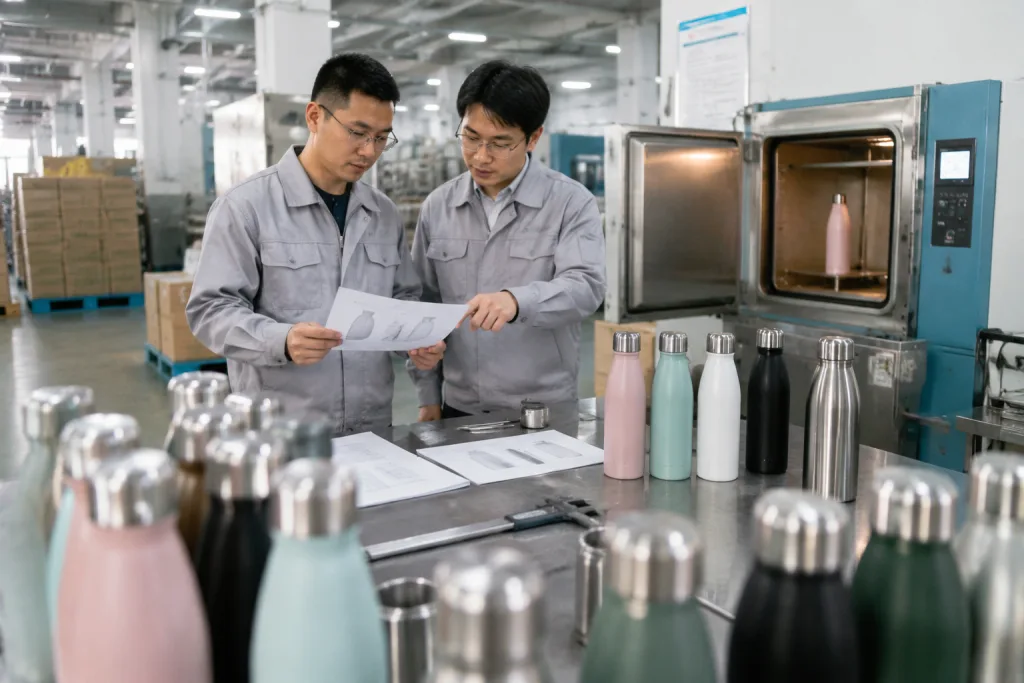
Key Takeaways
- 304 inner wall and 201 outer wall can save USD 0.25-0.45 per unit, but 304/304 is safer for outdoor retail
- A realistic custom thermos MOQ is 1,000 pcs per color for powder coating and 500 pcs for laser logo on stock colors
- BottleForge Zhejiang capacity is about 480,000 stainless vacuum units/month with 25-35 day production after artwork approval
- Use AQL 2.5 major / 4.0 minor plus a 24-hour heat-retention spot check before balance payment
A stainless flask spec sheet looks simple until the first shipment lands with weak 6-hour heat retention, scratched powder coating, lids that wobble 1.5 mm, or export cartons that split in the 76 cm drop test. If you buy for outdoor retail, corporate gifting, or seasonal promotion, the unit price is the wrong question to ask first. The real risk is signing off a loose spec, then finding the missing details when QC pulled the sample from the line.
As a Hangzhou, Zhejiang drinkware manufacturer, BottleForge sees this every week from new buyers comparing vendors vacuum flask quotations across China. One factory thermos quote may be USD 0.40 cheaper, but leave out inner copper plating, run a 0.38 mm shell instead of 0.45 mm, or switch the lid gasket from silicone to TPE without marking it on the PI. We’ve seen this go sideways. Read the spec line by line before you push price, especially when the buyer already flagged “same as sample” on the PO.
Body Steel Is Not One Line
The first line on most vendors vacuum flask spec sheets says stainless steel. Too thin. For a bulk thermos program, split it into inner wall grade, outer wall grade, and material test compliance on the RFQ and PO. We usually see two export builds on the line: 304 inner with 201 outer, or 304 inner with 304 outer. The inner wall is the part QC checks first with the PMI gun, because it touches water, coffee, tea, electrolyte drinks, and acidic fruit infusions.
For European and North American outdoor retailers, we normally quote 304 inner wall as the floor, with LFGB, FDA, or REACH-related migration documents matched to the destination market. A 304/201 build works for promotional thermos orders when the buyer says, “I need this under USD 3.20,” and the expected selling season is 6-12 months. A 304/304 customized thermos costs more, often USD 0.25-0.45 higher on a 500 ml flask, but it resists rust better after salt-spray storage and gives the sales team a cleaner retail claim.
Wall thickness also changes the buyer’s first impression. We’ve seen low-cost suppliers thermos quotes hide 0.35 mm outer shells; QC pulled the sample after a 1.2 m carton-drop test and found shoulder dents near the seam. They look fine in photos, then get marked during camping use or warehouse repacking. For a manufacturer thermos aimed at outdoor retail, 0.40-0.50 mm outer wall is a fair range. Ask for the gauge. Steel grade alone is the wrong question.
China factories can run both levels, but do not let the thermos vendor choose silently. Put steel grade, wall thickness, and test standard in the purchase order; we once had a PO typo showing “304 inside / 210 outside,” and the buyer flagged it before mass production. That saved 18 days of rework.
Vacuum Performance Needs Test Conditions
Heat-retention claims are where buyers and thermos factories usually talk past each other. A supplier might print keeps hot 12 hours, but without start temp, room temp, fill volume, and test method, the number is just decoration. We ran a 500 ml flask on the line last week with 95°C water in a 20°C room, and a solid unit still held about 58-64°C after 12 hours if the vacuum, copper layer, and lid seal were right.
For a vendors vacuum flask project, set the test like a buyer with a clipboard, not like a marketing sheet. Fill with water at 95°C ±2°C, close the lid within 60 seconds, hold at 20°C ±2°C, then read at 6 hours and 12 hours. For cold retention, use 4°C water or an ice-water mix and write the cutoff down. If the order goes into outdoor retail, I would still ask for one 24-hour spot test per production lot. It slows the pack-out a bit, but it catches bad vacuum before cartons leave Zhejiang.
The vacuum step itself is doing the real work. Copper plating on the inner surface helps reflect heat back, and on a 500 ml body it usually adds USD 0.08-0.18 per unit depending on size and MOQ. We’ve seen buyers push back on that line item on a 10,000-piece promo run; the math looks nice until the return rate starts climbing. For a retail thermos line, skipping copper plating is usually the wrong question to ask.
Ask your thermos factory to keep vacuum-failure records and share the reject rate, not a nice story. A proper China factory should know whether leakage and vacuum-fail rate sits at 0.5%, 1.2%, or worse, and QC should have the log from the gauge bench to prove it. If they cannot answer, they are probably not measuring. We once saw a PO typo on the test spec, 95°C printed as 59°C, and the buyer flagged it before the first sample run.
Capacity, Diameter, And Shelf Fit
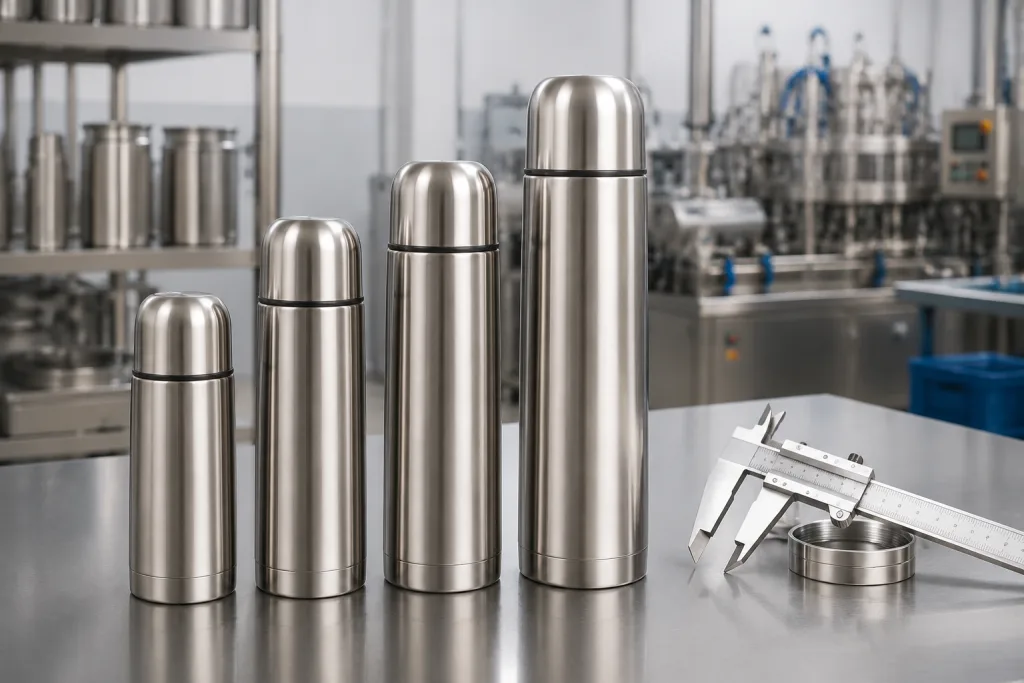
Capacity is not just milliliters. It changes the mold, carton count, freight cost, shelf face, cup holder fit, and what the buyer thinks the item is worth. We run 350 ml, 500 ml, 750 ml, and 1,000 ml most often on stainless thermos orders. For promotion and outdoor retail, 500 ml is still the low-risk size: it fits a 70 mm display slot, most backpack side pockets, and our standard 24 pcs export carton without wasting space. A 750 ml flask sells better for hiking kits, but the buyer flagged cup holder complaints on 2 projects last year.
For a thermos bulk order, confirm brimful capacity and usable capacity before artwork starts. Some factories quote 500 ml from total internal volume, while the real fill line sits at 470-480 ml once we leave headspace under the stopper. QC checks this with a 500 ml graduated cylinder at the leak-test bench, not by guessing from the CAD file. If your box says an exact volume for EU or US retail, that 20-30 ml gap can turn into a labeling problem.
Diameter is a logistics question. A flask body around 68-72 mm works for standard bags, shelf trays, and most display racks we see from chain-store buyers. An 85-90 mm body looks heavier and more premium, but the math often gets ugly: carton CBM rises, air freight jumps, and the line needs wider PE bag sizing. If you ship through Amazon FBA or retailer distribution centers, check outer carton dimensions and gross weight before sample approval. A 24 pcs carton for 500 ml bottles may land around 12-15 kg depending on gift box, divider, and manual thickness.
Customizable thermos projects go sideways when sales approves a shape and logistics sees it after the color sample is signed. Wrong order. Before sampling, ask for a line drawing with height, body diameter, mouth diameter, unit weight, and packed carton size. We usually mark these in mm and grams on the same PDF the buyer signs, because one PO typo like “Ø78” instead of “Ø68” can change the whole shelf plan. Basic work, but it saves money before molds or color samples are approved.
Lid System Decides Complaint Rate
The lid is where 7 out of 10 thermos customized complaint cases start after shipment. The steel body passes vacuum, but one loose silicone ring at 0.3 mm under drawing can turn into leakage claims across 5,000 units. For vendors vacuum flask sourcing, treat the lid as one assembly: cap resin and thread pitch need to match the cup, gasket Shore A hardness needs to sit on the drawing, and the closing torque should feel the same from sample to mass production. QC pulled a sample last month where the PO said “black gasket” but the approved sample had gray; small typo, big argument.
For outdoor retail, a screw cap with a separate drinking cup still gives the lowest trouble rate on the line. Simple wins. Push-button lids sell well in photos, but they bring springs, valves, and tiny sealing faces that shift after hot-water testing. If you use a push-button lid for a promotional thermos, run repeated open-close testing on the fixture, not just by hand. We normally suggest at least 3,000 cycles for a retail-grade lid and a 100% leak test on finished goods after assembly; our leak station runs inverted bottles for 30 minutes after 95°C fill.
Food-contact plastics should be named on the spec sheet, not guessed during production. PP is common for lid interiors. Tritan may be used for transparent parts. Silicone gaskets should be food-grade and removable for cleaning when possible, with hardness checked by a Shore A durometer before packing. For Europe, ask for LFGB or EU 10/2011 support where relevant. For North America, FDA food-contact documentation is usually expected by brand owners and distributors thermos buyers; the buyer flagged this once at booking, 12 days before ETD, and the lab file scramble was painful.
Do not ignore spare parts. A thermos distributor selling through outdoor shops may need replacement gaskets packed 1% extra, or held as after-sales stock with the same color code and mold number. A low-cost thermos supplier may treat lids as disposable. That is the wrong question to ask if your brand warranty is 12 months; the math doesn't work when one $0.06 gasket creates a full product return. Put lid drawings, gasket color, leak test method, and spare-part policy into the approved spec sheet, then make QC sign against it at pre-shipment inspection.
Finish And Logo Tolerances
Surface finish is the first thing a buyer sees, and it is where most thermos disputes start. Powder coating is the usual choice for outdoor flasks because it grips better and holds up against scuffing better than basic spray paint. On a 500 ml flask, powder coating usually adds around USD 0.20-0.45, depending on color, texture, and order quantity. MOQ is normally 1,000 pcs per color because the coating line setup, the spray gun changeover, and powder loss all cost money.
For a thermos custom project with lower volume, we run stock colors and add laser engraving or one-color silkscreen. Laser logo MOQ can be 500 pcs on stock bodies at BottleForge, while full Pantone color coating makes more sense at 1,000 pcs and above. Zhejiang factories can hit Pantone within a workable range, but stainless drinkware coating is not paper printing. Agree on a physical color chip or an approved pre-production sample, or the buyer will flag it later.
Logo method changes how the flask ages. Laser engraving burns through the coating and exposes the steel, so the mark stays clean and permanent. Silkscreen works on flat or gently curved areas, but weak ink or poor curing on the oven line will give you rub-off. Heat transfer handles complex artwork, yet it adds cost and needs adhesion testing. For a promotional thermos, silkscreen is enough. For a distributor thermos line, laser or a better transfer spec is the safer call.
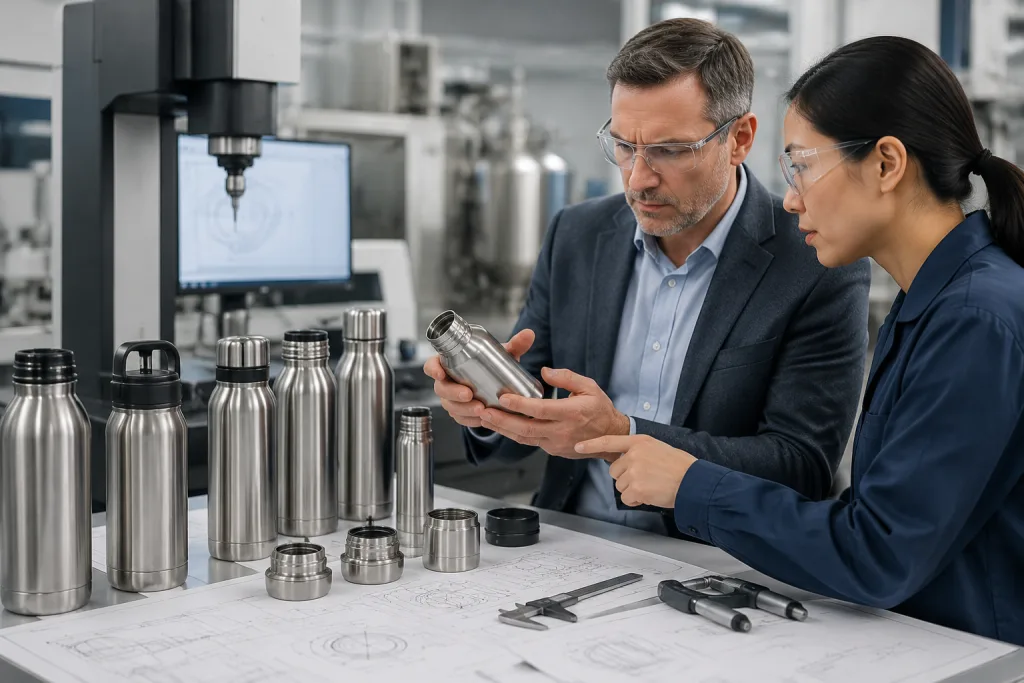
Put the logo size in millimeters, the position tolerance, and the defect limit in the PO. QC pulled the sample with a caliper and checked scratches, dust dots, orange peel texture, bad registration, and coating chips at the base. AQL inspection should cover all of that. If the logo is a real brand asset, do not approve production from a low-resolution JPEG.
Packing, Compliance, And Payment Controls
Packing is part of the product, not an afterthought. For a retail manufacturer thermos, we lock the color box dieline, EAN-13 barcode size, warning text, and leaflet language before the line opens; one PO came in with “dishwaser safe” on the artwork, and prepress caught it before 12,000 boxes went to print. A thermos promotional order can run a plain white box or kraft box, but the carton cannot be cheap paper. We run 5-ply master cartons for heavier stainless flasks, and we add L-shaped edge guards when the color box has gift-grade lamination.
If your goods ship to a retailer warehouse, confirm the carton drop test before production. Don’t ask only, “Is the packing strong?” That is the wrong question to ask. Our internal check is a 76 cm drop on corners, edges, and faces for packed cartons, then QC opens 3 cartons to check dented lids, crushed color boxes, and loose accessories. Some retailers ask for ISTA-style testing, so the math changes. For Amazon FBA, each unit may need FNSKU labeling, suffocation warning on polybags if used, and carton labels on the correct side; we have seen this go sideways when a buyer sent left-side label placement but the warehouse SOP required short-side placement.
Compliance should match the destination market. For Europe, ask for REACH and LFGB support, plus packaging waste documents if your importer reports EPR. For the US, FDA food-contact support and Prop 65 review matter when the material, coating, or marketing claim triggers it. If the factory says it has BSCI or ISO 9001, ask for the current certificate and audit date; QC pulled one supplier file last year where the PDF was 3 years old and the address did not match the stamped PI.
Payment control is simple: do not pay the balance until inspection passes. BottleForge typically works 30% deposit and 70% before shipment, FOB Ningbo or Shanghai, with 25-35 days production after sample and artwork approval. Our Hangzhou, Zhejiang facility can produce about 480,000 stainless vacuum units per month, but capacity does not replace a written spec, sealed golden sample, and final AQL report. The buyer may push for “ship first, inspect later”; we don’t like that, because one missed 0.4 mm lid gap can turn into a full-container complaint.
Send Your Thermos Spec For Factory Review
Share capacity, lid style, logo method, target price, and destination market. We will flag risky spec gaps before you place a bulk order.
Frequently asked questions
What MOQ should I expect for a custom stainless vacuum flask?
For most vendors vacuum flask orders, plan around 1,000 pcs per color when you need custom powder coating. If you use stock body colors with laser engraving, 500 pcs is often workable. A fully customized thermos with new mold, special lid, or exclusive shape may need 3,000-5,000 pcs because tooling, testing, and line setup are heavier. For promotional brands testing a campaign, we usually suggest starting with a 500 ml stock model, one logo method, and 500-1,000 pcs. That keeps sampling faster and avoids tying up budget in tooling before you know sell-through.
How much should a bulk thermos cost from China?
A realistic FOB China price for a 500 ml stainless vacuum flask often sits around USD 3.20-5.80, depending on steel grade, coating, lid type, copper plating, packaging, and order quantity. A basic 304 inner / 201 outer promotional thermos with white box will sit at the lower end. A 304/304 outdoor retail flask with powder coating, copper plating, color box, and stronger lid moves higher. Be careful with quotes that are USD 0.50-0.80 below the market. The saving may come from thinner wall steel, no copper plating, cheaper gasket material, or weak carton packing.
Can you match my brand Pantone color exactly?
We can match Pantone targets closely, but stainless powder coating is not the same as offset printing on paper. For a custom thermos, the smart process is to approve a sprayed metal color sample before mass production. Normal tolerance should be agreed visually under standard lighting, not judged from phone photos. MOQ for custom powder color is usually 1,000 pcs because the coating line needs setup and powder cleaning. If you need only 300-500 pcs, choose an existing factory color and use laser engraving or silkscreen branding instead.
What inspections should I require before shipment?
Use AQL 2.5 for major defects and 4.0 for minor defects as a baseline. For thermos bulk orders, inspection should check appearance, coating adhesion, logo position, capacity, lid fit, leakage, carton markings, barcode scan, and packing count. Add a heat-retention spot test using 95°C water, with readings at 6 or 12 hours. For push lids, include open-close cycle checks and 100% factory leak testing before final packing. If the order is over 5,000 pcs or going to a national retailer, third-party inspection before balance payment is cheap insurance.
What lead time is normal for a distributor thermos order?
For stock shape and stock color with laser logo, sample approval can take 5-7 days and mass production usually takes 20-30 days. For custom powder color, printed packaging, and pre-production sample approval, 25-35 days after artwork confirmation is more realistic. New mold development can add 30-60 days depending on complexity. Around Chinese New Year, add at least 2-4 weeks because stainless drinkware factories in Zhejiang and other China production areas face labor and coating-line congestion. Confirm lead time from approved sample date, not from first inquiry date.