Key Takeaways
- Start with use case: outdoor retail bottles usually need 12-24 hour insulation and 0.45-0.55 mm stainless walls
- A realistic MOQ for customized thermos orders is 1,000 pcs per color for stable coating and logo cost
- FOB China pricing can shift 8-18% depending on lid structure, coating, carton pack, and inspection level
- Use AQL 2.5/4.0 inspection, LFGB or FDA food-contact checks, and REACH review for EU promotional orders
You are not buying a bottle. You are choosing how much product risk your outdoor retail shelf or promotional campaign can carry. A vendors vacuum bottle order looks simple until the buyer flagged 304 vs 316 stainless steel, powder coating vs spray paint, laser logo vs silkscreen, then found the FOB quote was 18% below the landed cost after carton CBM and duty were added.
For most buyers, the starting point is not “what is your cheapest custom thermos?” That is the wrong question to ask. We first lock target use and thermal performance, then decoration method and supplier control with a 0.5 mm wall-thickness check on the caliper. BottleForge Industrial in Hangzhou, Zhejiang works with bulk thermos programs from 1,000 to 50,000 units, and we see the same mistake on the line: buyers chase the lowest price before the product spec is fixed.
Start With The Selling Use
The first decision is not capacity or color. It is where the bottle makes money. An outdoor retailer selling through 80 stores needs a different vendors vacuum bottle than a promotional brand shipping 5,000 pieces for a winter campaign. Retail buyers ask us about repeat use, shelf presentation, cap feel, and return rate. Promo buyers push on deadline, logo readability, carton labeling, and landed unit cost. We hear this every week. Last month one buyer flagged a PO because the carton mark said “thermos cup” while their warehouse file said “vacuum bottle,” and that small mismatch held the booking for 2 days.
For a hiking or camping line, we normally recommend 500 ml, 750 ml, and 1,000 ml bodies with double-wall vacuum insulation, 304 stainless steel inside, and a powder-coated exterior. A 750 ml factory thermos with 0.50 mm inner wall and 0.45 mm outer wall gives better dent resistance than 0.35 mm promotional stock. The math is simple: you pay more steel cost, but you reduce field complaints. QC pulled the sample after a 1.2 m drop test on the concrete floor, and the lighter body showed a flat spot near the bottom seam.
For a promotional thermos, the trade-off changes. You can choose a 500 ml body, PP lid, silicone seal, and one-position laser logo to stay inside a tight budget. If the campaign runs for 6 weeks, this is the wrong question to ask: “Can we use the same cap as the outdoor bottle?” The cap system costs too much for that order. It needs consistent color, clean branding, and cartons that survive parcel handling. We run 5 cartons through a corner-drop check before mass packing because parcel delivery is where cheap boxes go sideways.
When you brief thermos suppliers, write the selling use in one sentence. Example: 750 ml powder-coated stainless bottle for outdoor retail, sold at USD 24.99-29.99, packed in individual kraft boxes. That sentence helps a thermos manufacturer quote a real product instead of a vague catalog item. Our quoting team can match wall thickness, lid tooling, gift box paper, and MOQ from that one line, instead of sending 12 catalog PDFs and waiting 3 days for the buyer to narrow it down.
Choose Steel And Vacuum Performance
The first call is material and insulation target. We run 304 stainless steel for most inner and outer shells because it keeps the FOB in check and passes FDA or LFGB with less drama. For acidic drinks, coastal sales, or a premium outdoor line, 316 stainless steel liners are on the table, but the buyer usually sees a 12% to 18% price jump. The wrong question is “can you quote 316?” The better one is whether the drink and market actually need it.
Do not accept an insulation claim without the test setup. A spec sheet that says “keeps hot 24 hours” is marketing, not proof. Ask for start temperature, room temperature, fill volume, lid status, and the reading times. For a 750 ml bottle, we test with 95°C water, 20-25°C ambient, lid fully closed, then read at 6, 12, and 24 hours. On a decent line, we expect around 65°C at 12 hours and about 45°C at 24 hours, though wide mouths and simple lids give up heat faster.
Wall thickness matters, but only if you look at the whole cup. A 0.60 mm shell feels solid, yet it adds weight and pushes up packing loss in transit; a 0.30 mm shell dents fast when cartons get tossed around. For retail bulk thermos programs, 0.45-0.55 mm is a sane range. For low-cost thermos promotional orders, 0.35-0.40 mm works if the buyer signs off on the trade-off. We have seen that go sideways when someone expects premium feel at giveaway pricing.
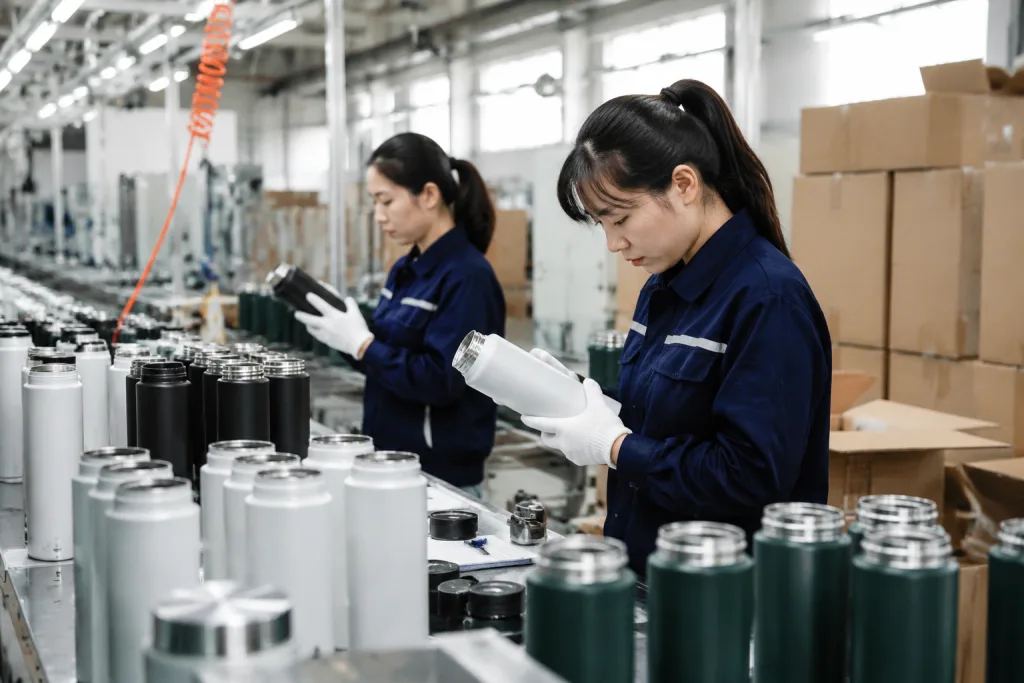
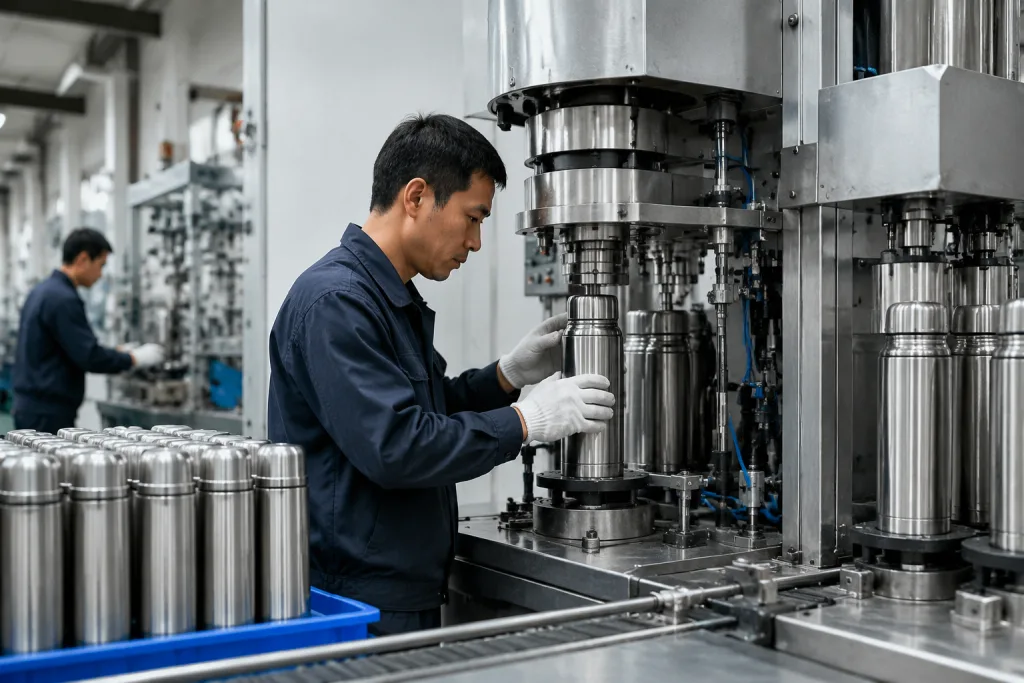
The vacuum stage is where a real thermos factory earns its margin. Dirty inner walls, weak seam welding, or a sloppy vacuum seal show up later as heat loss, and QC pulled the sample too late on more than one rushed order. At BottleForge Industrial in Zhejiang, we run vacuum decay checks and hold samples from each production lot because a bad bottle is expensive to chase after shipment. For any thermos bulk order over 3,000 pcs, ask for production samples from the actual line, not showroom stock.
Set The Decoration Method Early
Your logo choice can move the price, lead time, and reject rate more than the bottle shape. We run laser engraving, silkscreen printing, heat transfer, water transfer, UV print, and full-body powder coating with secondary branding. Each one fits a different order. The wrong question is “logo included?” Ask for logo size in mm, color count, print position, and what the buyer expects after 500 rub cycles or a dishwasher-style soak test. Last month QC pulled 32 samples from a matte black run because the PO said “front logo,” but the artwork showed a 42 mm side placement.
Laser engraving is the safe choice for outdoor retailers. It cuts through the coating and shows the 304 stainless underneath, so there is no ink layer to peel. Good for one-color brand marks. Not good for bright Pantone colors; the math doesn't work because engraving is metal tone, not ink. Silkscreen works when you need one or two solid colors at a lower cost, but the artwork must be clean and the line needs a curved-surface jig locked at the right angle. UV print handles gradients, but we do not approve it for a distributor thermos line until a 3M tape pull and scratch test pass on the coated sample.
Powder coating usually beats liquid spray paint on stainless bottles. For retail programs, we recommend powder coating thickness around 60-80 microns, with cross-hatch adhesion testing and a basic rub test on printed logos. Simple check. If the coating lifts at the grid edge, the buyer will flag it later. For a promotional thermos, standard spray coating may pass when the bottle is tied to a 3-day event, but do not sell it as rugged outdoor gear.
Color control is where we see orders go sideways. A thermos customizable program with six colors looks strong on a sales sheet, but each color adds setup time, coating risk, and MOQ pressure. For a first order, two or three colors at 1,000 pcs per color is easier to control than eight colors at 300 pcs each. If you need an exact brand color, give the Pantone code and approve a pre-production color panel before mass production; our coating room checks it under a D65 light box, not under a random office lamp.
Compare MOQ, Price, And Lead Time
The third decision is the commercial structure. FOB price alone is the wrong question to ask. We have seen USD 0.18 disappear on a quote after the buyer changed from a plain white box to a 350 gsm printed retail box, then added an FNSKU sticker. For standard stainless bottles, BottleForge Industrial usually starts a customized thermos order at 1,000 pcs per model and color. For new lid tooling or private mold body shapes, MOQ can move to 3,000-5,000 pcs because the CNC mold work, leak testing, and line setup have to be spread across enough units.
As a working range, a 500 ml stainless vacuum bottle with standard lid, powder coating, and laser logo may quote around USD 3.20-5.80 FOB Ningbo or Shanghai, based on steel price, lid parts, finish, and packaging. A 750 ml outdoor bottle with better cap, thicker body, and retail box may run USD 5.20-8.50 FOB China. Not promises. Use them as guardrails. Last month, QC pulled a 500 ml sample with a 0.3 mm coating chip near the shoulder, and that small defect still changed the rework cost on the line.
Lead time is usually 25-35 days after deposit and artwork approval for repeat styles. New colors, custom lids, or special packaging can push production to 40-55 days. Count backwards from warehouse arrival, not factory ship date, if your promotional brand has an event date. We ship plenty of urgent orders, and this is where the math goes sideways: ocean freight to North America or Europe can add 25-45 days by route, season, and port queue. One buyer flagged this after their PO said “ETD 18 May” but their event needed cartons in Chicago by 12 June.
A good thermos vendor will separate one-time costs from unit costs. Ask for a line-by-line quotation: bottle body, lid set, powder coating thickness, logo method, individual box, master carton, barcode or FNSKU label, test reports, and inspection support. This makes thermos supplier comparison cleaner. If one manufacturers thermos quote is 15% lower but excludes retail packaging and inspection, it is not lower. We run this check before PI because a missing carton spec, even a 44 x 33 x 28 cm master carton typo, can change loading quantity and freight cost.
Check Compliance Before Deposit
Do not wait until cartons are sealed to talk compliance. For Europe, we usually see LFGB food-contact testing on the buyer’s checklist, plus REACH checks for powder coating, painted logos, and restricted substances; 6 of 10 EU importers also ask us for recent BSCI factory audit records before they release a deposit. For the United States, FDA food-contact expectations and California Proposition 65 screening depend on the retailer, especially Amazon, Costco, and promo channels. Children’s bottles bring ASTM and CPSIA into the file, but this guide stays with stainless thermos orders for adult outdoor and promotional use. QC pulled the sample last month because the PO wrote “EU food grade” but did not say LFGB.
Food-contact testing needs to cover every part that touches liquid: inner stainless steel, lid plastic with resin grade marked, silicone gasket with Shore hardness, straw if included, plus any coating within 15 mm of the drinking rim. If a thermos manufacturer sends one old generic report, check model similarity, material list, test date, and lab name. A valid test report for a similar 304 stainless bottle saves time, but the retailer may still ask for project-specific testing under your SKU. The math doesn't work if you approve artwork today and discover a failed gasket migration test 12 days later.
Factory control counts as much as the PDF reports. BottleForge Industrial works from Hangzhou, Zhejiang with partner production lines in China that can output around 300,000 stainless drinkware units per month across thermos, tumbler, and sports bottle categories. We run split shipments when a distributors thermos order needs 8,000 units to Poland first and 12,000 units to Germany after the retail label is corrected. Capacity helps. It does not replace inspection, but it gives the line enough room to rework a scratched lid batch without killing the ship date.
Use AQL inspection terms instead of “check quality carefully” on the purchase order. A common setup is AQL 2.5 for major defects and 4.0 for minor defects, with critical defects at 0. Major defects include leakage at the lid thread, poor vacuum performance after a 95°C hot-water hold test, sharp edges on the mouth, wrong logo, and coating failure after 3M tape pull. Minor defects include small cosmetic marks inside agreed tolerance, such as one 1 mm dot on the base area. Put this in the purchase order before deposit, not after production is finished; we’ve seen this go sideways when the buyer flagged “wrong logo shade” only after 42 cartons were packed.
Build A Supplier Decision Matrix
Do not rank thermos suppliers by FOB price alone. That is the wrong question to ask. We run supplier scorecards with weighted criteria: product performance at 35%, quality system at 25%, landed cost at 20%, customization ability at 10%, and communication at 10% for outdoor retail programs. For promotional brands, deadline reliability may deserve 30% because 8,000 bottles arriving 12 days after a trade show are dead stock, even if the unit price looked good on the PO.
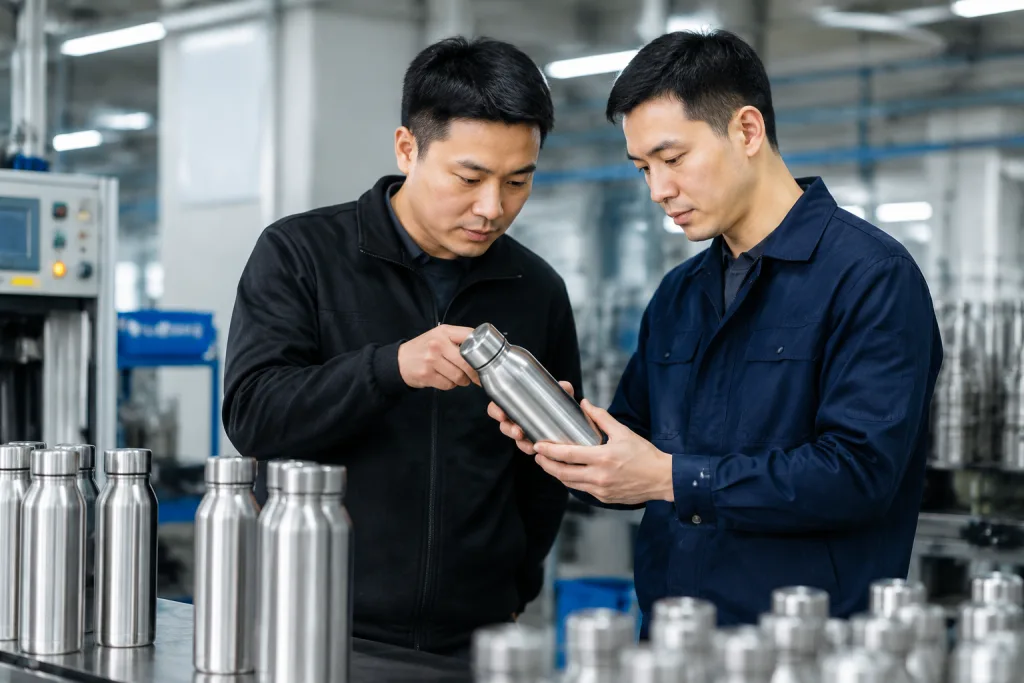
Ask each thermos supplier for the same evidence. We request product drawings, material declaration, insulation test data, coating test method, packaging drop-test plan, and recent inspection photos from a comparable order. QC pulled one sample last month where the 2D drawing showed a 54 mm mouth, but the actual caliper reading was 52.6 mm; the buyer flagged it because their ice-cube claim no longer worked. If you are building a thermos distributor program, also ask whether replacement lids, spare gaskets, and repeat colors can be supplied six months later. Replenishment is where 3 out of 10 low-cost vendors fail.
A manufacturer thermos partner should push back on weak specs. If you request a wide-mouth bottle with a bamboo lid, full-color wrap, and a 24-hour hot claim at the lowest price, a serious factory will explain the trade-offs. The math doesn't work on every design. On the line, bamboo lids need more hand checking for glue marks and gasket fit than a standard PP lid, so a quiet yes to every request is not good service. It often means the supplier plans to solve the problem later with substitutions.
For a first order, keep the decision controlled. Choose one body, one lid, 2 colors, and one decoration method. Approve a golden sample. Run a pilot order of 1,000-3,000 pcs before scaling to 20,000 pcs. We usually pack the pilot with the final carton spec, then check 1.2 m drop-test results before the buyer locks retail packaging. A vendors vacuum bottle program becomes predictable when you cut variables early and add complexity after real sell-through data.
Send Your Thermos Spec For A Straight Quote
Share capacity, logo, target price, market, and deadline. We will return MOQ, FOB pricing, lead time, and compliance options.
Frequently asked questions
What MOQ should I expect for a custom stainless thermos order?
For a standard stainless vacuum bottle with your logo, 1,000 pcs per model and color is a realistic MOQ in China. If you need six colors, expect 1,000 pcs per color unless the factory has stock-coated bodies. For private mold shapes, special lids, or exclusive caps, MOQ often rises to 3,000-5,000 pcs because tooling and setup cost need enough volume. For promotional thermos campaigns, some suppliers may accept 500 pcs, but unit cost and color control are usually worse. If you are testing a new outdoor retail line, a 1,000-3,000 pcs pilot order is usually safer than chasing a tiny MOQ.
How much does a vendors vacuum bottle cost FOB China?
A practical FOB China range is USD 3.20-5.80 for a 500 ml stainless bottle with standard lid, powder coating, and laser logo. A stronger 750 ml outdoor retail bottle with thicker wall, better cap, and printed retail box often lands around USD 5.20-8.50 FOB Ningbo or Shanghai. Price changes with steel grade, wall thickness, lid structure, coating, logo method, carton strength, and test requirements. Be careful with quotes that are 20% below the market. They may use thinner steel, weaker coating, low-grade plastic, or exclude inspection and packaging that you still need to pay for later.
Which logo method is best for outdoor retail thermos bottles?
Laser engraving is usually the best first choice for outdoor retail because it is durable and does not peel. It works especially well on powder-coated bottles where the laser reveals the stainless steel below. Silkscreen is cost-effective for one or two solid logo colors, but it needs adhesion testing on curved surfaces. UV print is useful for gradients and complex graphics, though scratch resistance should be checked before approval. For a retail custom thermos, ask for a logo sample and run a rub test, tape test, and dishwasher-style wash simulation if your brand claims heavy-duty use.
What compliance documents do EU and US buyers usually need?
For EU buyers, LFGB food-contact testing and REACH screening are common requests, especially for coatings, plastics, and silicone gaskets. Some retailers also ask for BSCI audit records or factory social compliance documents. For US sales, FDA food-contact expectations apply, and some buyers request California Proposition 65 screening. If the bottle is for children, ASTM and CPSIA requirements may apply. Ask your thermos manufacturer for current reports, but check whether the tested materials match your order. A 2021 report for a different lid plastic is not strong evidence for a 2026 customized thermos program.
How should I inspect a bulk thermos shipment before it leaves China?
Use a written AQL inspection plan. A common standard is AQL 2.5 for major defects and 4.0 for minor defects, with critical defects at 0. The inspector should check carton marks, quantity, barcode or FNSKU labels, coating, logo position, lid fit, leakage, smell, sharp edges, and random insulation performance. For a 5,000 pcs thermos bulk order, inspection normally takes one working day if cartons are ready and sampling is straightforward. Do not rely only on factory photos. A third-party inspection in Zhejiang or another China production area is cheap compared with rejected retail stock.