Key Takeaways
- Tritan bottle MOQ is usually 3,000 units/model, while custom color often starts at 5,000 units
- Choose 1.8-2.2 mm wall thickness for reusable retail bottles, not thin giveaway shells
- EU and North America programs need LFGB, FDA, REACH, and BPA-free documentation before PO
- AQL 2.5/4.0 inspection catches lid leakage, logo defects, carton drops, and assembly issues
If you are searching for vendors tritan water bottle, you are past the pretty catalog stage. You need a bottle spec that will not come back from retail, a lid that stays dry after a 6-carton drop test, and a canteen supplier who can keep Pantone color, logo position within 1.5 mm, and packing the same on the next PO.
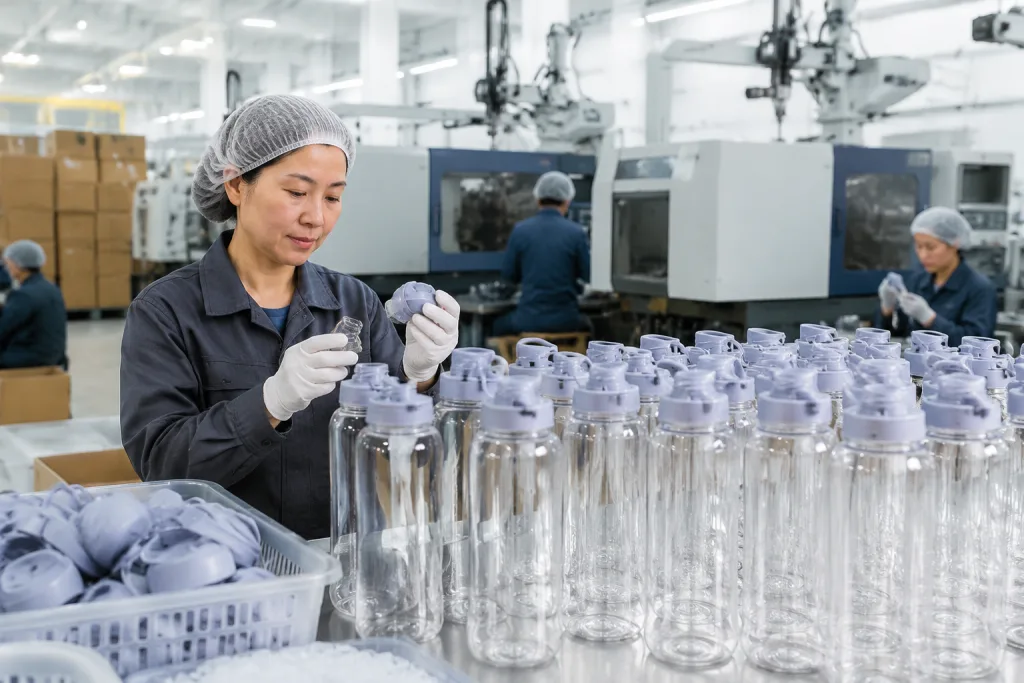
Tritan looks simple on a shelf. On the line, it is a spec fight. A 650 ml sports bottle, a 1 L canteen customized for outdoor retail, and a 2 L custom growler should not sit in one RFQ; the mold, cap torque, carton weight, and test method all change. From our Zhejiang, China production base, BottleForge Industrial quotes around 80,000 Tritan units/month, with typical MOQ from 3,000 units per model and 35-45 day lead time after approved sample. We have seen this go sideways when a buyer writes “same as sample” on the PO but changes the straw lid drawing in the last email.
Tritan Versus Other Canteen Materials
A smart buyer does not ask whether Tritan is “better.” Better for what? This is the wrong question to ask. Tritan copolyester gives clear body color, solid drop resistance, BPA-free positioning, and lower weight than stainless steel. We use it most for gym bottles with flip lids and school bottles where parents want to see the water level; on one 8,000 pcs PO last May, the buyer flagged stainless as too heavy after the packed carton hit 13.6 kg.
Here is the practical head-to-head view from the line:
- Tritan: around 1.8-2.2 mm wall thickness, good drop resistance, transparent body, usually 90-100°C heat resistance depending on grade and lid parts; QC pulled the sample after a 1.2 m drop test and checked the base ring for whitening.
- Stainless steel: heavier and stronger on perceived value, best when the program needs vacuum insulation; the math does not work if the buyer also wants full color transparency or printed ml markings down the side.
- PP or PE: lower resin cost and softer hand feel, fine for 3,000 pcs low-cost canteen promotional orders; weak choice for retail shelf impact because the body can look cloudy after molding.
- Glass: clean taste and a premium hand feel, but fragile in distributor drinkware shipments; we have seen 2 cracked inner bottles in one AQL 2.5 pre-shipment inspection when the sleeve fit was loose by 0.6 mm.
For a canteen distributor selling to outdoor shops, Tritan often wins on weight and clarity. Simple. For a distributor growler program, stainless or insulated construction makes more sense if cold retention is the selling point. For a customized growler made from Tritan, we pitch capacity, low weight, and wide branding space; we do not pretend it will hold ice like a double-wall 304 stainless growler. We have seen this go sideways when a buyer’s Amazon copy promised 12-hour cold retention on a single-wall Tritan sample.
At our canteen factory in Zhejiang, we normally recommend Tritan when the bottle needs to stay clean-looking after 6-12 months of use, pass BPA-free testing, and accept silk screen, heat transfer, or UV print without the logo floating off after tape testing. We run a 3M tape pull on decorated samples before approval. China factories can make all materials, but the right canteen manufacturer should push back on your use case before pushing one material.
Spec Table Before You Quote
Put every vendors tritan water bottle quote into one spec table before you talk price. We run into this weekly: Buyer A compares a 600 ml bottle with a thin flip lid to a 750 ml bottle with silicone seal, carry loop, and retail box, then says Supplier 2 is cheaper by USD 0.18. The math doesn’t work. Last month QC pulled a 600 ml sample at 586 ml on the fill gauge, so even capacity needs checking before anyone argues about material.
A useful RFQ table should include these fields:
- Capacity: 500 ml, 650 ml, 750 ml, 1,000 ml, or 2,000 ml. Tolerance is usually ±3-5% depending on mold; we check it with a graduated cylinder before sealing the counter sample.
- Body material: Tritan TX1001, TX2001, or equivalent BPA-free copolyester, with batch traceability. Ask for the resin lot number, not just “Tritan” typed on the PI.
- Wall thickness: 1.8 mm minimum for retail; 2.0-2.2 mm preferred for sports and outdoor canteen customizable programs. Our line checks the side wall with a digital caliper at the shoulder, waist, and base.
- Lid system: screw cap, flip straw, one-click lid, chug cap, or wide-mouth cap with silicone gasket. The buyer usually flags leakage first, so we run an inverted water test for 30 minutes.
- Decoration: silkscreen, pad print, heat transfer, UV print, sleeve, or molded logo. For UV print, send Pantone codes and artwork size in mm; “same as photo” slows the sample room down.
- Packing: bulk polybag, color box, kraft box, barcode label, FNSKU, or master carton with drop-test requirement. If Amazon is involved, confirm FNSKU placement before mass packing; one PO typo can cost 2 days of relabeling.
For a custom canteen program, ask every canteen supplier to quote FOB Ningbo or FOB Shanghai, not just EXW. We ship from Zhejiang to Ningbo port often, and the truck cost for 1 x 40HQ is easier to normalize than 6 different EXW quotes. Also ask whether tooling is existing, modified, or new. Existing mold sampling can take 7-10 days. New mold development is more like 25-35 days before first trial sample, and we’ve seen this go sideways when the buyer approves color chips before the mold texture is finished.
Use-Case Fit Wins the Comparison
A Tritan bottle sells or fails by channel, not by the CAD drawing. We’ve run the same 650 ml body for a trade-show canteen order and for a 12-month retail listing, and the complaint pattern was different by week 3. Promo buyers flagged carton scuffs and logo position; retail buyers flagged lid feel, shelf packaging, and repeat leak claims. Pick the bottle around the first failure your customer will notice.
For gym and sports retail, check grip shape, one-hand drinking, lid opening force, and leak test at 45° and upside down for at least 30 minutes. We run this on the bench with dyed water, 12 pcs per color, because clear water hides slow seepage around the silicone seal. A 650-750 ml bottle with a chug lid and matte grip texture usually beats a fancy lid with five small parts. Fewer parts. Fewer returns.
For school and kids channels, check ASTM or CPSIA requirements if selling in the United States. Avoid small detachable parts, especially loose straw caps under 32 mm, because QC pulled one sample last year after the buyer flagged it as a choking-risk photo in the inspection chat. A 500-600 ml body with rounded edges and printed measuring scale works well. If the program is a canteen customized for a school brand, make sure ink adhesion passes tape test after 24 hours curing.
For outdoor and travel, 1,000 ml wide-mouth bottles are common because users want ice filling and easy cleaning. A customizable canteen for camping needs a thick handle and a stronger hinge pin; we normally ask for a 3.0 mm pin instead of 2.2 mm when the buyer wants a carry loop. A molded handle is tougher than a decorative flexible strap. The math does not work if the strap looks nice but fails after 300 pull cycles.
For corporate gifting, the logo area and packaging carry more weight. Customizable drinkware buyers often want 1-color silkscreen under USD 2.80 FOB for 5,000 units, while retail buyers may accept USD 3.20-4.50 if the lid and packaging are better. We’ve seen this go sideways when the PO says “matte black box” but the artwork file says kraft paper, so confirm packaging before mold color and carton marks are locked. Be honest with your sales forecast before selecting the spec.

Decoration Is Not Just Artwork
Logo decoration is where about 3 in 10 customized drinkware projects start to slip. The buyer sends a clean AI file, usually built on a flat 1:1 layout. We print it on a curved, slightly tapered Tritan body, and the trouble shows up fast: the mark stretches near the shoulder, white ink looks thin over smoke gray resin, or the red shifts under a glossy wall. QC pulled one 750 ml sample last month where a 45 mm circle logo measured 48 mm after wrapping. The artwork was not the problem. Decoration was chosen too late.
Silkscreen is still the safest low-cost option for one or two colors on a straight bottle section. We run it with a mesh screen and fixture block, and it gives clean edges for most canteen promotional programs. Typical logo area is 60 x 80 mm on a 750 ml bottle, but bottle curvature decides the real limit. Pad printing works better for small logos on lids or uneven grip areas; our pad machine handles 25-35 mm lid marks without fighting the radius. UV printing gives full color, but approve a real sample first because gloss, transparency, and ink build change the look. Buyers flag this often.
For premium custom drinkware, molded logos last longer than surface ink, but the math does not work for every order. A logo insert or mold engraving may cost USD 300-900 depending on complexity and whether the mold accepts modification. On our side, the mold shop checks the insert seat with a caliper before quoting, because 0.2 mm off can leave a flash line around the logo. Laser engraving is not common on Tritan bodies; it is more suitable for stainless steel. Do not let a canteen vendor promise every logo method on every surface. We have seen this go sideways.
Color matching needs discipline from day one. Transparent smoke gray, amber, and blue can vary between resin batches, even when the PO uses the same color name twice. For a canteen customizable program, specify Pantone for lid and silicone, and approve resin color chips for the body. We typically hold ΔE under 1.5-2.0 for solid plastic parts when the resin and masterbatch are controlled. For transparent parts, visual approval under D65 light is more honest than pretending Pantone alone solves it; our QC bench uses a light box, and we reject chips that look fine in the office but go green at the rim.
Compliance Separates Vendors Fast
Good canteen makers raise compliance before price. Weak vendors lead with price and send certificates later, often for a different resin or even another plant. If you import into Europe or North America, the paperwork has to match the bottle on the line, not the sales deck.
For Tritan water bottles, ask for a BPA-free declaration, FDA food-contact compliance for the US, LFGB for Germany and EU buyer checks, plus REACH/SVHC paperwork for chemical safety. If the bottle is for children, ask for CPSIA, ASTM F963 where relevant, and total lead/cadmium limits on coatings. For a retail chain order, BSCI or Sedex often comes up. QC pulled a lid sample last week and found the ink spec was missing, so do not let the buyer talk you out of full documents.
Ask the canteen supplier for test reports issued in the last 12 months, with the material name, model photos, and factory name on the page. A “Tritan certificate” from a resin maker helps, but it does not replace finished-goods testing, especially when the lid uses PP, silicone, TPE, stainless pins, or printed ink. We have seen buyers approve a PO with the bottle code misspelled, then argue later when the report does not match.
Put inspection in the PO. AQL 2.5 for major defects and 4.0 for minor defects is normal. Critical defects such as broken plastic, sharp edges, contamination, or severe leakage need zero tolerance. On a 5,000-unit order, third-party inspection usually checks 200 pieces under general inspection level II. That is not overkill. The math does not work if you try to save a few hundred dollars and eat 500 complaints after arrival.

Price Ranges Buyers Can Use
Factory pricing moves with resin cost, RMB/USD rate, lid structure, packaging, and order quantity, but buyers still need numbers for the first quote sheet. For existing-mold Tritan bottles from China, a simple 650 ml body with screw lid and 1-color logo often lands around USD 1.65-2.20 FOB at 5,000 units. We run this on a standard injection line with a 32-cavity cap tool, and QC usually checks logo position within 1.5 mm before packing. A sports lid with silicone seal plus color box pushes the range to USD 2.50-3.60. A 1,000 ml outdoor custom canteen with wide-mouth cap and thicker body usually sits around USD 3.20-4.80 FOB.
For a customized canteen in a private color, expect MOQ around 5,000 units per color. That is not factory drama. The math doesn't work below that because the color masterbatch purge alone can waste 18-25 kg of Tritan before the line runs clean. For a fully new mold, tooling can range from USD 4,000 to USD 12,000 for body and lid sets, sometimes higher when the lid has a flip button, lock ring, or spring pin. A custom growler or customizable growler with large capacity needs more tooling steel and more cycle time, so comparing it with a standard sports bottle is the wrong question to ask.
Distributors should calculate landed cost before arguing over USD 0.08 on the bottle. Ocean freight, duty, inland trucking, inspection, and packaging changes can add 12-28% depending on destination and shipment size. For Amazon or marketplace programs, add FNSKU labeling, polybag suffocation warning where required, carton weight limits under 15-18 kg if your 3PL demands it, and drop-test packaging. We had one PO last quarter with “FNSK” typed instead of “FNSKU”; the buyer flagged it after 3,000 labels were printed. Small typo. Real cost.
If a canteen vendor quotes 20% below the pack, ask what changed. It can be thinner wall, recycled material, cheaper silicone, lower carton grade, or no real inspection. Sometimes it is a legitimate mold advantage, such as a shorter cycle time on a hot-runner tool. Often it is not. QC pulled one sample from a low-price offer and found the wall at 1.25 mm where the drawing called for 1.6 mm. A serious canteen manufacturer will show the cost breakdown without acting insulted.
How to Shortlist the Factory
Shortlisting canteen suppliers should make weak factories sweat. Good. You are not buying one nice sample; you are buying the same bottle 30,000 times after the sales chat goes quiet. Ask for a 2-minute production video, injection machine list with tonnage, daily QC sheet, recent export carton photos, and a clear shot of the drying hopper. A canteen factory that produces 80,000-120,000 Tritan units/month should explain 105°C resin drying, 38-45 second injection cycle time, gasket assembly pressure, and 100% leak testing at the line without sending the question to three departments.
For BottleForge Industrial in Hangzhou, Zhejiang, we run the job in this order: RFQ review with SKU count and MOQ, material confirmation, artwork layout, pre-production sample, mass production, inline inspection, final AQL inspection, and FOB shipment. China sourcing works best when the buyer locks the spec before production. Changing lid color after resin is ordered, moving a barcode by 12 mm, or resizing a 5-layer export carton from 48×36×32 cm after the carton die is made costs time. The buyer flagged this once on a PO typo, “matte black” written as “mate black,” and the math didn’t work after cartons were printed.
Use a sample ladder, not hope. First approve an available mold sample to check grip, lid thread feel, and whether the bottle fits a 74 mm car cup holder. Then approve a decorated sample with your logo, Pantone target, and the exact pad-print position measured from the bottom in mm. Last, approve a pre-production sample from mass materials before the full run starts; QC pulled the sample beside the injection line, not from a showroom shelf. For most distributor canteen and distributor drinkware orders, this adds 7-14 days but removes 3-5 arguments later.
Check communication quality early. If a canteen supplier cannot answer whether the gasket is silicone or TPE, or whether the body is virgin Tritan or mixed material, stop pushing for a cheaper quote; this is the wrong question to ask. Ask for the material batch label, gasket Shore hardness, and one leak-test photo showing the jig pressure. Good canteen manufacturers do not need fancy words. They need stable specs, realistic lead times, and bad news before the vessel closing date.
Send your Tritan bottle spec for factory review
We will check capacity, lid, logo, MOQ, compliance, and FOB cost before you commit to tooling or sampling.
Frequently asked questions
What MOQ should I expect from vendors tritan water bottle factories?
For existing molds, 3,000 units per model is a normal starting MOQ from a China canteen manufacturer. If you need a custom body color, lid color, or silicone color, plan on 5,000 units per color because resin and masterbatch setup waste is real. A simple logo change can often stay at 3,000 units. New mold projects usually make sense from 10,000-20,000 units/year, otherwise tooling cost of USD 4,000-12,000 becomes hard to absorb. For distributors testing a new channel, we usually suggest one proven 650 ml or 750 ml model first, then adding a custom canteen or customized growler once sell-through data is clear.
Is Tritan safe for EU and North American drinkware programs?
Tritan is widely used for BPA-free drinkware, but safety depends on the full finished product, not only the body resin. You should request FDA food-contact documentation for the US, LFGB for EU confidence, REACH/SVHC for chemical compliance, and BPA-free declarations. If the bottle is for children, add CPSIA and relevant ASTM checks for coatings and small parts. The lid may include PP, silicone, TPE, stainless pins, or printed ink, so the canteen supplier should provide documentation for all food-contact parts. For retail orders, we recommend finished-product testing within 12 months and model photos shown on the report.
Which decoration method is best for a canteen promotional order?
For most canteen promotional programs, 1-color silkscreen is the best balance of cost, durability, and clarity. It works well on straight or mildly curved Tritan bottle walls and keeps setup cost low, often USD 40-80 per color depending on artwork. Pad print is better for small lid logos or curved small areas. UV print is useful for full-color branding, but you should approve a real sample because color looks different through transparent plastic. Heat transfer can cover a larger area, but it is not always the strongest choice for heavy outdoor use. For 5,000 units, silkscreen usually remains the safest default.
How do I compare prices from different canteen vendors fairly?
Build a table and force every canteen vendor to quote the same capacity, material grade, wall thickness, lid type, gasket material, logo method, packing, carton size, inspection level, and FOB port. A USD 2.10 bottle and a USD 2.70 bottle may not be the same product. One may use 1.5 mm wall thickness and bulk packing, while the other uses 2.0 mm body, silicone seal, color box, and AQL inspection. Ask for net weight per unit because resin weight exposes shortcuts quickly. For Zhejiang or wider China sourcing, FOB Ningbo or FOB Shanghai pricing is easier to compare than mixed EXW quotes.
Can I use one Tritan bottle design for retail, gifting, and distributors?
You can, but it is rarely ideal. Retail needs shelf appeal, barcode accuracy, stronger packaging, and lower defect tolerance. Corporate gifting needs logo impact, fast sampling, and predictable packing. Canteen distributors need repeatable carton dimensions, stable stock planning, and sometimes mixed-color assortments. A 750 ml Tritan bottle with a reliable chug lid can work across channels, but you may need different packaging: bulk cartons for distributor drinkware, kraft boxes for promotional orders, and color boxes for retail. If annual demand is above 30,000 units, consider one shared body mold with two lid options to reduce tooling risk while serving more channels.