Key Takeaways
- Ask for resin grade, wall thickness, and drop test data before approving a 3,000-unit MOQ
- Tritan bottle FOB pricing usually moves USD 0.20-0.55 per unit based on lid structure and decoration
- AQL 2.5/4.0 inspection should include leak, torque, print adhesion, and carton drop checks
- Normal production lead time is 25-35 days after artwork and deposit approval
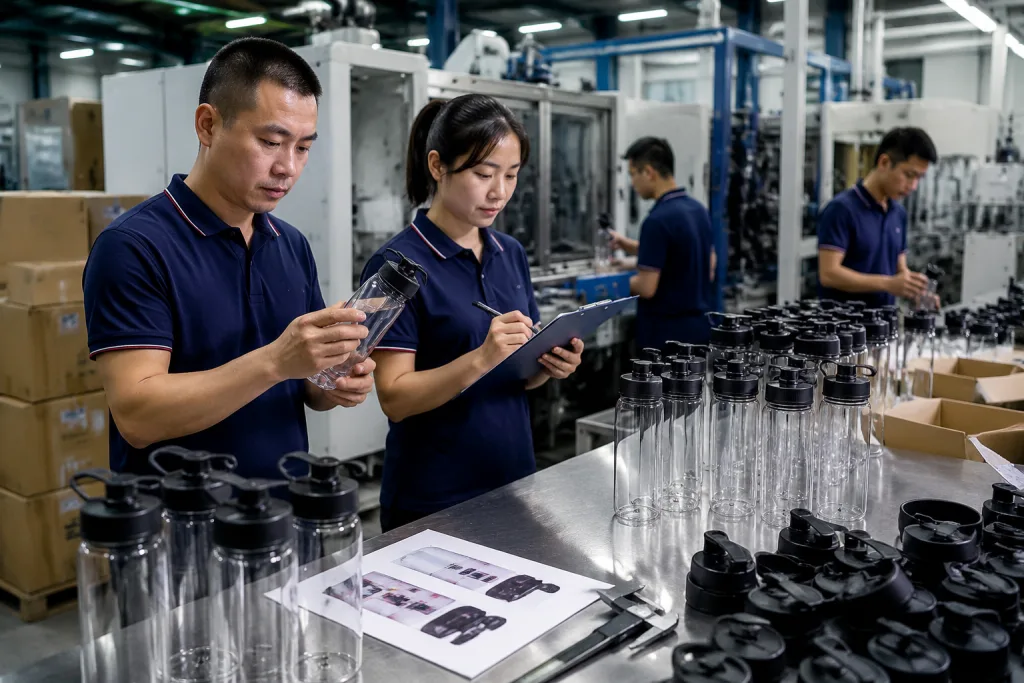
A Tritan bottle spec sheet looks simple until you have to sign off 10,000 units for retail, promotion, or distributor stock. Capacity tolerance, Eastman resin grade, lid thread fit, logo process, carton burst strength, and compliance testing all move your landed cost and your claim risk; on our line in Zhejiang, QC checks the first-off sample with a 0.02 mm caliper before we run mass production.
If you are comparing vendors tritan bottle quotations from China, unit price is the wrong question to ask first. A USD 0.18 cheaper bottle gets expensive fast when caps leak at 45° in the tilt test, FNSKU labels peel after 24 hours, or REACH documentation is missing; we have seen buyers flag a PO typo on “TRITAN” after cartons were already printed, and the math did not work. Here is how we read the spec line by line at our Zhejiang factory before we quote custom drinkware.
Material Line: Tritan Is Not Enough
A quote that says “Tritan bottle” is still missing two pieces we check before we open the mold file: the exact resin reference and the food-contact position. Tritan is a copolyester family, not one universal material. For export custom drinkware, buyers usually ask for BPA-free, low-odor transparent bodies, with impact resistance above cheap AS or PS plastic. Good start. Not a spec. Last month QC pulled a 750 ml sample from the line that looked fine under the light box, but the PO only said “Tritan,” with no resin grade written anywhere.
Ask your canteen supplier to confirm the resin source and food-contact declaration, then ask whether the body is 100% new material or mixed with regrind. For retail and corporate programs in Europe and North America, we run 100% new food-grade Tritan for the bottle body. Regrind may save USD 0.04-0.08 per unit, but the math doesn't work if the buyer flags cloudy bodies at final inspection. We’ve seen stress marks around the shoulder show up after 3 drop-test cycles from 1.2 m, especially near the gate mark.
Typical bottle body wall thickness should sit around 1.8-2.5 mm depending on shape and capacity. A 650 ml slim sports bottle can work at 1.8 mm if the mold has proper ribs. A 1,000 ml gym bottle usually needs closer to 2.2-2.5 mm, or it feels soft when squeezed. Feel sells. If you are sourcing a custom canteen or canteen promotional program, this is the wrong question to ask after sampling; buyers judge the bottle in the first 5 seconds, usually by squeezing the shoulder and checking the cap fit with a 0.05 mm feeler gauge.
For BottleForge Industrial in Hangzhou, Zhejiang, our standard MOQ for a customized canteen Tritan project starts at 3,000 units per color, with monthly plastic drinkware capacity around 420,000 units across bottle and tumbler lines. That scale matters because resin consistency and color batching are easier to control when production stays on one managed line instead of 4 small subcontractors in China. We ship with batch cards tied to each color lot, and our last issue was not material failure but a buyer PO typo: “smoke gray” on page 1, “clear gray” on page 3.
Capacity, Mold, And Real Use
Capacity on the PO is usually written as 500 ml, 650 ml, 750 ml, or 1,000 ml. Ask one question first: is it brim-full or practical fill? Brim-full means our lab tech fills the bottle to the top edge on a 0.1 g scale before the lid goes on. Practical fill leaves 15-25 mm headspace, so the cap can close without pushing water through the straw vent. A bottle marked 750 ml often gives 700-720 ml in normal use. We see this argument at least 6 times a year, and it is the wrong question to leave until carton artwork is finished.
This matters for distributor drinkware catalogs and online listings because complaints start fast when the claim is loose. If your box says 1 liter and the user pours in 930 ml with a kitchen measuring cup, the bottle may pass inspection, but the marketing claim is asking for trouble. Last month QC pulled the sample from line 3, checked it with a graduated cylinder, and the buyer flagged the 70 ml gap after the Amazon copy was already uploaded. A solid canteen manufacturer should list brim-full capacity and recommended fill capacity on the spec sheet.
Mold ownership needs a careful read. Existing factory molds keep tooling cost low and cut lead time: for an existing 750 ml Tritan sports bottle, sampling can take 7-10 days and bulk production usually takes 25-35 days after deposit. A private mold for a canteen customized shape can cost USD 3,500-12,000, depending on body complexity, cap tooling, grip insert, and number of cavities. Tooling lead time is normally 30-45 days before the first T1 sample. We run the first trial on a 160T or 200T injection machine, then the mold master checks flash, parting line, and cap fit with a go/no-go gauge.
If you are a canteen distributor or distributor canteen buyer, skip unusual shapes unless they fix a channel problem. Pretty renderings do not pay freight. A curved bottle may waste 8-12% carton space once we stack it into a 5-layer master carton. A square profile can look stronger on shelf, but it needs bigger corner radii to pass a 1.2 m drop test; we have seen sharp corners crack at the lower shoulder after the third drop. A useful spec sheet shows product size, net weight, carton quantity, and master carton dimensions, not just a clean image from the designer.
Lid System Drives Claims
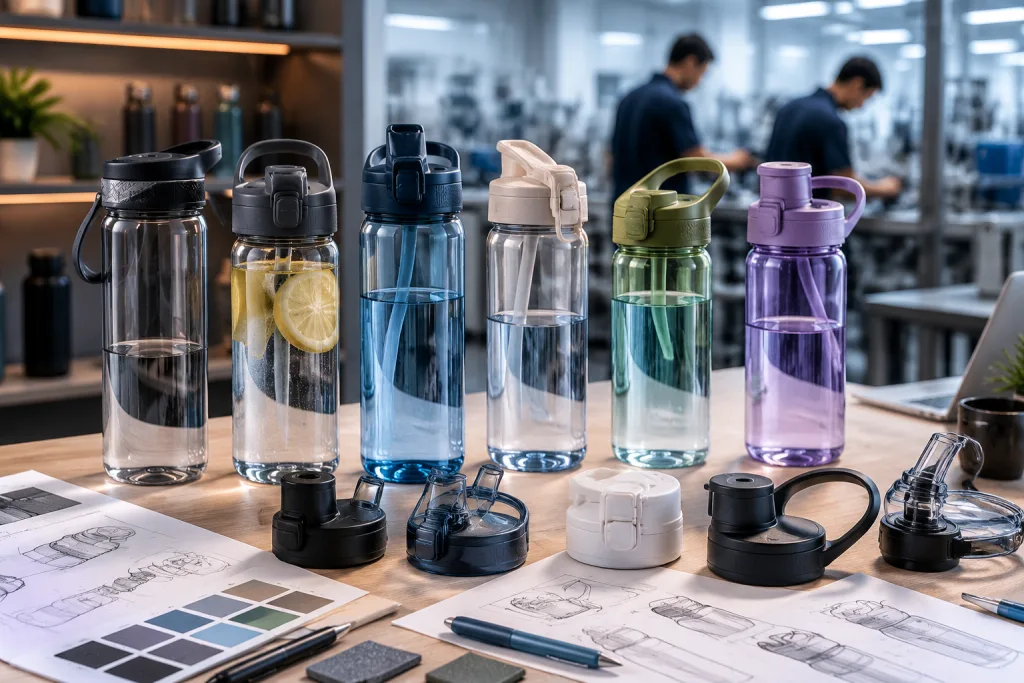
The lid is where most vendors tritan bottle jobs win or go sideways. Buyers stare at the clear body, then the first complaint is usually leak, odor, or a cracked cap. We run flip straw, screw cap, push-button one-hand lid, chug spout, and handle cap on the line, and each one changes cost, test time, and the claim you can print on the carton.
A basic screw cap stays the lowest-risk choice. Fewer parts. Easier washing. The mold stack is simpler, too. If a buyer asks for straw-lid pricing on a school order, I push back fast, because the math does not work: a flip straw adds the silicone straw, vent plug, hinge or spring, and about USD 0.25-0.45 FOB at the same volume versus a basic screw lid.
Leak testing belongs in the QC plan, not at the packing table. We use an inverted leak test for 30 minutes, a shake test for 15 seconds, and random torque checks on threaded lids with a torque wrench set to the spec. For push-button lids, the open-close cycle should reach at least 3,000 cycles for normal promotional use and 5,000 cycles for retail-grade programs. Silicone parts should be food-grade and removable for cleaning where possible.
For kids, outdoor, and canteen promotional orders, the carrying loop needs its own test. A soft TPE loop feels better in hand but can stretch after repeated pulls. A hard PP handle holds shape better, though a thin hinge can crack. For canteen distributors, we write in the handle pull test, usually 8-12 kg static load for 60 seconds on the pull gauge. That one line cuts a lot of after-sales noise.
Decoration Specs Change Cost
Logo application is not decoration only; it is part of the commercial spec. A customized drinkware order for a bank, fitness chain, university, or distributor growler program gets checked first by color match and logo wear after handling. For Tritan bottles, we run silkscreen printing, heat transfer, UV printing, pad printing, and sometimes laser marking on stainless accessories, not on the Tritan body. Last month QC pulled the sample under a D65 light box, and the buyer flagged a 1.5 mm logo position drift before we released the line.
Silkscreen is practical for 1-2 color logos on straight or gently curved surfaces. It is the safer choice for canteen custom orders above 3,000 units when the artwork is not chasing photo-level detail. A one-color logo may add USD 0.06-0.12 per unit depending on print area. Heat transfer suits full-wrap or gradient artwork, but it can add USD 0.18-0.40 per unit and needs stricter adhesion testing. UV printing works for smaller runs and multi-color artwork, but large curved surfaces need fixture control; if the jig has 0.8 mm play, the print edge walks. We have seen this go sideways.
Color matching needs a spec line. “Blue” is the wrong question to ask. Use Pantone C or U codes and confirm whether the color applies to the lid, body tint, silicone ring, straw, or packaging. For transparent Tritan bodies, color masterbatch shifts under different lighting; one buyer approved a chip in office light, then rejected the same tone near a warehouse door at 4 p.m. We normally send color chips or pre-production samples before bulk production for orders above 5,000 units, and we label them by part name so nobody mixes up lid blue with body blue on the PO.
Print adhesion testing should include 3M tape pull, 50-cycle wet rub, and dishwasher discussion if you plan to claim dishwasher safe. Be careful with that claim. Some Tritan bodies tolerate top-rack dishwasher conditions, but printed logos and lid components may not. A serious canteen manufacturer in China should separate material tolerance from finished-product claim; the math does not work if a USD 0.06 print gets treated like molded-in color after 20 wash cycles. On our side, QC records tape angle, rub weight, and water temperature before the shipment file is closed.
Compliance Is A Buying Spec
I’ve got the rewrite scope. Next I’m tightening the prose so it sounds like a factory-side buyer note, while keeping every HTML tag in place.Compliance should not wait until after production. If you ship to the EU, ask for food-contact declarations, and add REACH statements when the resin or additive falls under it. For the US, buyers usually ask for FDA food-contact support, and for children’s products they may also want CPSIA or ASTM test reports based on the age grade and sales channel. If your buyer is a national chain, their checklist will run tighter than the legal minimum. We see that on the line when the PO names the lab before artwork is approved.
AQL is the factory language, and the math does not work if you leave it vague. For most customized drinkware shipments, we run AQL 2.5 for major defects and 4.0 for minor defects. Sharp edges, contamination, serious leakage, or the wrong material stay at zero tolerance. A one-page defect chart beats an argument at the loading dock, which we have seen go sideways more than once. QC pulled the sample with a 3 mm gauge, and that ended the debate.
For a Tritan bottle line, the usual checks are visual inspection, capacity, leak test, cap torque, drop test, barcode scan, logo adhesion, odor check, and carton drop. On our bench, the cap torque wrench is set before the test starts, not after. A 1.0-1.2 m drop on a filled bottle is common for sports SKUs, but the height should match the market. A 1,000 ml bottle with a rigid lid needs a different call than a 500 ml giveaway. The buyer flagged that once when the sample passed dry and failed full.
Factory audits matter when you sell to established distributors. BSCI, Sedex, or ISO 9001 paper does not make a bottle perfect, but it tells you whether the supplier runs a real control system. BottleForge Industrial works from Zhejiang, China with incoming material checks, inline QC, and final random inspection reports for export orders. We keep the COA and lot code at the packing table because the buyer often asks for proof two days before ship. A typo on the PO can slow carton marking, so we catch it before the pallets move.

Packing, Labels, And Logistics
Packing looks like the dull line on the spec sheet until a shipment lands with 3 crushed gift boxes in the first carton QC opens. For Tritan bottles, we usually run one bottle in a PE bag or 28 gsm paper wrap, then an inner box or egg-crate divider depending on the finish, then a 5-ply K=A master carton with tape over the long seam. Glossy logos and clear bodies mark easily. QC pulled samples after a 1.2 m drop test last month, and the rubbing showed up right where the bottle shoulder touched the divider.
For Amazon, marketplace, and distributor drinkware orders, label control is part of the product. FNSKU labels, carton labels, suffocation warnings, country-of-origin marking, and mixed-SKU carton rules need sign-off before the line starts packing. We once had a PO with “Made in PRC” typed on the carton artwork while the buyer’s routing guide required “Made in China”; that small wording issue held 860 cartons for relabeling. A canteen vendor that only quotes FOB Ningbo or FOB Shanghai without asking the final sales channel is doing half the job. The bottle can pass inspection and still be unsellable if the labels are wrong.
Carton specs should show carton size, gross weight, units per carton, barcode placement, and drop-test requirement. For 650-750 ml Tritan bottles, we usually pack 24 units per carton, around 13-14.5 kg gross depending on lid style. For larger 1,000 ml bottles, 12 or 18 units cuts compression damage; the math does not work when a tall carton stacks 6 layers high in a humid container. Keep master cartons below 15 kg where possible for warehouse handling. If you are building a custom growler or customized growler line in plastic or stainless, packing rules change again because the unit weight and surface finish are different.
FOB terms need clean wording. FOB Ningbo from Zhejiang is common for us; FOB Shanghai adds trucking cost, often 1-2 days, but it can fit better with a buyer’s consolidation schedule. Air freight works for urgent promotional orders, but bulky drinkware punishes the rate because the chargeable weight jumps on carton volume. If timing is tight, we ship 5-10% by air for launch stock and send the balance by sea. We have seen this go sideways when a buyer asked ocean freight to save a missed artwork approval date.
Price Lines Worth Challenging
A serious vendors tritan bottle quote should break out enough detail to compare line by line. Ask for body material, capacity, lid type, logo method, packing method, MOQ, sample time, production lead time, FOB port, payment terms, and test basis. On our drop-test rack, a 5-ply carton, silicone spare parts, and AQL 2.5 change the cost fast, so the cheap line item is often the wrong one.
As a working reference, a 650-750 ml Tritan bottle with screw or flip lid, one-color logo, and standard carton packing often lands around USD 1.45-2.30 FOB China at 3,000-10,000 units. A push-button lid, full-wrap print, gift box, or premium handle can move that to USD 2.40-3.80. We ran the same body on the molding line with a 68 mm cap last month, and the buyer flagged the quote once the lid spec changed. Resin price, exchange rate, and order season can shift the number, so use these ranges to press back on vague offers.
Payment terms are usually 30% deposit and 70% before shipment for first orders. For repeat canteen distributors with stable volume, better terms can be discussed after several clean shipments. Samples are usually USD 50-150 for existing items with logo setup, refundable against bulk orders in some cases. Our QC pulled two logo samples on the pad printer before release; that is the kind of detail that tells you whether the sample fee is real or just noise. Private mold samples are different, and tooling does not start without a tooling deposit.
The best buying habit is simple: approve a written spec, not a chat screenshot. That is the right question to ask. Whether you source a customizable growler, canteen customized bottle, or broader customizable drinkware range, the signed spec sheet should become the inspection standard. We have seen this go sideways when the PO had a typo on the lid color and nobody caught it until packing. That sheet protects you, the factory, and your customer when production starts moving fast.
Send Your Tritan Bottle Spec For Factory Review
Share capacity, lid, logo, packing, target price, and market. Our Zhejiang team will check the spec and quote practical options.
Frequently asked questions
What MOQ should I expect for a custom Tritan bottle order?
For existing molds, a realistic MOQ is 3,000 units per color for most vendors tritan bottle projects. Some canteen suppliers may accept 1,000 units, but the unit price rises because resin color matching, logo setup, and packing labor are spread across fewer pieces. For custom color bodies, 3,000-5,000 units is more practical. For private mold projects, expect 10,000 units or more for a sensible first production run, plus tooling cost of roughly USD 3,500-12,000 depending on shape and lid complexity.
Can Tritan bottles be dishwasher safe?
The Tritan body can often tolerate top-rack dishwasher conditions, but the finished bottle claim depends on the lid, silicone parts, print method, and temperature cycle. A one-color silkscreen logo may not survive repeated high-heat washing as well as the body. If you want to print “dishwasher safe” on packaging, ask your canteen manufacturer to run finished-product testing, not only material testing. We normally separate body heat resistance, lid deformation, and logo adhesion into different checks before approving that claim.
How long does production take after sample approval?
For an existing mold with standard color and one logo, normal production lead time is 25-35 days after deposit, artwork approval, and pre-production sample approval. Add 5-10 days if you need custom masterbatch color, retail gift box printing, or more complex logo work. Private mold projects take longer: usually 30-45 days for tooling and T1 samples, then another 25-35 days for bulk production after the mold is corrected and approved.
What tests should I require before shipment?
At minimum, require AQL inspection with leak testing, visual defect check, capacity measurement, cap torque check, print adhesion, barcode scan, odor check, and carton drop testing. For retail or distributor canteen programs, use AQL 2.5 for major defects and 4.0 for minor defects, with zero tolerance for sharp edges, contamination, or serious leakage. If the product is for children, add age-grade and market-specific testing such as CPSIA or ASTM-related checks where applicable.
Is Tritan better than stainless steel for promotional canteens?
It depends on the channel. Tritan is lighter, transparent, and usually cheaper for a canteen promotional order, with many 650-750 ml projects around USD 1.45-2.30 FOB China at 3,000-10,000 units. Stainless steel is better for insulation, premium gifting, and custom growler programs, but it costs more and weighs more. If your buyer wants a low-cost gym, school, or event bottle, Tritan is practical. If they want hot/cold retention, choose stainless vacuum construction.