Key Takeaways
- A practical MOQ for a custom travel tumbler is usually 500-1,000 pcs per SKU, with 3,000+ pcs for deeper customization.
- A usable FOB price band for a 16 oz insulated tumbler is often USD 2.80-6.50, depending on steel grade and decoration.
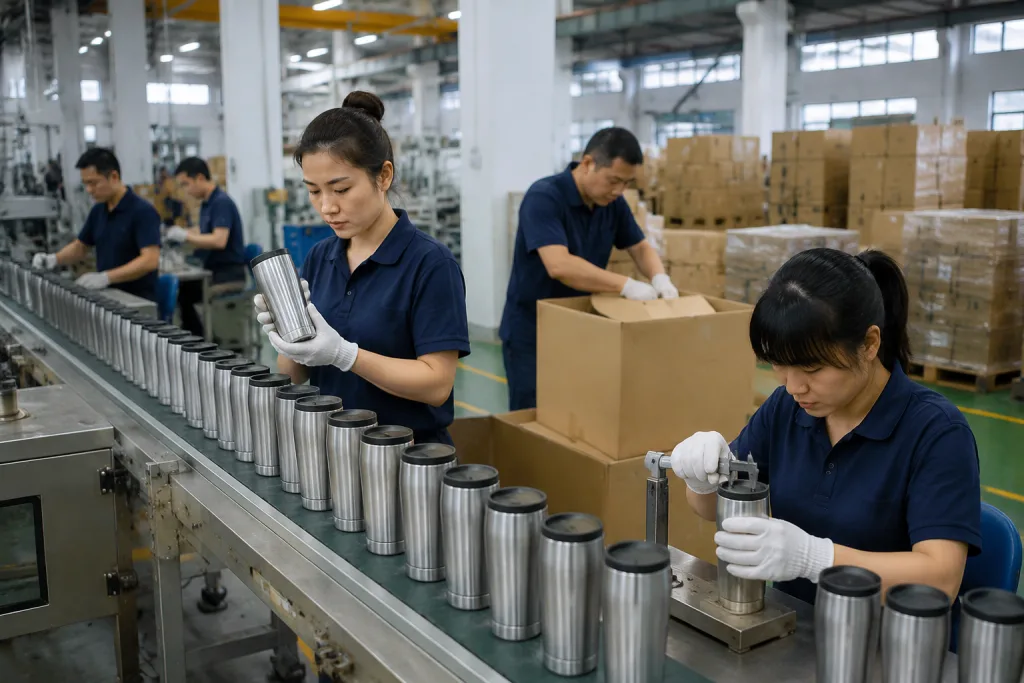
- A Zhejiang factory with 280,000 units/month can support repeat programs, but only if you lock spec, artwork, and carton plan early.
- AQL 2.5 for major defects and 4.0 for minor defects is a reasonable starting point for drinkware inspection.
If you are sourcing a vendors travel tumbler program, you are not buying a cup. You are buying fill rate, shelf presence, and a product that gets through a 12 kg export carton without leaking, denting, or eating your margin. Ask the dull questions first. What is the MOQ? What is the real FOB? Which lid passes a 30-second shake test after QC pulls the sample from the line?
We build in Zhejiang, China, and we see the same issue on bulk travel mug orders for coffee launches and coffee mug customized projects for corporate gifts: the spec sheet decides the result. A factory direct quote should give you wall thickness in mm, steel grade, decoration method, packing, and lead time without three follow-up emails. If the quote only says “premium stainless steel,” the math does not work. The buyer will flag it later.
What are you buying, exactly?
When buyers search vendors travel tumbler, price usually gets the first look and spec gets the second. That order is wrong. First decide if you need a promo piece, a retail-ready insulated cup, or a private label SKU that has to sit on a shelf for 12 months. A 500-piece seasonal coffee travel mug order can live with simpler cartons and lighter print. A coffee mug private label run cannot; QC pulled one sample last week and the lid failed a 3-meter leak check, so the whole carton had to be reworked.
Start with the use case and work back to the build. A coffee brand needs the tumbler to hold heat through a 35-minute commute and still clean up well after repeat use. A corporate-gift buyer wants it to look sharp on day one and stay readable after 50 wash cycles. If you are scanning a coffee mug supplier list or a coffee mug supplier directory, ask for the base material, lid build, and insulation method in the first email. We ship fewer wrong quotes that way. The math does not work if those three points are still vague.
- Ask for steel grade: 304 covers standard food-contact use; 316 makes sense when the buyer wants a stronger corrosion story for coastal or outdoor programs.
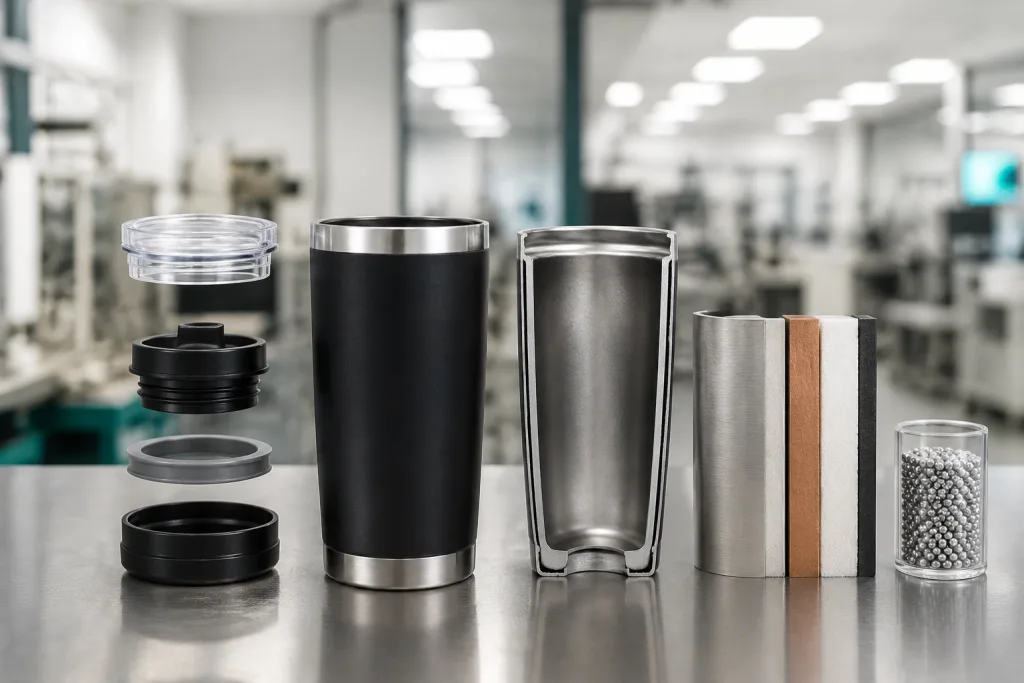
- Ask for wall structure: single-wall, double-wall, or vacuum insulated, because a 0.5 mm wall and a vacuum cup do not price the same and they do not perform the same.
- Ask for packaging: individual box, bulk pack, or retail box with barcode and FNSKU space; we have seen a PO typo send 2,000 units to the wrong carton spec.
If a coffee mug factory cannot answer those three points fast, they are selling you a guess.
Which specs actually matter?
The best bulk travel mug is not the one with the longest feature sheet. It is the one with the fewest places to fail. On the line, we see complaints start at the lid seal, thread fit, powder coat adhesion, or vacuum integrity. QC pulled 32 pcs from a 3,000 pcs pilot run last month; 5 leaked after the lid was tightened past the stop mark. If you want a bulk coffee tumbler that does not come back with buyer photos and red circles, freeze the spec before sampling gets creative.
Buyer checklist
- Capacity: 12 oz, 16 oz, or 20 oz; do not force a 20 oz body into a 16 oz retail box. The math does not work once the insert card and polybag are added.
- Body thickness: 0.4-0.6 mm stainless steel is common; 0.4 mm saves weight, while 0.6 mm takes dents better in carton drop tests.
- Lid material: PP for economy, Tritan for clearer premium presentation, silicone gasket for better sealing. Ask for the gasket hardness, not just the color.
- Finish: powder coat, matte spray, polished steel, or soft-touch; each changes scratch resistance. We run tape tests before approving a new coating batch.
- Performance target: hot retention of 6-12 hours and cold retention of 12-24 hours, depending on construction. A narrow 20 oz body usually beats a wide 12 oz cup.
For coffee mug custom made programs, ask for a simple test set: hot water leak test, 1-meter drop test, and 24-hour temperature hold. Basic, yes. It still catches most bad structures before mass production. We fill samples to 90%, lock the lid, turn them upside down for 30 minutes, then record the result on the inspection sheet. A coffee mug manufacturer in Zhejiang should show these checks without drama; this is normal factory work in China, not special treatment.
How should you brand it?
Branding is where 7 out of 10 coffee mug customized quotes start leaking margin. Buyers ask for “just a logo,” then the artwork lands across a seam, a taper, or a lid curve. We run straight-screen print on flat powder-coated bodies with a 120T mesh screen, and it holds fine after the tape test. Put that same print on a travel lid and QC pulled the sample after 200 rubs because the edge started lifting. Laser engraving lasts better and looks cleaner on a coffee mug custom or coffee mug customizable line, but the coating has to be dark enough, or the bare 304 stainless patch needs enough contrast to read from 60 cm.
If you are building coffee mug promotional products for events, keep the spec tight: 1 imprint location, 1 PMS color, 1 carton mark. Simple ships. For a 5,000 pcs conference order, that usually means fewer artwork approvals and 12 days production instead of 18 days with mixed decoration. If you are building coffee mug private labeling for retail, the buyer will flag shelf impact, barcode placement, and whether the logo is visible from 1.5 meters away under store lighting. We have seen this go sideways when the PO says “logo front,” but the dieline puts the barcode on the same face.
Rule of thumb: if the decoration needs a long explanation, it is probably too expensive for a bulk program.
A good coffee mug oem manufacturer gives imprint area drawings, not just a pretty mockup. Ask for exact width and height in millimeters, plus the safe zone around the seam and handle. On our line, we normally keep 8 mm away from a weld seam and 12 mm from a handle joint before printing. If you are comparing coffee mug distributors against a factory direct source, the factory usually wins because it controls mold, coating, and print timing under one roof. The math does not work when a middleman approves a 45 mm logo, then the jig only supports 38 mm. That is why a coffee mug factory direct quote needs the real imprint drawing attached, not just a JPEG render.
What price should you expect?
Pricing for a bulk coffee mug or bulk coffee travel mug is not material plus labor. Lid mold, powder-coating loss, logo setup, inner box spec, carton cube, and file revisions all hit the quote. We had one PO last month where the buyer wrote Pantone Black C with two spaces and no coating code; QC pulled the pre-production sample, and the line waited half a day for confirmation. A clean RFQ saves money. A vague RFQ creates sample rounds and surprise charges.
For a standard 16 oz vacuum tumbler, a realistic FOB range is often USD 2.80-6.50 per piece at 500-1,000 pcs, depending on steel grade, finish, and decoration. A simple one-color logo in one position is cheap, usually because we run it on the pad printer with a 60 mm print window. A wrap print, gift box, or custom lid can add USD 0.25-1.20 each. If you are chasing coffee mug bulk pricing for a distributor program, ask the supplier to break out tooling, decoration, packaging, and carton loading separately, or the math gets muddy fast.
Commercial checklist
- MOQ: 500 pcs per color is practical for stock bodies we already run; custom color or custom lid may need 1,000-3,000 pcs because the coating line does not like tiny batches.
- Lead time: 20-30 days for repeat stock work, 35-45 days for new custom production after artwork approval and pre-production sample sign-off.
- Terms: FOB Ningbo or FOB Shanghai are common from Zhejiang suppliers; some buyers choose EXW when their forwarder is consolidating drinkware, bags, and small appliances in one warehouse.
- Sample fee: USD 30-80 per sample is normal and often refundable on order, but custom logo samples cost more if we need a new screen or laser jig.
When you talk to coffee mug suppliers, asking only for the cheapest unit price is the wrong question. Ask for landed cost into your warehouse or 3PL, including carton size, gross weight, and how many pieces fit a 40HQ. We have seen a USD 0.18 cheaper tumbler lose money because the master carton was 58 cm tall and loaded 11% fewer pieces per container. That landed number decides whether the program works.
How do you avoid bad lots?
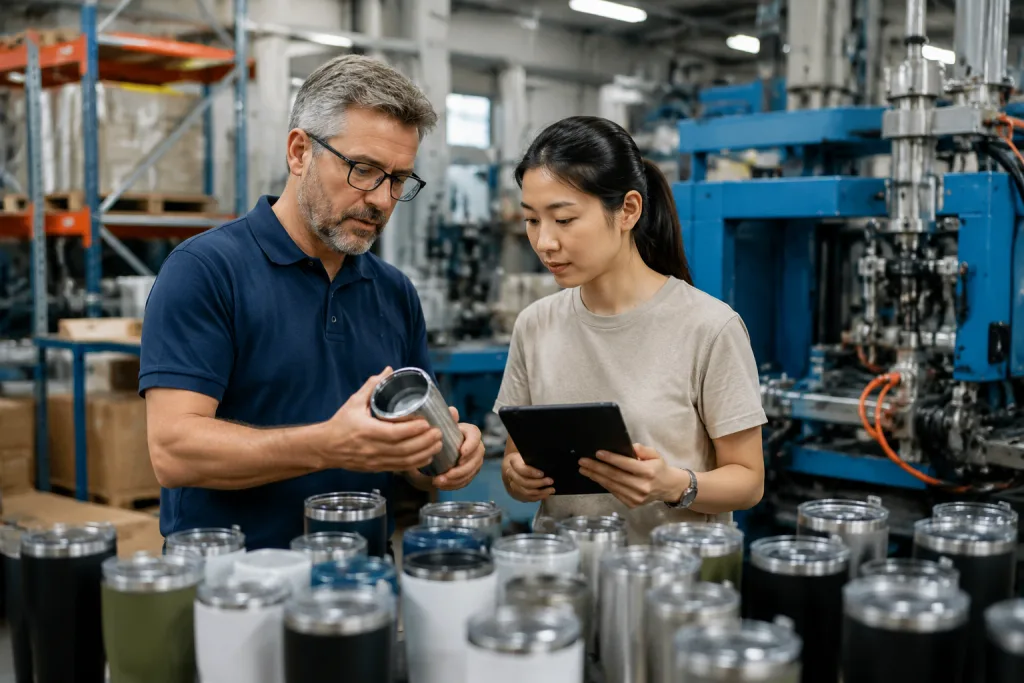
Quality control is where a factory proves it is a partner, not just a mailbox. For a travel tumbler, we run leak tests on the assembled lid, check powder coating under a 6500K light box, verify vacuum hold after 8 hours, measure logo position with a 0.5 mm tolerance, and do carton drop checks before booking space. Short test plan, big difference. If the supplier replies “all ok” without showing the checklist, the buyer is asking the wrong question.
For a Zhejiang factory, I expect incoming 304 stainless checks with a handheld XRF gun, in-line leak testing at the assembly table, and final inspection by AQL. AQL 2.5 major and 4.0 minor is a sensible starting point for most drinkware buyers. For retail or Amazon programs, tighten cosmetic limits on dents, lid scratches, and coating pinholes; we’ve seen this go sideways when 1.2 mm FNSKU label drift caused warehouse relabeling on 38 cartons.
- Compliance: request REACH, LFGB, FDA food-contact support as needed for your market, and match each report to the exact PP lid, silicone ring, straw, or coating used on the PO.
- Factory system: ISO 9001 and BSCI help, but ask for actual audit dates, scope, and whether the drinkware line was included; one buyer flagged a 2022 audit that only covered office records.
- Packaging test: confirm carton compression and drop protection if the route is long-haul export, especially for 12 kg master cartons and 1.2 m drop testing on corners.
A coffee mug factory should keep a golden sample and production sample for each SKU, with the color code, logo file name, and lid version written on the sample tag. Sounds old-school. It saves fights later when QC pulled the sample and the buyer claimed the handle logo was 3 mm too low. In China, the factories that survive export work document details. The rest sell stories.
Send your tumbler spec for a factory quote
We can review material, MOQ, branding, and packaging in one pass so you get a workable bulk price, not a guess.
Frequently asked questions
What MOQ should I expect from vendors travel tumbler suppliers?
For a standard custom tumbler, 500 pcs per SKU is a realistic starting point if the body and lid are stock tooling. If you want a custom color, custom carton, or a specific lid shape, expect 1,000-3,000 pcs. Full OEM work with new mold changes can go higher. A coffee mug private label buyer should also budget one sample round and one pre-production sample, because that is usually where logo size and lid fit get finalized. In Zhejiang, many factories can support mixed orders, but they still want one clear spec per SKU.
What is a fair FOB price for a bulk coffee travel mug?
For a 16 oz double-wall vacuum tumbler, a fair FOB range is often USD 2.80-6.50 each at 500-1,000 pcs. The low end is a simple body with one-color decoration and standard packaging. The high end covers premium coating, laser engraving, gift box, or upgraded lid materials. If a coffee mug supplier quotes far below that range, check what is missing: steel grade, insulation performance, or packaging. If they quote far above it, they may be adding unnecessary margin or expensive setup fees.
Which decoration method lasts best on a travel tumbler?
Laser engraving usually lasts the longest because there is no ink layer to wear off. On powder-coated stainless steel, laser gives a clean premium look for coffee mug custom made and coffee mug customizable programs. Screen printing is cheaper and works well for coffee mug promotional products, but it can scratch if the tumbler is washed aggressively or packed tightly in transit. If you need strong retail durability, ask for a rub test, a dishwasher cycle test, and a sample photo after 24 hours in hot water.
What certifications should I request for Europe and North America?
At minimum, ask for food-contact compliance support such as LFGB for Germany, FDA-related food-contact statements for the U.S., and REACH documentation for restricted substances. For factory systems, ISO 9001 and BSCI are useful signals, but they are not a substitute for product testing. If your customer needs extra assurance, request material declarations for 304 or 316 stainless steel, BPA-free statements for lids, and silicone composition details. A serious coffee mug manufacturer should provide these without turning it into a special favor.
Should I buy from a coffee mug factory direct or a distributor?
If your order needs custom color, custom logo placement, or a private label carton, factory direct is usually better because the same team controls molding, coating, and packing. A distributor can be useful for small urgent buys or when you only need stock inventory, but the margin is usually higher and the spec control is weaker. For repeat programs, a coffee mug factory direct relationship in China or Zhejiang gives you better visibility on lead time, QC, and re-order stability. If you are comparing a coffee mug supplier list, ask who actually owns the production line.