Key Takeaways
- A practical custom tumbler MOQ starts at 500 pcs for stock colors and 3,000 pcs for custom powder coating
- 304 stainless steel at 0.4-0.5 mm outer wall thickness is the safe baseline for a bulk travel tumbler
- Laser engraving suits premium coffee mug private label orders; silkscreen is better under USD 0.20 per logo
- Plan 25-35 days production after artwork approval, plus 7-35 days freight depending on air, rail, or ocean
Searching for a vendors travel mug looks simple until the 6 quotations on your desk read the same. One coffee mug supplier writes 500 pcs MOQ, another writes 3,000 pcs, and both use glossy photos that hide 0.45 mm vs 0.55 mm wall thickness, powder-coat adhesion, lid fit, and 5-layer carton strength. We see this weekly. If you are buying for a coffee brand or a corporate-gift run, QC pulled sample lids with a 0.8 mm wobble before; that small gap is what turns a “premium” mug into 200 complaint emails.
“Find the cheapest coffee mug factory” is the wrong question to ask. Decide four things before chasing price: cup structure with target capacity and steel grade, logo process with artwork tolerance, packing route with carton drop-test needs, and AQL 2.5 inspection points. On our Zhejiang, China line, buyers usually save more by locking these choices before tooling than by pushing another USD 0.08 off the unit price; we once had a PO typo change matte black to glossy black, and the math did not work after 36 cartons were already packed.
Start With The Use Case
A vendors travel mug for a coffee subscription box is not the same product as a conference giveaway. The coffee customer uses it at 7:30 a.m., checks whether the drink is still hot after the school run, and might photograph it next to your 250 g bag of beans. The corporate-gift buyer usually pushes us on delivery date, logo position, and a unit price that stays inside a fixed procurement cap. Before asking for a coffee mug supplier list, define the job of the mug. We see this go sideways when the PO says “travel cup” but the artwork file is built for a straight wall, not a tapered body.
For coffee brands, we run 12 oz and 16 oz stainless travel tumbler projects most often, with a slim cup-holder base, powder coating, and a splash-resistant lid. The 16 oz size fits the North American café habit better; 12 oz looks sharper for espresso-based drinks and retail shelves in Europe. For corporate gifting, 20 oz can work if the packaging budget is controlled. Big boxes punish you. On our packing table, a 20 oz tumbler in a color box can cost 18-28% more to ship per unit than a 12 oz tumbler, even when the factory price gap looks small on the quotation sheet.
If you are sourcing a bulk coffee mug for office programs, ask whether the product needs to survive dishwashers, car cup holders, and courier drops from about 80 cm. Buyers often ask only for “double wall vacuum,” but this is the wrong question to ask. Will people use it 260 workdays a year, or will it sit in a tote bag after one event? Daily-use programs need tighter lid tolerance, better coating adhesion, and an AQL inspection; QC pulled one sample last month because the slider lid gap measured 0.7 mm too wide. One-off promotional programs can use simpler lids and single-color silkscreen to keep the coffee mug promotional products budget under control.
Do not start with the catalog. Start with the setting: café shelf, employee gift, event table, online bundle, or distributor inventory.
Pick The Tumbler Construction
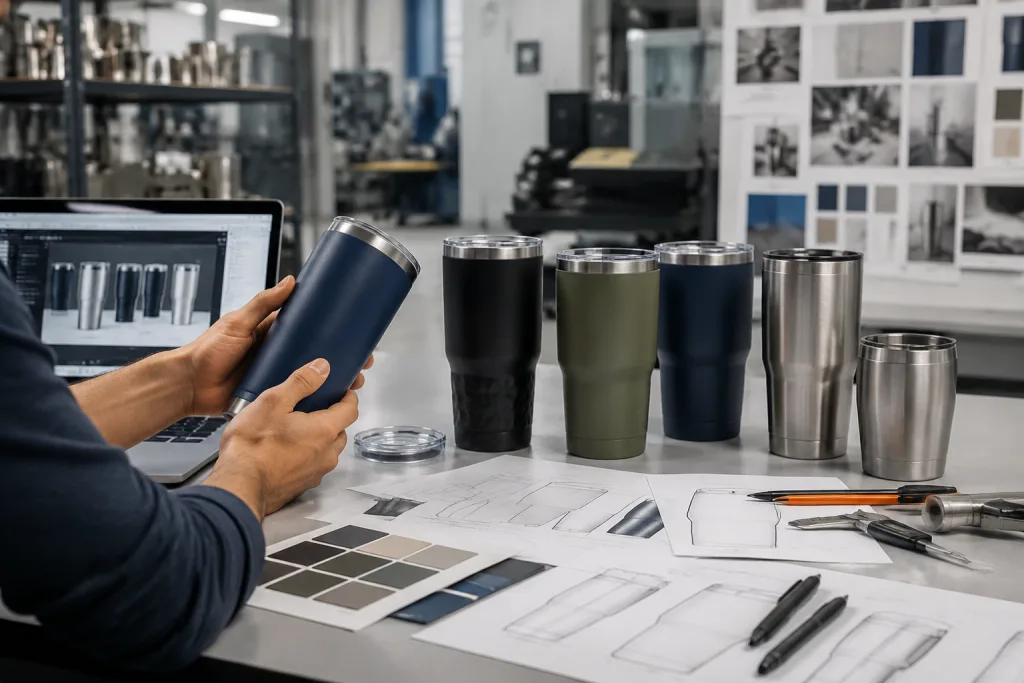
Construction sets the quote before we even talk about logo: price, weight, insulation, dent risk, and how the buyer feels when the carton is opened. For the inner liner, we run food-grade 304 stainless steel as the normal choice for any bulk coffee travel mug. For the outer shell, 201 stainless saves about USD 0.18-0.35 on a 16 oz cup in recent quotes, but I push back on it for coffee mug private labeling if the brand wants repeat use and fewer rust emails. We have seen this go sideways after salt-spray testing, where QC pulled the sample and found orange spots near the bottom seam after 24 hours. For a coffee mug custom made for a premium coffee brand, specify 304 inner and 304 outer, or ask the factory to write the steel grade on the PI and carton spec sheet.
Wall thickness matters. No shortcut here. A common commercial range is 0.4-0.5 mm for the outer wall and 0.3-0.4 mm for the inner wall. Below that, the tumbler can look fine in a WeChat photo but dent when 24 pcs cartons get stacked under 13 kg during truck transfer to Ningbo port. For a bulk travel mug program, a 0.05 mm difference can change cost by USD 0.12-0.25 per unit depending on capacity and steel price. That is real money, but replacing dented stock costs more when the buyer flags 7 cartons in AQL 2.5 inspection.
Lids are where coffee mug manufacturers often shave cost quietly. Check whether the lid is PP, Tritan, or AS, whether the gasket is silicone, and whether spare gaskets can ship with the order at 1%-2% of MOQ. A sliding lid looks convenient, but cheap sliders trap coffee residue; we had one café buyer reject samples because the slider smelled sour after three dishwasher cycles. For a coffee mug customized for café retail, I prefer a simpler press-fit lid with a clean drink opening, tested for 180-degree tilt leakage for 30 seconds. It is honest: not fully leakproof, but safe for walking and car use.
- Budget promotional: 12-16 oz, 201 outer and 304 inner, PP lid, silkscreen logo for short event orders where price beats lifespan.
- Coffee retail: 12-16 oz, 304 inner and outer, powder coating checked by cross-hatch tape test, laser or 1-color print.
- Corporate premium: 16-20 oz, 304 stainless, gift box packed in 5-layer export carton, optional handle lid for commuter use.
Control Branding Before Pricing
Branding is not decoration; it decides the process route on the line. If a buyer asks for coffee mug custom pricing before final AI artwork, we can only quote a working number. Same stainless body, different headache. A coffee mug customizable by laser, silkscreen, heat transfer, or 360-degree UV print needs different fixtures, curing time, and QC checks; last month QC pulled 32 pcs from a UV trial because the logo sat 2 mm too close to the taper.
Laser engraving is the safest choice for premium travel tumblers. It does not peel, it holds 0.3 mm small text, and it looks sharp on powder coating when the rotary jig is centered. The trade-off is simple: you get the steel color underneath, not Pantone ink. A typical laser logo cost is USD 0.12-0.35 per unit after a USD 30-60 setup, depending on logo size. Silkscreen works for a one-color logo on a flat panel or gentle curve. It can be under USD 0.20 per unit at 1,000 pcs, but wraparound art is where we have seen this go sideways, especially when the buyer sends thin lines under 0.25 mm.
If you need a coffee mug customized with full-color artwork, heat transfer or UV printing can work, but plan for extra sample approvals and tougher abrasion checks. We run 3M tape pull and 50-cycle rub tests before signing off. For coffee brands, a small front logo plus custom paper sleeve often sells better than a loud full-wrap design. This is the wrong question to ask if the goal is only “more print area.” People carry a travel tumbler in public; subtle branding feels more expensive.
Private label buyers should decide the full mark plan before pricing: base engraving with diameter in mm, lid embossing with mold cost, gift box artwork with barcode position, insert card copy with warning text, and master carton shipping mark with country-of-origin wording. Coffee mug private labeling is not just the tumbler. If you sell through distributors or online channels, carton labeling, barcode placement, and country-of-origin marking belong in the order file. In China export production, unclear artwork is one of the top 3 causes of 5-7 day delays before mass production starts; we once lost 6 days because the PO showed “matte black” while the artwork file said “black glitter.”
Match MOQ To The Channel
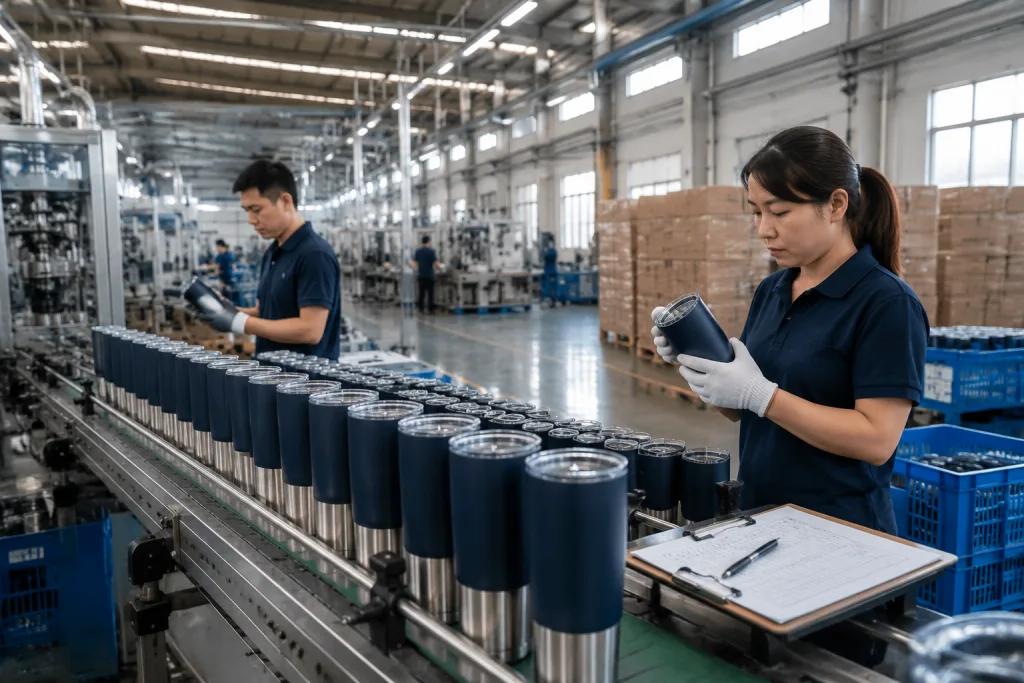
MOQ is not a moral test. It is a tooling, coating, and line-change calculation. At our Hangzhou, Zhejiang facility, we run about 450,000 units per month across stainless bottles, tumblers, and thermos lines. For a stock-color vendors travel mug, 500 pcs per SKU is workable because the line can pull from approved black, white, navy, or stainless inventory. For a custom Pantone powder coat, the MOQ is usually 3,000 pcs. Below that, the math doesn't work after the coating booth is cleaned, the spray gun is reset, and QC checks color with the Pantone book under D65 light.
If you are a coffee mug distributor testing a new market, start with stock black or stainless and spend the saved money on packaging inserts and AQL 2.5 inspection. We have seen this go sideways: one buyer wanted five colors at 500 pcs each, then flagged shade difference on the navy sample after QC pulled 12 pcs from the first carton. If you are a national coffee chain or large corporate-gift buyer, custom coating makes sense above 3,000-5,000 pcs because setup cost gets spread across enough units. A coffee mug in bulk order split across too many colors is the common trap. Two colors at 1,250 pcs each usually ships cleaner than five small color lots.
Price bands only mean something when the specification is locked. As a rough FOB China guide, a 12 oz double-wall stainless travel tumbler may run USD 3.20-4.60 at 1,000 pcs. A 16 oz powder-coated bulk coffee tumbler often sits around USD 4.10-5.80. Gift packaging can add USD 0.35-1.20, and a 350 gsm tuck box behaves differently from a rigid box with EVA insert. These are not promises. Steel price, exchange rate, lid type, and logo method move the number; last quarter, one PO typo changed laser logo to silk print, and the buyer flagged it only after we sent the pre-production photo.
For coffee mug factory direct buying, ask each vendor to quote the same Incoterm, preferably FOB Ningbo or FOB Shanghai if your freight forwarder already handles booking. EXW China looks cheap on paper, then inland trucking, export handling, and documentation land on your side of the bill. We ship Ningbo often, and a 20 ft container quote can swing by USD 180-260 just on local charges depending on warehouse pickup point. This is the wrong question to ask if you only compare unit price.
Packaging Is A Cost Decision
Packaging is where coffee buyers and gift buyers either keep margin or burn it. A retail coffee mug custom program may need a printed color box, product insert, QR code, and barcode. A corporate order may need a white gift box with a logo sticker and outer carton labels by department. A distributor may want neutral cartons because the same bulk travel tumbler goes to three accounts. The wrong question is “What looks best?” The real question is, what will the box do on the line and in transit.
The box should match the shipping method. For ocean freight, carton compression and humidity matter. For parcel fulfillment, drop resistance matters more. A common tumbler gift box uses 350-400 gsm paperboard, but that alone will not stop corner crush. We normally run an inner polybag or paper wrap, a fitted box, and a 5-ply export carton for heavier 20 oz mugs. QC pulled a sample after a 60 cm drop, and the lid kept the cup safe but the corner panel still scuffed. For Amazon-style programs, FNSKU labeling and carton weight under 15 kg can prevent warehouse handling problems.
Custom packaging MOQ can sit above tumbler MOQ. A printed box may require 1,000-2,000 pcs, while a stock white box can start at 500 pcs. We have seen buyers push back hard on box MOQ, then send a PO with a 1,200 pcs mug order and a full-color sleeve for every unit. The math does not work. If you want a coffee mug promotional order for an event, do not overbuild the box. Put the money into a clean logo, a lid that does not rattle, and carton marks that help the receiving team count fast.
Buyers often compare coffee mug supplier directory options by unit price only. That misses dimensional weight. A 16 oz tumbler in a loose oversized box can add USD 0.20-0.60 per unit in freight compared with a tighter box. We ship plenty of cartons that look cheap on paper but jump one DIM bracket because the outer size is 42 x 42 x 28 cm instead of a tighter fit. For North America and Europe, that freight gap is usually bigger than the savings from choosing a thinner steel body.
Set Inspection Rules Early
Write the QC rules before you pay the deposit. We push buyers to do this because it saves ugly arguments at final inspection, especially when the line is already packed and cartons are stacked on pallets. For custom travel tumblers, the PO should name the material grade, capacity tolerance in ml, logo position tolerance in mm, coating adhesion, lid fit, carton drop requirement, and inspection level. AQL General Inspection Level II with critical 0, major 2.5, minor 4.0 is a common baseline for export drinkware. Put it in the PO, not in a WeChat message.
For food-contact compliance, ask for LFGB or EU food-grade testing if selling in Europe, and FDA food-contact documentation for the United States. For corporate programs, REACH and BPA-free declarations are often requested. If the buyer is a large retailer or multinational, BSCI audit status may matter. A factory in Zhejiang, China should be able to provide current test reports for similar stainless steel and plastic lid materials, but custom colors or coatings need fresh testing in plenty of cases. We had one buyer flag a matte beige coating because the old report was for black powder coating; the lab did not accept the color family as “similar.”
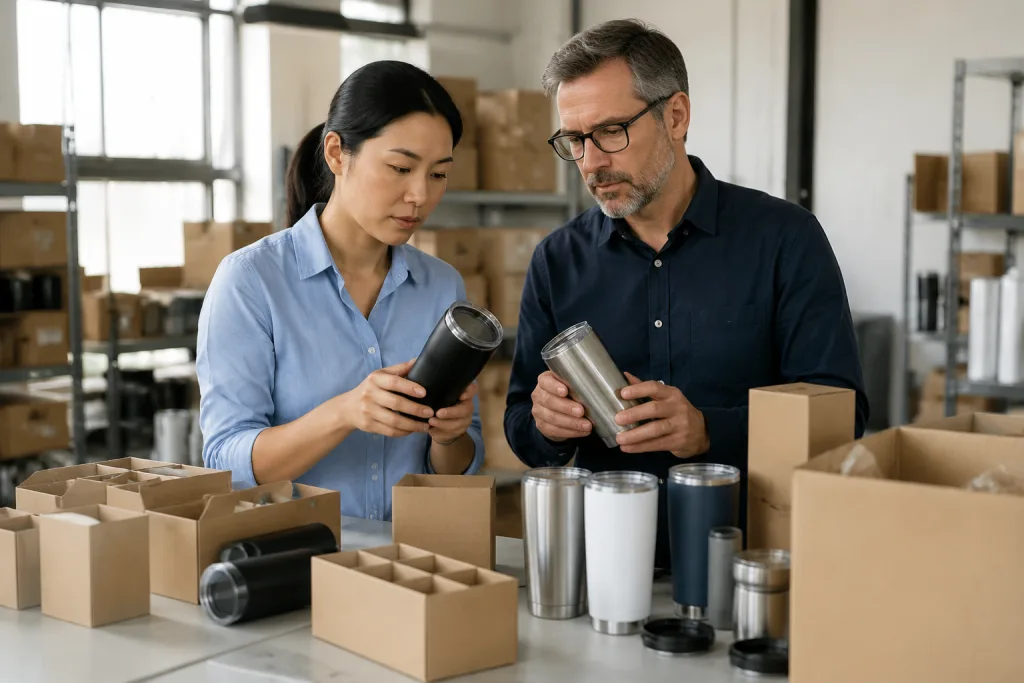
Inspection needs practical checks, not just a clean-looking surface under warehouse lights. Fill the tumbler with hot water for 6 hours and record the temperature drop with an IR thermometer or probe thermometer. Check 20-32 samples for lid fit, gasket seating, coating scratches, odor, sharp edges, and logo alignment. Run a 3M tape test on printed logos. For powder coating, cross-hatch adhesion testing with a 1 mm cutter tells you more than rubbing it once with a thumb. QC pulled the sample, not the catalog photo.
If you are buying through coffee mug distributors, ask whether inspection happens at the coffee mug factory or only after arrival. This is the wrong question to leave until shipment week. Factory-side inspection catches problems while replacement lids, reprinted bodies, or carton relabeling are still possible. Arrival inspection has value, but by then the event date or launch date may already be exposed; we have seen 3,000 pcs stuck because the distributor found a PO typo in the logo Pantone only after the goods landed.
Choose Supplier Type Honestly
There is no single best source. Factory direct works when your spec sheet is already clear: 304 stainless body, lid material, coating Pantone, logo size in mm, carton marks, and approval person. We run better with repeat orders because the line can hold the same powder-coating jig and the same leak-test setting. You get tighter control over materials, samples, production dates, and corrective actions. The catch is speed. If the PO says “matte balck” and nobody confirms whether that typo means matte black or matte blue, the sample desk will stop, and 3 days disappear.
A trading company or sourcing office makes sense for mixed orders: 2,000 tumblers plus ceramic mugs, tote bags, and notebooks in one shipment. You may pay 5-15% more, but one person chases the loose pieces. A coffee mug oem manufacturer is the better fit when the tumbler carries the brand and you need mold changes, private label packaging, or 6-month stock planning. My pushback: a “unique” shape is often the wrong question to ask. We have seen this go sideways when a buyer picked a narrow base, then QC pulled the sample because it failed the 10-degree tilt test and the tooling fix cost 12 days, not 2.
If you are building a coffee mug supplier list, ask fewer questions, but make them sharper. What is your monthly output, 80,000 pcs or 300,000 pcs? What is the MOQ for custom coating? What AQL do you accept? Can you quote FOB Ningbo and DDP separately? Do you have current LFGB, FDA, or REACH reports for the lid material? Can you send a pre-production sample before mass production? A serious coffee mug factory answers with numbers, not adjectives; last month one buyer flagged “food grade lid” with no report number, and that file failed our document check in 4 minutes.
The right vendors travel mug program should feel boring before production starts. Specs locked. Samples signed. Cartons defined. Inspection criteria clear. That is how coffee mug manufacturers in China keep a bulk coffee mug project on schedule: the first-article sample sits on the QC table, the caliper reading matches the drawing within 0.2 mm, and nobody is arguing about logo position after the line has already packed 36 cartons.
Build Your Travel Tumbler Spec Before Quoting
Send capacity, logo method, MOQ, packaging, and destination. We will return a practical FOB China quote with sample timing.
Frequently asked questions
What MOQ should I expect for a custom vendors travel mug order?
For stock tumbler bodies and standard colors, 500 pcs per SKU is usually workable for a coffee mug custom order. If you need custom Pantone powder coating, plan on 3,000 pcs because the coating line has setup loss and cleaning time. Custom printed boxes often start around 1,000-2,000 pcs. For a first coffee brand launch, 500-1,000 pcs in stock black or white with laser engraving is usually the lowest-risk way to test demand before moving to full private label production.
How long does bulk coffee travel mug production take?
A normal bulk coffee travel mug order takes 25-35 days after deposit, artwork approval, and pre-production sample confirmation. Add 5-7 days if you need custom color matching or a printed gift box proof. Ocean freight from China to North America or Europe may add 25-40 days port to port, while air freight can be 5-9 days at a much higher cost. If your event date is fixed, work backward with at least 15 days of buffer for inspection, customs, and inland delivery.
Is laser engraving or printing better for a coffee mug custom logo?
Laser engraving is better for durability and a premium retail look, especially on powder-coated stainless tumblers. It usually costs USD 0.12-0.35 per unit depending on logo size. Silkscreen is cheaper for simple one-color logos and can be under USD 0.20 per unit at 1,000 pcs, but it needs adhesion testing. Full-color UV or heat transfer works for promotional artwork, though rejection rates can be higher. For coffee mug private label programs, I normally recommend laser plus a branded box or sleeve.
What certifications should a coffee mug manufacturer provide?
For Europe, ask for LFGB food-contact testing and REACH documentation where applicable. For the United States, FDA food-contact compliance for stainless steel and lid plastics is the usual baseline. BPA-free declarations are commonly required for PP, Tritan, or silicone lid components. If you supply large corporations, BSCI or similar social audit documentation may also be requested. A responsible coffee mug manufacturer should provide test reports tied to similar materials, but new coatings or unusual plastics may need fresh testing before shipment.
Can one supplier handle private label packaging and distributor cartons?
Yes, but you need to define it early. Coffee mug private labeling can include base logo, lid logo, color box, instruction insert, barcode, FNSKU, master carton marks, and pallet labels. For distributor stock, neutral boxes with SKU labels may be better than fully branded packaging. At 500 pcs, stock packaging with stickers is usually economical. At 1,000-3,000 pcs, printed boxes make more sense. Send your carton labeling rules before mass production so the factory can pack by SKU, department, or destination.