Key Takeaways
- Set toddler bottle MOQ expectations at 1,000 pcs/color for standard molds and 3,000 pcs/color for custom lids
- Require 100% leak testing plus AQL 2.5 major and 4.0 minor final inspection
- Specify silicone hardness at 50-60 Shore A for straw and bite-valve components
- Allow 35-45 days production after approved sample for most customized drinkware orders
A toddler bottle order does not fail like an adult tumbler order. Unit price may sit at only USD 2.20-4.80 FOB China, but the trouble starts with small silicone parts, bite marks on the straw, lids dropped from 90 cm, color migration, and parents who spot a 0.3 mm scratch near the logo. Catalog photos hide that. If you are comparing vendors toddler bottle programs, start with the failure points, not the render.
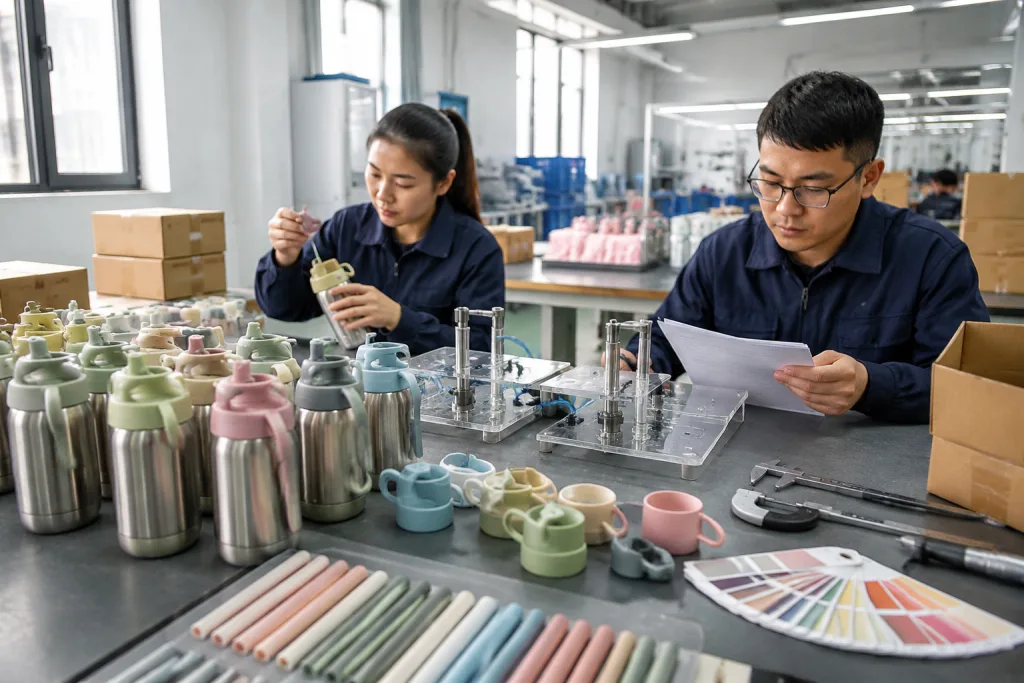
On our Hangzhou, Zhejiang production floor, we see the same fight too often: loose specs turn into debit notes. A canteen supplier may write “food grade” and “leakproof,” but your purchase order needs wall thickness in mm, leak test method, AQL level, packaging drop height, and artwork tolerance. QC pulled one sample last month where the PO said “blue lid,” but the buyer meant Pantone 2925C; the line had already packed 38 cartons. Our Zhejiang lines run about 450,000 drinkware units/month, with toddler bottle MOQ from 1,000 pcs per color for standard molds.
Leak claims fail first
Leakproof is where toddler bottle arguments start. The word is too soft. One canteen manufacturer will stand a bottle upright on a stainless test bench for 30 minutes and call it passed. Your buyer’s customer turns it sideways in a school bag, pressed against a tablet and a lunch box. QC pulled 12 samples last month that passed upright testing; 3 showed wet tissue marks after the side-load check.
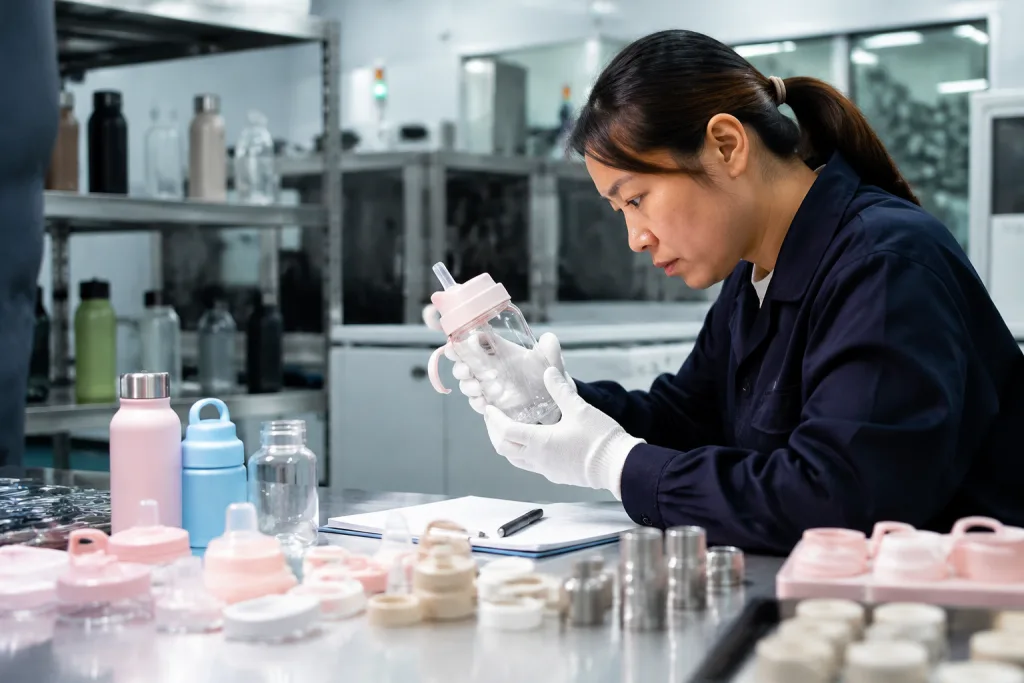
For vendors toddler bottle orders, put the leak test directly into the spec sheet. We run it like this: fill to 90% capacity with room-temperature water, close the lid to a defined torque with a 0.6 N·m torque wrench, invert for 30 minutes, then shake 20 cycles at about 1 cycle/second. For straw bottles, test again after opening and closing the spout 500 cycles. Cheap hinges pass on day one. After 5 daycare-style cycles through the line, they start showing stress whitening at the pin.
The lid stack decides the result: PP lid, silicone gasket, straw connector, vent hole, cap hinge. Ask your canteen factory for gasket dimensions and Shore hardness, not just “food grade silicone” on a quote sheet. Silicone at 50-60 Shore A is common for toddler drinking parts because it seals without turning stiff for children. If the supplier cannot state the hardness, the math does not work. You are buying an uncontrolled part, and the buyer will flag it during pre-shipment inspection.
For custom canteen or customizable canteen programs with shared lids across several bottle bodies, confirm interchangeability by cavity number. One mold cavity can sit 0.15 mm off. Small number, big headache. On a 350 ml toddler bottle, that gap can break the seal at the gasket lip. We put 100% leak testing in the control plan, not only random inspection, and we mark failed pieces by cavity on the QC sheet before the line keeps packing.
Coatings chip under small hands
Toddler bottles get dropped. No surprise there. They hit tile floors, stroller frames, lunch tables, and teeth marks show up more often than buyers expect. A powder coat that passes on a 20 oz travel tumbler can fail on a 350 ml toddler bottle if the washer line, phosphate pretreatment, bake curve, and adhesion check are treated as “same as adult bottle.” We’ve seen this go sideways when QC pulled the sample after packing and found chips around the bottom radius from a 1 m fall.
If you order customized drinkware with color coating, ask for cross-hatch adhesion testing under ASTM D3359 or ISO 2409. For normal promotional adult bottles, 7 out of 10 buyers we deal with accept 3B or better. For toddler bottles, we prefer 4B or 5B after the coating has cured for 24 hours, checked with a fresh 3M 600 tape strip and a clean cutter blade. Also request a 1 m drop test on a filled bottle, 3 drops on base, side, and lid. A dent is acceptable if agreed; coating flaking near a drinking area is not. The buyer flagged that once, and they were right.
Decoration can fail before the bottle body does. Silk screen is economical for canteen promotional orders, usually adding USD 0.08-0.18 per color per position, but the line needs the right ink hardener ratio and 12 hours of drying before bulk handling. Laser engraving costs more on stainless steel but does not peel. Heat transfer can look premium, yet the math doesn't work if the logo scuffs during shelf testing. For a canteen customized project sold through retail, specify 3M tape test, 500-cycle wet rub, and logo position tolerance within ±1.5 mm. We run that with a simple rub tester, not guesswork.
A canteen vendor who only quotes the cheapest finish may win your spreadsheet and lose your reorder. If you are a distributor drinkware buyer, ask for two finish options: standard powder coat and higher-adhesion child-use coating. On our Hangzhou line, the child-use coating usually adds one slower bake pass and a tighter first-piece check at the coating booth. The difference may be USD 0.12-0.28 per unit, which is less than one return shipment from a retailer. Cheap coating is the wrong place to save money.
Small parts become compliance problems
Toddler bottles sit one step away from toy rules, even when the PO says “drinkware.” New buyers miss this. A 350 ml bottle body might pass food-contact testing, then QC pulled the lid set and found a 12 mm silicone charm that raised small-parts questions for the EU buyer. The lid, straw, handle, name tag, and decorative charms all need a market and age-grade check before tooling.
For Europe, discuss LFGB or EU 1935/2004 food-contact testing, REACH restricted substances, and EN 14350 if the bottle is sold for young children. For the United States, FDA food-contact materials are the baseline; ASTM F963 small-parts logic matters when the design looks toy-like or the listing says children under 3. Do not accept a generic stainless steel report from another SKU. We had one buyer send a 304 stainless report for a 500 ml sports bottle, but the toddler bottle used a pink PP lid and a different silicone straw, so the lab report did not match the shipped item.
Common materials are 304 stainless steel for bottle body, PP for lid, Tritan or PPSU for clear bodies, and food-grade silicone for straw or seal. If a canteen supplier offers “BPA free” only, push back. The math doesn't work. BPA-free says nothing about phthalates, heavy metals, odor, migration, or colorant safety. On our line, we separate PP lid resin by supplier lot and check silicone straw odor after 4 hours in a 70°C drying cabinet, because one bad batch can hold up a 3,000 pcs shipment.
For canteen manufacturers in China, component traceability is the practical control. Ask for batch numbers for silicone and plastic resin, plus incoming QC records. At BottleForge Industrial in Hangzhou, Zhejiang, we keep material lots tied to production dates; six months later, a complaint is not solved by someone’s memory. We scan resin bags at incoming inspection, and the QC sheet records the lot, weight in kg, and production date. Good canteen suppliers do not treat compliance as a PDF decoration. They treat it as traceability.
Capacity and mouthfeel get overlooked
Buyers often chase the outside print and miss the child using it. A 500 ml bottle looks like better value on a quote sheet, but it is the wrong question to ask for a 2-year-old. For toddler ranges, 280-420 ml is the safer commercial band. A filled 350 ml stainless bottle usually lands around 480-620 g depending on wall thickness and lid design; our QC scale on the packing table flagged one 350 ml sample at 642 g after the silicone boot was added. Parents notice fast when the child needs two hands just to lift it.
For stainless steel vacuum toddler bottles, common inner wall thickness is 0.30-0.40 mm and outer wall 0.40-0.50 mm. Going thinner can cut USD 0.10-0.20, but dent resistance drops; we run the drop check from 80 cm onto the steel plate, and thin outer walls show corner dents too easily. Going too thick pushes weight up and hurts repeat use. For single-wall canteen customizable styles, 0.50-0.60 mm can pass, but insulation is gone. Be clear whether you are sourcing a toddler bottle, a small custom canteen, or a child-sized sports bottle; the tooling, weld line, and lid fit are not the same.
Mouthfeel is not a soft topic. Straw inner diameter and bite-valve slit drive the complaint rate more than most buyers expect. Too much flow creates spills; too little flow makes children chew the valve until the slit tears. Ask for a pre-production sample using the actual straw tooling, not a similar part borrowed from another SKU; we have seen this go sideways when the buyer approved a 6 mm straw sample and the mass-production tool was 5 mm. For a canteen vendor, borrowed sample parts are common during early quoting, but they should not become your approval basis.
If you plan a matching family range with custom growler, customizable growler, or distributor growler sizes, split the child SKU spec on the PO. Adult growlers chase capacity and thermal retention. Toddler bottles need safety, grip, cleaning access, and controlled flow. The math doesn't work if the line treats a 350 ml toddler bottle like a shrink-down 1.2 L growler; even the brush opening and silicone gasket compression need their own check.
Packaging breaks before the bottle
A toddler bottle can pass factory inspection and still land in the buyer’s warehouse as dead stock because the carton was treated like packing tape work. We have seen this go sideways: QC pulled the sample after a 2-hour vibration check and the bottle was fine, but 18 of 120 retail sleeves had corner scuffs. Retail cartons crush. Printed sleeves rub through. Silicone straws take a bend when 24 units are packed too tight. For North America and Europe, distributor canteen buyers and retail buyers judge the pack as part of the bottle, not as a separate problem.
Start with export carton strength. For most 350 ml toddler bottles, a 5-ply K=A or K=K carton is reasonable if the shipment is LCL or handled through 3 warehouse transfers. Specify carton gross weight under 15 kg where possible; our line usually targets 12.8–14.5 kg for toddler bottle cartons so the math works for hand loading. Require a 76 cm carton drop test on 1 corner, 3 edges, and 6 faces for small parcel risk. If you are preparing e-commerce inventory, think like ISTA, even without formal certification. The wrong question is “Will the bottle break?” Ask whether the retail box still looks sellable after the carton hits concrete.
For Amazon-style fulfillment, add FNSKU labeling, suffocation warnings for polybags above the required opening size, and barcode scannability checks with a handheld Honeywell scanner before sealing the master carton. A distributor drinkware program may also need master carton labels with PO number, SKU, color, quantity, net/gross weight, and country of origin. China origin marking must match your import documentation. We once had a PO with “mint green” on the order and “green mint” on the carton mark; the buyer flagged it before release, and 42 cartons needed relabeling.
Inner protection does not need to be fancy. A paper sleeve or kraft box can work if the fit is controlled within 2–3 mm. What fails is messy packing: lids rubbing against coated bodies, loose straws moving around in cartons, instruction leaflets missing from some units. QC should photograph the packaging BOM at sample approval: outer carton, inner box, polybag, straw bag, manual, label position. We ship better when those photos sit in the approved sample file. A good canteen distributor will ask for this before deposit, not after the first container ships.
Price hides tooling and inspection
A quote that says USD 2.65 FOB Ningbo is not the full number. On the line, we separate mold ownership, lid structure, coating yield, test reports, carton spec, and inspection scope before we talk price. I have seen buyers push back on a “cheap” offer after QC pulled the sample and found the lid gasket was counted in the quote, not the base bottle.
For an existing 350 ml stainless toddler bottle, a fair FOB China range is about USD 2.40-4.20, depending on lid, coating, and packaging. A custom lid mold can cost USD 4,000-12,000, and a new bottle body mold may run USD 6,000-18,000. If you want an exclusive canteen shape, ask who owns the mold, where it sits, and whether maintenance is covered after 100,000 shots or stampings. That is the real question.
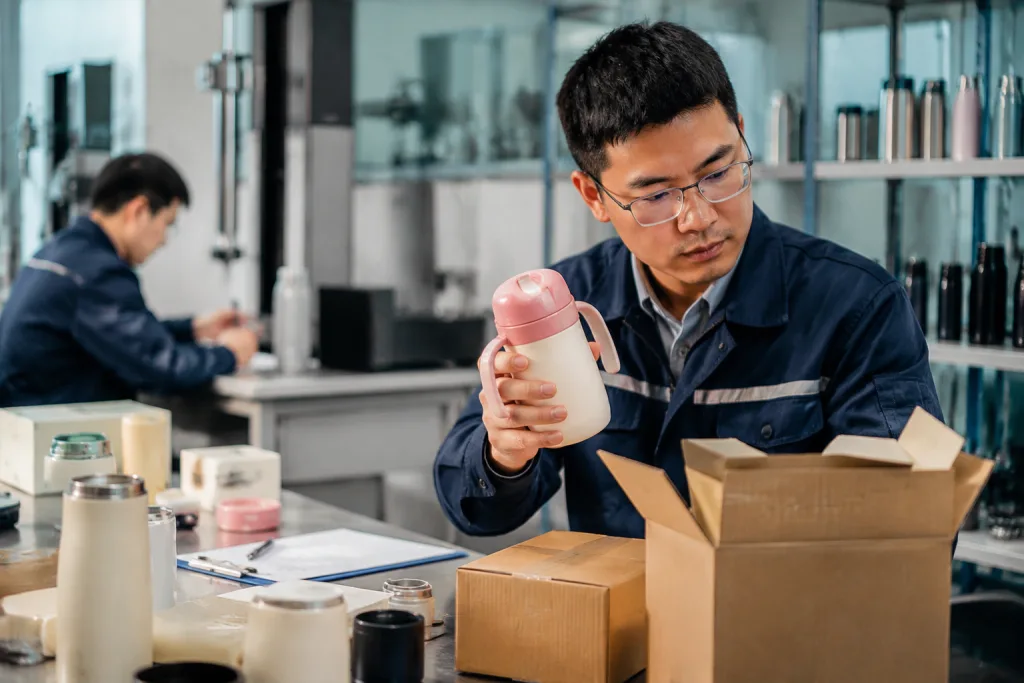
Inspection has a cost too. AQL final inspection adds time more than unit cost, but it still has to be booked. For toddler products, we run AQL 2.5 major / 4.0 minor at minimum, with critical defects set to 0. Critical defects include sharp edges, loose small parts, blocked vent holes, exposed metal burrs, contamination, and leakage; last month QC found a 0.8 mm burr at the rim and the batch stopped there. If you need third-party inspection, book it 5-7 days before the planned vessel cut-off.
Payment terms change the risk. Many China factories use 30% deposit and 70% before shipment, and for repeat canteen distributors we may stretch terms after 2-3 clean orders. The buyer flagged one PO that said “70% before shippment,” and that typo was a warning sign, not a small detail. If a canteen manufacturer offers a low price, free tooling, free testing, and long credit on the first order, check what got cut out first.
Sampling must match production
A good-looking pre-production sample means nothing if the line cannot repeat it at 3,000 pcs. Sampling failure is not just color drift. We have seen resin grade swapped from PP 5 to PP 7, silicone nipples from a different batch, weld seams touched up with a hand polisher, lids adjusted one by one with a small torque wrench, and logo artwork printed in the sample room instead of on the production pad-printing machine.
For vendors toddler bottle projects, we run samples in stages. First, lock the structure from an existing mold and check the lid fit with a 0.05 mm feeler gauge. Second, approve material chips and Pantone chips under the same light box used by QC. Third, approve a pre-production sample made with production tooling, production coating, and production packaging. Keep two signed samples: one with you and one sealed at the factory. Photograph the weight on a gram scale, outer diameter, height, Pantone code, logo position, straw length, and carton layout. Small detail, big trouble later.
Write lead time like a production schedule, not a sales promise. Standard custom drinkware with existing molds usually needs 7-10 days for digital proof and sample, then 35-45 days mass production after approval and deposit. New tooling can add 20-35 days before sample approval. During peak China export months before summer and Q4, add another 7-14 days if you need special colors or child-compliance testing. Last May, one buyer pushed for 18 days total on a 5,000 pcs toddler bottle order; the math did not work because LFGB testing alone took 9 days after QC pulled the sample.
This is where a canteen manufacturer with disciplined records beats a cheap trading quote. Whether you call it customized canteen, canteen customized, customizable drinkware, or a toddler bottle line extension, the approval file controls the order. We keep the signed sample, BOM, color chip, artwork file, carton mark, and PO version in one job folder because one typo on a PO can turn “straw 115 mm” into “straw 105 mm.” If the factory needs heroic manual work to copy the sample, mass production becomes a sorting job. We have seen this go sideways.
Send your toddler bottle spec for factory review
We will check materials, MOQ, tooling risk, packaging, and QC points before you commit deposit on a China production run.
Frequently asked questions
What MOQ should I expect for vendors toddler bottle orders?
For standard toddler bottle molds, expect MOQ around 1,000 pcs per color and 3,000 pcs per design if you use a custom lid color or special silicone part. New lid tooling usually pushes the practical MOQ to 5,000 pcs because resin setup, color matching, and assembly loss become inefficient below that level. For mixed-color distributor canteen orders, some factories in China will offer 500 pcs/color, but the unit price may rise by USD 0.25-0.60. If you are testing a new retail program, start with one bottle body and two colors rather than four shapes. That keeps inspection, packaging, and spare parts simpler.
How do I compare a canteen supplier quote fairly?
Ask every canteen supplier to quote the same Incoterm, usually FOB Ningbo or FOB Shanghai for Zhejiang production. Then separate bottle body, lid type, coating, decoration, packaging, test reports, and inspection. A USD 2.80 quote may exclude retail box, while a USD 3.15 quote may include powder coating, one-color silk screen, kraft box, and 100% leak test. Also confirm stainless grade, wall thickness, silicone hardness, and AQL level. If one canteen vendor avoids those details, you are not comparing equal offers. For toddler bottles, the cheapest quote often removes QC time or uses a looser lid assembly tolerance.
Can I use the same supplier for toddler bottles and custom growler programs?
Yes, if the factory has both child bottle assembly control and larger vessel forming capacity. A custom growler or customized growler program focuses on welding, vacuum insulation, handle strength, and 32 oz to 64 oz capacity. A toddler bottle focuses on small parts, silicone, controlled flow, and child-safe edges. Many canteen manufacturers can produce both, but you should audit the actual lines. Ask for monthly capacity by category, not total factory capacity. A plant claiming 800,000 units/month may be strong in tumblers but weak in straw-lid assembly. Use separate specs, separate AQL defect lists, and separate compliance reports.
What tests should be mandatory before shipment?
At minimum, require 100% leak testing on assembled bottles, visual inspection under AQL 2.5 major / 4.0 minor, sharp-edge check, cap open-close cycle test, coating adhesion test, barcode scan test, and carton drop test. For toddler bottles, add silicone odor check, straw pull test, small-parts review, and migration testing based on your market. Europe may require EU food-contact and REACH documentation; the United States commonly needs FDA food-contact material support. For a canteen promotional order, buyers sometimes skip lab tests to save USD 300-800. That is risky for child products. Test the exact colors and materials you will ship.
How long does a customized drinkware toddler bottle order take?
For existing molds, plan 7-10 days for artwork proof and sample preparation, 3-5 days for sample courier delivery, and 35-45 days for mass production after approval. If you need new tooling for a customized canteen lid or unique bottle body, add 20-35 days for mold development and first samples. Lab testing can add 7-12 working days depending on the test scope. Sea freight to Europe or North America is separate, often 25-40 days port-to-port. A realistic calendar from deposit to warehouse arrival is usually 70-100 days. Rushing is possible, but toddler bottle QC should not be the part you compress.