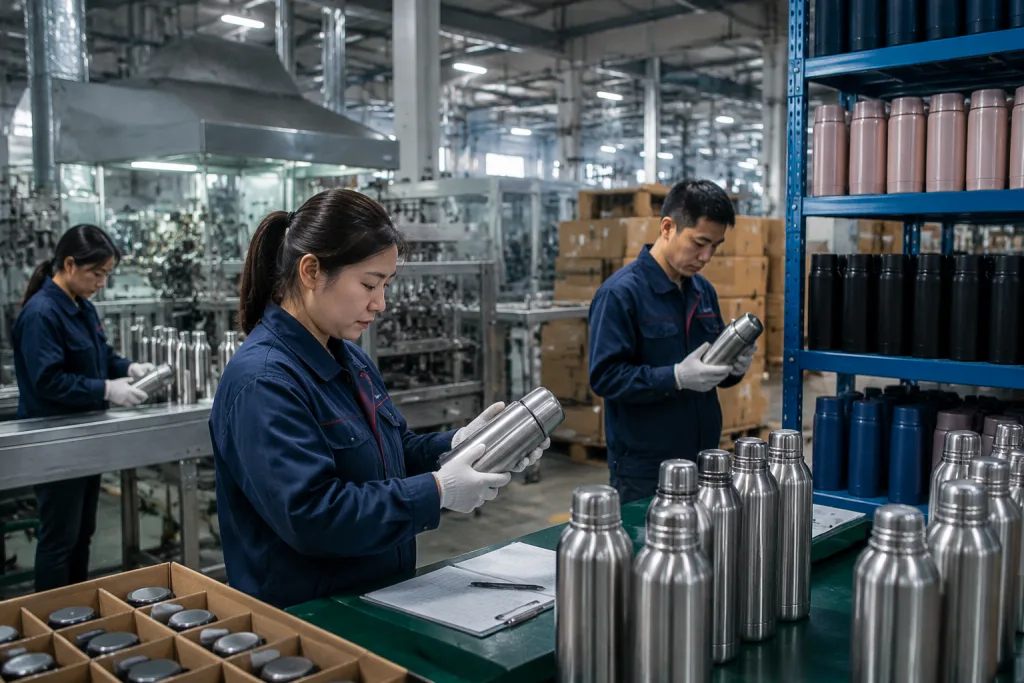
Key Takeaways
- A practical stainless thermos MOQ starts at 1,000 units per color for powder coating and 3,000 units for custom mold work
- 304 stainless steel at 0.45-0.55 mm inner wall thickness is the normal export baseline
- FOB Ningbo pricing often ranges from USD 3.20-7.80 depending on capacity, lid, coating, and packing
- Plan 25-35 days for production after artwork, deposit, and pre-production sample approval
Search for a vendors thermos flask supplier and you’ll see 300 polished product photos before you see one usable spec sheet. That hurts when you are buying for outdoor retail shelves or a promotional thermos campaign with a fixed launch week. We had one buyer flag a 750 ml hiking flask because the sample was 83 mm wide, 6 mm too fat for their backpack side pocket. A 750 ml flask for hikers, a 1 L worksite bottle, and a gift-set customized thermos need different lids, wall thickness, cartons, and test standards.
At BottleForge Industrial in Hangzhou, Zhejiang, we see buyers lose 8% to 15% margin by comparing only capacity and unit price. Wrong question. A stainless thermos order should be checked against steel grade, vacuum hold time, lid structure, coating adhesion, carton drop test results, compliance files, and failure risk. Last month QC pulled a sample after the powder coat showed edge chipping at the bottom radius after a 3M tape test. China can build sharp pricing, but the math does not work unless you specify the product like a buyer on the line, not like someone browsing a catalog.
Compare by specification, not catalog photo
A thermos vendor can quote the same 500 ml bullet flask in brushed steel, matte black, or gradient powder coating, and the photo will look almost identical. The cost is not. Neither is the risk. On our Hangzhou line, a matte powder body usually needs one more coating check with the 3M tape test, while brushed steel goes straight to polishing inspection after the vacuum oven. For outdoor retailers and promotional brands, comparing by catalog photo is the wrong question to ask. Start with the technical stack.
Use the table below when checking a supplier thermos quotation from China against another factory thermos offer. It pulls the talk back to numbers instead of soft claims like “premium quality” or “keeps hot all day.” Last month, one buyer flagged two offers that were USD 0.18 apart; QC pulled the sample and found the cheaper flask had a 0.38 mm outer wall, not the 0.50 mm written on the PI.
| Spec item | Outdoor retail fit | Promotional brand fit | What to confirm |
|---|---|---|---|
| Steel grade | 304 inner and 201 or 304 outer | 304 inner, 201 outer often acceptable | LFGB/FDA food-contact report |
| Wall thickness | 0.45-0.55 mm inner, 0.50 mm outer | 0.38-0.45 mm can work for gift use | Drop test and dent tolerance |
| Vacuum retention | 6 hours above 65°C for 500 ml | 6 hours above 58°C often accepted | Test method and ambient temperature |
| Lid system | Leakproof screw cap or cup cap | Push button, tea filter, or gift lid | Silicone grade and spare parts |
| Branding | Laser mark or one-color print that survives rub testing | Full-color print, paper sleeve, or gift box | Artwork tolerance within ±1 mm |
For thermos bulk buying, a USD 0.30 saving on the body disappears fast if the lid leaks at 2% during incoming inspection. We have seen this go sideways: 24 leaking caps in a 1,200 pcs pre-shipment pull, all from one gasket cavity. AQL 2.5 for major defects and AQL 4.0 for minor defects is a reasonable starting point for distributor thermos orders. If the product will sit in an outdoor retail channel, tighten leakage and coating adhesion checks before shipment, and ask the factory to record the water test time, not just tick “pass” on the QC sheet.
Retail flask versus promotional flask
The same manufacturer thermos line can feed two different buyers, and we quote them differently on purpose. An outdoor retailer needs a flask that survives returns, cold mornings, backpacks, and repeat use. A promotional buyer needs a customizable thermos that looks clean, ships on time, and stays inside the campaign budget. Both orders are fine. Mixing the spec is where money gets burned; last month QC pulled 32 samples from a shared line because the PO said “gift flask” but the buyer later asked for retail shelf packaging.
For retail, I would quote a 750 ml or 1,000 ml double-wall flask with 304 stainless steel inner wall, powder coating above 60 μm, and a lid gasket that can be removed for cleaning. The unit price may land at USD 5.20-7.80 FOB Ningbo depending on packaging. You pay for lower return rates and better reviews. Retail buyers should ask for a 1.2 m drop test on a filled bottle, cross-hatch coating adhesion, salt spray data for painted accessories, and carton drop testing under ISTA-style handling. We run the coating check with a 100-grid cutter and 3M tape; if the black powder coat lifts at the shoulder radius, the math doesn’t work for retail.
For promotional thermos work, the priority changes. A 500 ml customized thermos with 304 inner, 201 outer, laser engraving, and white box packaging can sit around USD 3.20-4.60 FOB Ningbo at 3,000 units. If the order is for a conference, employee kit, or seasonal gift, a perfect retail-grade lid matters less than stable logo placement and delivery date. The buyer usually flags logo height first; on one 500 ml job, we moved the mark 8 mm lower after the sample looked cramped under the lid band.
Do not ask suppliers thermos factories for “best price” until you know which failure you are willing to pay to avoid.
Our Zhejiang production network can output about 450,000 stainless drinkware units per month across thermos flask, tumbler, and sports bottle lines. That capacity helps, but a rushed custom thermos with unclear artwork still fails like any other rushed product in China. We’ve seen this go sideways from a tiny PO typo: “Pantone 186C” became “168C,” and the line packed 7 cartons before QC caught the color mismatch under the D65 light box.
Steel choices and vacuum performance
Most stainless thermos suppliers quote 304 stainless steel for the inner liner because it passes the usual food-contact checks for export orders. For the outer shell, we run 201 stainless on price-sensitive promo jobs, often at 3,000–5,000 pcs MOQ, while 304 outer makes more sense for outdoor retail, coastal markets, or gift sets where the buyer will check rust complaints after 6 months. “Stainless steel” is too loose. Last quarter QC pulled 12 outer shells from a 201 batch and found two with salt-spray staining near the bottom weld, so the grade needs to match the selling channel.
For a vendors thermos flask project, put the steel setup on the PO: 304/201, 304/304, or 316 inner for higher-end food-contact positioning. 316 is rarely needed for normal coffee, tea, or water, and the math doesn’t work if the retail shelf price only moves by USD 0.30. We’ve seen this go sideways when a buyer wrote “SS flask” on the PO and expected 304/304 after the mold deposit was paid. If a thermos manufacturer pushes 316 without naming the use case, push back.
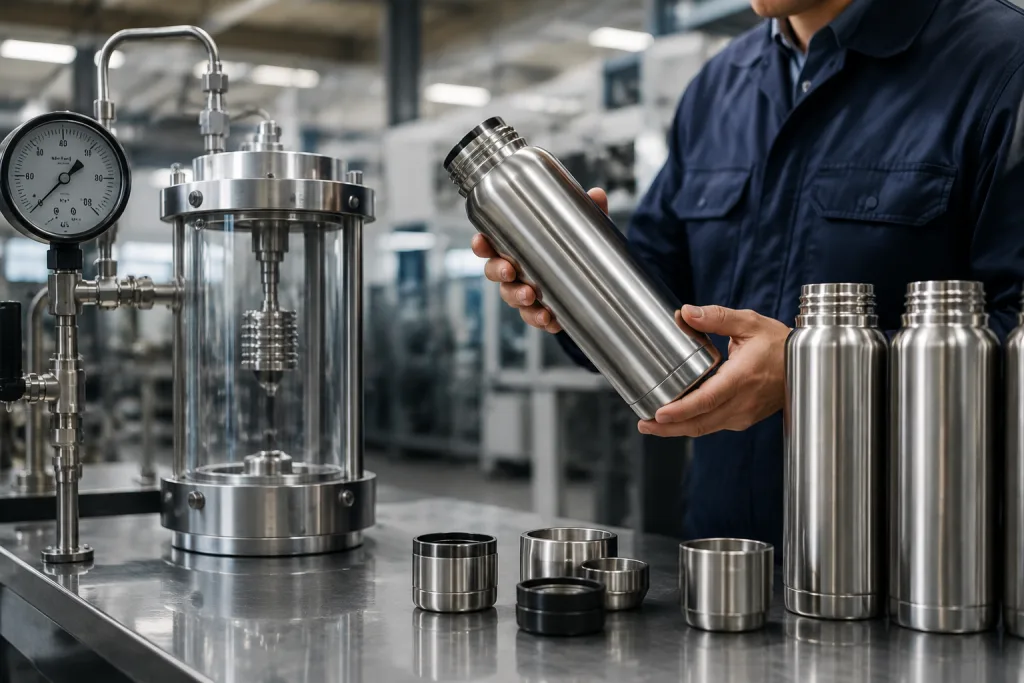
Vacuum performance is not just steel grade. Body diameter, mouth opening, copper plating, lid insulation, and weld consistency all change the result; on the line we also watch the neck weld with a 0.02 mm feeler gauge after polishing. A narrow-mouth 500 ml bottle usually holds heat better than a wide-mouth food jar at the same volume. For common testing, fill the flask with water at 95°C, close it for 6 hours at 20°C ambient, then measure the remaining temperature. A solid 500 ml retail flask should stay above 65°C after 6 hours. A larger 1,000 ml flask can beat that because it carries more thermal mass.
Ask your thermos factory to split “lab best result” from “mass production standard.” The production standard is the one that protects your shipment. We normally define heat retention by capacity and lid design in the purchase order; for example, 750 ml screw-cap flask: 6 hours above 68°C, leakage test 100% on line, and random vacuum check per carton lot. QC needs a number to inspect. Last month the buyer flagged one PO typo, “58°C” instead of “68°C,” and catching it before pre-production saved a 12-day argument with the inspector.
Branding methods side by side
Custom branding is where thermos projects go sideways fast. We see a logo look sharp on PDF, then stretch on a 70 mm diameter body or land across the welded seam. On brushed steel, a light gray mark can disappear. QC pulled a sample off the line last week and the buyer flagged the logo shift after the first spin test. Pick the decoration method based on order size, rub resistance, and where the buyer sells. This is the wrong question to ask if you start from the artwork alone.
- Laser engraving: We run this for outdoor flasks and corporate sets. It holds up, looks clean, and usually adds USD 0.10-0.25 per unit, depending on logo area. It sticks best on powder coating or brushed stainless steel; on mirror polish, the contrast can be weak.
- Silkscreen printing: This works for 1-3 spot colors and keeps the budget under control on 1,000-5,000 unit promo orders. Ask for a dishwasher simulation and rub test before approval; a buyer once pushed back after the second wash turned the logo hazy.
- Heat transfer: Use it for multi-color logos and gradients. The print looks stronger on shelf, but we inspect edge lift and registration on the line, because a 2 mm shift shows up fast.
- Water transfer or full wrap: Good shelf impact, but the reject rate climbs if the seam lands in a bad spot. We only push it when the distributor margin can cover setup, inspection, and scrap.
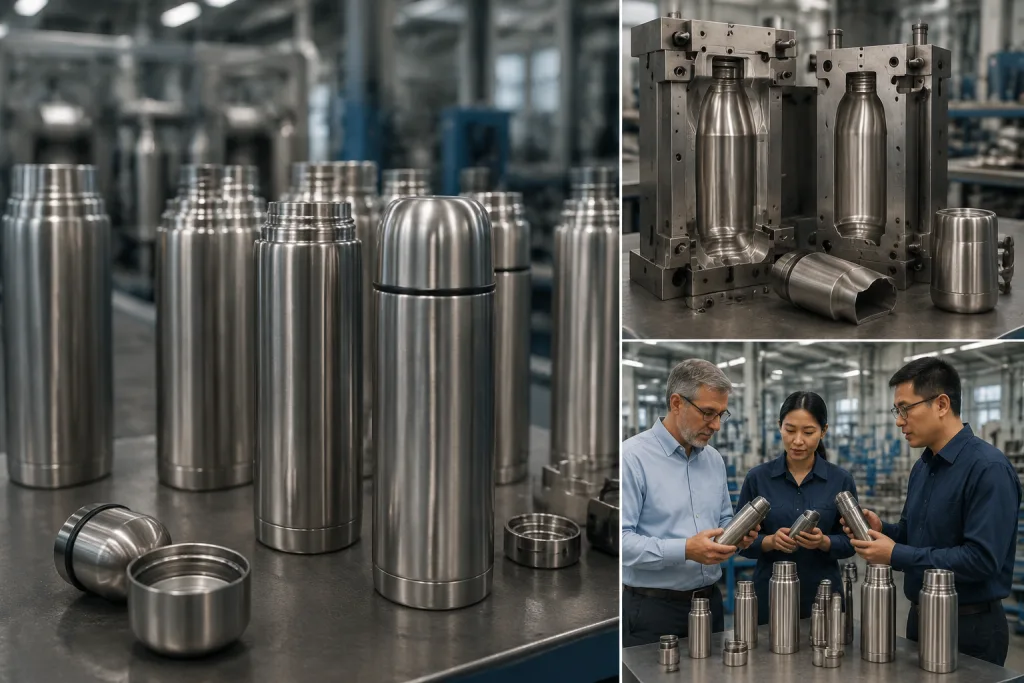
- Embossed or custom molded parts: Use this for long-running brand programs. Tooling usually runs USD 800-3,000, with MOQ at 3,000-5,000 units, and the math does not work for a one-off seasonal order.
If the buyer needs multiple retailer names or FNSKU labels, keep the bottle standard and move the work to the carton, sleeve, or outer box. We've shipped plenty of runs that way, and it is usually cheaper than reopening artwork for each small batch. For Amazon-style or distributor fulfillment, barcode placement, suffocation warnings on polybags, carton marks, and FNSKU accuracy matter as much as the logo itself. We once caught a PO typo on the FNSKU before packing; that saved a 12-day delay.
MOQ, tooling, and real pricing
MOQ is not a punishment. It is the break-even line. For one thermos program, we need to buy 304 stainless coil, set the powder booth, align the laser jig, book line workers, and let QC pull samples under AQL 2.5. For a standard stainless thermos vendor program, 1,000 units per color is the number that usually works for powder coating or laser engraving. At 300 pieces, the math doesn't work unless we run stock bodies, add a small-order charge, or accept a thinner margin.
For thermos bulk orders using existing molds, common MOQs look like this: 500 units for plain stainless stock with laser logo if inventory exists; 1,000 units for one custom color, usually with one Pantone spray setup and a 2-hour line change; 3,000 units for multi-color print or custom packaging, because the print plate and carton artwork need their own checks; 5,000 units or more for exclusive lid colors, special coatings, or seasonal retail assortments where the buyer wants shelf consistency across 4 SKUs. A true custom mold for a new lid, handle, or body shape usually starts around 3,000 units, with tooling costs from USD 1,200-6,000 depending on complexity. We have seen this go sideways when a buyer asks for a new flip lid at 800 pieces.
FOB China pricing should be split line by line. Ask whether the price includes inner box, master carton, logo setup, sample fee, spare gaskets, export carton strength, and palletization. QC once pulled a 500 ml sample where the master carton was only 5-layer 6 kg strength, not the 8 kg export carton written in the PO. A 500 ml stainless thermos may quote at USD 3.20 with a plain white box, but USD 4.10 with powder coating, laser logo, printed retail box, and thicker carton. A 1 L outdoor flask can move from USD 5.50 to USD 7.80 depending on cup cap, carry handle, and coating.
A good thermos supplier will not hide these cost drivers. At BottleForge in Hangzhou, Zhejiang, we would rather show you the price ladder than win an order with a number that fails during sampling. We ship better when the spec is fixed early: coating code, logo position in mm, carton burst strength, and spare gasket count. China still gives strong value, but only if the specification and packing standard are locked before deposit.
Compliance for Europe and North America
Outdoor retailers and promotional brands should treat compliance as part of the product, not as a PDF chased after packing. For Europe, buyers usually ask us for LFGB food-contact testing, REACH checks on powder coating or plastic lids, plus packaging marks that match the local recycling rule. For North America, we prepare against FDA food-contact expectations, California Proposition 65 review, and ASTM-related packaging or child-use points when the channel requires them. We run the coating panels through a 3M tape test before sending samples, because one buyer once approved color first and flagged missing REACH wording only after the PO was cut.
If the flask is for children, do not casually reuse an adult product. This is the wrong question to ask. A kids-cap bottle needs its own bite-valve material check, small parts review, CPSIA consideration, and safer packaging claims. For adult outdoor flasks, the bigger return risks are heavy metals in coating, odor in silicone gaskets, leakage, sharp edges, and capacity claims that miss by 15 ml on a 500 ml cup. QC pulled the sample last month because the silicone ring smelled after 24 hours in a sealed PE bag.
BSCI or Sedex audit availability also matters for retail buyers. Around 6 out of 10 distributor thermos programs we see do not need a factory audit for each order, but chain-store buyers often ask for social compliance before purchase order release. If your supplier thermos factory cannot provide a current audit or explain its audit status, add 10 to 15 working days to approval. A report expiring in 30 days may not satisfy your customer. We have seen this go sideways when a buyer's PO said “Sedex valid,” but the attached report had 18 days left.
Use third-party inspection before shipment when the order value justifies it. A typical pre-shipment inspection checks quantity, workmanship, function, barcode, carton marks, drop test, coating, and leakage, with inspectors opening cartons by the square-root sampling method on the line. For customized thermos orders above USD 20,000, inspection is cheap insurance. Set AQL levels before production: critical defects 0, major 2.5, minor 4.0 is common, but leakage should be critical if your customer has strict return policies. The math doesn't work if one leaking flask triggers a full carton return.
Picking the right vendor type
Not every thermos manufacturers setup fits the same buyer. A trading company works for mixed gift sets, say 3 drinkware shapes plus notebooks in one PO. A focused thermos factory is the better pick when vacuum loss, powder coating, and repeat color matter; we check cup bodies on a helium leak tester and pull coating panels against the Pantone card under a D65 light box. For outdoor retailers planning a 2-season or 3-season line, a manufacturer thermos partner with export engineering support usually saves trouble, because the lid drawing, gasket hardness, and carton drop test all need owner-level control.
For a promotional agency, speed and artwork handling often sit at the top. Proofing must be clean. We have seen a buyer flag a 1 mm logo shift only after the event cartons were printed, and that job went sideways fast. You need pre-production samples, barcode checks, and cartons with the correct event labeling before the line starts packing. For an outdoor retail brand, repeatability is the hard part. The second order must match the first order’s color, lid feel, heat retention, and packaging strength; QC pulled the sample from line 2 last month because the push-button lid felt 0.3 kg heavier than the approved sample.
Ask direct questions before choosing a thermos distributor or factory partner: How many units per month can the line produce? What is the normal lead time after sample approval? Which steel certificates match this exact model? Is leakage tested 100% or by sampling? Can you reserve the same lid mold for repeat orders? Who handles claims if 1.5% of caps fail in the field? The wrong question is “Can you make it cheap?” Ask who owns the failure when 600 caps come back from stores. We run a 100% water leak check on screw lids for custom runs, then AQL 2.5 for packed cartons, and those two checks catch different problems.
Our standard lead time is 25-35 days after deposit and approved sample for most stainless thermos bulk orders, with samples usually ready in 7-10 days when using existing molds. Fixed launch date? Start earlier. Sea freight to Europe or North America can add 28-45 days depending on port, season, and customs. The math does not work if artwork approval slips from day 3 to day 12, then the buyer asks us to keep the same ship date. A good thermos vendor will push you to confirm the color code, lid version, carton mark, and PO spelling early; one typo in a destination label can stop 320 cartons at the warehouse door.
Send your thermos flask specification for a factory quote
Share capacity, steel grade, logo method, target price, and delivery country. We will return practical MOQ, FOB pricing, and lead time.
Frequently asked questions
What MOQ should I expect for a custom stainless thermos flask?
For an existing stainless thermos model, expect 1,000 units per color for powder coating or silkscreen printing. If you only need laser engraving on stock brushed steel, 500 units may be possible when inventory is available. Custom packaging usually starts at 1,000-3,000 units because printed box factories have their own setup minimums. New lid tooling, molded handles, or exclusive body shapes normally need 3,000-5,000 units plus tooling. If a thermos supplier offers 100 units with fully custom color and retail box, ask whether it is using leftover stock or charging a much higher unit price.
How much does a bulk thermos order cost FOB China?
For thermos bulk orders, a 500 ml stainless flask with 304 inner wall, 201 outer wall, laser logo, and white box often lands around USD 3.20-4.60 FOB Ningbo. A 750 ml outdoor-grade flask with 304/304 steel, powder coating, stronger lid, and printed retail box may run USD 5.20-6.80. A 1 L flask with cup cap, handle, and thicker carton can reach USD 7.80 or more. Final cost depends on steel grade, wall thickness, coating, lid parts, logo method, packaging, and inspection requirements.
Is 304 stainless steel enough for outdoor retail thermos flasks?
Yes, 304 stainless steel is the normal export standard for the inner liner of a retail stainless thermos. For the outer shell, 304 is better than 201 if the flask will face wet outdoor use, coastal markets, or premium positioning. A practical outdoor spec is 304 inner and 304 outer, 0.45-0.55 mm inner wall, powder coating above 60 μm, and a removable food-grade silicone gasket. You can ask for LFGB or FDA food-contact reports, but also request mass production heat retention and leakage test data.
Which branding method is best for a promotional thermos?
For a promotional thermos, laser engraving is the safest choice when you want durability and a clean corporate look. It usually adds USD 0.10-0.25 per unit and works well on matte powder coating. Silkscreen printing is better for simple 1-3 color logos and larger 1,000-5,000 unit campaigns. Heat transfer is useful for full-color artwork, but edge adhesion needs inspection. If the campaign has many recipient names or FNSKU labels, consider keeping the bottle standard and customizing the sleeve, insert card, or gift box instead.
How do I reduce defects before shipment?
Start by writing measurable specs into the purchase order: capacity tolerance, steel grade, heat retention target, coating thickness, logo position, packaging, and AQL level. For many customized thermos orders, use AQL 2.5 for major defects and 4.0 for minor defects, with leakage treated as critical if your customer has strict returns. Ask for pre-production samples, then run a pre-shipment inspection when goods are at least 80% packed. Check 100% leakage testing on the factory line, carton drop resistance, barcode accuracy, and random vacuum performance before approving shipment.