Key Takeaways
- Specify 304 inner steel at 0.4-0.5 mm wall thickness for most bulk thermos programs
- Use AQL 2.5 for major defects and AQL 4.0 for minor cosmetic issues
- Plan 35-45 days production after artwork and pre-production sample approval
- Keep logo tolerance within ±1.5 mm for laser engraving and ±2.0 mm for screen printing
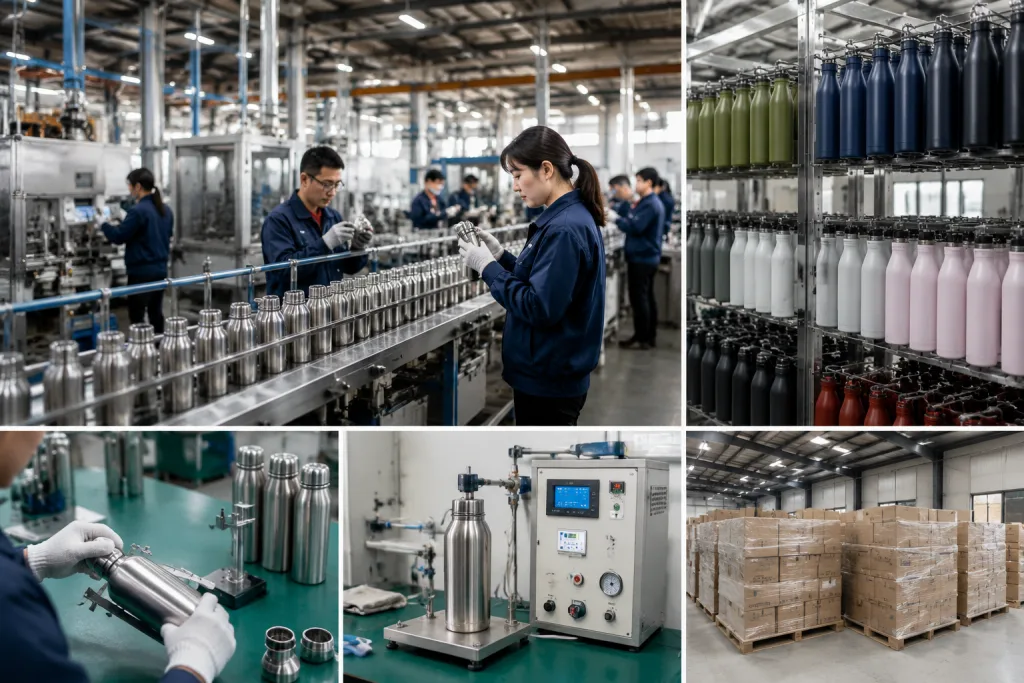
A stainless thermos order usually fails in boring places: a silicone lid gasket that starts weeping after 200 closures on the torque test, a powder coat that chips after carton rub, or a logo that looked fine on the gold sample but shifted 3 mm when the line changed fixtures. Small stuff. If you sell outdoor gear or promotional thermos programs, those small failures turn into returns, chargebacks, and the kind of customer call nobody wants on a Monday morning.
We manufacture in Hangzhou, Zhejiang, and we ship custom thermos projects from China for distributors, outdoor retailers, and brand owners. We run about 480,000 units per month, with practical MOQ starting at 1,000 units per color for standard shapes. The buyer asking only for the lowest FOB price is asking the wrong question. A safer buyer sends the lid drawing, logo placement tolerance, carton drop requirement, and color chip before production starts, because QC pulling a leaking sample at final AQL is 12 days too late.
Vacuum Failure Starts With Thin Steel
The first failure mode in a vendors thermos bottle program is poor heat retention, and we see it before the cartons ever leave Hangzhou. A vacuum flask is two stainless shells welded together, evacuated on the vacuum station, then sealed at the tail plug. If the inner or outer shell is cut too thin, the body can oval during hydraulic forming, mirror polishing, laser welding, or a 12 kg carton stack test. One small neck distortion, even 0.3 mm out of round on the caliper, can make the vacuum fail after shipping.
For an outdoor or promotional thermos, we run 304 stainless steel on the inner wall and 201 or 304 stainless on the outer wall based on the buyer’s price target. Inner wall thickness should sit around 0.4-0.5 mm. Below 0.35 mm, the FOB saving looks nice on the PO, maybe USD 0.06-0.09 per piece, but the math does not work if QC pulls 18 failed samples from a 500-piece pilot lot. For premium customized thermos orders, a 304/304 structure is easier to sell on the gift box and holds up better against coffee, tea, electrolyte drinks, or acidic beverages.
Do not accept a supplier thermos quotation that only says “stainless steel” without grade, thickness, and test method. Ask for material declarations and, for EU programs, food-contact documentation aligned with LFGB or EU 1935/2004 expectations. For North America, confirm FDA food-contact suitability and any customer-specific requirements. We once had a buyer flag a PO typo where “304 inner” became “201 inner” in the supplier PI; catching that before mass production saved 3,000 bottles from being made wrong.
Our standard heat-retention check for a 500 ml thermos custom order uses 95°C water, room temperature at 20°C ±2°C, and a 6-hour reading. A qualified unit should stay above 55-60°C depending on lid structure and bottle geometry. Shape matters. Wide-mouth bottles lose heat faster than narrow-mouth styles, and we measure that with a probe thermometer after the lid torque is checked. A good thermos manufacturer will say this upfront, not hide behind a clean lab number from another bottle shape.
Leaking Lids Are Usually Spec Failures
Buyers usually blame the thermos line when a lid leaks. Sometimes the line deserves it. In 7 out of 10 leak complaints we review, the real problem is a loose PO line that only says “leakproof lid.” That is the wrong spec. Define the silicone grade, closure type, minimum thread engagement, torque feel, and test angle. Our QC bench in Hangzhou uses a 0.1 N·m torque wrench for disputed samples because “normal hand tight” means one thing to a merchandiser and another thing to a 62 kg packing worker. Outdoor retailers need this nailed down because bottles ride sideways in backpacks and sample cartons for 12 days at sea, not standing upright on a desk.
For a custom thermos lid, food-grade silicone is the normal gasket material. We run most gasket samples at Shore A 50-60, checked with a Shore durometer before pilot production. Too soft, and the ring rolls or gets pinched when the cap is tightened. Too hard, and the gasket does not compress enough to seal against the mouth. Threaded stainless or PP lids need at least 2.5 turns of engagement; below 2.0 turns, the math does not work after powder coating adds 0.03-0.05 mm on the thread. Push-button lids need cycling tests because the spring and pin can pass the first leak test, then fail after 500 open-close cycles.
Our basic leak test is simple: fill with room-temperature water, tighten to normal hand torque, place the bottle horizontally for 30 minutes, then invert and shake for 10-15 seconds. QC pulled one 750 ml sample last month after finding 3 drops under the flip lid seam at minute 18, and that was enough to stop the line. For distributor thermos orders going into outdoor channels, we often add a 1.0 m drop test on the bottom and side with water inside. If the lid pops, cracks, or leaks after the drop, the design gets changed before mass production. No debate.
Promotional brands need to be careful with novelty lids. A handle with a metal pin, a carabiner loop with thin PP ribs, or a two-piece tea infuser all sound good in a sales deck, but each part gives water another path out. We have seen this go sideways when a buyer approved a compass cap from a rendering, then flagged wobble on the pre-shipment sample because the insert sat 0.6 mm proud. If you need a promotional thermos for event giveaways, a plain screw lid often survives better than a smart-looking lid made for photos. For retail, extra features can earn shelf space, but only when the thermos supplier can show stable tooling, cycle-test records, and a clean AQL 2.5 lid inspection.
Coating Problems Show Up Late
Powder coating and paint defects often show up after the goods leave Zhejiang, not during a clean factory walk-through. We’ve had QC pass a 20-carton pilot run, then the buyer flagged rim chips after 14 days in a Rotterdam warehouse because the cartons were stacked 6 layers high and rubbed through the PE bag. Shelf handling and dishwasher misuse expose weak adhesion fast. For bulk thermos orders, cosmetic failure hurts because the vacuum still works, but the shopper reads chipped coating as cheap.
Pick the finish before you chase colors. Powder coating gives better hand grip and usually survives outdoor use better; on our line we check film thickness with a coating gauge, often around 60–80 μm for standard matte bottles. Spray paint gives smoother color matching, but the math doesn’t work if the buyer expects dark glossy paint, low scratch claims, and a tight price at 3,000 pcs. Bare stainless takes abuse, but fingerprints and small dents show under retail light. For a customizable thermos program with 8 or 12 colors, powder coating is the safer commercial choice.
Your purchase order should state adhesion and abrasion requirements, not just “good coating.” A simple cross-hatch tape test works: cut the grid with a 1 mm blade, press down 3M tape, pull at the same angle, then record coating loss. For tougher programs, we run a 300-cycle rub test or a carton vibration simulation before packing approval. If you sell to outdoor retailers, ask for a 1.0 m drop test and define acceptable coating damage before mass production. “No obvious peeling” is better than silence, but marked photos are better. QC pulled one sample last season where the PO said “mat black” instead of “matte black”; that typo cost 5 days of email and one extra spray panel.
Color control needs numbers. Use Pantone codes for coated finishes, but stainless substrate and matte powder change how the eye reads color. A delta E target below 2.0 is tight and usually adds cost; below 3.0 is more realistic for thermos bulk runs above 5,000 pcs. Approve a physical color chip or pre-production sample, not a PDF mockup. We match color well in China, but give the factory a target the spectrophotometer can measure, not a laptop screen guess.
Logos Fail When Artwork Is Treated Casually
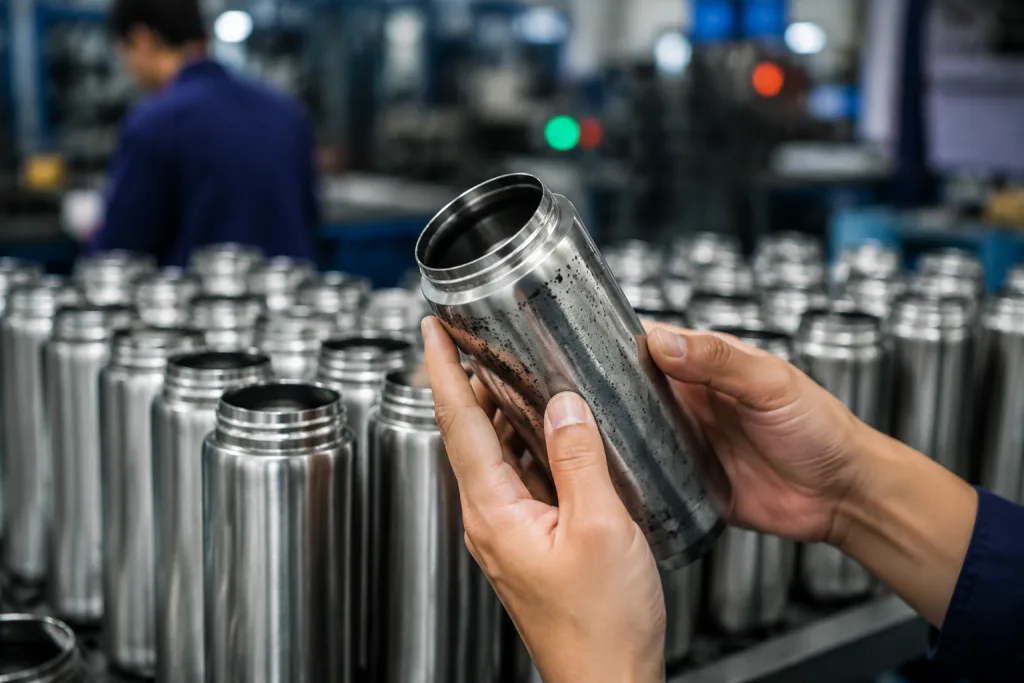
A thermos promotional order lives or dies by the logo. Outdoor retailers judge the bottle from 1 meter on a shelf; promo buyers judge it from the first unboxing photo. The usual failures are crooked placement, weak opacity, 6 pt text filling in, laser contrast drifting between samples, and artwork wrapped onto a radius where the deer head or brand mark looks stretched. We had QC pull 32 bottles from a 3,000 pcs run last year because the logo sat 4 mm higher on one side. Small miss. Big complaint.
For laser engraving, keep line thickness above 0.2 mm when possible. Tiny legal text or thin script fonts can look sharp on a flat proof and disappear on a powder-coated cylinder after the rotary jig starts moving. Laser is durable and clean, especially for premium customized thermos programs, but it exposes the base metal or underlayer, so final contrast depends on coating color, laser power, and focus height. We run black powder at a different setting than matte white; the technician checks the first piece with a 10x loupe before the line continues. Black powder with laser engraving usually looks strong. Silver on light colors looks too quiet for most retail logos.
For screen printing, specify print area, ink type, curing method, and tolerance. A practical logo placement tolerance is ±2.0 mm for screen print and ±1.5 mm for laser engraving on most cylindrical bottles. Full-wrap prints need more caution. Registration across a tapered body is harder than on a straight-wall tumbler, and artwork near the seam can leave a visible 1 to 2 mm mismatch after curing. The buyer flagged this on a 500 ml tapered bottle once; the math did not work, so we moved the badge logo 18 mm away from the seam.
Do not let a thermos vendor start mass production from only an AI file and a mockup. Ask for an artwork sheet showing logo size in millimeters, distance from base or shoulder, print color, method, and viewing direction. For Amazon or retail packaging, confirm barcode size, FNSKU placement if needed, and scannability after shrink wrap. We scan the first packed carton with a handheld Zebra scanner, not from the PDF. A good manufacturer thermos team will catch obvious artwork risks. A careless thermos supplier will print exactly what you sent, even when the PO says “front center” and the mockup shows the logo facing the handle.
Packaging Breaks More Orders Than Bottles
Distributors thermos buyers often spend 90% of the discussion on the bottle and 10% on packaging. For sea freight into a 3PL, then store or event reshipment, this is the wrong split. A 304 stainless bottle usually survives the trip. The color box fails first. Last month QC pulled 8 crushed boxes from a 200 pcs pre-shipment stack test because the buyer chose 300 gsm display board to save USD 0.06.
For export cartons, we run 5-ply corrugated for most bulk thermos shipments. A typical carton for 24 pieces of 500 ml bottles may need gross weight around 12-15 kg, depending on the bottle and packaging. Keep carton weight below 18 kg if workers will hand-load containers. Add dividers or individual white boxes when coating protection matters; our line checks rub marks with a simple 3M tape pull and a 30 cm shake test. For premium retail, use color boxes with E-flute or stronger board, not thin display packaging that crushes under pallet pressure.
If your route includes parcel delivery, skip the standard master carton answer. Ask for ISTA-style drop orientation: corner, edge, and face drops from 60-80 cm depending on packed weight. For e-commerce thermos distributors, one bottle per mailer needs a different design than 24 units per export carton. Foam inserts, molded pulp, or honeycomb sleeves may add USD 0.12-0.45 per unit, but the math works better than replacing dented bottles one by one. We have seen this go sideways when a buyer approved a mailer with 4 mm clearance and DHL crushed the cap area on 37 samples.
Packaging also affects compliance and receiving. EU and UK buyers should check recycling marks, language requirements, importer address needs, and retailer packaging rules. North American promotional buyers should confirm case pack, carton markings, PO number, item number, and barcode before production; one PO came in with “24pcs/ctn” on page 1 and “36pcs/ctn” on page 3, and the buyer flagged it only after carton printing. In Zhejiang, we see avoidable delays when packaging artwork is approved 10 days after bottle production starts. That turns a normal 35-45 day lead time into a missed vessel booking.
Inspection Plans Need Real Defect Lists
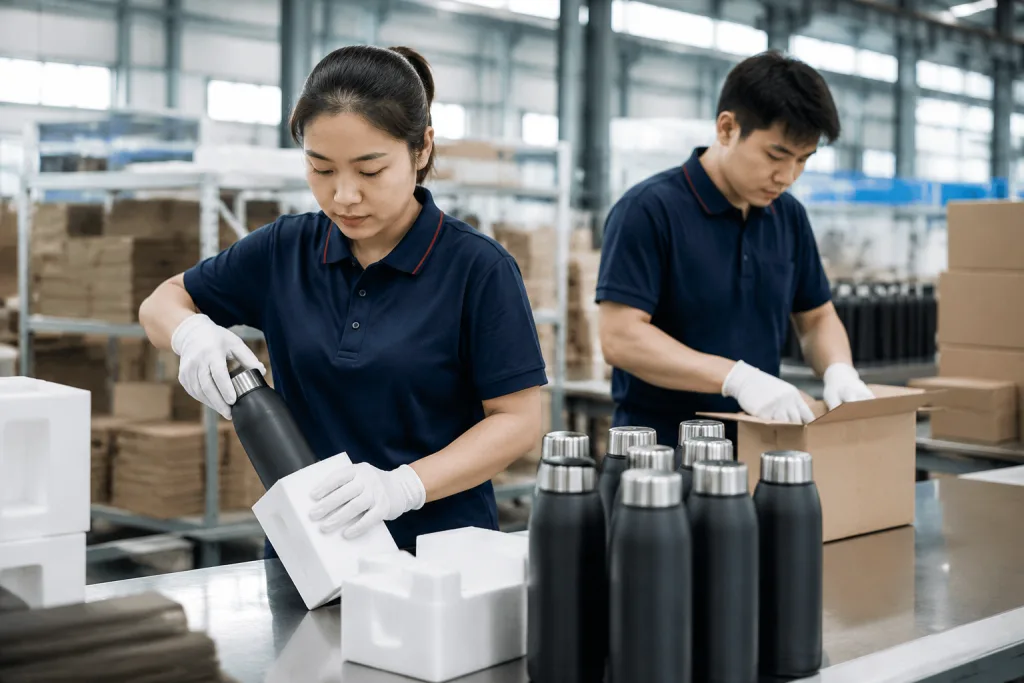
AQL inspection works only when buyer and factory use the same defect words. If your QC checklist says “good quality,” that is not a checklist. We ask buyers to define function defects like leakage after 3 minutes inverted, safety defects like 0.3 mm burrs on the lip, appearance defects like coating pinholes over 1 mm, assembly defects like loose lid threads, packaging defects like crushed 5-ply cartons, and labeling defects like a barcode that fails on a Zebra DS2208 scanner. QC pulled one sample last month with “OK” written beside every line. Useless sheet.
For a typical thermos supplier order, we suggest AQL 2.5 for major defects and AQL 4.0 for minor defects. Critical defects should be zero tolerance. Major defects include leakage, failed vacuum performance, sharp burrs on drinking surfaces, cracked lids, wrong material, missing parts, unreadable barcode, and incorrect logo. Minor defects include coating dust spots under 0.5 mm, light polishing marks outside the main viewing face, carton scuffs under 20 mm, or a logo position 1.5 mm off visual center but still inside the signed tolerance. The buyer flagged this once because the PO said “logo centered,” while the artwork file allowed ±2 mm. That typo cost 6 hours on the line.
Pre-shipment inspection should count cartons and open packed goods. Pull random samples from finished packed stock, then check capacity with a measuring cylinder, weight on a 0.1 g scale, lid fit, odor, coating, logo, barcode scan, carton drop, and heat retention sampling. For thermos bulk orders above 30,000 pcs, we run in-line inspection after coating and before logo printing. Catching a coating adhesion failure after 80,000 units are printed is a bad day for everyone. We have seen this go sideways; the math does not work once printed bottles need stripping, re-polishing, and re-coating.
Ask the thermos factory for production checkpoints: incoming steel inspection, welding check, vacuum test, polishing review, coating adhesion test, logo inspection, leak test, and final packing audit. At BottleForge Industrial in Hangzhou, China, we run standard orders with documented QC photos and batch records; for higher-risk retail projects, we support third-party inspection from SGS, Intertek, or Bureau Veritas. The point is not paperwork. The point is to make rejection criteria visible before 12 pallets of finished goods sit by the loading door with money already tied up.
Price Pressure Creates Predictable Damage
Every buyer wants a sharp FOB price. Fair enough. The trouble starts when a vendors thermos bottle target sits below the steel, lid, coating, carton, and QC cost needed for that sales channel. Push a manufacturer thermos quote down by USD 0.40 and the line has only a few places to cut: 0.38 mm steel instead of 0.45 mm, thinner powder coat, 5-layer carton swapped to 3-layer, 12 cartons checked instead of 32, or a simpler lid gasket. We have seen this go sideways. QC pulled the sample, the lid passed a desk test, then leaked after the buyer’s warehouse did a 1.2 m drop check.
For standard 500 ml stainless vacuum bottles from China, realistic FOB pricing often sits around USD 3.20-5.80 depending on steel grade, lid design, coating, logo method, packaging, and order quantity. A simple promotional thermos at 5,000 units with one-color logo can land near the lower end. A retail-ready customized thermos with 304/304 steel, powder coating, laser logo, color box, and tighter QC will sit higher because we run extra coating adhesion checks with 3M tape and a cross-cut blade before packing. If a quote is 18-25% below the market range, ask what changed. This is not hidden efficiency. The math doesn’t work.
MOQ also matters. For existing molds, 1,000 units per color is workable for 7 out of 10 custom thermos projects we quote. For new color powder, custom lid color, or private tooling, 3,000-5,000 units is more realistic because the powder supplier has its own batch MOQ and the injection line does not like changing masterbatch for 600 lids. For a fully new thermos customizable shape, tooling can run USD 3,000-12,000 and sampling can take 20-35 days before mass production even begins. Last month a PO had “Pantone Black C” with two spaces and no lid color noted; that small typo cost 2 days before pre-production sample approval.
A good thermos vendor should help you split sales features from risk reducers. Spend money on the parts your customer will punish you for: vacuum retention, leakproof lids, coating durability, logo accuracy, and packaging strength. Save money on overbuilt gift boxes or 6 SKU colors in the first order when 2 colors will prove the shelf first. We ship repeat programs when the buyer funds the failure points, not the decoration pile. That is how thermos suppliers and buyers avoid claim photos after delivery, especially the ugly ones showing dented color boxes and wet cartons at the DC.
Send Your Thermos Spec Before You Buy
Share your target volume, bottle size, logo method, market, and delivery date. We will flag the production risks before quoting.
Frequently asked questions
What MOQ should I expect for a custom stainless thermos order?
For existing stainless thermos molds, a practical MOQ is usually 1,000 units per color with one logo method. If you need custom powder coating, matched lid colors, or special packaging, 3,000 units per SKU is more realistic because coating lines and material purchasing need stable volume. For a new mold, expect 5,000-10,000 units for the first production run plus tooling cost. At our Zhejiang factory, standard custom thermos lead time is normally 35-45 days after artwork and pre-production sample approval. Sampling usually takes 7-12 days for existing shapes and 20-35 days if tooling changes are involved.
Which stainless steel grade should outdoor retailers choose?
For outdoor retail, use 304 stainless steel for the inner wall. It has better corrosion resistance than 201 and is safer for coffee, tea, sports drinks, and acidic beverages. The outer wall can be 201 for cost-sensitive promotional thermos projects, but 304/304 is better for premium retail positioning. A normal wall thickness is 0.4-0.5 mm for the inner shell. Ask your thermos manufacturer to state steel grade, thickness, and food-contact compliance in writing. For EU programs, request documentation aligned with LFGB or EU food-contact expectations. For North America, confirm FDA food-contact suitability and retailer-specific restricted substance rules.
Is laser engraving better than screen printing for logos?
Laser engraving is more durable because it removes or marks the surface instead of adding ink. It is a strong choice for customized thermos orders sold through outdoor retailers, especially on powder-coated bottles. Screen printing is better when you need exact brand colors, larger graphics, or lower cost on high-volume promotional thermos runs. For laser, keep fine lines above 0.2 mm where possible. For screen printing, plan a placement tolerance around ±2.0 mm. If your logo has small text, gradients, or a full wrap, ask for a physical pre-production sample before mass production. A PDF proof is not enough.
What inspections should I require before shipping thermos bulk orders?
Use AQL 2.5 for major defects and AQL 4.0 for minor defects on most thermos bulk orders. Critical defects should be zero tolerance. Your checklist should include leak testing, vacuum heat-retention sampling, lid assembly, sharp edge check, coating adhesion, logo placement, capacity, barcode scan, carton marks, and packaging drop resistance. For larger orders above 20,000 units, add in-line checks after coating and before logo printing. Waiting until final inspection can be expensive because a coating or logo problem may already affect every packed carton. Third-party inspection from SGS, Intertek, or Bureau Veritas is common for retail buyers.
How much should a stainless thermos from China cost?
For a standard 500 ml stainless vacuum bottle from China, FOB pricing often ranges from USD 3.20 to USD 5.80. The low end usually means an existing mold, simple lid, 201 outer steel, basic powder coating, one logo, and standard carton packing. The higher end covers 304/304 steel, better lid structure, stronger coating, laser engraving, color box, inserts, and tighter QC. Very cheap quotes can be real, but they usually remove something: steel thickness, coating quality, packaging strength, or inspection time. Ask your thermos supplier to itemize the cost drivers instead of comparing only one FOB number.