Key Takeaways
- A realistic custom thermal bottle MOQ is 1,000-3,000 units per color depending on coating and logo process
- 304 stainless steel is standard for food contact; 316 is useful for premium saltwater or outdoor ranges
- Normal custom drinkware lead time is 35-50 days after artwork, deposit, and sample approval
- Use AQL 2.5/4.0 inspection and request 8-12 hour thermal test data before shipment
If you search for vendors thermal bottle, you are not shopping for a nicer PDF catalog. You need a canteen supplier that can hold 6-hour and 12-hour temperature claims, print a 0.3 mm logo edge without blur, pass EU or North American compliance, and ship on a real date. We’ve seen launches slip because the buyer approved artwork fast, then QC pulled the sample and found the lid gasket sitting 1 mm proud.
At our Hangzhou, Zhejiang facility, the useful questions start before quotation: capacity, steel grade, coating, lid tooling, MOQ, carton spec, AQL level, and whether the vendor understands distributor drinkware programs. Ask this early. China has 200+ canteen manufacturers quoting similar shapes, but not every canteen factory is built for repeat B2B orders where one typo on the PO carton mark can hold 3,000 pcs at packing.
What Are You Actually Buying?
A thermal bottle looks simple on the shelf, but the PO is buying a stack of choices: steel grade, vacuum result, cap parts, coating, logo method, packing, compliance papers, and freight plan. When buyers ask us for vendors thermal bottle pricing, the first mistake is quoting “500 ml” or “750 ml” only; last month QC pulled 12 samples from the line and two failed the 6-hour ice-water check because the cap gasket spec was left blank on the PO.
A canteen promotional order for a 2-day trade show can run with a basic flip lid, one-color silkscreen logo, and standard white box. A distributor canteen program for outdoor retail needs powder coating that survives a 3M tape test, spare gasket planning, EAN barcode control, and carton drop-test records at 76 cm. A custom canteen for a corporate gift might care more about the finish under the D65 light booth and a rigid presentation box than 24-hour cold retention. Ask the use case first. Price comes after.
Here is the practical split we use in Zhejiang when qualifying a request:
- Promotional tier: 201 or 304 stainless body, 0.4-0.5 mm wall, single logo, MOQ around 1,000 units; we run these on standard tooling and usually check logo position with a 0.5 mm caliper mark.
- Retail tier: 304 stainless inside and outside, 0.5-0.6 mm wall, powder coating, leak test, retail box, MOQ around 2,000 units; the buyer often flags barcode scan rate before they flag bottle shape.
- Outdoor tier: reinforced base, carry handle, wider mouth, optional 316 inner steel, MOQ usually 3,000 units or more; the math doesn't work if you ask for a new handle mold on 800 units.
If a canteen vendor quotes in 10 minutes, be careful. A serious canteen manufacturer will ask where the bottle will sell, whether it touches children’s use, if you need REACH, LFGB, FDA, or California Prop 65 documentation, and whether cartons ship to a warehouse, Amazon FBA, or a distributor network. We’ve seen this go sideways: one PO had “FDA” typed as “FAD,” nobody checked it, and the buyer lost 12 days fixing documents before shipment. Those details change cost by USD 0.20-1.50 per unit.
Which Specs Change The Price?
Thermal bottle pricing is not magic. Steel grade, lid structure, coating, decoration, and packing move the number fast. For a 750 ml double-wall stainless bottle made in China, FOB Ningbo or Shanghai often sits around USD 3.20-6.80 depending on the spec sheet. A heavy custom growler or customizable growler can climb into USD 8.00-14.00 once the body weight, cap seal, and outer carton get bigger. We’ve seen buyers push for “same look, lower price”; the math does not work.
The body steel is the first lever. 304 stainless steel is the normal pick for customized drinkware because it keeps corrosion under control without blowing up cost. 316 stainless fits premium outdoor, marine, or acidic beverage positioning, but it can add 8-18% to the metal component cost. Wall thickness matters too. A 0.35 mm bottle may pass a shelf photo, yet it dents on the line fast. For distributor drinkware, 0.5 mm or above is the safer call. QC pulled the sample once and the caliper showed 0.48 mm on a PO that said 0.5 mm. That buyer flagged it right away.
Coating is the second lever. Spray paint costs less, while powder coating usually holds up better against scratches and gives a more retail-ready hand feel. If a canteen is customized with gradient color, rubber paint, or metallic finish, expect extra sampling days and a higher scrap rate at first run. We run a UV lamp check and tape test before mass production, because pretty finish alone is the wrong target. The cleaner the look, the tighter the inspection standard needs to be.
Decoration cost depends on logo size and wear resistance:
- Silkscreen: economical for 1-2 colors, roughly USD 0.08-0.25 per position.
- Laser engraving: durable, clean, good for stainless or coated surfaces, roughly USD 0.15-0.45.
- Heat transfer: better for complex graphics, usually USD 0.30-0.80.
- Full-wrap print: attractive, but the line needs close checks for seam match and scuffing.
Packaging is often underestimated. A plain egg-crate carton is cheap. A retail color box with insert, FNSKU label, suffocation warning polybag, and master carton barcode can add USD 0.25-0.90 per unit. A good canteen supplier will quote these lines one by one instead of burying them. We’ve had buyers send a PO with “gift box” typed in the note field and nothing else; that typo can turn into a 12-day delay when the artwork team has to chase the spec.
How Should You Check A Factory?
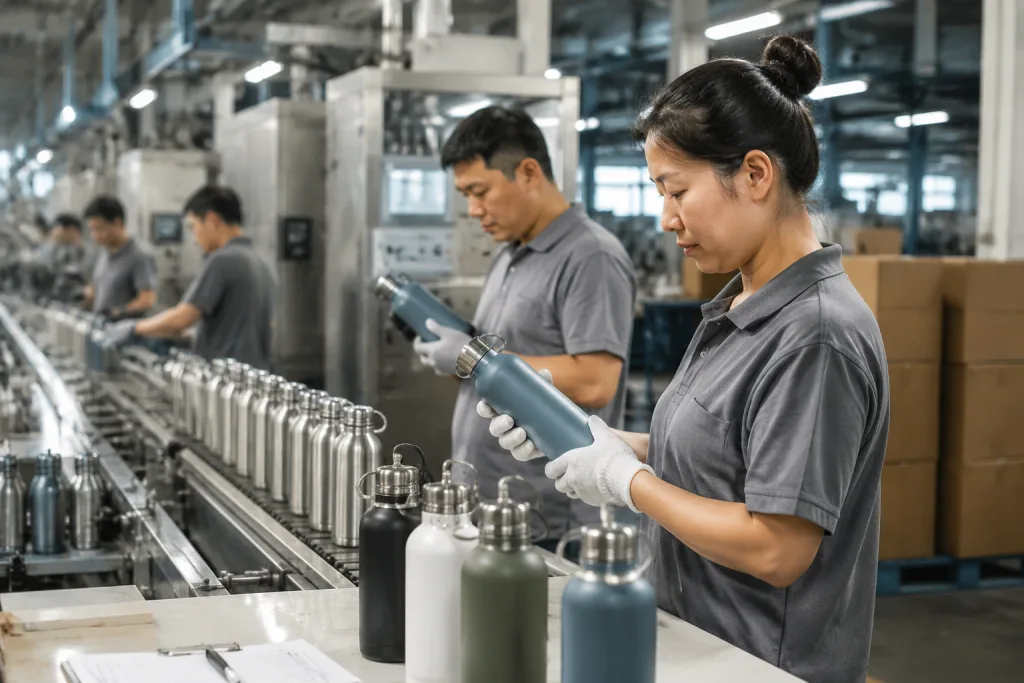
You do not need to visit every canteen factory in China, but a website and a nice sample box are not enough. Ask for a short line video, the latest IPQC sheet, material certificates, and this week’s output board. On our Hangzhou, Zhejiang floor, the whiteboard beside the vacuum welding area shows daily output by SKU; we run about 450,000 stainless drinkware units per month across bottles and tumblers, with normal custom MOQ from 1,000 units per SKU.
Ask blunt questions. How many vacuum forming lines? Which process leaves the factory gate? Is powder coating done in-house or sent to a coating shop 18 km away? How many leak-test stations are on the line? What is the daily capacity for your exact bottle shape, not the best-selling 500 ml model? If a canteen manufacturer needs two days to answer, the math does not work. They may be trading orders, not controlling production. We have seen this go sideways when QC pulled the sample and the lid thread gauge failed by 0.3 mm.
For compliance, match the certificate to your market. Europe buyers usually ask for LFGB and REACH, then BSCI or Sedex audit records if the retailer requires social compliance. North American buyers often need FDA food-contact declarations, CPSIA if children are involved, and ASTM-related packaging or safety claims depending on channel. Check the tested material, product type, lab name, and report date. A random old report for another item is not proof; last month one buyer flagged a 2021 report that listed PP straw parts while the PO called for Tritan.
Use this vendor checklist before deposit:
- Business license and export record under the same China company name; the company chop should match the PI, not a sister trading firm.
- Recent factory audit: BSCI, Sedex, ISO 9001, or customer audit if available, with the CAPA page included.
- Material declaration for 304 or 316 stainless steel and food-grade PP, silicone, or Tritan parts; ask QC to attach the coil batch number.
- Sample thermal test: boiling water at 95°C, room temperature 20-25°C, measured at 6 and 12 hours with the thermometer model recorded.
- Leak test method: inverted bottle, pressure or vacuum test, and random sampling ratio; we prefer a 30-minute inverted hold for screw lids.
- Clear AQL plan: common standard is critical 0, major 2.5, minor 4.0, written on the inspection booking before mass production starts.
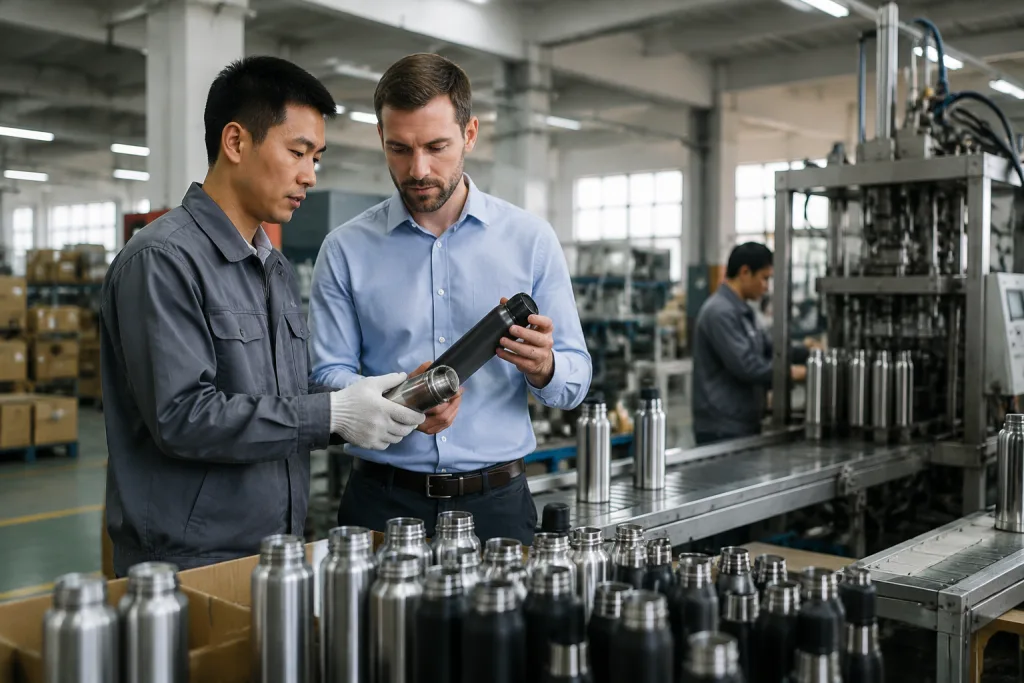
A canteen vendor who welcomes inspection is easier to work with than one who says inspection is unnecessary. This is the wrong corner to cut. We ship cleaner orders when the buyer sends the checklist before deposit, because the line, QC table, and carton drop-test setup are aligned from day one.
What MOQ Is Actually Reasonable?
MOQ is where 7 out of 10 buyer-vendor calls get unrealistic. A canteen customizable program with six colors, three logos, and two lid options does not run cleanly at 300 units per variant unless we use stock bodies and stock lids. The math doesn't work. Factories set MOQ because the powder booth needs cleaning, the pad-printing jig needs setup, stainless steel sheet or tube needs to be booked, and the line loses 45-90 minutes on each changeover.
For standard custom drinkware, use these planning numbers:
- Stock bottle plus logo: 500-1,000 units per design if the body color is already available; QC still checks logo position with a 0.5 mm tolerance gauge.
- Custom color powder coating: 1,000-2,000 units per color, since one color change can waste 8-12 kg of powder during booth cleanup.
- Custom mold or lid tooling: 3,000-5,000 units for first production, with tooling cost often USD 1,500-8,000; the buyer should approve the T1 sample before we run mass production.
- Custom growler: 1,000-3,000 units depending on capacity and cap structure; 1.9 L swing caps need a different leak-test fixture than screw caps.
- Private label retail packaging: usually 1,000 units minimum because box printing has its own setup cost, and one typo on a PO can turn 1,000 color boxes into scrap.
If you are a new canteen distributor testing a market, ask for a mixed approach. Use one proven bottle body, two colors, one logo method, and one retail box. That gives you enough differentiation without forcing the canteen manufacturers to reset the line all day. We run these starter programs often: QC pulled the sample at 10:30, the buyer flagged the matte black as too glossy, and we fixed it before bulk coating. A distributor growler order can start with a standard 1.9 L or 2 L body, then move to customized growler tooling after sell-through data is proven.
The honest answer: low MOQ often means higher unit price, weaker color control, or leftover stock bodies. That is acceptable for a pilot. Do not build a national launch around a sourcing structure that cannot scale; we've seen this go sideways when the second PO needed 12 days but the first supplier quoted 18 days just to find matching bodies. For repeat distributor canteen programs, 2,000-5,000 units per purchase order is a healthier range for price, consistency, and production attention.
How Do You Avoid Logo Problems?
Logo problems cost money because they show up after the easy fixes are gone. The bottle is already welded, powder coated, packed in 24 pcs master cartons, and then QC pulls a sample and sees the logo is 4 mm too low or the white ink looks gray on matte black. We have had a buyer flag this at final inspection with 6,000 pcs finished. For customized canteen orders, artwork control is not paperwork. It is line control.
Start with vector artwork in AI, EPS, or PDF format. Do not send only a PNG copied from a website; our prepress desk will usually kick it back within 2 hours. Specify Pantone colors, logo size in millimeters, print position from the base or shoulder, and whether the logo faces the drinking side or the back side. For a canteen promotional order, one-position silkscreen is often enough if the logo is under 70 mm wide. For retail customizable drinkware, laser engraving or heat transfer usually holds up better when the buyer expects dishwasher claims or shelf-ready finish.
Curved bottle walls distort artwork. Simple problem, costly miss. A wide logo on a narrow 500 ml bottle can wrap too far around the cylinder, so the front view looks smaller than the PDF proof. Tall bottles with tapered shoulders need a flatter decoration zone; our pad-print jig normally gives a cleaner result when the printable band stays below the shoulder radius. This is why approving only a digital mockup is the wrong question to ask. You need one pre-production sample in hand.
Use this approval sequence:
- Confirm dieline or decoration area in millimeters, including safe space from the bottom edge and weld line.
- Approve digital mockup with exact logo size and placement, not “centered” written on the PO.
- Approve physical sample under normal lighting, since studio photos can hide weak white ink on black coating.
- Check adhesion using 3M tape test for print and cross-hatch test for coating if required.
- Keep a signed golden sample at the factory and buyer office, with date, color code, and inspector name on the label.
A good canteen supplier will photograph the first 20-50 decorated units before mass printing continues. We run this stop at the silkscreen station before the operator loads the next rack, and yes, it costs about 15 minutes. The math still works. For North American and European distributors, that pause is cheaper than rework, air freight, or retailer chargebacks when 3,000 bottles ship with the logo facing the wrong side.

What Quality Tests Should Matter?
Do not inspect a thermal bottle like a ceramic mug. Vacuum insulation, leak resistance, coating durability, and cap fit are where orders fail. We had QC pull 32 pcs from a 3,000 pcs custom logo run last May; the body looked clean, but 7 lids seeped after 10 minutes upside down on the stainless test rack. Pretty is not enough. If it leaks in a backpack or drops from 68°C to lukewarm in three hours, the buyer will call it a reject.
For thermal performance, write the test method on the PO. We run a common check by filling the bottle with 95°C water, closing the lid to the normal torque, placing it in a 20-25°C room, then recording temperature after 6, 12, and 24 hours with a probe thermometer. Not every bottle needs a 24-hour claim. This is the wrong question to ask if your retail tag only says “keeps hot for 6 hours.” For most retail bottles we ship, 6-hour hot and 12-hour cold data is enough, but the packaging claim must match the actual test sheet.
For leak testing, we recommend 100% leak check on the line for vacuum bottles, then random inspection before packing. The check needs to cover cap assembly, silicone gasket seating, and inverted storage for at least 10 minutes. QC pulled the sample once because a worker fitted a 54 mm gasket into a 56 mm lid groove; it passed at first shake, then failed in the carton. Straw lids and flip lids fail more often than simple screw caps because each spring, plug, and vent hole adds one more place to leak.
For coating, ask for shop-floor tests, not soft promises. The math does not work if the factory says “no scratch problem” but refuses to run a blade, tape, or rub test before mass production.
- Cross-hatch adhesion test on powder coating, cut with a 1 mm grid blade and checked with 3M tape.
- Alcohol rub test for printed logo, usually 50-100 cycles, with the printed area checked under normal packing-room light.
- Dishwasher claim testing only if you intend to print dishwasher-safe claims; otherwise skip the claim and avoid returns.
- Carton drop test from 60-80 cm, especially for e-commerce cartons, with corner, edge, and flat-side drops recorded.
- Salt spray test if selling outdoor or marine-positioned customizable canteen products, since beach shops will flag rust spots fast.
AQL inspection should be written into the purchase order. Critical defects should be 0, major defects often AQL 2.5, minor defects AQL 4.0. If your channel has stricter retailer requirements, send the manual before quotation, not after the deposit. We have seen this go sideways when a buyer’s PO typo said “AQL 1.5” while their vendor guide required AQL 2.5, and the third-party inspector held 86 cartons at final inspection. China factories can meet stricter standards, but the inspection labor, sorting time, and expected rejection rate must be priced honestly.
How Should Distributors Plan Reorders?
A distributor canteen or distributor growler program works best when reorders feel routine. If every repeat PO turns into a fresh development job, the math doesn't work. We want the first order to set up the second and third: approved sample sealed in a PE bag, color chip stapled to the file, barcode checked on the carton proof. Simple stuff.
Lock the bill of materials. Same body mold, same lid resin, same gasket hardness, same coating code, same logo process, same carton layout. We run this through a BOM sheet before the line opens, down to the 0.5 mm silicone gasket tolerance. If a canteen suppliers network changes a lid without notice, your customer service team hears about leaking caps before anyone in purchasing does. Spare parts also matter. For sports lids and growler caps, keep 1-2% spare lids or gaskets available. That costs less than replacing full bottles after QC pulled the sample and found a loose flip-top pin.
Build your calendar backward. For a normal repeat order from Zhejiang, expect 30-40 days production after deposit for an unchanged SKU, plus 25-35 days ocean freight to many European ports or 18-30 days to the US West Coast depending on routing. Add 3-5 days for customs, 2-4 days for inland trucking, and at least 1 warehouse receiving slot. If you need goods on shelf by September 1, placing the PO in late July is usually too late. We have seen this go sideways when the buyer flagged a missing “matte” coating note on the PO after the cartons were already printed.
For customized drinkware sold through distributors, track sell-through by color and capacity, not only total units. Black and white carry volume, but seasonal colors protect margin when the MOQ is split cleanly, such as 1,008 pcs per color on a standard line plan. If you plan to add a canteen custom gift set, custom growler, or new canteen promotional SKU, keep it away from replenishment orders. New artwork delays proven items. That is the wrong risk to take when warehouse stock is already under 12 weeks.
One practical rule: reorder when you have 10-12 weeks of stock left, not when the warehouse looks empty.
A stable canteen manufacturer should help you forecast steel, coating, and packaging lead times before peak season. Ask for coil status, powder coating queue, and carton supplier booking before you send the deposit. We ship smoother when those three checks are done early. That is where a long-term China supplier earns its margin.
Send Your Thermal Bottle RFQ For Factory Review
Share capacity, artwork, MOQ, market, and packaging needs. Our Zhejiang export team will return a practical quote with production notes.
Frequently asked questions
What is the normal MOQ for a custom thermal bottle order?
For a stock bottle with one logo, 500-1,000 units may be possible if the color is available. For a custom powder-coated bottle, plan on 1,000-2,000 units per color. If you need a new lid, new mold, or special retail packaging, 3,000-5,000 units is more realistic. A canteen promotional order can start smaller, but a distributor drinkware program usually gets better pricing and consistency at 2,000 units or more per SKU.
Can I use one supplier for bottles, canteens, and growlers?
Yes, if the factory has the right production range. Many stainless drinkware factories can handle a custom canteen, travel bottle, and custom growler, but growlers need stronger cap sealing and heavier body control. Ask for actual production photos, thermal test reports, and carton specs for each category. A customizable growler is not just a larger bottle; 1.9 L or 2 L capacity increases dent risk, carton weight, and freight cost.
Which certification should European or North American buyers request?
For Europe, request LFGB or EU food-contact testing, REACH declarations for coatings and components, and audit records such as BSCI or Sedex if your retailer asks for social compliance. For North America, FDA food-contact documentation is common, and CPSIA may apply if the product is intended for children. Match the test report to the actual material: 304 stainless steel, silicone gasket, PP lid, coating, and printed ink where relevant.
How long does sampling and mass production take?
A logo sample using an existing bottle normally takes 7-12 days after artwork confirmation. A custom color sample usually takes 10-18 days because powder coating or spray color matching needs adjustment. Mass production is typically 35-50 days after deposit and sample approval. For a new mold or canteen customized lid, add 20-35 days for tooling and testing before the first production run starts.
What should I include in my RFQ to get accurate pricing?
Include capacity, target market, steel grade, body color, logo method, logo size, lid type, packaging, compliance needs, delivery term, and annual forecast. Say whether you need FOB Ningbo, FOB Shanghai, DDP, or FBA preparation. Attach vector artwork and any retailer manual. If you only ask for “best price for 750 ml bottle,” canteen vendors will quote different assumptions, and the prices will not be comparable.