Key Takeaways
- A 1,000 pcs MOQ is realistic for most vendors tea bottle OEM projects
- 304 stainless steel is usually enough; 316 raises cost by about USD 0.35-0.80 per unit
- AQL 2.5/4.0 inspection should cover leaks, coating, logo, capacity, and carton drop tests
- Powder coating normally needs 20-25 micron film thickness for stable daily-use durability
A vendors tea bottle looks simple on the shelf. Once you approve the spec, the small stuff starts biting: 304 stainless or not, how fine the infuser mesh runs, whether the lid seal holds at 95°C, if the powder coat chips on a carton drop, and which logo method fits the neck ring. We’ve seen buyers fixate on a pretty render, then the first hot-tea test shows a loose cap and the whole order goes back to the line.
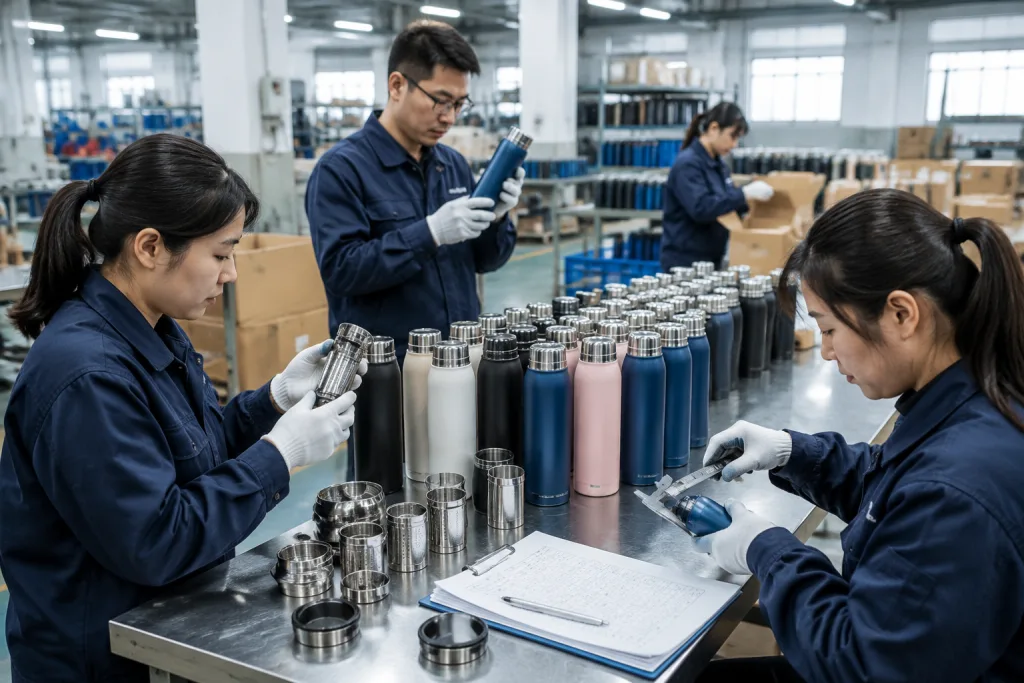
At our Zhejiang, China factory, we quote custom drinkware by specification, not by mood board. A normal stainless tea bottle project starts at 1,000 pcs per SKU, with sample development in 7-10 days and bulk lead time of 25-35 days after artwork approval. QC pulled the sample on the bench with a 500 ml fill and a torque check, and that is the kind of detail that tells you where the risk sits before you place the PO.
Capacity And Bottle Geometry
Capacity is the first line buyers check, and it gets waved through too fast. For a vendors tea bottle, 350 ml, 450 ml, 500 ml, and 600 ml are the sizes we run most often. Under 350 ml, the shelf price can look thin unless the bottle sits in a gift set. Over 600 ml, the filled weight starts to work against office use, and hot tea stays awkward to carry.
Geometry drives the real complaints. A slim 500 ml bottle can look sharp on the render, but once the body hits 72 mm, some cup holders reject it. If the mouth is under 45 mm, cleaning turns into a headache and the infuser has to shrink, which cuts leaf expansion. QC pulled the sample on one 42 mm mouth last month for that exact reason, and for loose-leaf tea we push 50-56 mm plus a removable basket with 0.5 mm perforations.
If you buy for a canteen line or a drinkware program, locking capacity across models saves time on the floor. One 500 ml tea bottle, one 750 ml custom canteen, and one 1.2 L custom growler can share carton size, color callouts, and price bands. The buyer flagged a PO typo once because six random molds meant six packing specs. That is the wrong way to run a program.
For OEM orders in China, tooling is usually not the issue if you stay on existing body molds. The cost jumps when you change the shoulder, lid, or diameter. A new body mold can add USD 1,500-4,500 and 20-30 days, and we have seen that delay a launch by two weeks when the buyer asked for a 68 mm neck after sample approval. If the shape does not need brand protection, existing Zhejiang tooling is the cleaner first order.
Steel Grade And Wall Thickness
The material line needs to say which steel goes on each part. For most vendors tea bottle programs, we run 304 stainless steel on the inner wall and 201 or 304 stainless steel on the outer wall. For higher-end retail, write 304 inside and 304 outside on the PO, not just “premium stainless.” If the bottle is for fruit tea, lemon water, or tea that sits 6-8 hours with tannins, 316 inner steel makes sense, but the math does not work if the buyer expects the same quote. It usually adds about USD 0.35-0.80 per unit depending on capacity and market steel pricing. Last month QC pulled a 500 ml sample with 304 marked inside, but the BOM only listed “SS” for the bottom plate. We stopped it before pre-production.
Wall thickness is the next detail buyers feel in hand. A common vacuum tea bottle uses 0.4 mm inner wall and 0.5 mm outer wall before forming. Cheaper offers may drop to 0.35 mm or less. Looks fine in photos. Then it dents. We see this during mouth rolling, polishing, carton compression, and the first warehouse drop test from 80 cm. For a canteen promotional order handed out at events, lighter construction can pass if the target price is tight. For a retail customized drinkware line, thin steel creates warranty noise, and the buyer will flag it after the first 200 customer reviews.
Ask your canteen manufacturer or canteen supplier to declare steel grade by component: body, infuser, lid insert, handle pin, and bottom plate. Mixed materials are normal. Hidden swaps are not. We also ask for LFGB or FDA food-contact test reports on stainless steel, silicone, coating, and plastic parts before the deposit moves to tooling. For Europe, REACH and LFGB are common expectations; for North America, FDA food-contact compliance and California Prop 65 review may be needed depending on your sales channel. One buyer sent us a PO with “304 lid” typed in, but the approved drawing showed a PP lid with a 304 tea strainer. Small typo, big argument.
Do not approve “stainless steel” as a material spec. It is not a spec; it is a category.
Infuser, Lid, And Leak Control
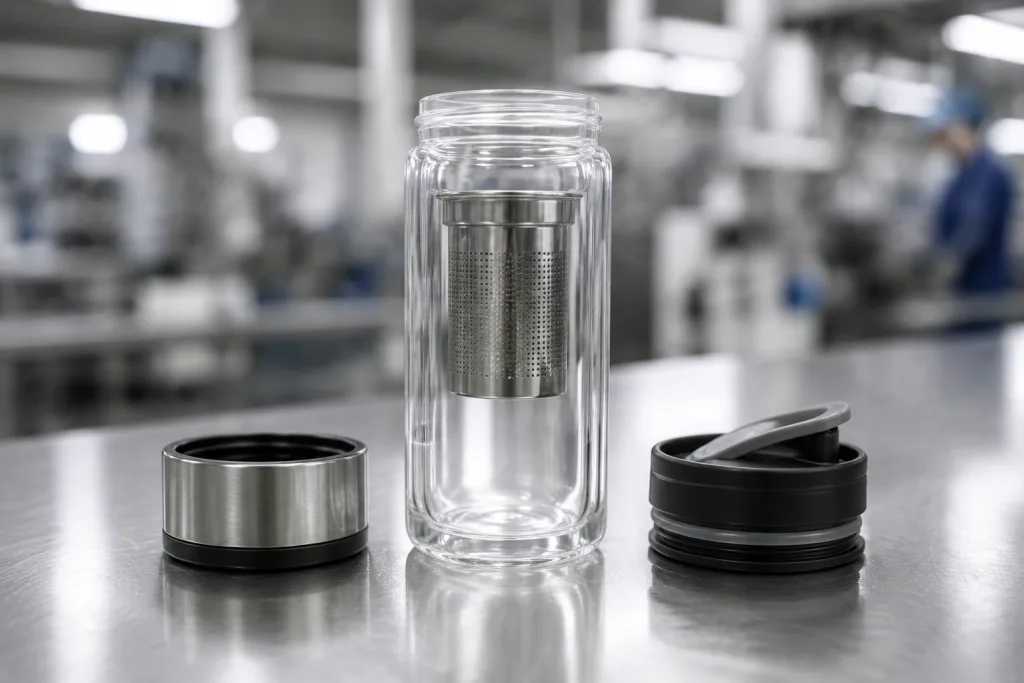
The tea function sits in the infuser and lid, not the bottle body. For a vendors tea bottle, lock down the infuser type, mesh opening, basket height, handle style, and whether it is top-hung or drop-in. We usually spec a 42-55 mm basket height on 350-500 ml bottles after QC checks it with a digital caliper. Top-hung baskets come out cleaner for office users. Drop-in baskets hold more leaves, but we’ve seen them rattle in transit and drip tea on the desk when removed hot.
For a proper tea bottle, 304 stainless steel infuser mesh is the safe default. Mesh holes around 0.5-0.8 mm handle most loose tea without clogging too badly. Fine mesh looks premium on the sample table, but the math does not work if the buyer’s market drinks powdered tea or broken black tea, because rinse complaints come back fast. On one 3,000 pcs run, QC pulled the sample after the mesh trapped residue in 6 rinse cycles. If you are building a customizable canteen family with both tea and water versions, keep the same bottle body and sell the infuser as an accessory. Fewer SKUs. Canteen distributors also get a clean replacement-part story.
Lid construction is where cheap quotes hide risk. A basic PP lid with silicone gasket is fine if the bottle stays upright most of the time. For bags and commuting, ask for 360-degree leak testing. Our normal factory test is inverted leakage for 30 minutes after filling with 90°C water, plus random torque checks during final inspection. We run the torque meter at the line, then record failures by cavity number if one lid mold starts drifting. For push-button lids, add a vibration test, because springs and locks fail in a different way from screw lids. We’ve seen this go sideways after a buyer skipped that test to save 0.03 USD.
Silicone should be food-grade, usually with hardness around 50-60 Shore A for a stable seal. Too soft, and the gasket deforms after repeated cleaning. Too hard, and it leaks when the lid tolerance varies by 0.2 mm. If your canteen vendor says the lid is “same as sample,” this is the wrong question to ask. Write the gasket material and spare gasket policy into the purchase order; we once had a PO typo that said “silicon ring,” and QC flagged it before packing 24 pcs per carton.
Insulation Claims Need Numbers
Vacuum insulation is easy to overclaim, and buyers get burned when the test basis is fuzzy. A proper spec should state starting water temperature, room temperature, fill volume, test time, and the minimum temperature left at the end. For a 500 ml stainless tea bottle, we usually treat “hot above 60°C after 6 hours” as a fair claim if the sample starts with 95°C water at 20°C ambient. If a catalog says “12 hours” and there is no test sheet behind it, the buyer flagged it for a reason.
Heat loss does not come from one point. Weld quality, copper lining, vacuum level, lid structure, and neck diameter all matter. A wide-mouth tea bottle loses more through the cap area than a narrow-mouth thermos, and that is normal. On the line, we see 2 mm lid gasket changes move the result more than glossy marketing copy. If the customer wants easier cleaning and tea leaves room to move, the right question is not “why isn’t it the strongest spec?”
For distributor growler or customizable growler jobs, the numbers need a different lens because 1.2 L behaves differently from a 500 ml tea bottle. A 1.2 L customized growler often holds cold longer, but the cap seal has to survive more hand use and more torque. Do not copy a tea bottle sheet into a growler PO. That math does not work, and we have seen it go sideways when the buyer only changed the artwork line and left the insulation claim alone.
In our Zhejiang production line, we run vacuum checks on 100% of insulated stainless units before packing. QC pulled the sample, and any body that fails the vacuum test gets held before logo printing or laser engraving so nobody wastes time on a dead shell. If a canteen factory cannot walk you through its vacuum test method, that is a bigger warning than a USD 0.20 price gap.
Branding Method And Finish Risk
Logo method should fit the finish, order quantity, and shelf price. For vendors tea bottle orders, we run silkscreen printing, laser engraving, heat-transfer printing, water-transfer printing, UV printing, and powder coating with logo cut-through. Silkscreen is still the cheap slot for 1-2 color logos, usually USD 0.08-0.18 per print position. Laser engraving sits higher at USD 0.15-0.35, but it does not peel, and buyers who sell corporate custom drinkware usually prefer that clean mark.
Powder coating is the main finish on canteen customized and tea bottle programs. We ask for 20-25 microns and a cross-hatch adhesion test every time. A nice matte surface that flakes in QC is not premium; it is a return ticket. Gloss paint shows scuffs fast, while soft-touch coatings look good on the sample but can mark in sea freight if the carton drop test is weak. One bad batch of 2,000 pcs teaches that fast.
If you sell canteen promotional items, lower-cost spray paint and silkscreen can make sense because the product life is shorter. If you are a canteen manufacturer buying for retail shelves, powder coating plus laser engraving is the safer call. For full-wrap artwork, ask for a pre-production sample; we have seen buyers approve a flat PDF and then flag the shoulder distortion on the first blank after the line wraps it.
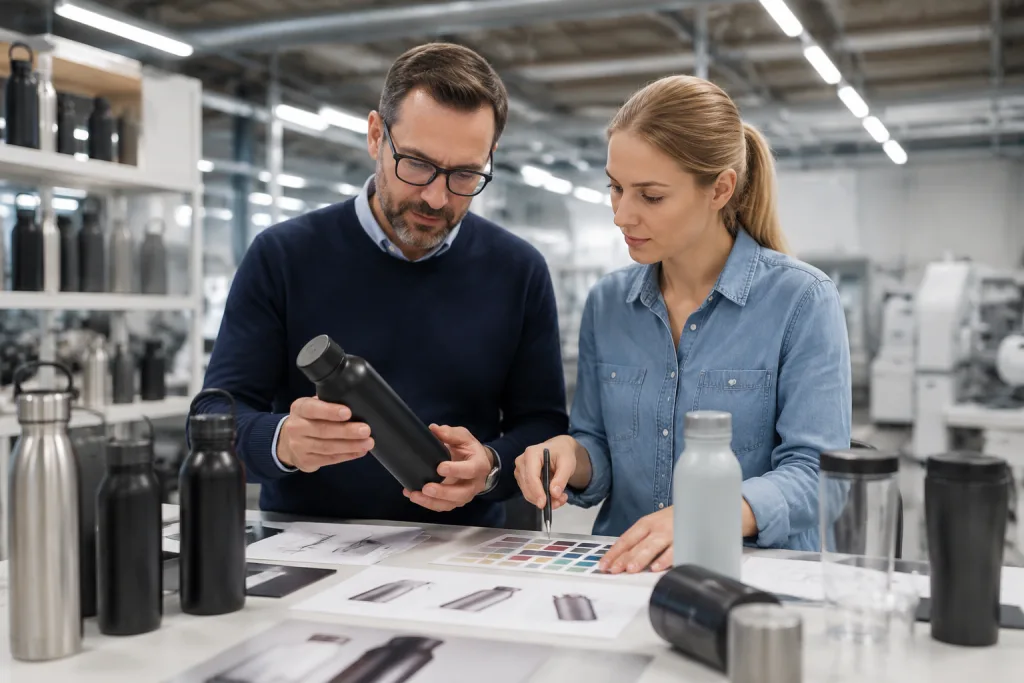
Pantone matching needs a tolerance target. On stainless steel and powder coating, Delta E under 2.0 is hard to hold and usually adds cost. For most B2B drinkware, Delta E under 3.0 is the practical number. Approve color under D65 light, not only under office lighting in Hangzhou, Zhejiang or in a buyer’s meeting room in Europe. The spectrophotometer on our QC table does not care about the room decor.
Packing, Compliance, And Channel Fit
Packing is damage control, not decoration. We usually quote a vendors tea bottle in a white box, kraft box, color box, or gift tube, then match the packing to the sales channel. For e-commerce, we run a polybag or paper wrap, 2 mm corner pads, and carton drop testing from 76 cm. For canteen wholesale, the buyer often pushes back on “pretty box” cost because the math is paid by CBM, not by how nice the shelf photo looks.
A typical 500 ml tea bottle carton might hold 24 pcs, with gross weight around 9-12 kg depending on steel thickness and packaging. The master carton should use 5-ply corrugated board, usually K=A or similar export grade; QC pulled one sample last month where the carton burst at the handle cutout after a 20 kg stack test. If you ship to Amazon FBA or a third-party warehouse, lock FNSKU labels, suffocation warnings for polybags, carton weight limits, and scannable outer carton labels before production starts.
Compliance depends on destination. Europe usually needs LFGB, REACH, and sometimes BSCI or Sedex factory audit expectations from larger retailers. North America commonly asks for FDA food-contact documentation, CPSIA only if it is a kids product, and ASTM or Prop 65 review depending on category and state. A kids tea bottle is a different job from an adult office tea bottle; the buyer flagged this once after the PO said “student bottle” while the artwork showed a cartoon bear.
If you are buying from canteen suppliers in China, ask for current test reports on the exact materials, not a five-year-old report for a different lid. Reports matter, but they do not replace incoming inspection. For higher-risk retail programs, we recommend third-party pre-shipment inspection at AQL 2.5 major and 4.0 minor, with separate critical checks for leakage, sharp edges, odor, capacity, logo position, barcode scan, and carton marking. We have seen this go sideways when the report covered 304 stainless body steel but the tea strainer mesh came from another batch, so our line checks it with a magnet and a 500 ml water-fill test.
MOQ, Price, And Order Control
Price only makes sense after the spec is locked. For a 500 ml stainless vendors tea bottle with 304 inner steel, infuser, powder coating, and one-color logo, a realistic FOB China range is often USD 3.20-5.80 per unit at 1,000-3,000 pcs. On our quoting sheet, the first check is simple: body diameter in mm, lid type, coating code, logo size, and carton qty. Laser engraving, 316 steel, gift packaging, custom lid colors, or full-wrap printing will move the price up. Cheap quotes are where we’ve seen this go sideways. If one factory is 18% under the pack, ask for steel grade proof, wall thickness, vacuum test method, and packing spec before you celebrate.
MOQ depends on what you customize. Stock color with logo may start at 500-1,000 pcs. Custom powder coating usually needs 1,000 pcs per color because the coating line does not like tiny batches; a 120 pcs color run wastes powder and rack time. A custom lid or new mold can require 3,000-5,000 pcs because the setup cost and component MOQ are higher. For a canteen customizable program with multiple colors, splitting 1,000 pcs into ten colors is the wrong question to ask. The math doesn’t work unless you accept a higher unit price and a slower slot on the line.
Payment terms for new buyers are commonly 30% deposit and 70% before shipment after inspection. FOB Ningbo or FOB Shanghai are practical terms for Zhejiang factories; we ship both, but Ningbo often saves 1 truck transfer from Hangzhou. Lead time is usually 25-35 days after deposit and final artwork approval, but peak season can add 7-14 days. Artwork delays hurt more than buyers expect. Last month QC pulled the sample on day 6 because the PO said Pantone 553C, while the AI file showed 554C. If your launch date is fixed, reserve production capacity before you finish every detail of the retail page.
Good order control is boring: signed PI, approved golden sample, artwork file with dimensions, carton mark file, inspection checklist, and written tolerance for color and logo position. We run logo position tolerance at ±1.5 mm unless the buyer signs off on a tighter spec, and that needs a real fixture, not eyeballing at the pad-printing table. Whether you call the partner a canteen vendor, canteen factory, canteen manufacturer, or distributor canteen source, the work is the same. Clear specs beat friendly emails when production gets busy.
Send Your Tea Bottle Spec For Factory Review
Share capacity, logo, market, and target price. We will return a practical OEM quote with MOQ, lead time, and risk notes.
Frequently asked questions
What MOQ should I expect for a vendors tea bottle order?
For a standard stainless vendors tea bottle using existing molds, 1,000 pcs per SKU is the normal working MOQ in China. Some stock-color logo orders can start at 500 pcs, but the unit price is usually higher and color choice is limited. Custom powder coating normally needs 1,000 pcs per color because coating setup, line cleaning, and rejection allowance must be covered. If you need a new lid mold, special body shape, or private infuser design, expect 3,000-5,000 pcs and 20-30 extra days for tooling. For first-time B2B buyers, I usually suggest one body size, two colors, and one logo method to keep cost and inspection simple.
Is 304 stainless steel enough for tea bottles?
Yes, 304 stainless steel is enough for most tea bottle programs, especially for hot tea, plain water, and daily office use. The key is to specify 304 for the inner wall and infuser, not just “stainless steel” on the quote. If your product is marketed for lemon tea, fruit infusion, salty drinks, or premium retail, 316 inner steel can be a useful upgrade. It typically adds USD 0.35-0.80 per unit depending on capacity and order size. For a canteen promotional project, 304 inner with 201 or 304 outer is often the better commercial balance. Ask for LFGB or FDA food-contact reports on the actual steel and silicone parts.
Which logo method is best for customizable drinkware?
For customizable drinkware, laser engraving is the safest premium option on powder-coated stainless bottles because it does not peel and handles dish-rack abrasion better than ink. Expect about USD 0.15-0.35 per logo depending on size and position. Silkscreen is cheaper, often USD 0.08-0.18 for a simple one-color print, and works well for promotional orders. UV printing is better for multicolor artwork but needs careful adhesion testing. If you are a canteen distributor selling to corporate buyers, offer both: silkscreen for budget campaigns and laser engraving for executive gifts or retail. Always approve a pre-production sample, not only a digital mockup.
How do I compare quotes from different canteen suppliers?
Put every quote into the same spec grid before comparing. Match capacity, inner and outer steel grade, wall thickness, infuser material, lid plastic, silicone grade, coating type, logo method, packaging, MOQ, FOB port, sample cost, and lead time. A USD 0.40 cheaper quote may simply be using 0.35 mm steel instead of 0.5 mm outer wall, or spray paint instead of powder coating. Ask whether vacuum testing is 100% or random, and whether inspection follows AQL 2.5/4.0. For canteen suppliers in Zhejiang, FOB Ningbo is common; for other China regions, FOB Shanghai or Shenzhen may change inland freight and timing.
Can one factory produce tea bottles, canteens, and growlers together?
A capable canteen manufacturer can usually produce tea bottles, custom canteen models, and customized growler products in one program, but not every line handles every size equally well. Tea bottles focus on infuser fit, lid sealing, and clean drinking experience. Canteens may need carry handles, wider bodies, or outdoor durability. Growlers need stronger caps, larger welding control, and carton protection because 1.2 L or 1.9 L units are heavier. Combining categories can reduce color and packaging development costs, but keep inspection checklists separate. At BottleForge Industrial in Zhejiang, China, our monthly stainless drinkware capacity is about 450,000 units across thermos, tumbler, bottle, canteen, and growler lines.