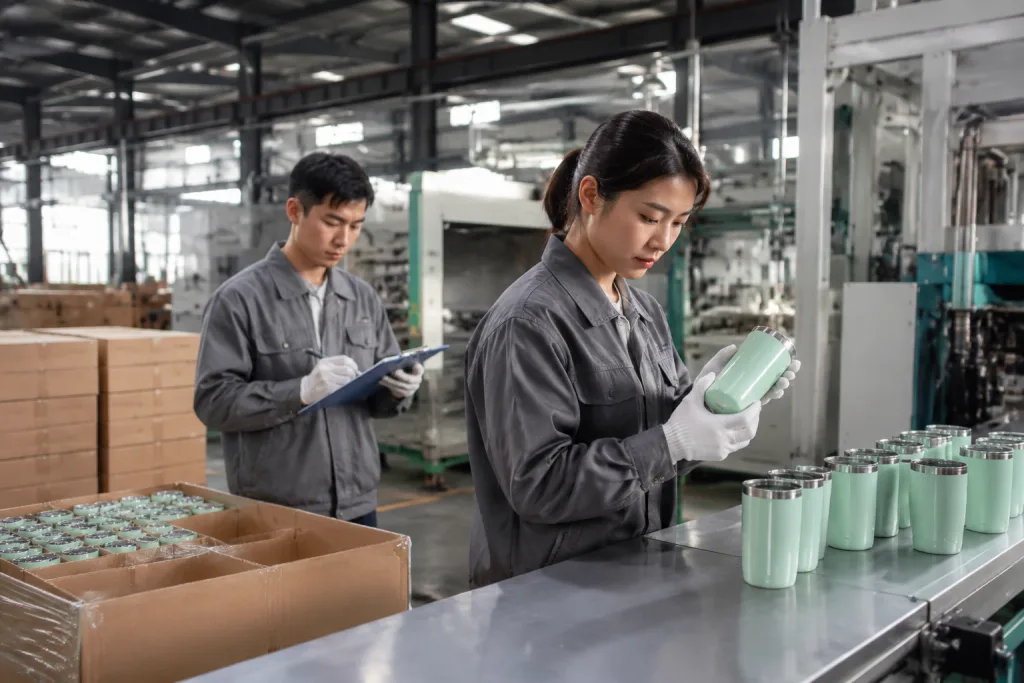
Key Takeaways
- Ask for 304 inner steel, 201 or 304 outer steel, 0.4-0.5 mm wall thickness, and actual capacity tolerance
- A realistic custom tumbler MOQ is 1,000-3,000 units per color for powder coating or full-color print
- Plan 7-10 days for sampling and 25-35 days for mass production after artwork approval
- Use AQL 2.5/4.0 inspection, 100% leak test on lids, and carton drop testing before shipment
You can get a vendors stainless steel tumbler quote before lunch. Buying from that quote is the hard part. On paper, 8 offers may read the same: 304 stainless steel, vacuum insulated, custom logo, 20-day delivery. The trouble shows up after QC pulls the sample: 0.38 mm body wall sold as 0.45 mm, powder coating that fails a 3M tape test, lids that rock by 1.2 mm, soft cartons, or a finish the line cannot repeat across 10,000 units.
We manufacture custom drinkware in Hangzhou, Zhejiang, and the buying mistakes we see usually start with loose specs, not bad intent. If you are comparing a canteen manufacturer in China, a trading company, or 4 canteen suppliers, ask practical questions before you approve samples or send a deposit. “Same as last order” is the wrong spec; we have seen that go sideways after a PO typo changed matte black to gloss black and the buyer flagged it only during pre-shipment inspection.
Start with the product job
Before you ask a canteen vendor for pricing, write down the job of the tumbler. Not the slogan. The actual use. A corporate gift tumbler for office desks can live with a simple slider lid; a cycling event bottle gets dropped, squeezed into cages, and blamed for every leak. A retail distributor program needs carton marks, barcode scans, and color matching held tighter than a one-off canteen promo order. We had one buyer flag a PO typo last month: “matte back” instead of “matte black.” QC pulled the sample before mass coating, or 8,000 pieces would have gone the wrong way.
For stainless steel tumblers, your technical brief should lock capacity, body shape, lid style, insulation target, logo method, color, packaging, compliance market, and shipping term. If those points stay open, 6 canteen suppliers will quote 6 different cups. The cheapest price is often built on thinner steel, a basic lid, and the coating nobody wants after a 3M tape test. This is the wrong question to ask if you only ask, “What is your best price?” On the line, 0.4 mm and 0.5 mm wall thickness do not run the same in forming, polishing, or dent inspection.
- Capacity: 12 oz, 16 oz, 20 oz, 24 oz, 30 oz, or metric volume such as 350 ml, 500 ml, 600 ml, 750 ml. Tell the vendor if the volume is filled to brim or usable drinking volume.
- Material: 304 stainless steel inner wall is the normal requirement for food contact. Outer wall can be 201 or 304 depending on budget, but ask for the grade on the PI and carton label.
- Construction: double-wall vacuum insulation, copper plating optional, 0.4-0.5 mm wall thickness for most mid-market tumblers. We run vacuum testing after welding, not after the goods are packed.
- Lid: push-on, screw lid, slider lid, straw lid, or leak-resistant flip lid. Do not call every lid leakproof; the buyer flagged this on 3 Amazon-style projects after sample inversion tests.
- Finish: powder coating, spray painting, electroplating, brushed steel, mirror polish, rubber paint, or full-wrap print. For powder coating, ask for the Pantone number and a sprayed color chip, not just a screen photo.
At BottleForge Industrial in Zhejiang, our standard custom drinkware quotation sheet forces these details because it saves both sides time. Our current stainless steel line can produce about 450,000 units per month across tumblers, bottles, canteens, and growlers. That number only matters when the spec is clear enough to book tooling, coating, printing, and packing without rework. We ship faster from a clean brief: 12 days for repeat artwork is realistic, while a lid change after PPS approval can push the same order to 18 days.
Questions your vendor must answer
A serious vendors stainless steel tumbler discussion should sound like a production review, not a catalog chat. You do not need to be a metallurgist. You do need straight answers on material grade, sample lead time, MOQ by decoration method, test method, and Incoterms before you issue a purchase order. Last month QC pulled a pre-production sample from the line and the PO said “304 inside,” while the supplier worksheet showed 201 outer wall with no note on the invoice. That is how claims start.
What steel is used where?
For most European and North American buyers, the inside wall should be SUS304. Some premium programs ask for 316, but the math does not work unless the product is sold for saltwater use, acidic drinks, or a paid-up premium claim. We run plenty of 304 inner / 201 outer builds for price-sensitive promos, while 304 outer makes sense when the buyer is worried about rust marks after 48 hours in a salt spray check. Ask the canteen manufacturer to list both walls clearly on the proforma invoice and the pre-production sample report, down to “inner: SUS304, outer: SUS201” or “inner/outer: SUS304.”
What is the real MOQ?
A plain stainless tumbler may start at 500 units if the factory has stock bodies on the rack. Powder coating with a logo usually starts at 1,000 units per color because the coating booth, curing oven, and silk-screen jig all need setup time. Full-wrap heat transfer often needs 3,000 units; film waste and first-run alignment loss make smaller runs painful. For a custom canteen or customized growler, MOQ can jump again if the capacity needs a dedicated mold, and this is where we have seen buyers push back after seeing a 35-day tooling schedule instead of a 12-day stock-body sample.
What testing is routine?
Ask for vacuum retention testing, lid leak testing, coating adhesion by cross-cut tape test, rub testing for logo durability, and drop testing on export cartons. For mass orders, inspection should use AQL, commonly 2.5 for major defects and 4.0 for minor defects. On our line, QC records water temperature after 6 hours and checks lid leakage by inverting filled samples for 30 minutes on white paper. Simple test. It catches trouble. If the product is for children, add ASTM, CPSIA, or applicable EU food-contact checks. For adult drinkware, LFGB, FDA food-contact, REACH, and Prop 65 may apply depending on your market.
Good suppliers do not mind specific questions. They prefer them, because unclear buying briefs create disputes after shipment.
Customization choices that affect cost
Custom drinkware looks easy on a quote sheet, then the logo hits curved steel. A mark that sits clean on a notebook can stretch on a 20 oz tapered tumbler by 2-3 mm near the shoulder. Fine 0.2 mm text often plugs up on silkscreen, especially after the second pass. Metallic gradients are the wrong question for laser engraving; the beam only cuts back to the steel or the coating layer under it. Full-wrap art also pulls out of shape near the top and bottom radius. We check the AI or PDF file on a dieline before sampling, because fixing artwork after 3,000 pcs are on the line is where the math doesn't work.
Here is the cost order we run in China production. Laser engraving is clean and holds up well for 500-2,000 unit corporate jobs, but it only shows the metal or base layer below the coating. One-color silkscreen is the cheaper route for simple logos, usually adding about USD 0.08-0.18 per unit depending on print size; our printer uses a 120T mesh screen for most tumbler logos. Multi-color silkscreen needs registration and separate screens, so a 2-color logo is not just “one more color” on the PO. Heat transfer and sublimation work for photo-style graphics, but setup cost and scrap risk climb fast. UV printing handles full-color logos on a limited panel, but it runs slower than screen printing, about 600 pcs per shift versus 1,800 pcs on a simple one-color screen job.
For a customized canteen or customizable growler, body shape changes the job. Straight-wall cylinders are easier to print. Tapered tumblers need adjusted artwork templates, and QC pulled the sample last month because a vertical brewery logo leaned 4 mm from top to bottom. Wide-mouth growlers need different laser fixtures, not just a different setting on the machine. If you are a distributor growler buyer serving breweries, etched measurement marks, swing caps, and stainless handles all change the production route, so quote them at the start instead of adding them after sample approval.
- Lowest risk: stock body with one powder-coated color, one-position laser logo under 60 mm wide, white box, MOQ 500 pcs.
- Medium risk: two-color logo with registration tolerance, retail gift box, custom PMS coating, barcode labels checked by scanner before carton sealing.
- Higher risk: full-wrap artwork over 180 degrees, new lid tooling, matte gradients, mixed cartons, Amazon FNSKU labeling with carton-by-carton sorting.
A good canteen supplier should push back when your design is asking for trouble. We would rather adjust a 0.3 mm line in artwork before sampling than explain 8% print defects during AQL 2.5 inspection. We have seen this go sideways: the buyer approved a tiny ® mark on screen, then flagged it when QC found it filled in on 312 pcs. Fix it early.
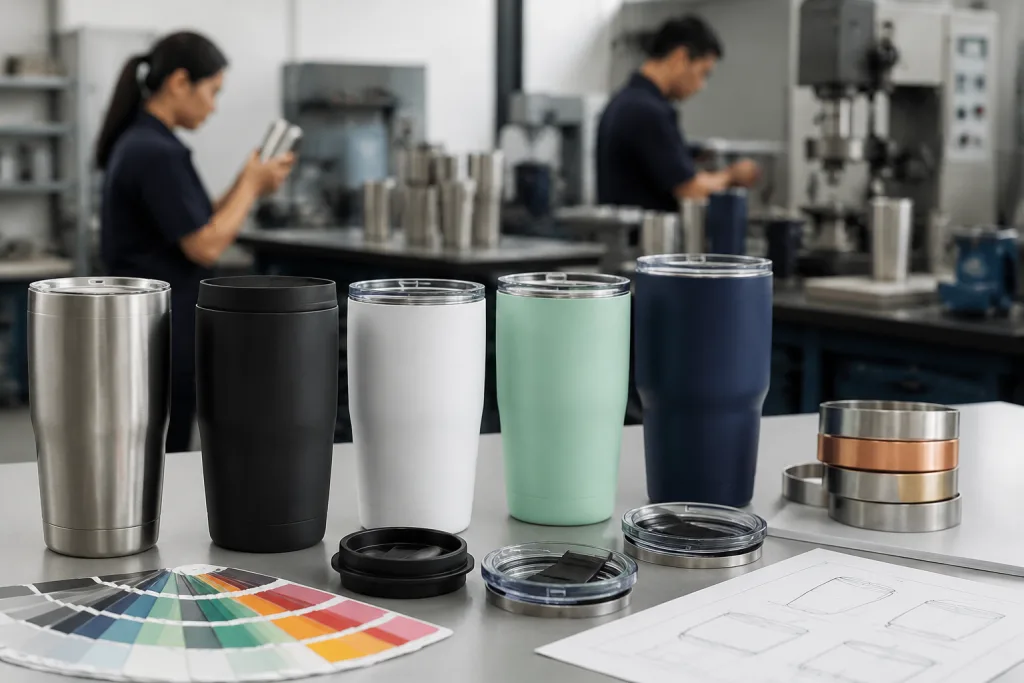
Price checks beyond unit cost
Unit price matters, but it is one row in landed cost, not the whole sheet. We have seen a USD 3.20 FOB Ningbo tumbler lose to a USD 3.45 quote after QC pulled 80 pcs from the line and found lid wobble over 1.5 mm, soft cartons, and a 91% pass rate. Cheap gets expensive fast. Buyers comparing canteen manufacturers in Zhejiang and other parts of China should force every quote into the same format: product specification with steel thickness, decoration method with print area in mm, packaging style, carton size, gross weight, MOQ, sample fee, lead time, payment term, and port.
Typical FOB pricing for a 20 oz double-wall stainless steel tumbler from China can range from about USD 2.60 to USD 5.50 depending on steel grade, coating, lid complexity, decoration, and packaging. A 40 oz handle tumbler may sit around USD 4.80 to USD 8.50. A custom growler or customized growler with 64 oz capacity can move higher because one carton may only hold 12 pcs instead of 24 pcs, and the stainless shell eats more material. We run these checks on an electronic scale before quoting, not after the buyer signs the PI. These bands are not promises; they are a quick way to catch offers where the math does not work.
Packaging is where buyers get surprised. A plain egg-crate bulk carton is cheap, but it will not survive retail handling or Amazon-style warehouse scans. A color box may add USD 0.18-0.45 per unit. A rigid gift box can add USD 0.80 or more. If you sell online, ask for 5-ply export cartons, 1.2 m drop testing, polybag rules, desiccant count per carton, FNSKU labels, and barcode placement on the long side of the carton. We had one PO where “matte black” became “mate black” on the carton mark artwork; the buyer flagged it before mass printing, which saved 3,000 boxes from scrap. If you are a canteen distributor shipping to multiple warehouses, mixed SKU packing adds labor and label risk.
Payment terms should be written clearly on the PI. About 7 out of 10 factories ask for 30% deposit and 70% before shipment. For repeat buyers, staged payment after inspection can be negotiated, especially when the order is over 5,000 pcs and the supplier already has open mold history with you. Do not send balance payment before you review production photos, packing list, and inspection result under AQL 2.5 if that is your agreed standard. This is not mistrust. It is normal B2B discipline, and we have seen rushed balance payments go sideways when the final carton count showed 118 cartons instead of 120.
Factory checklist before deposit
Before you pay a deposit, put the factory on one written checklist. Simple is fine. Written matters. A stainless steel tumbler factory in China should clear basic checks before your 30% TT goes out, especially when the order is for retail shelves or a launch date. We once had a buyer send a PO with “matte black” in the item line and “gloss black” in the packing notes; QC caught it at the sample bench, not after 12,000 cups were sprayed.
- Business fit: Does the factory run stainless steel drinkware on its own line, or only trade it? Ask for production floor photos, the machine list, and recent export packing photos showing real cartons, not showroom samples.
- Audit status: BSCI, Sedex, ISO 9001, or customer audits matter. They do not prove the cup will pass inspection, but they show the factory knows controlled documents, version stamps, and audit binders.
- Compliance: Confirm FDA, LFGB, REACH, Prop 65, CPSIA, or ASTM requirements before quotation. Testing after production is the wrong question to ask; the lab needs the coating, plastic lid material, and gasket spec before the line starts.
- Quality plan: Ask what is checked at incoming material, vacuum process, coating, printing, assembly, and final packing. On our line, QC pulls samples for vacuum retention, coating adhesion with 3M tape, lid leak check, and carton drop risk.
- Sample control: Require a signed pre-production sample with color, logo position, lid fit, weight, and packaging confirmed. We mark PMS color, logo height in mm, cup weight in grams, and lid gasket fit on the sample tag.
- Production timing: Standard lead time is often 25-35 days after deposit and artwork approval. Peak season before Q4 can stretch to 45 days, especially when coating ovens are booked and the buyer changes the logo film after approval.
- Export handling: Confirm FOB Ningbo or FOB Shanghai, carton marks, HS code, pallet option, and document timing. A wrong carton mark or missing PO number can hold 1,000 cartons at the forwarder for 2 days.
For BottleForge Industrial, a normal MOQ is 1,000 units for logo-only stainless tumblers and 3,000 units for custom PMS coating projects with full spray setup. Samples usually take 7-10 days if no new mold is needed. New lid or body tooling can add 20-35 days before sampling. Ask every canteen supplier for the same numbers, then compare answers line by line. The math does not work if one factory quotes 18 days for a molded lid while the tool shop alone needs 12 days for CNC and trial fitting.
If a vendor refuses inspection, dodges compliance questions, or says every finish is “no problem,” slow down. We have seen this go sideways. Experienced canteen suppliers will mention limits, like dark powder coating hiding small weld marks better than mirror polish, because they have paid for rejected cartons before.

How to approve samples properly
Sample approval is where 7 out of 10 buyers rush and then pay for it later. A sample is not a desk trophy for the marketing team; it is the control standard we run on the line. When you approve a customized drinkware sample, you approve the 304 stainless feel, finished weight in grams, color, coating texture, logo size in mm, lid fit, gift box, and carton layout. We have seen this go sideways when a buyer approved a 380 g tumbler sample, then complained after bulk goods came out at 410 g because the PO never fixed the target weight.
Check the sample against your purchase spec, not memory. Use a digital scale for weight, fill it with water to confirm capacity, check wall thickness with a caliper if the supplier sends a cut sample, and photograph the logo with a ruler beside it. Simple tools work. For powder coating, compare color under the same light box setting, not beside a window at 5 p.m. A PMS code is a guide, not a magic promise on curved metal. A Delta E tolerance under 2.0 is tight; 6 promotional projects out of 10 accept Delta E 3.0-4.0 depending on color and coating type.
For lids, test with hot water and room-temperature water. Invert the tumbler for 30 seconds if the lid is claimed as leak-resistant, and write down whether the leak came from the slider, silicone ring, or air vent. QC pulled one sample last month where the silicone gasket was 0.6 mm thinner than the approved lid, and the buyer flagged drip marks after air shipment. Shake testing is the wrong question to ask unless the design is sold as leakproof. Slider lids reduce splash, not full leakage. If your sales team wants to claim leakproof performance, specify a screw lid or locking flip lid and ask for test data.
For canteen promotional orders, logo durability matters more than buyers expect. Rub the printed logo with a damp cloth, then with a dry cloth, and count the strokes instead of guessing. Ask the factory what rub cycle they run, such as 3M tape adhesion, alcohol rub, or 500-cycle abrasion testing. For custom canteen and distributor canteen programs, check carton strength and inner packing too; a 12 kg master carton dropped from 80 cm can ruin good products before the consumer sees them. We ship strong cups every week, but weak dividers still lose money.
Do not approve by saying “looks good” in a chat message. Send a written approval list with photos, sample code, date, and the buyer name on the file. State exactly which sample is approved and which issues must be corrected, even small items like a 2 mm logo shift or a typo on the color label. That written trail protects both sides when bulk inspection starts under AQL 2.5 and someone asks why the line followed the approved sample.
A practical buying sequence
The buying sequence we trust is plain: technical brief, target price, supplier feedback, quotation, artwork check, sample, revised quotation if needed, deposit, pre-production sample, production, inspection, balance, shipment. Don’t skip the boring parts. Last April, a buyer sent a PO with “matte balck” printed on the color line, QC pulled the sample under the D65 light box, and we lost 6 days fixing artwork that should have been caught before deposit.
If you are new to sourcing from Zhejiang or broader China, start with a stock body before paying for new tooling. A 600 ml stock tumbler can still look private label with powder coating checked at 60-80 microns, laser engraving, retail box artwork, and insert cards packed on the line. New molds make sense when annual volume is high enough, usually 20,000-50,000 units per shape, or when your brand needs a lid, handle, or silhouette that stock models cannot provide. For 3,000 pcs, the math usually doesn’t work.
For distributors, assortment planning matters before the factory opens a coating batch. Instead of buying 5,000 units of one untested color, we’d rather see 2,000 black, 2,000 white, and 1,000 navy if the MOQ allows. For canteen distributors and distributor drinkware buyers, this cuts inventory risk without turning the order into a warehouse headache. Each extra color still means a spray-gun cleanout, color chip approval, and a chance the buyer flags a shade shift against the Pantone card.
A realistic schedule for a custom drinkware order is 2-3 days for specification alignment, 7-10 days for sample production, 2-5 days for buyer review, 25-35 days for production, 1-3 days for final inspection, and then ocean or air transit. If your launch date is fixed, work backward and add a 10-day buffer. Drinkware is not hard to make, but the coating room, pad-printing bench, carton supplier, and export documents each have a queue. We’ve seen this go sideways when a buyer approves the cup on day 12 and asks for shipment on day 18.
The buyer who gets the best result is not the one who beats down the lowest price. It is the buyer who defines the product clearly, compares vendors on the same spec sheet, checks the pre-production sample with a caliper and scale, and pays for the quality level the market expects. AQL 2.5 inspection catches defects, but it cannot rescue a vague brief.
Send your tumbler spec for a factory quote
Share capacity, logo, color, packaging, quantity, and destination. We will return a practical MOQ, lead time, and FOB China price.
Frequently asked questions
What MOQ should I expect from vendors stainless steel tumbler factories?
For a stock stainless steel tumbler with a one-position logo, 1,000 units is a common MOQ from a real factory in China. Some vendors may accept 500 units if they have ready bodies and standard colors, but the unit price will be higher. For PMS powder coating, full-wrap print, or a canteen customized project, expect 3,000 units per color. New molds for lids, handles, or special body shapes usually make sense only above 20,000 units because tooling, testing, and trial production costs need volume to spread out.
How do I know if I am working with a canteen manufacturer or trader?
Ask for the production process map and photos from welding, vacuuming, polishing, coating, printing, and packing. A real canteen manufacturer should be able to explain daily output, machine count, QC checkpoints, and sample workflow without hesitation. Traders can still be useful, especially for small mixed orders, but you should know who controls quality. Ask whether the inspection will happen at the factory, what AQL level is used, and whether your approved sample will be kept on the production line. Vague answers are a warning sign.
Which logo method is best for customized drinkware?
For durability, laser engraving is usually the safest choice on powder-coated stainless steel. It does not peel, and it looks clean for corporate and retail programs. For simple colored logos, silkscreen printing is economical at 1,000-5,000 units, often adding USD 0.08-0.25 per unit depending on size and colors. UV printing works for detailed full-color logos but is slower. Heat transfer is better for full-wrap artwork, though it needs tighter artwork control and higher MOQ. Match the method to the design, not the other way around.
What compliance documents should canteen suppliers provide for Europe and North America?
For the United States, ask for FDA food-contact documentation and, where relevant, Prop 65 assessment. For children’s products, CPSIA and ASTM requirements may apply. For the EU, LFGB or EU food-contact testing, REACH, and sometimes migration testing are common. The report should match the material and coating used, not a random old product. If you sell through large retailers, they may require testing from SGS, Intertek, TÜV, or Bureau Veritas. Confirm compliance before sampling because coatings, inks, and plastics can change the test requirement.
What inspection standard should I use before shipment?
A normal final random inspection uses AQL 2.5 for major defects and AQL 4.0 for minor defects. Critical defects should be zero. Check appearance, coating scratches, logo position, capacity, lid fit, leakage, odor, carton marks, barcode labels, and packaging. For drinkware, we also recommend vacuum performance checks and 100% lid leak testing during production, not only at final inspection. If your order is 10,000 units, do not rely on factory photos alone. A third-party inspection usually costs far less than replacing a failed shipment.